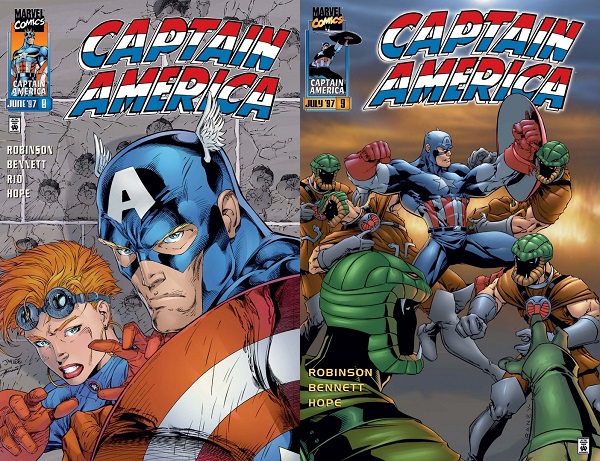
These two issues see Captain America, having severed his ties with SHIELD in the last issue, taking to a motorcycle to reacquaint himself with America and eventually confronting white supremacism (operating under a familiar name).
As issue #8 opens—and as is prominent on the Jim Lee cover above—Cap explains to his partner of five minutes, Rikki “Bucky” Barnes, the new symbol on his forehead, replacing the SHIELD eagle he dramatically peeled off at the end of the last issue, and why he has to ride solo for a while as a “hard-travelin’ hero.”
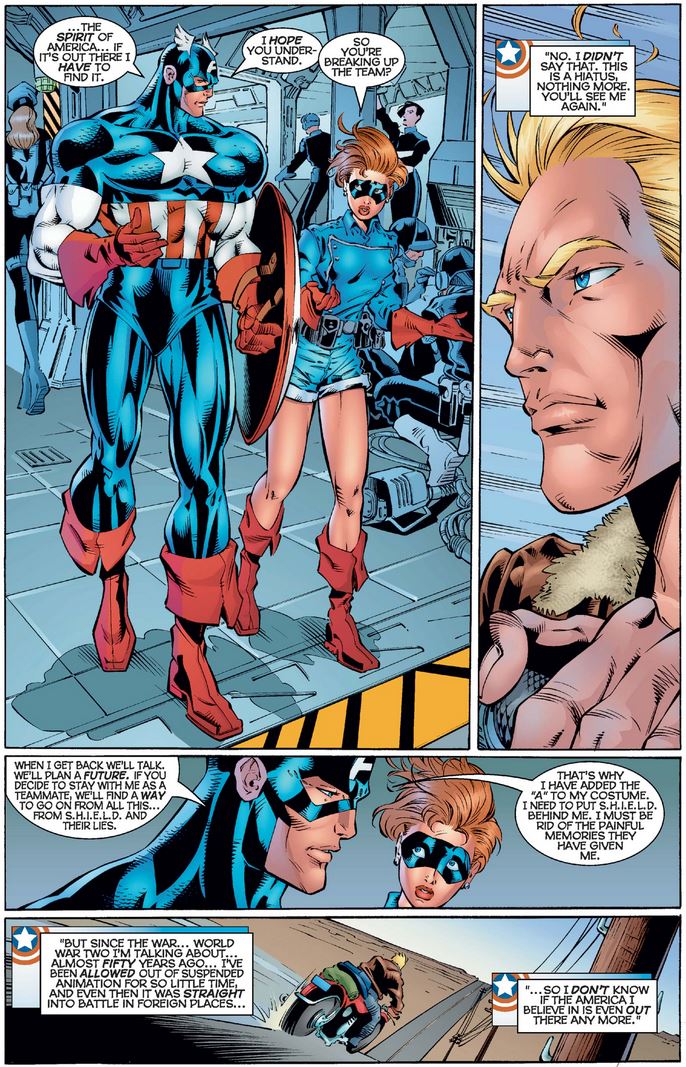
While Cap is trying to remain hopeful—and salutes any SHIELD agents not named “Fury”—Rikki risks bringing him down to earth, but he steadfastly refuses to buy it…
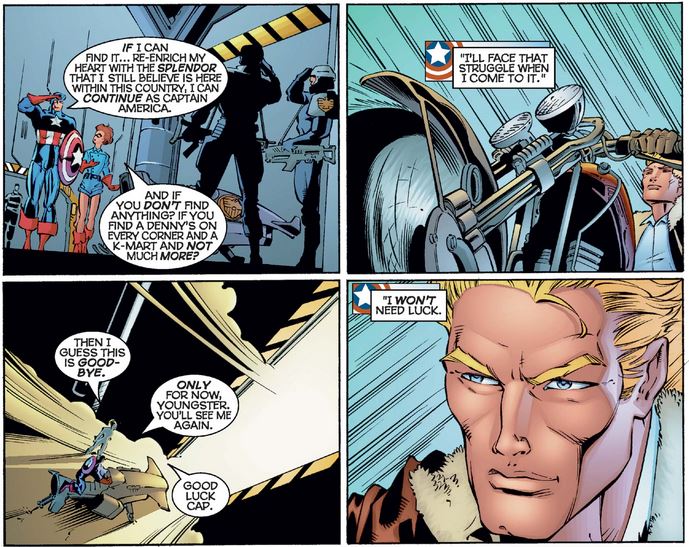
…following the last line above with “not if the spirit of America awaits me.”
Some time later he makes his way to Texas, where Officer Jake Wang tells him about trouble with a local militia group…

…but this time Cap does not “understand that reference,” even though the Waco siege happened in 1993. Nor does he likely remember the Sons of the Serpent, a white supremacist group that has plagued the 616 universe since Avengers #32.

Another officer runs up to them with news that some of the Sons have taken hostages at a local diner, including an elderly man who tries in vain to reason with them.
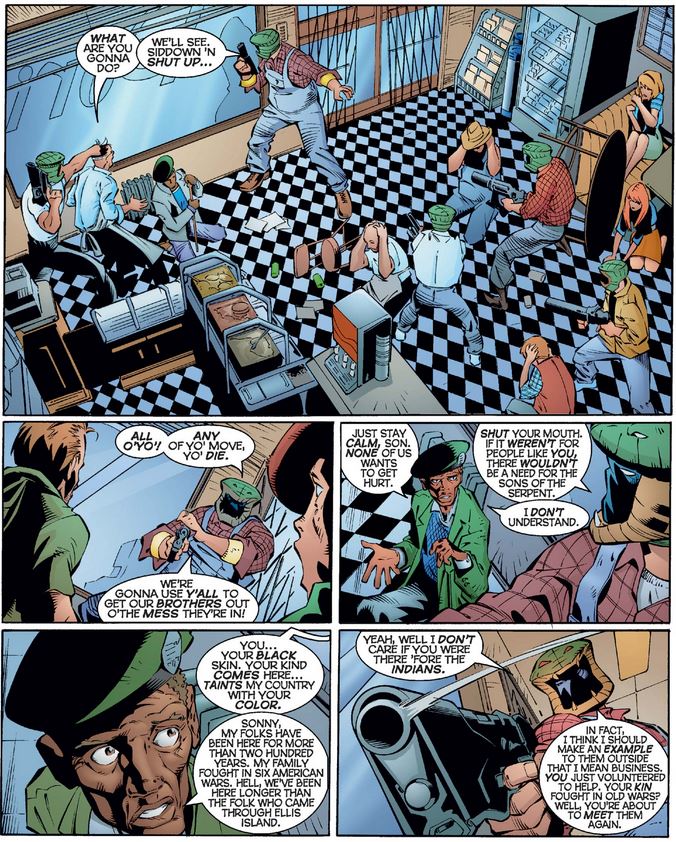
On the next page we learn more about the man: Grover Williams, veteran of World War II, who’s disappointed at the state of the country he proudly fought for but still refuses to give into hate.
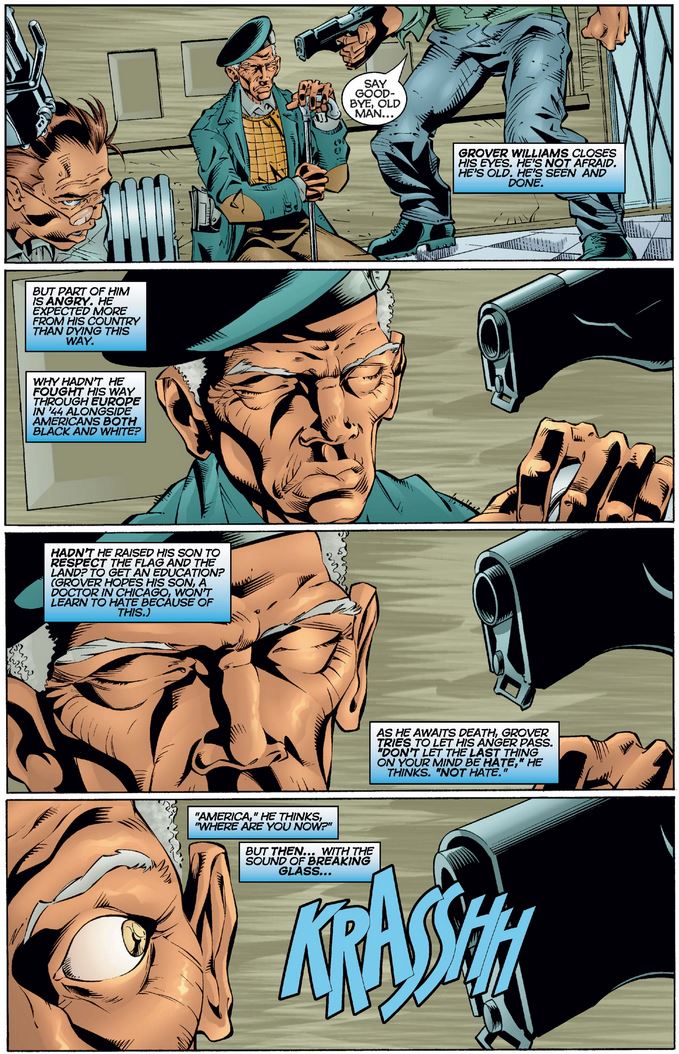
Cap bursts in and draws the Serpents’ gunfire…
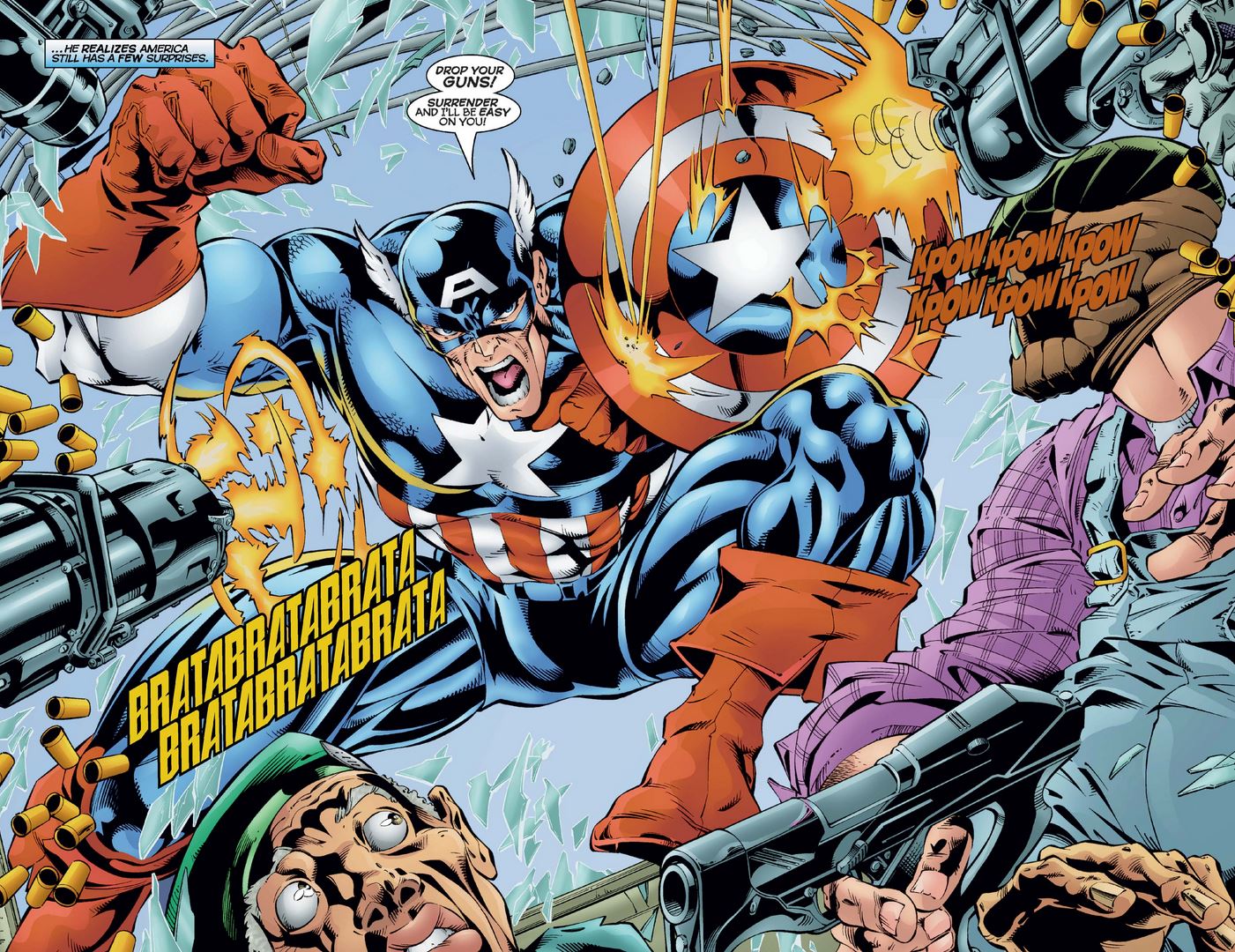
…easily dispatching them with apparently no fatalities. But he forgot one, who receives a stern warning…

…before catching an umbrella upside his head.
Cap thanks Williams, the wielder of the mighty Ümbrella, who tells him about his war service and that of his brother, whose life Cap saved.
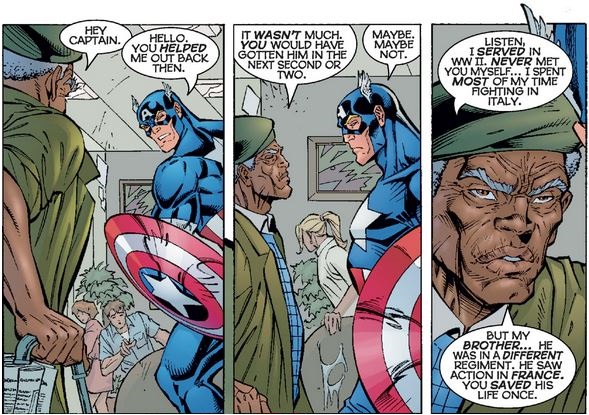
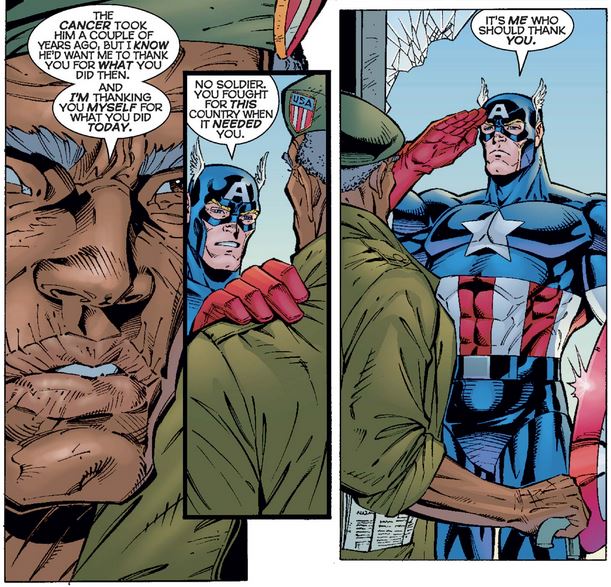
As he regularly does, Cap deflects his fellow veteran’s gratitude and praise, returning it ten-fold to a man who fought with courage and honor without any super-soldier serum or shield.
Next, Cap heads to the compound of the “Texas Chapter of the Serpent,” where an FBI agent tells him their weaponry seems more like science fiction than military-grade. Like Williams in the diner, Captain Eyebrows tries to open a dialogue and address their concerns with logic and reason…
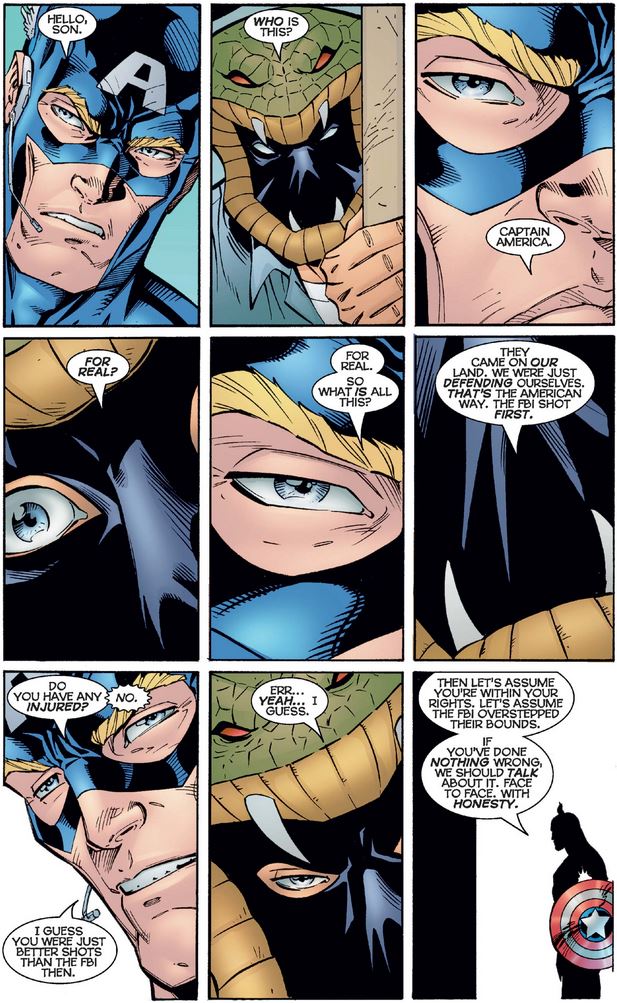
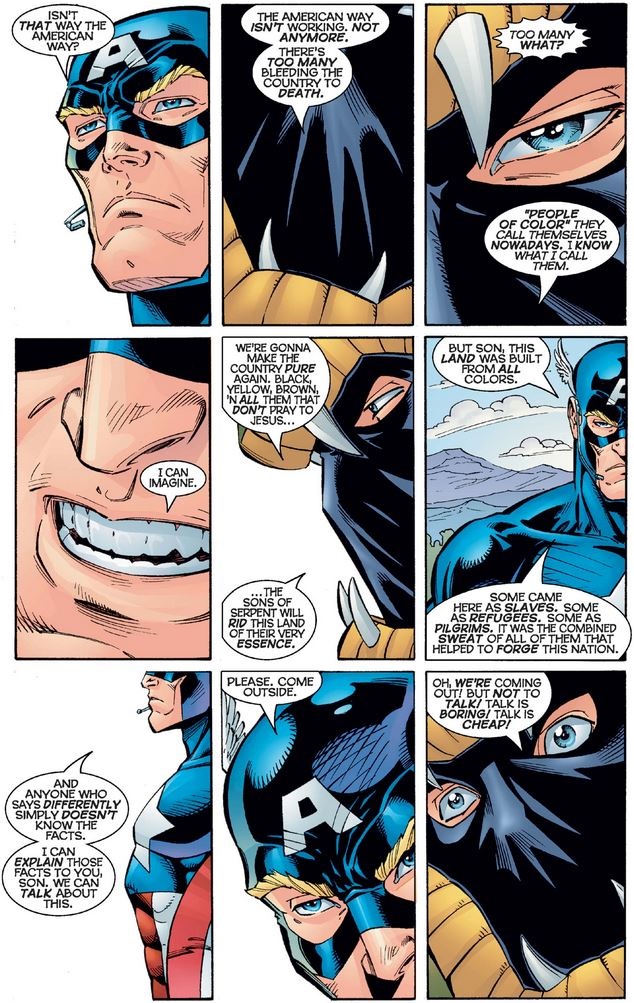
…as well as appealing to their presumed patriotism. But the terrorist responds with the typical excuse of “drastic measures for drastic times,” often used by extremists when dismissing the same legal guardrails they would support if anyone else suggested bypassing them. The Serpent then goes full-bore into a racist rant, which Cap counters with a defense of e pluribus unum (“out of many, one”) followed by an offer to explain further, which his conversation partner rudely declines.
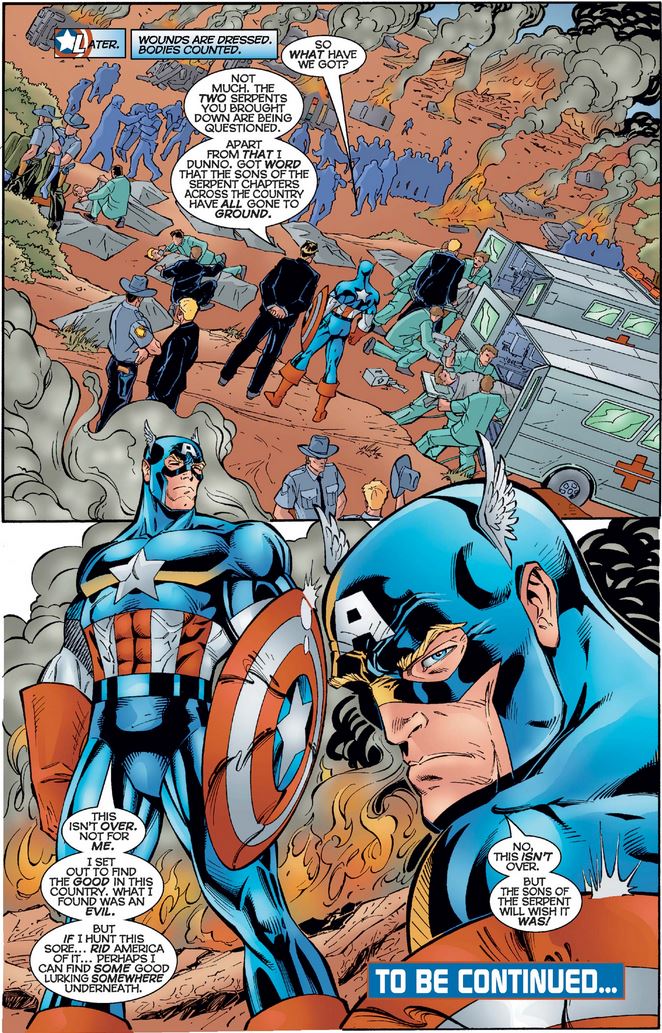
At that moment, several aircraft burst out of the compound, prompting Cap to shield the officers and agents they’re firing on before leaping to one small craft and pulling its two pilots to the ground. After the rest of Serpents flee, Cap surveys the situation and knows what his next mission is.
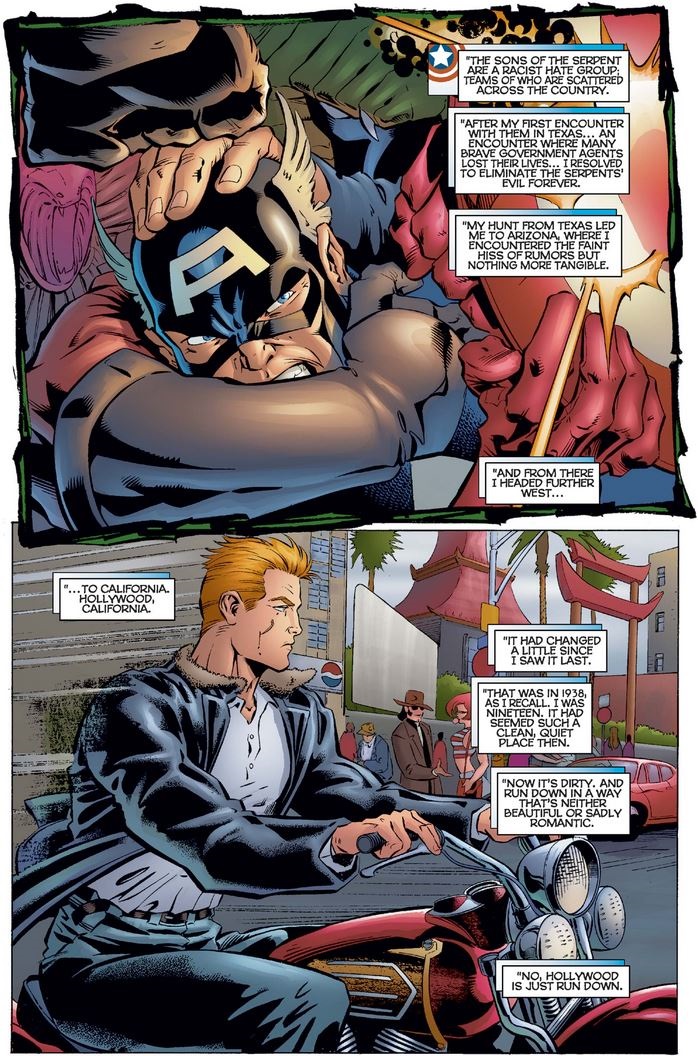
Issue #9 starts with Cap newly arrived in sunny Hollywood after a brief scuffle in Arizona, but finds it sorely lacking… compared with 1938.
(Although I doubt Cap is referring to movies, speaking as an classic film fan, 1938 was a pretty good year for movies, even if it was no 1939.)
It isn’t clear to me whether his issue is with Hollywood specifically or Los Angeles in general, but he is not impressed with either (with only the criticism of Los Angeles as a sprawling metropolis sounding familiar).

After cleaning out another Serpent den, he meets Detective O’Brian and deflects his praise as he did with Williams in the last issue. O’Brian makes reference to his skin color to explain how he feels about minorities being attacked by white supremacists, to which Cap responds that everyone should be upset about that, not just those personally targeted, going on to say that racist hate and violence make people more aware of racial differences…

…to the point where they can become defensively hateful of others out of fear.
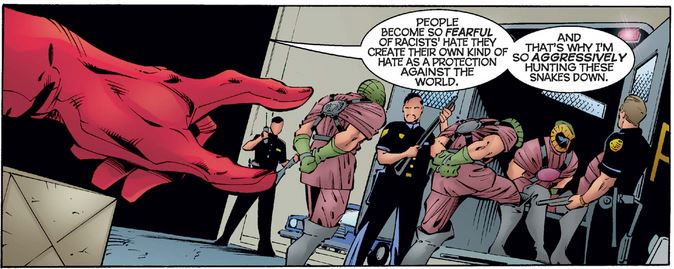
I’m not sure exactly how to understand this: Besides the question of being “fearful” of racist hate, the best interpretation I can give to it is a criticism of a certain brand of identity politics, in which the targets of racist hate may isolate themselves among those of their race, defending themselves against the world and possibly forming resentments toward other groups. (The last part is where it loses me.)
Returning to more practical issues, Cap takes one of the captured Serpents to see the La Brea tar pits and pretends to torture him for information. As often happens when good cops play bad cop, the terrorist calls his bluff, but Cap turns their arguments back on him, claiming the Serpents’ radical tactics have inspired him to adopt new ones.

It must have worked, because Cap gets his information and finds the L.A. chapters’ munitions base, discovering that their surprising high-tech weaponry is coming from the American government. He also learns that the group plans to bomb the famous Hollywood sign and kill a number of people to send a message about Jewish filmmakers promoting “un-Christian values.”
After thwarting the Serpents, one of the filmmakers suggests making a movie about Cap, but he’s afraid the sentiment would be sacrificed for spectacle.

I have to say here that Frank Capra is one of my favorite directors too. It’s a Wonderful Life is well known, of course—and deservedly so—but I also highly recommend Mr. Smith Goes to Washington, Mr. Deeds Goes to Town, and Meet John Doe, all of which show ordinary people of honor and integrity fighting back against an increasing cynical and corrupt world.
Similar to his epilogue with Mr. Williams in Texas, one of the men he saved fights back tears to tell Cap about another life he saved during World War II, following it with a hug that takes the Sentinel of Liberty by surprise.

The issue ends with Cap and O’Brian watching a news report about the Serpents’ continued killing spree, decrying the “taint” of “foreign filth” and saying it’s worth to kill half the country to make it “habitable” for the other half, and Cap knows where he must go: like Jimmy Stewart’s Mr. Smith, he must go to Washington to investigate the source of the Serpents’ weapons (which he does in the next issue).
ISSUE DETAILS
Captain America (vol. 2) #8, June 1997: James Robinson (writer), Joe Bennett and Al Rio (pencils), Sandra Hope and Al Rio (inks), Wildstorm FX (colors), Richard Starkings and Comicraft (letters). (More details at Marvel Database.)
Captain America (vol. 2) #9, July 1997: James Robinson (writer), Joe Bennett (pencils), Sandra Hope (inks), Wildstorm FX (colors), Richard Starkings and Comicraft (letters). (More details at Marvel Database.)
Collected in: Heroes Reborn: Captain America.
PREVIOUS ISSUE: Captain America #7 (May 1997)
ALSO THESE MONTHS: Avengers #8-9 (June-July 1997)
NEXT ISSUES: Captain America #10-11 (August-September 1997)
 THE VIRTUES OF CAPTAIN AMERICA
The saluting isn’t to my taste but make sense as this version of Cap spent most of his time as a soldier. I interpret that confusing Cap speech as follows: “when a person is afraid of differences they assume everybody else is also afraid of differences so they think everybodies out to get them.”
I too am a fan of classic films, especially Capra! Oliver Stone made great movies Cap should see, but Frank Capra may be my vote for greatest director of all time. His films no doubt inspired a young Steve Rogers. I would add only Lost Horizon to your list. Capra’s movies encapsulate the incredible groundswell of grassroots coming-together by the common people from which Steve would have learned his commitment to: the “little guy:, making a difference, never giving up and the common good. In fact I truly believe that one of the most useful things we could do in today’s America is have John Doe Clubs in each and every town.
Cap creators have sighted Capra regulars Jimmy Stewart & Gary Cooper as actors who are Cap-like. I agree. But, IMO the golden age actor who most embodies “Cap-ness” is Henry Fonda. Amazing as Tom Joad in The Grapes of Wrath– the movie that, for me, defines the ethos of the Great Depression. IMO the best modern movie about the 30s is Tim Robbin’s Cradle Will Rock. Chock full of information about the era and entertaining as heck. Made like a Frank Capra “screwball comedy” and based on a couple true stories. Highly recommended.
LikeLike