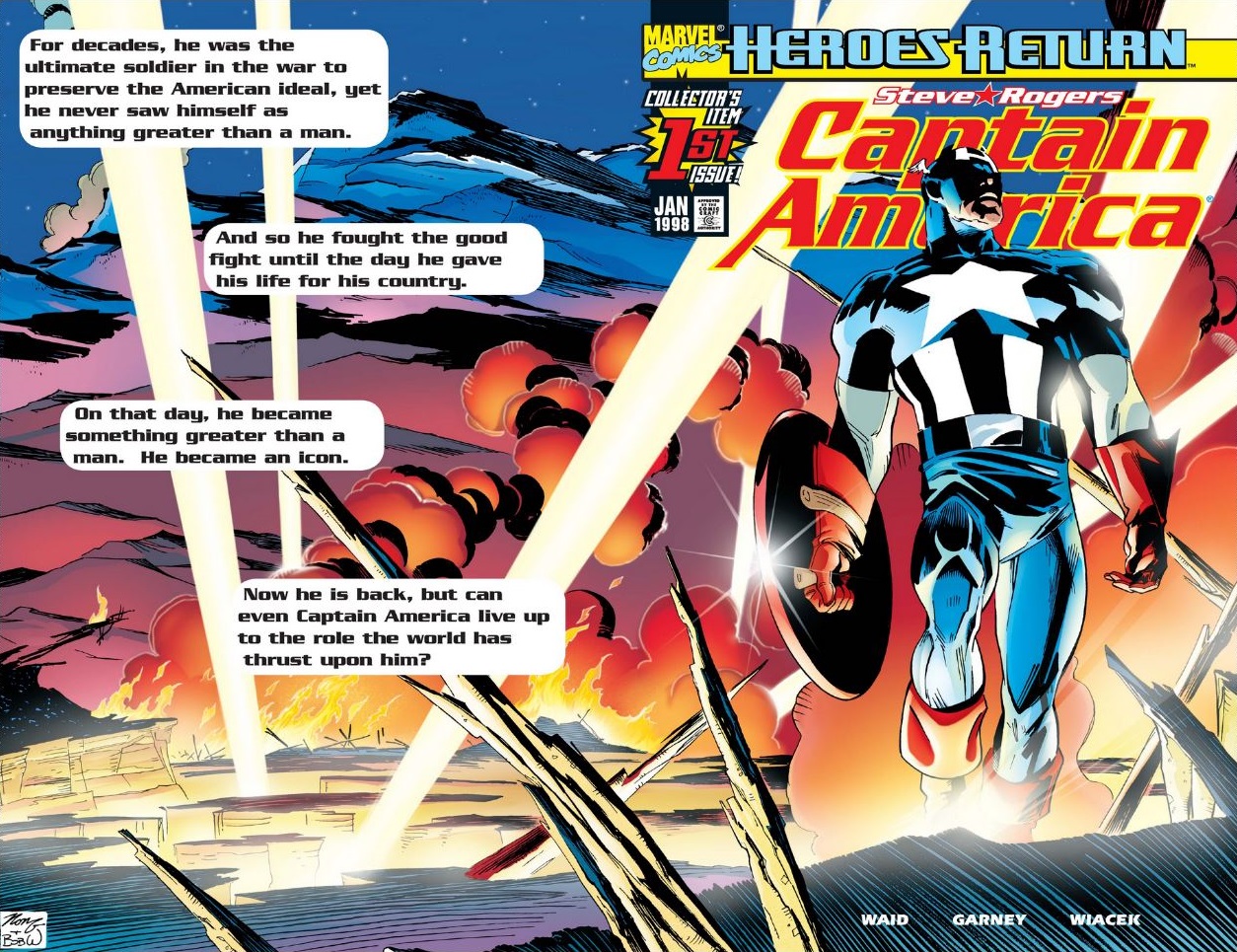
Over 500 posts to get a Captain America #1, and now we get another one a dozen posts later? Welcome to modern Marvel Comics, where we go from new #1s to triple-digit legacy numbering and back again in the blink of an eye.
The “Heroes Return” era brings our lost heroes—Captain America, Iron Man, Thor, and a handful of other Avengers, plus the Fantastic Four—back from the pocket universe Franklin Richards shunted them into after their battle with Onslaught. While the “Heroes Reborn” were living new lives in the other world, everyone in the 616 universe believed them dead, with the other heroes soldiering on (and some new “heroes” taking their place).
For Cap’s part, the first issue of volume 3 of his title also marks the welcome return of the main creative team from the end of volume 1, Mark Waid and Ron Garney, who drop our hero back in the 616 world without losing a step. He does find some things have changed, though. For starters, he reappears in Tokyo for some reason, where he confronts domestic terrorists opposed to Westernization. When one takes the torch from a replica of the Statue of Liberty and threatens the U.S. flag with it, Cap chooses this symbolic moment to spring into action…

…and keeps his speech brief.

Both the terrorists and the onlookers are surprised to see him, and Cap is taken aback by the enthusiasm of the latter while the former gets away. (And the Marilyn Monroe impersonator gets a “just doin’ my job, ma’am” from her favorite hero.)

While Cap chases the terrorist, we get a double-page montage of his origins, re-establishing the classic canon to erase the memory of his brief “Heroes Reborn” life.

We’ll zoom in on the text at the left—nothing new, but the reaffirmation is always appreciated, especially after the last year.

Also note he still has the pointed bits on his cowl under his eyes, introduced in “Heroes Reborn” (but which will not last long).

Cap engages the local authorities, who give us a clue as to what it going on (thanks to “Marvel Translate”)…

…but leaves Cap just as clueless as before (and likely feeling a little mocked). Taking a moment to look around, he sympathizes with the terrorists’ concern (but not their actions) before tracing his last memory, the fight with Onslaught that led to… well, you know.

Blissfully unaware of two local fans’ criticisms of his “cosplay,” Cap picks up a magazine and starts to understand the strange reactions to him—more on that soon—but it’s the TV news report that really opens his eyes.

Unfortunately we don’t see Cap’s reaction, as the scene changes to the terrorists’ headquarters and their leader, Lady Deathstrike. When we return to our hero, he has managed to acquire his favorite disguise, into which he changes next to a massive statue…

…of himself, promoting a Captain America movie. This drives home to him the Japanese terrorists’ resentment of Westernization (without justifying their actions, of course) and gives him a clue as to their next target, which he intends to stick around for.
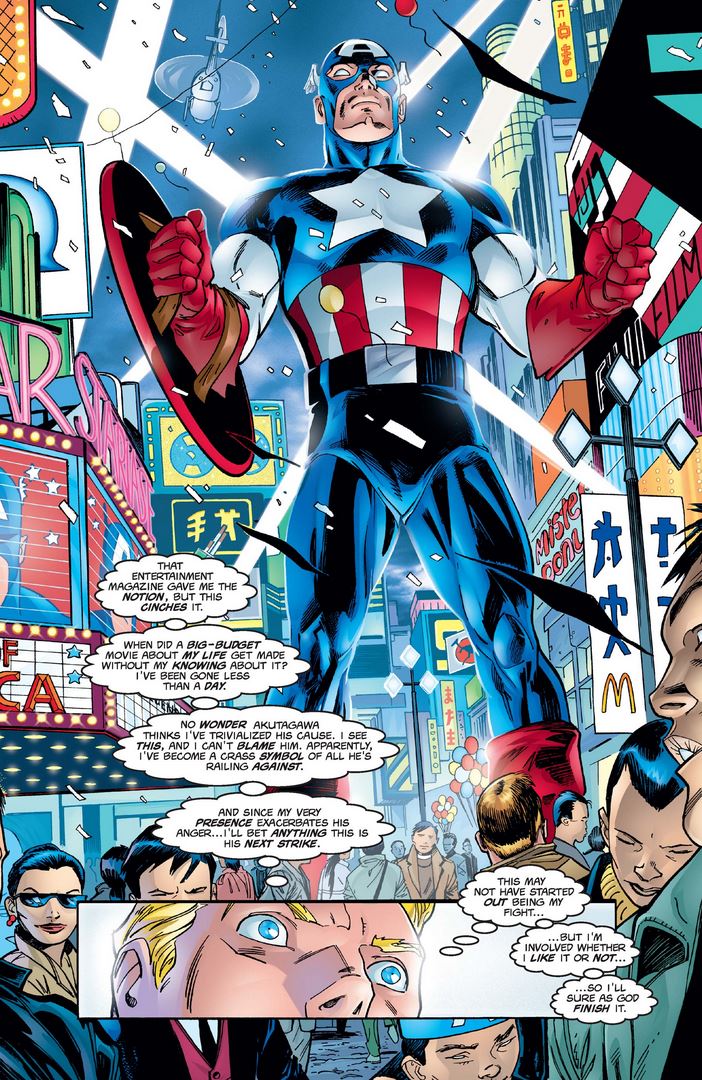
(It might also be a subtle callback to the “Heroes Reborn” era Captain America #8, when a movie producer Cap rescued from white supremacists suggested making a movie about him.)
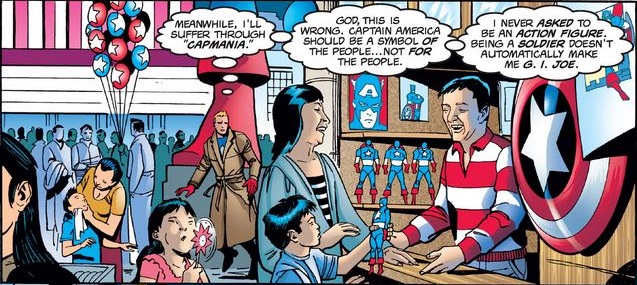
We are also introduced to an ongoing element of the first part of this new run: “Capmania,” in which our hero finds himself a pop culture phenomenon, a status quo with which he is very uncomfortable.
When a reporter sees this random American walking around, he asks him what he thinks about the Westernization controversy. Cap explains that he can see points on both sides, acknowledging the regret over the disappearance of traditional culture while at the same time recognizing that free choices of individuals contributed to it, and also expressing concern about the impact this has on America itself.
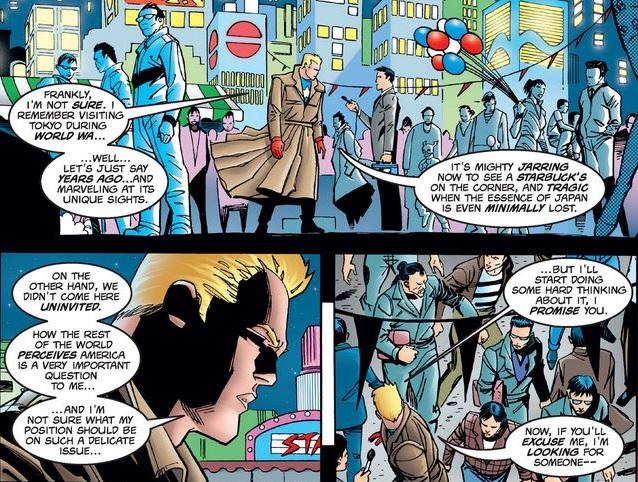
Admirably, he doesn’t claim to have a firm, settled opinion on a topic he’s been thinking about for literally ten minutes, although he does sound like a politician at the end when he promises “to do some hard thinking about it.” (Note also the mention of “Starbuck’s,” when in later comics writers will invent clever names and puns for large chains like this.)
Having located one of the terrorists, Cap follows him into the movie theater, where The Legend of Captain America has just begun…

…and he ends up giving the crowd much more of a show than they expected as he both fights and interrogates the terrorists (with the movie’s exposition tracking the events suspiciously closely!).
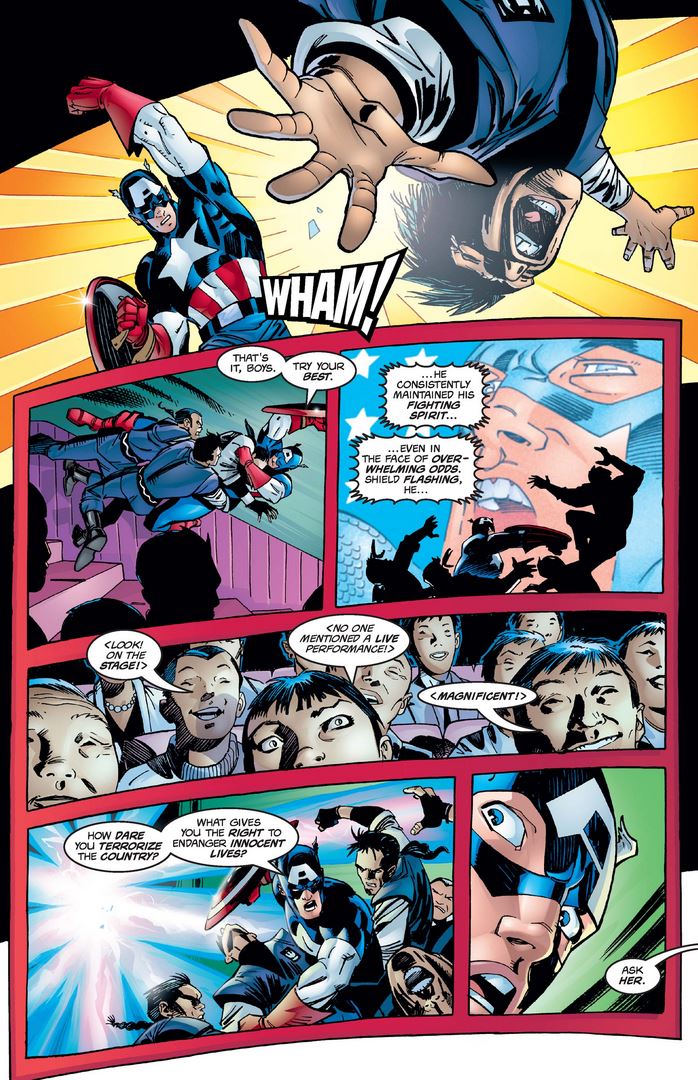
Lady Deathstrike adds to the moviegoers’ entertainment value…

…and Cap must clarify yet again that he opposes their methods, not necessarily their message. Lady Deathstrike trots out the old chestnut “the ends justify the means,” to which Cap does not even bother to respond. (“Whatever, Tony.” “Who’s Tony?”)

While he fights Lady Deathstroke, Cap is also concerned with crowd control and disabling the nerve gas, and he cleverly sees a way to use one problem against another.
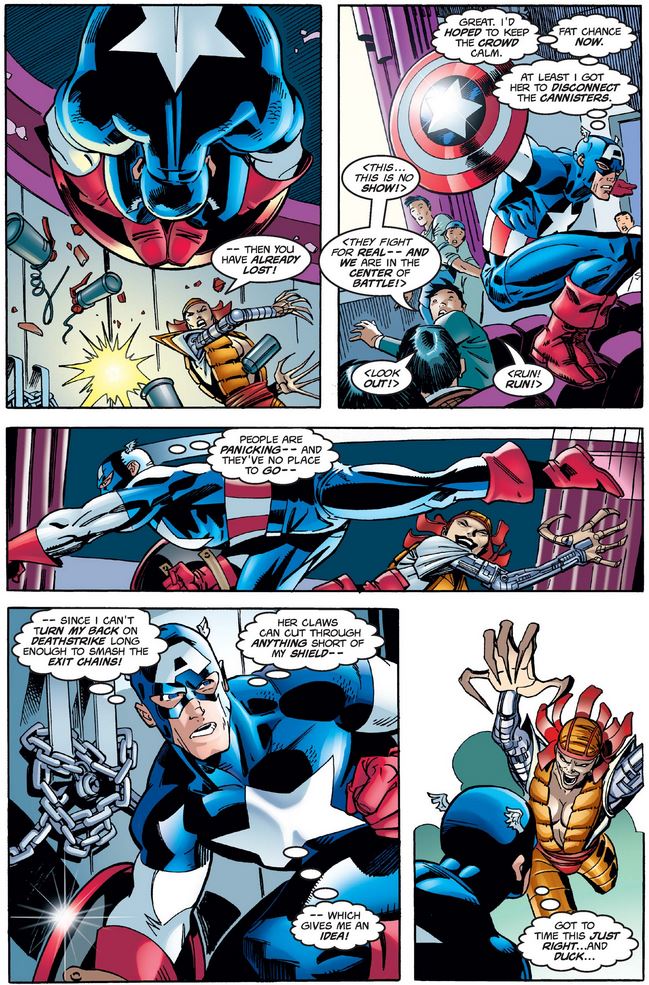
Unfortunately, Lady Deathstrike saw it too, so Cap’s struggle continues while the lead terrorists tries to salvage the last of the nerve gas and the movie shows Cap fighting Nuke (from Daredevil #233).
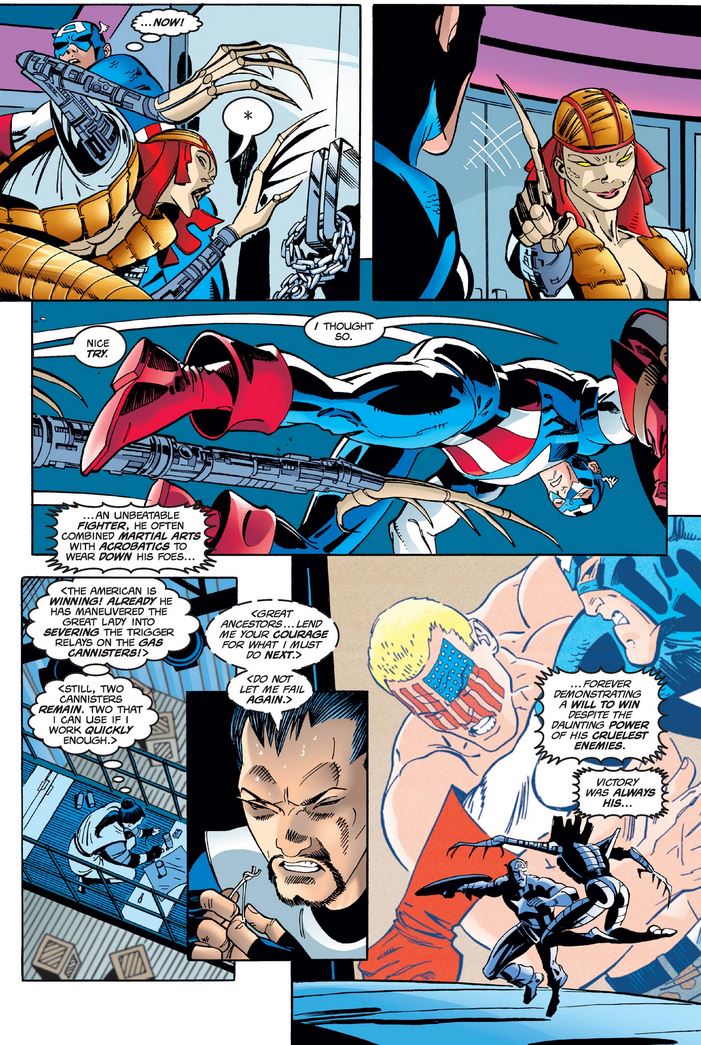
(This movie seems more like a documentary than a biopic, but if so, you have to wonder how they got all the amazing footage of these classic battles.)
Lady Deathstrike feigns surrender, which Cap doesn’t buy for a second, but he is stunned when he hears the film narrator say that he’d been gone for an entire year after the Onslaught battle.
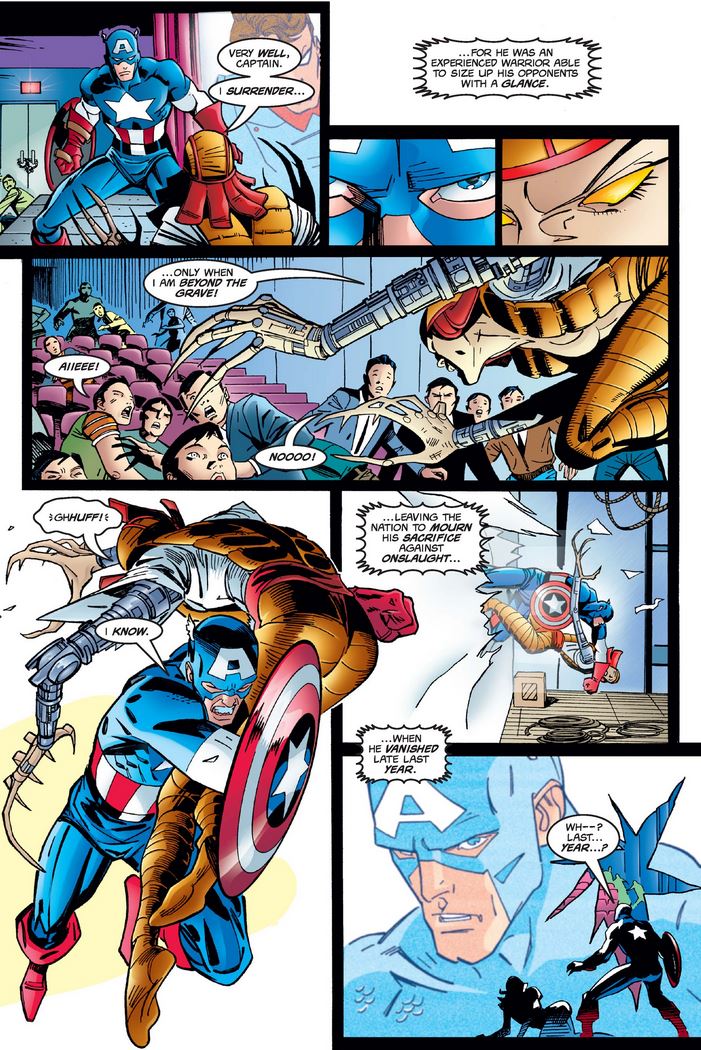
This gives Deathstrike a clear shot, but it only steels Cap’s resolve to end this fight once and for all.
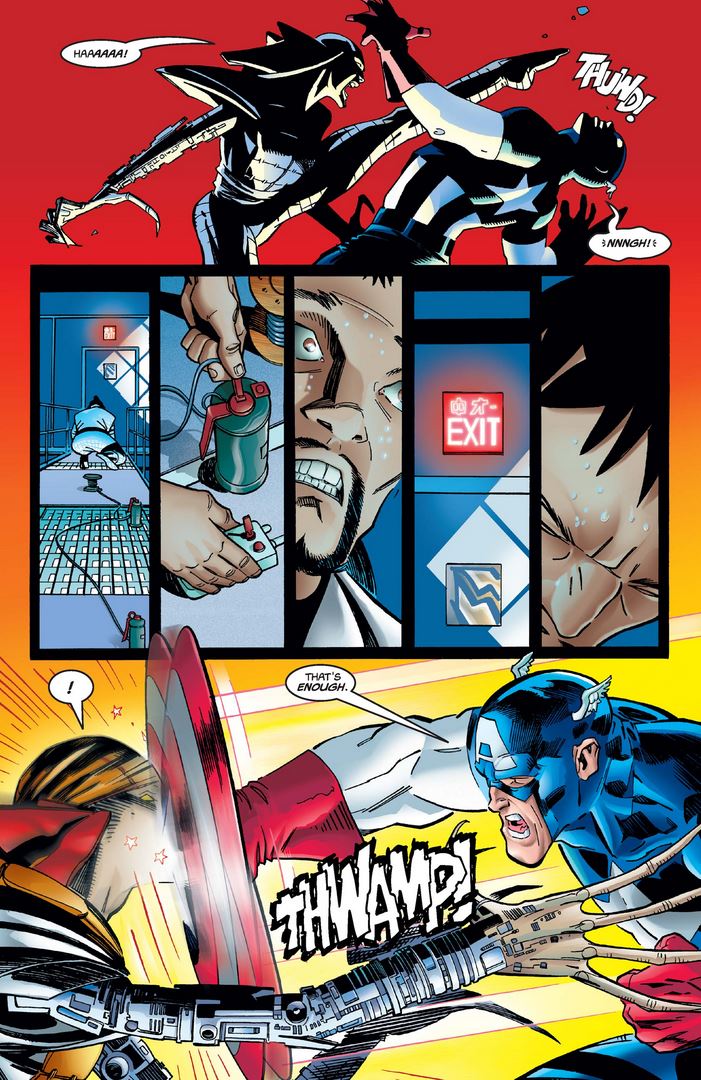
(The sound I hear in my head when I look at the striking image above is nothing like THWAMP!)
Cap makes sure Lady Deathstrike stays down for the time being, although she does manage to taunt him after her top man threatens to trigger the nerve gas and kill everyone in the theater.
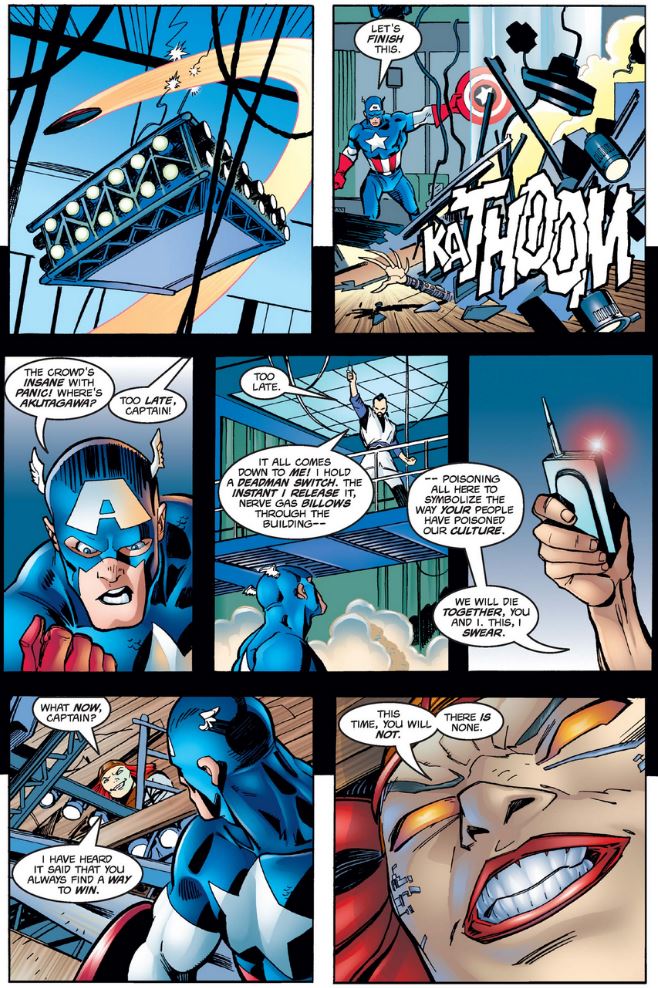
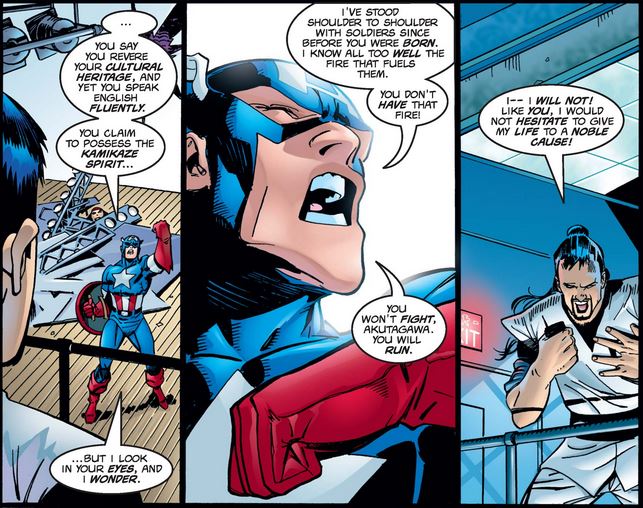
When the head terrorist, Akutagawa, speaks of standing up for the honor of the nation and his willingness to die for it, Cap engages in some taunting of his own, accusing Akutagawa of lacking the fortitude and dedication he claims…
…and upping the ante by removing the terrorist’s only means of escape.
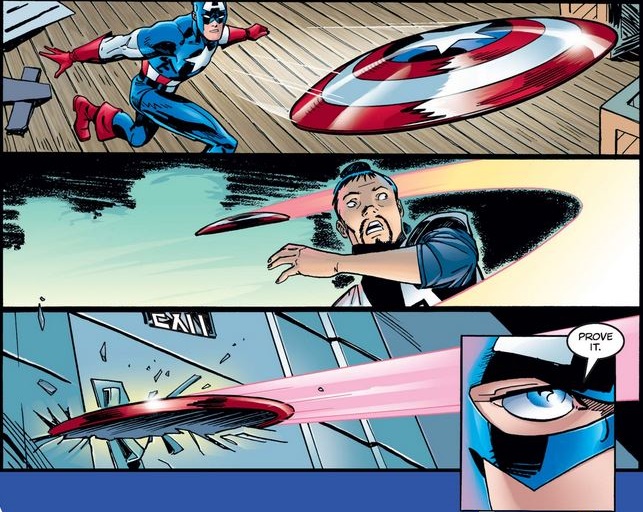
Cap’s gamble works…
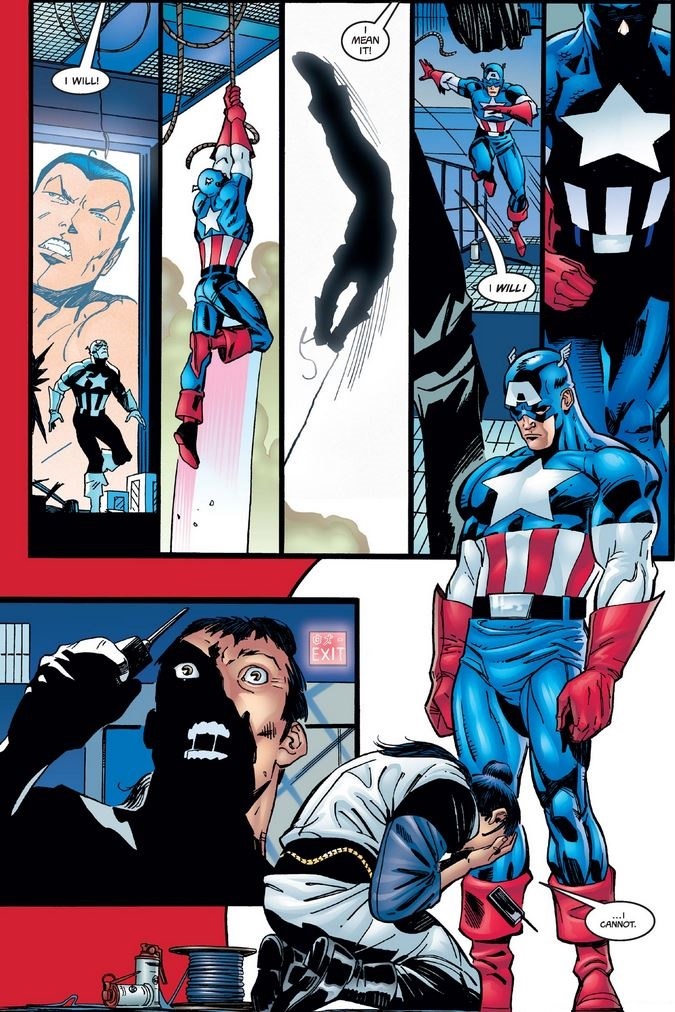
…although afterwards, when speaking to a reporter, he denies it was any gamble at all because he had nothing to lose because Akutagawa would have killed everybody anyway. But he still took a significant risk in the particular strategy he chose, daring him to push the button rather than trying to talk him out of it.
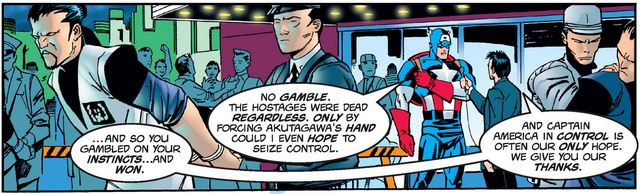
We close with the reporter’s final words, which preview the increasing focus on “Capmania” in the coming issues…

…as well as our hero’s discomfort with the whole business (which only grow worse).
ISSUE DETAILS
Captain America (vol. 3) #1, January 1998: Mark Waid (writer), Ron Garney (pencils), Bob Wiacek (inks), Joe Rosas and Digital Chameleon (colors), John Costanza (letters). (More details at Marvel Database.)
Collected in: Captain America: To Serve and Protect and Captain America: Heroes Return–The Complete Collection Vol. 1.
NEXT ISSUE: Captain America #2 (February 1998)
 THE VIRTUES OF CAPTAIN AMERICA
Leave a comment