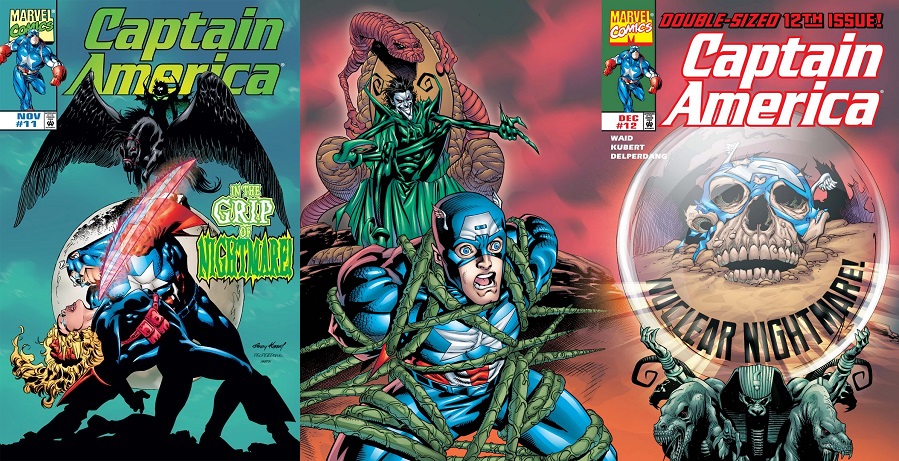
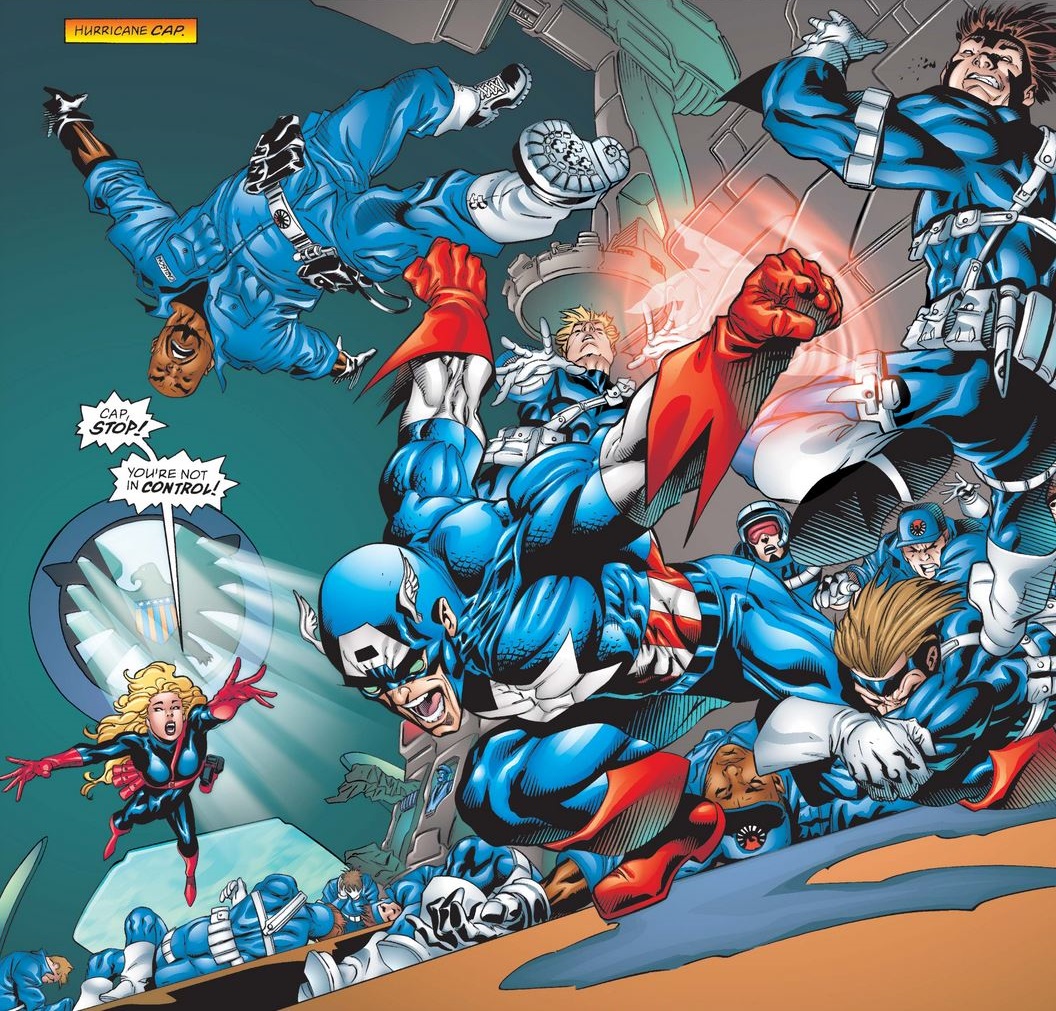
These two issues of Captain America wrap up the storyline that began in issue #9 dealing with outstanding Americans being overcome with rage, which it turns out was due to the influence of the villain Nightmare. The last issue ended with Captain America’s dream self voluntarily entering Nightmare’s realm, after which his body is taken over and start a rampage against SHIELD in the real one, as we see in this double-page spread from issue #11.
After the possessed Cap commandeers a jet, leaving Sharon grateful she doesn’t believe in “that ‘American dream’ claptrap,” Nightmare mocks the real Cap.
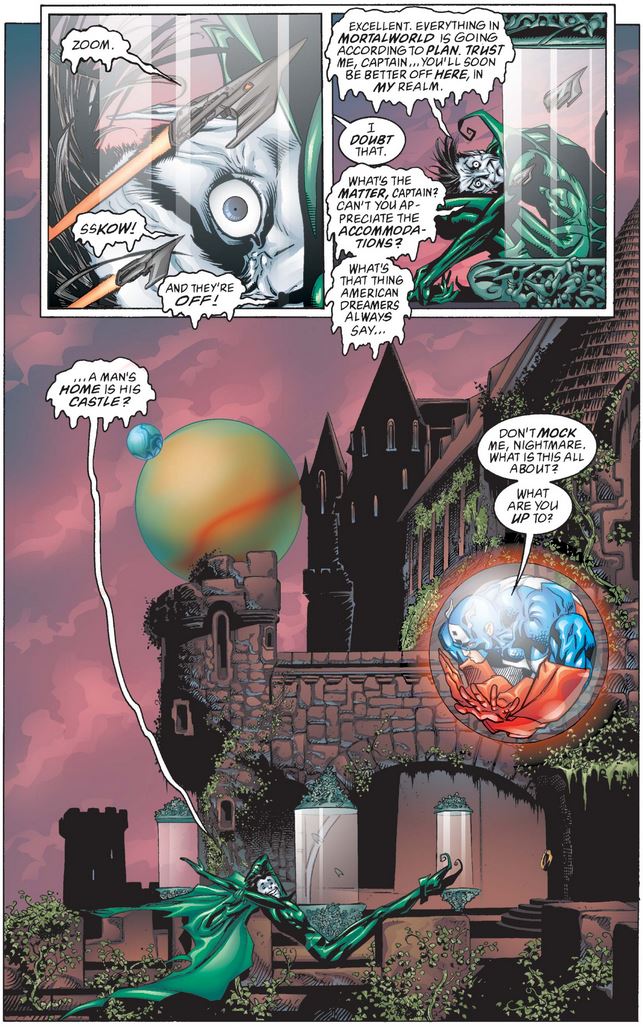
Nightmare goes on to explain how he co-opted the American dream itself—taking the term a bit too literally, if you ask me—and used it to wheedle himself inside the minds of those who believe in it and succeeded at it to twist it into a nightmare suiting his name. As he draws more and more such people into his realm, he plans to use Cap to start a nuclear war (plunging the whole world into endless sleep and nightmare, mwa ha ha).
Meanwhile, in the real world, Sharon realizes that Cap is headed toward a nuclear missile silo and fears the worst. She tries to bring his plane down, but when he fires back, she has no choice but to shoot him down, and his plane explodes, surprising Nightmare, Cap, and Sharon alike.

Not really: He parachuted out at the last minute, and once on the ground he heads to the missile base, with Sharon close behind.
As Nightmare shows Cap two more people overtaken by rage—Luis Ramirez, father of the family staying in Cap’s abandoned apartment, and city council member Andrew Bolt, he of the political endorsement mess during the Skrull affair—our hero finally summons the will to break out of his bubble, but to little effect.

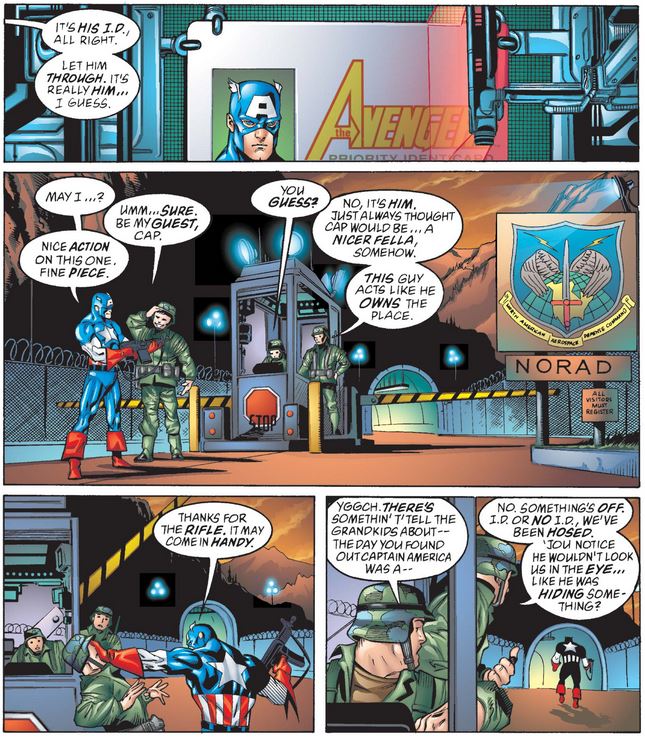
In the real world, the possessed Cap uses his credentials to gain access to the missile base, though he leaves the security personnel thinking he’s a bit off compared to his reputation.
Sharon catches up to him, shoots his rifle out of his hand, and continues to shoot at his leg and shoulder as he approaches. He dares her to kill him (“and the American dream,” natch), and when she can’t bring herself to do it, she finds herself in Nightmare’s realm, apparently more dedicated to the dream than she thought.

In issue #12, Nightmare repeats his plan for nuclear winter to Sharon while, in the real world, she and Cap make inroads into the missile base. Cap discovers he can break through to the other prisoners in the nightmare world (now including Dugan), starting by convincing them they’re being manipulated.

His impassioned plea below, while he fights winged beasts, resembles the debates inspired by philosopher Robert Nozick’s “experience machine” thought experiment: is the simulation of happiness as good as the actual experience of it, and does freedom to choice have an independent value above the value of the choices we make?

Sharon tries to back up Cap’s words, but Nightmare uses them to taunt our hero, believing himself invulnerable to attack in his own world…
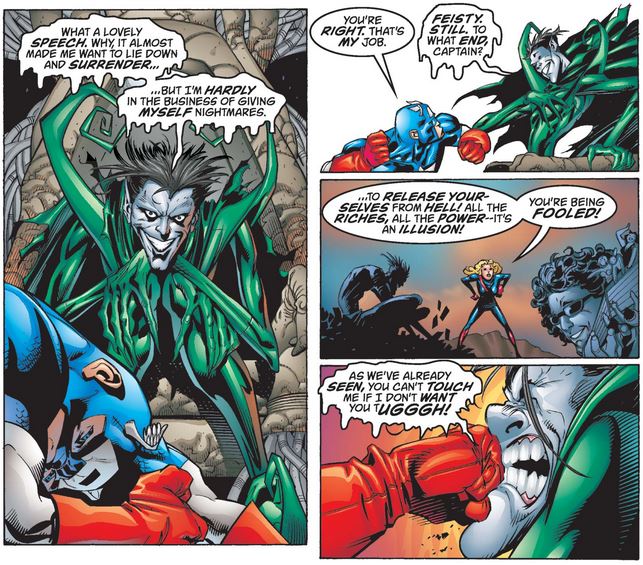
…but he’s not, because he made the mistake of bringing someone in who is the master of his own “dream” world (in a manner of speaking).

While Cap and Nightmare fight, Sharon rallies the other prisoners, dreamers all…
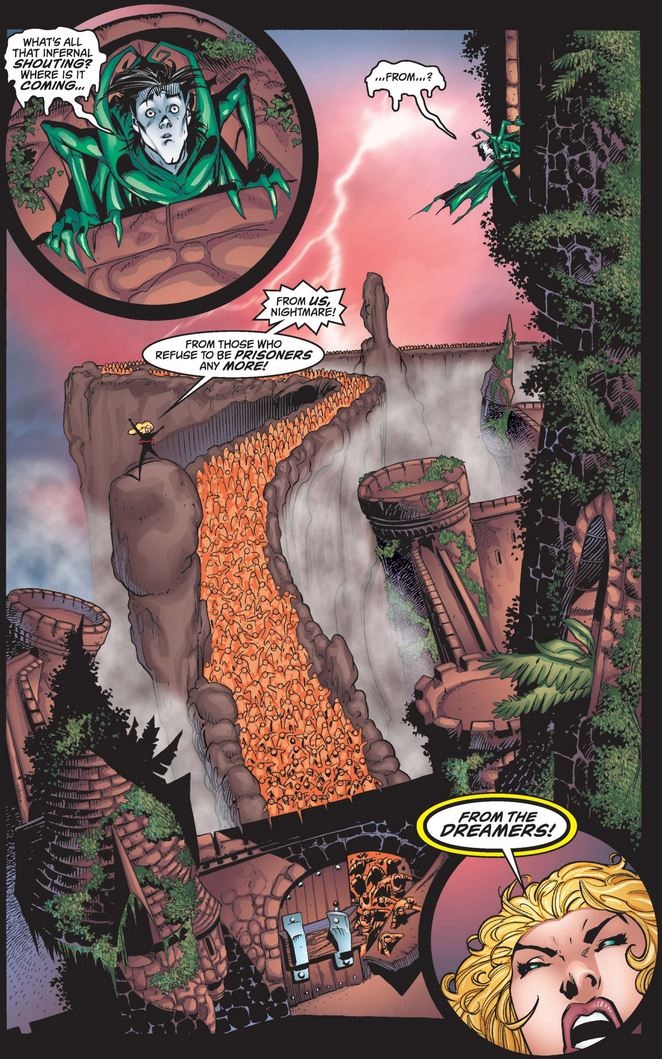
…but, as Cap would do, she deflects the credit, saying it was all him.
Cap fights his way up to Nightmare, arguing that dreams are more powerful than nightmares, presumably because they have the power to inspire, and his dream in particular is shared by many who truly believe in it.
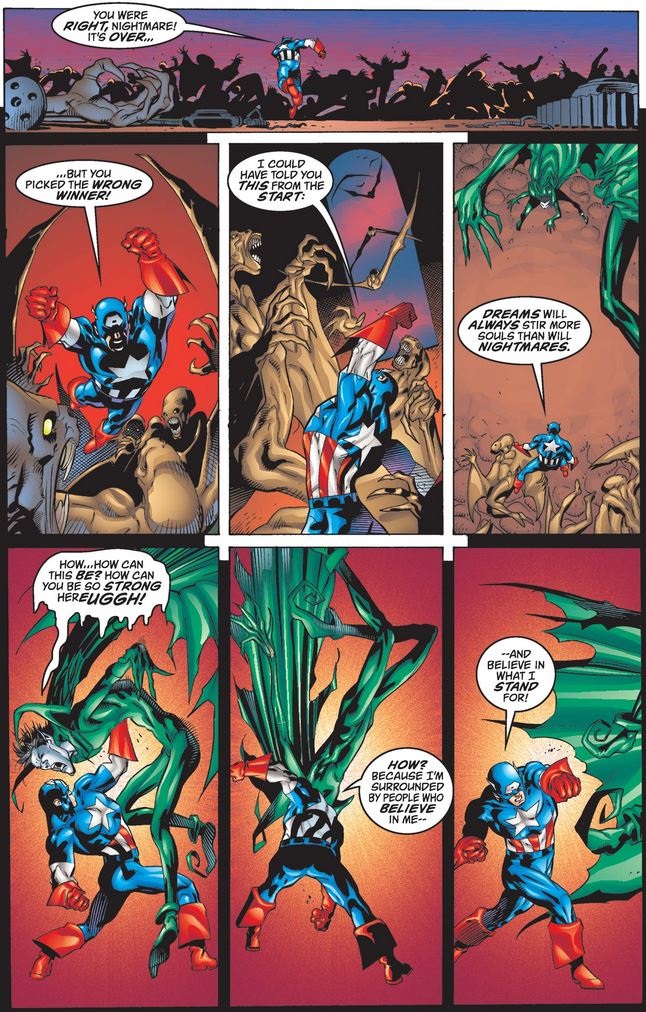
Cap reiterates how Nightmare lost before demanding he let them go…

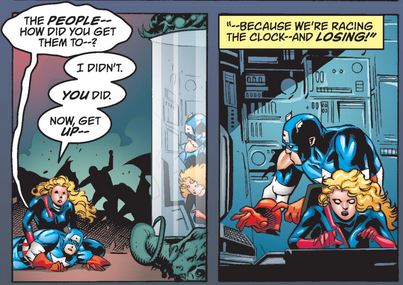
…and once back in the real world, he and Sharon find themselves in the middle of a missile launch that their other selves initiated. Sharon is kept from the control panel by the military—”Where were you five minutes ago?” she asks—so Cap has to go directly to the problem (after getting his shoulder bandaged up).

In an astonishing display of strength and resolve, he struggles to close the bay doors while the missiles are launching…

…and even after he manages to do it, he still needs to get out…

…and there’s only one place to hide.
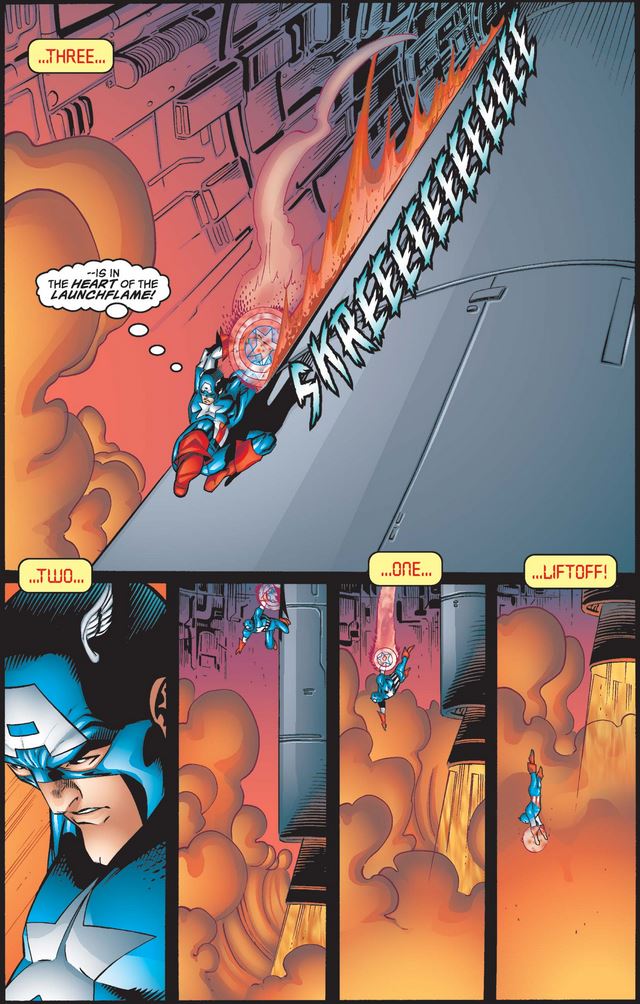
Cap’s new shield passes yet another stress test, as brilliantly depicted by Kubert, Delperdang, and Sotomayor.

Cap isn’t in the clear yet, though: After the missile hits the closed door, the silo begins to collapse, much like the building in the last issue, so he has to dodge flaming metal while running to the door.
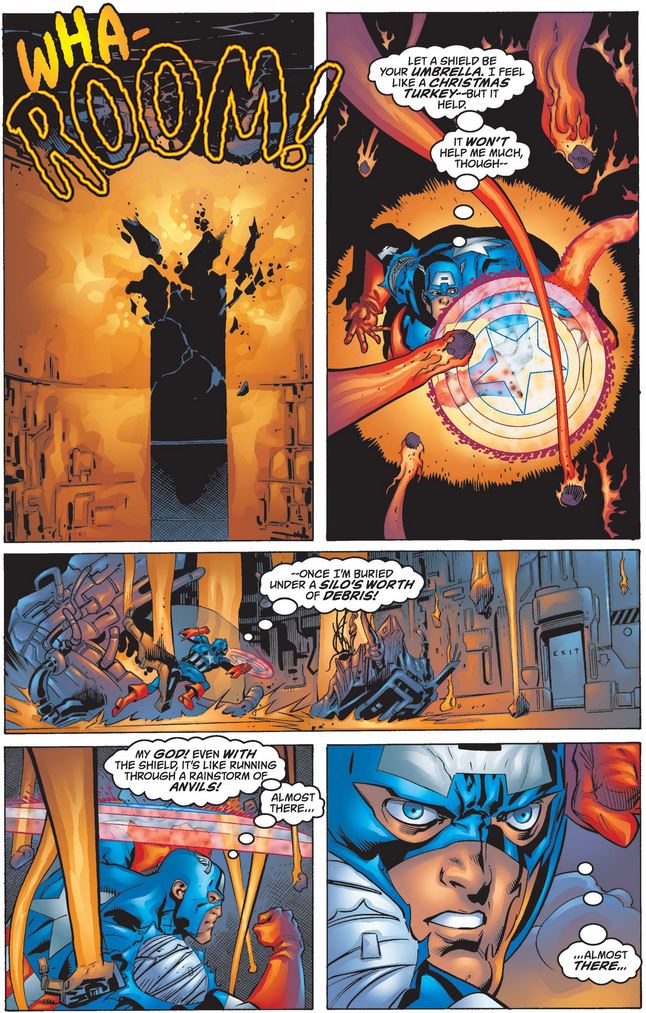
I’m not sure if he yells to Sharon because he needs help or he’s concerned about her, but perhaps the thought of her helps him break free…
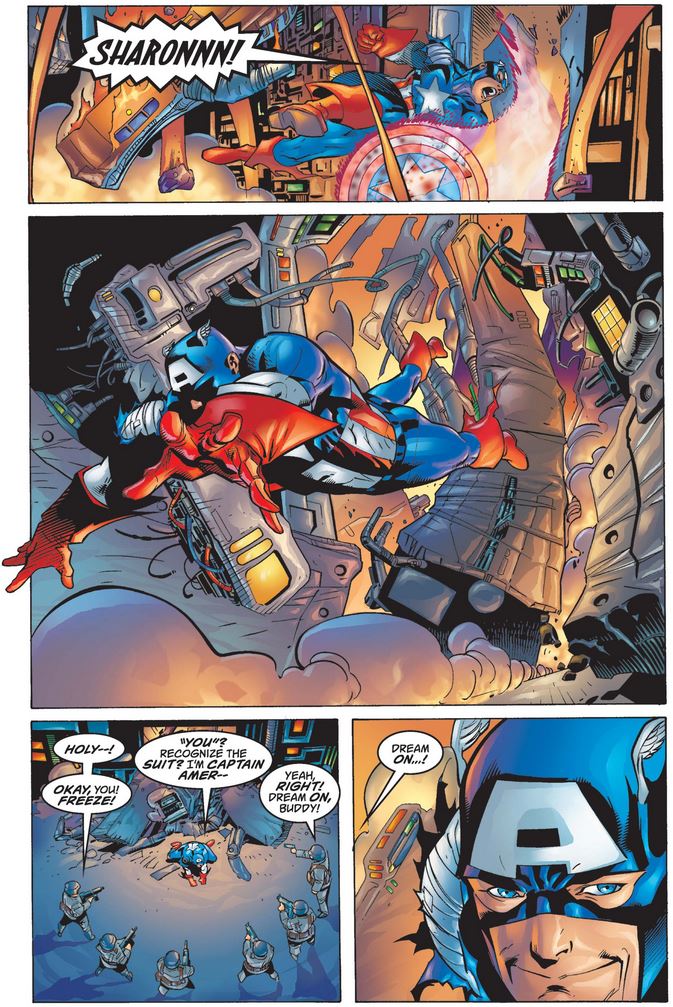
…only to see the assembled guards, who probably remember (even if Cap doesn’t) that it was “Captain America” who broke in and set the missiles off in the first place. (And yes, cute line at the end—extra points if you heard that in Steven Tyler’s voice.)
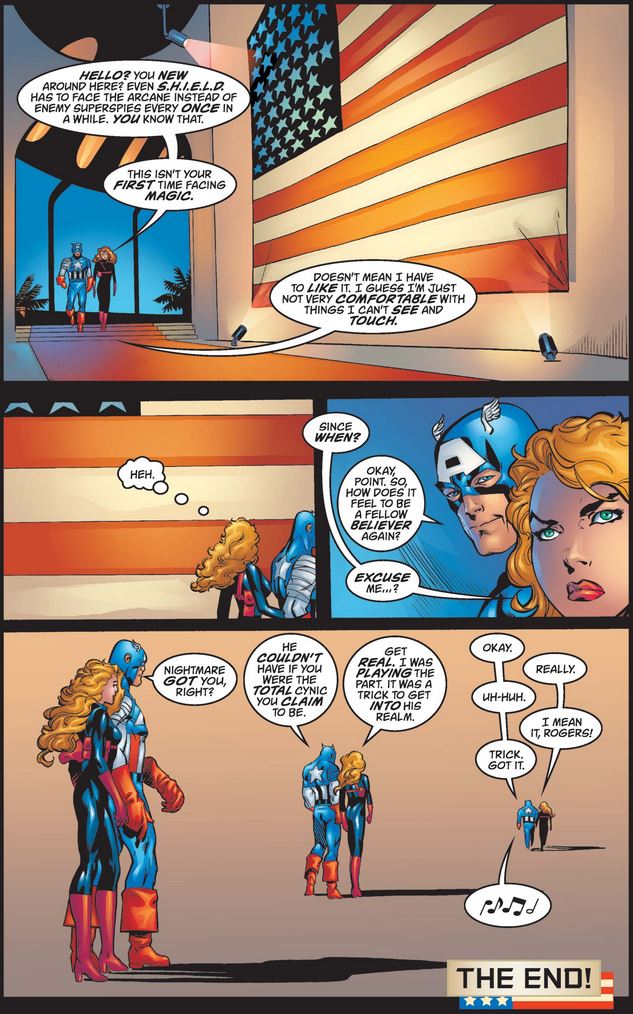
Dugan patches things up with the authorities, but Cap’s concerned about the possibility of more supernatural issues arising, well outside his comfort zone.

Sharon ribs him about his devotion to principles and ideals, which are just as hard to “see and touch” as magic, giving him an opening to gleefully welcome her back to the club of patriots.
Also this month, in Thor #6, Cap has the pleasure of giving the Parademic of the Year award to Jake Olson, the mortal whose body Thor now inhabits, for an act of bravery and heroism above and beyond the call of duty (all of which happened in issues #1-2). But Thor does not feel worthy, given Jake’s own fate, so he turns down the honor.

Despite his boss’s objections, Thor stands by his word, which Cap respects, admiring “Jake” for refusing honors which he feels are undeserved and take away from those who truly deserve them—even if Cap doesn’t know why.

And this is just one example of why Thor is, in fact, worthy—for more, see my book on exactly this topic.
ISSUE DETAILS
Captain America (vol. 3) #11, November 1998: Mark Waid (writer), Andy Kubert (pencils), Jesse Delperdang (inks), Chris Sotomayer (colors), Todd Klein (letters). (More details at Marvel Database.)
Captain America (vol. 3) #12, December 1998: Mark Waid (writer), Andy Kubert (pencils), Jesse Delperdang (inks), Chris Sotomayer (colors), Todd Klein (letters). (More details at Marvel Database.)
Collected in: Captain America: Heroes Return–The Complete Collection Vol. 1.
Thor (vol. 2) #6, December 1998: Dan Jurgens (writer), John Romita, Jr. (pencils), Klaus Janson (inks), Gregory Wright (colors), Richard Starkings (letters). (More details at Marvel Database.)
Collected in: Thor by Dan Jurgens & John Romita Jr. Volume 1 and Thor Epic Collection: The Dark Gods.
PREVIOUS ISSUE: Captain America #10 (October 1998)
ALSO THESE MONTHS: Avengers #10-11, Iron Man #10, Quicksilver #13, The Incredible Hulk #470, Silver Surfer #146, and X-Man #46 (November-December 1998), Captain America: Sentinel of Liberty #3-4 (November-December 1998), Deadpool #23 (December 1998), Thunderbolts #0, and Avengers Forever #1 (December 1998)
NEXT ISSUE: Captain America #13 (January 1999)
 THE VIRTUES OF CAPTAIN AMERICA
It seems like many of the people who fulfilled the American Dream, and were therefore accessible to Nightmare’s attack, demonstrated a pinnacle of success that was not about giving to others- but mainly about personal accomplishment. There’s always a lot of talk about the American Dream in Cap comics and here Waid has him define it as, simply, freedom. But I wonder if Cap wouldn’t define it as it was originally defined when he was a kid in the 1930s.
The phrase the “American Dream” was originally coined by James T. Adams in 1931. This is how he defined it: “The American Dream is that dream of a land in which life should be better and richer and fuller for everyone. Money making and material improvements, mere extensions of the material basis of existence, have become goods in themselves…[mimicking] the aspects of moral virtues. The original American Dream has always been about quality and spiritual values. The American dream that has lured tens of millions of all nations to our shores in the past century has not been a dream of merely material plenty, although that has doubtless counted heavily. It has been much more than that. In our struggle to make a living we neglect to live. The true American Dream is a genuine individual search and striving for the abiding values of life, and for the common man to rise to full stature in the free realms of communal spiritual and intellectual life.”
LikeLike