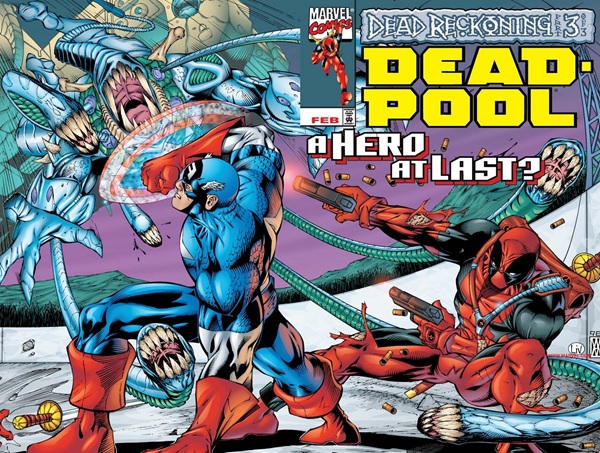
This three-part story in Deadpool’s first ongoing series is… something. I’m not going to worry about putting all of this into context, because Captain America is just as clueless through these comics as I am, but I will do my best.
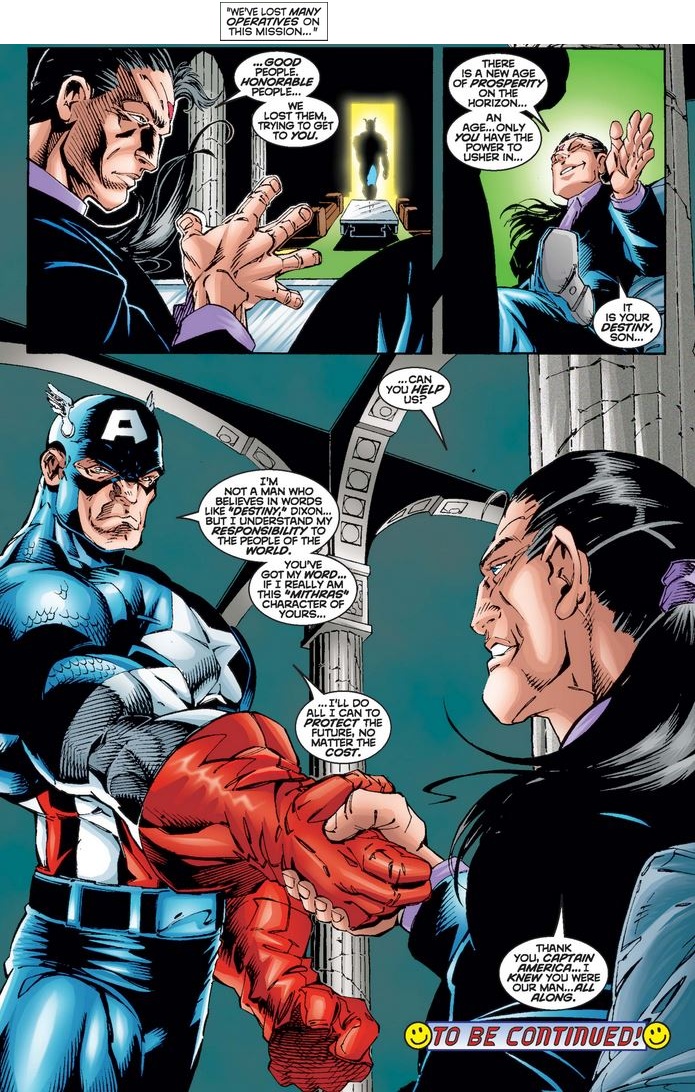
Issue #23 ends with the gentleman below, Dixon of the intergalactic law firm of Landau, Luckman, & Lake, telling Cap that he is the “mithras” entity that was foreseen to protect an alien messiah from a monster named Tiamat and save the world. (They previously thought that Deadpool was the mithras, but don’t let that influence your judgment of them.) Cap is skeptical, to say the least, but is willing to help if he can.
In issue #24, Cap sees the carnage wrought by Tiamat and reacts as we would expect…
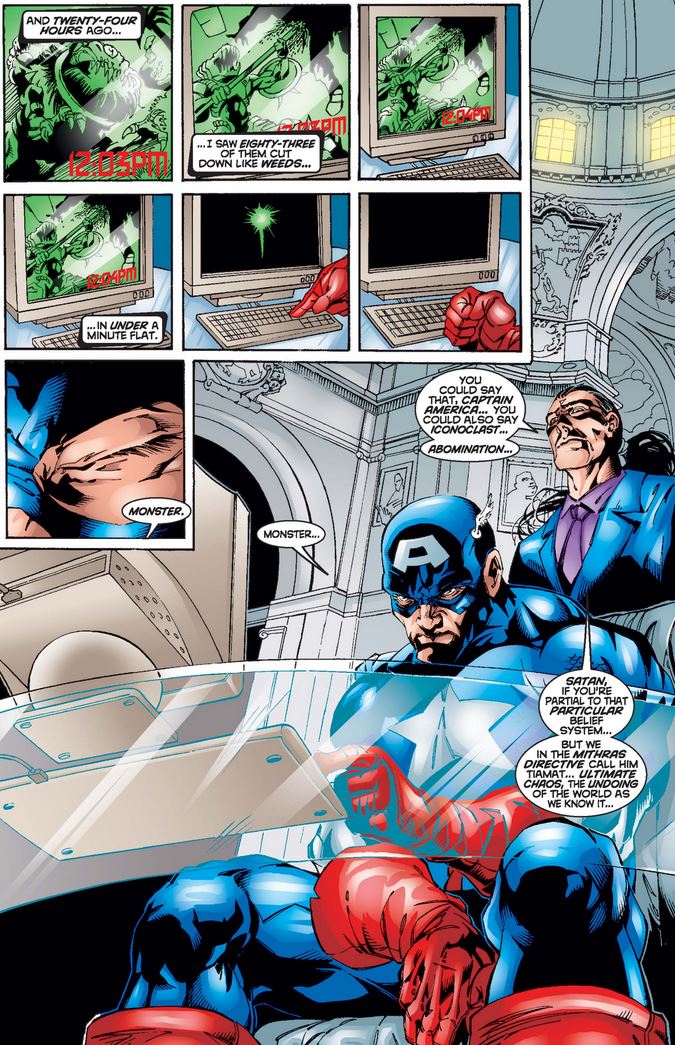
…but his criticism is not aimed at Tiamat, as his skepticism of Dixon and LL&L grows.
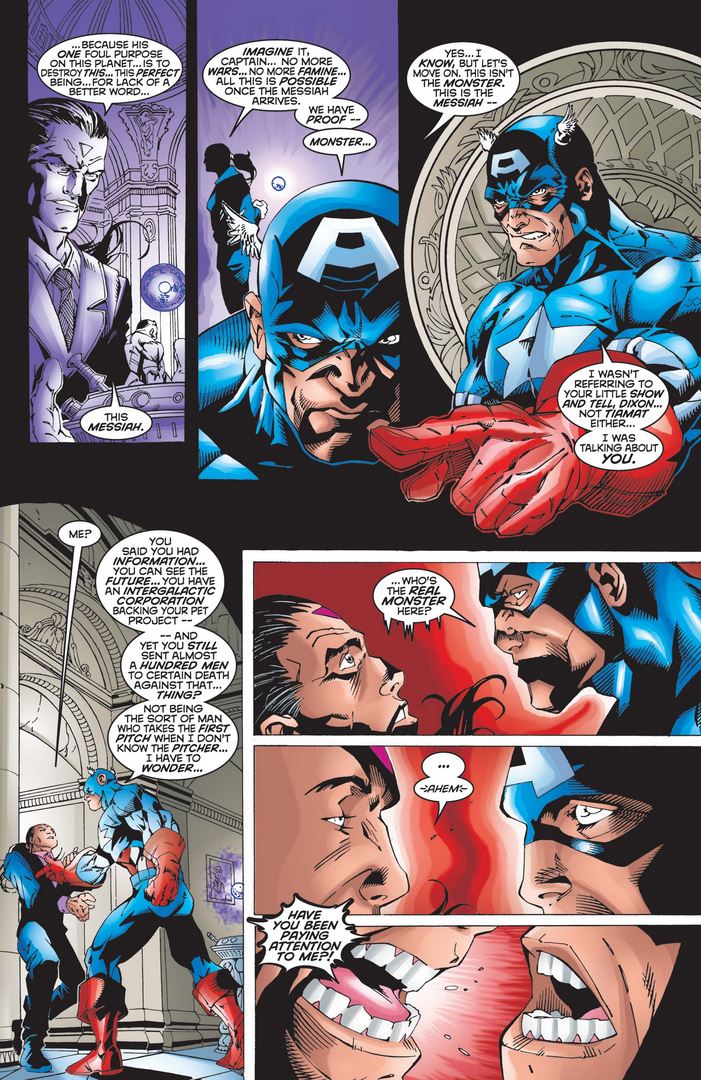
Dixon happily admits he’s a monster who would do anything to bring about the “ultimate peace” promised by his alien messiah, and says he expects the same from Cap—whose position on “the ends justify the means” he’s clearly not familiar with.
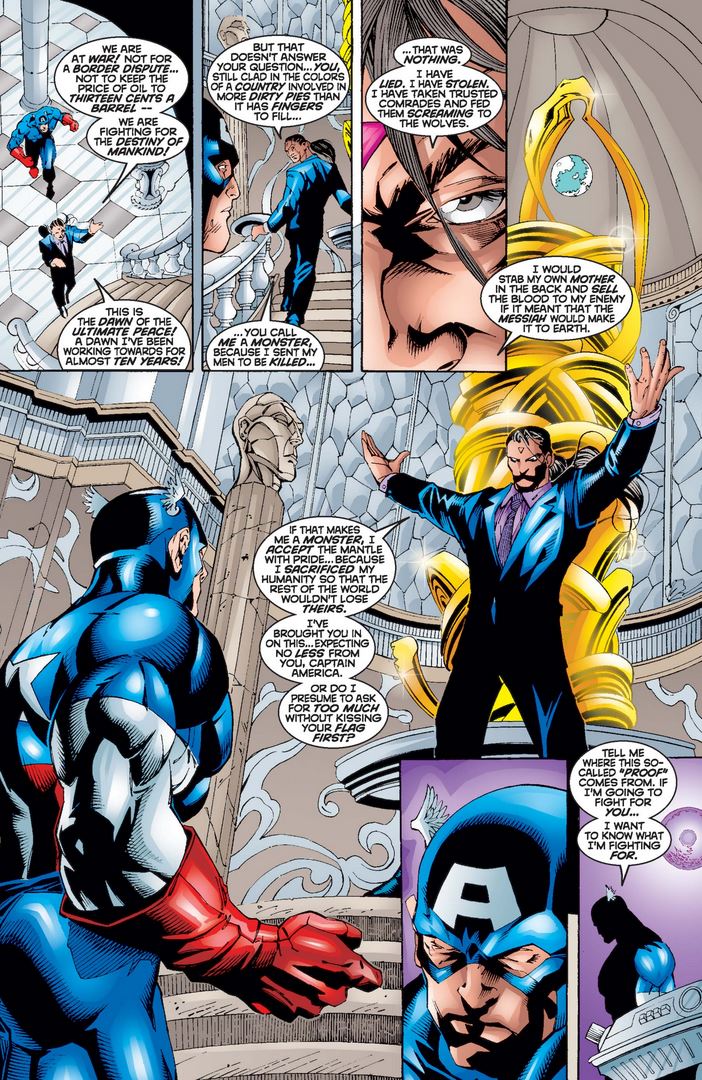
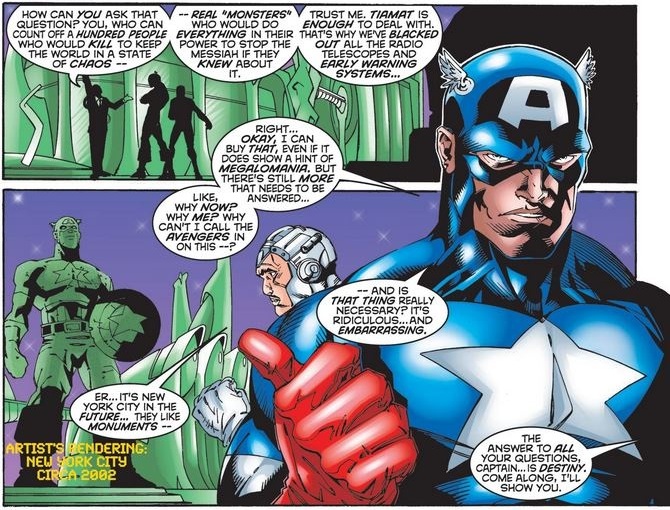
Nonetheless, Cap doesn’t bail, but he demands to know more. After Dixon explains how the messiah promises world peace, Cap asks why he keeps this a secret, and accepts Dixon’s explanation—but still wonders why he is “the chosen one” and balks at the idolatrous atrocity in green.
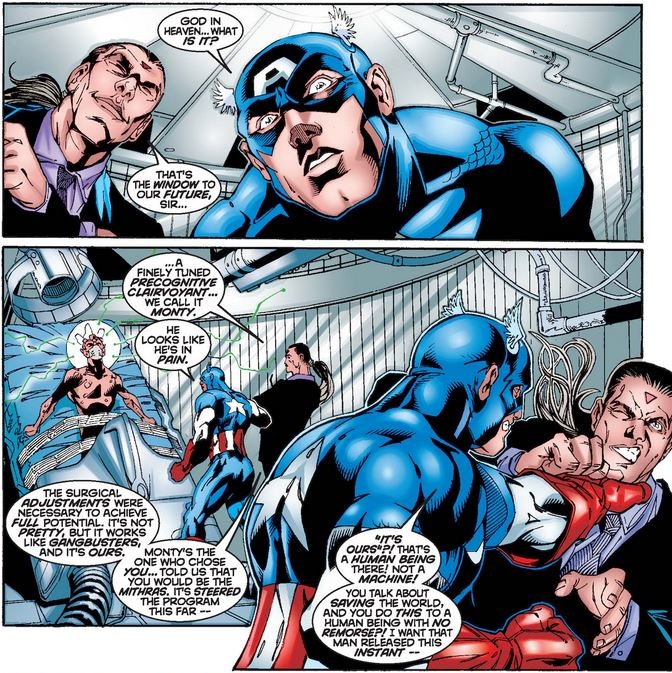
Dixon introduces Cap to Monty, their seer, but this just reignites Cap’s indignation at LL&L’s treatment of people.
Monty himself intervenes, demonstrating his privileged knowledge by mentioning the events of the recent Captain America #9-12, which no one knows about (except us, based on these three posts).
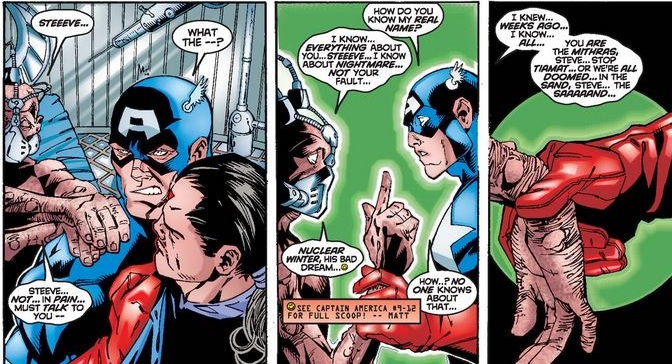
Cap is convinced, and based on the stakes he agrees to continue, but warns Dixon about any further morally abhorrent behavior that even the possibility of “world peace” would not justify (even under threshold deontology, a view that endorses the suspension of moral principles if the cost of maintaining them becomes too high, as discussed in pp. 148-150 of my book).
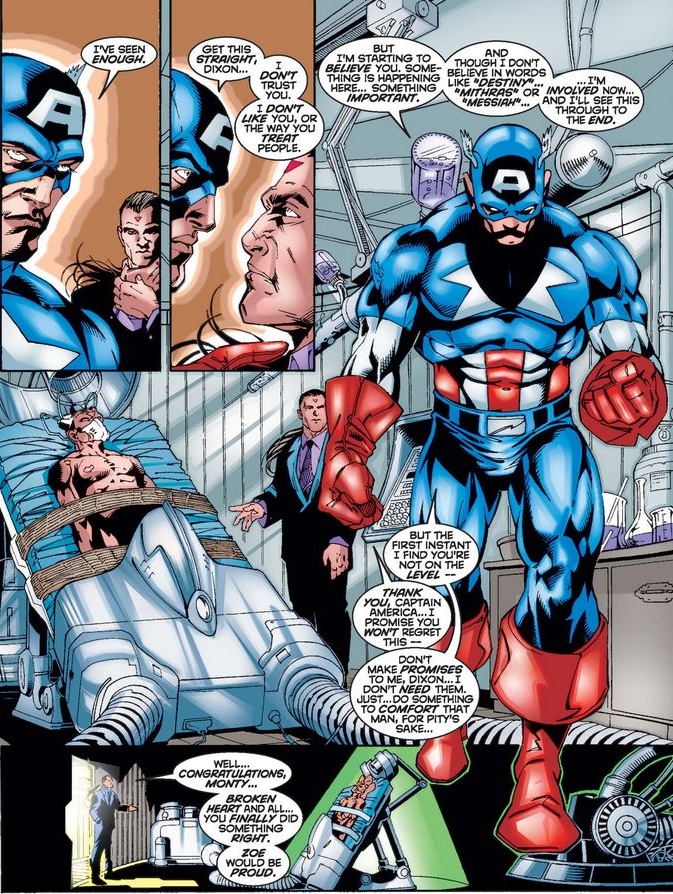
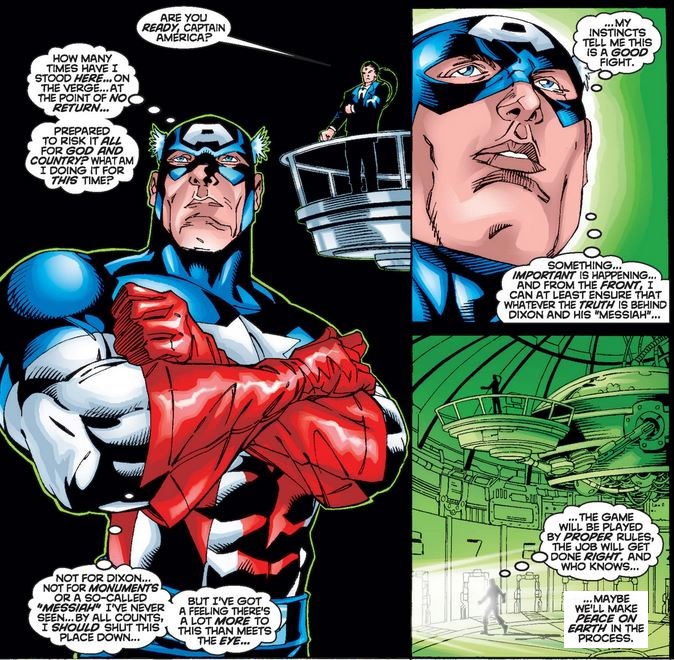
As he prepares to enter the fray, Cap reflects on the choice he’s made, trusting his gut and promising to make sure Dixon and LL&L don’t cross any more lines.
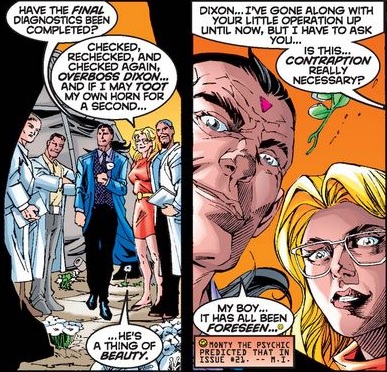
Issue #25 opens with Cap reacting rather adversely to his new outfit…
…which makes the armor he started wearing in Captain America #438 look understated in comparison.
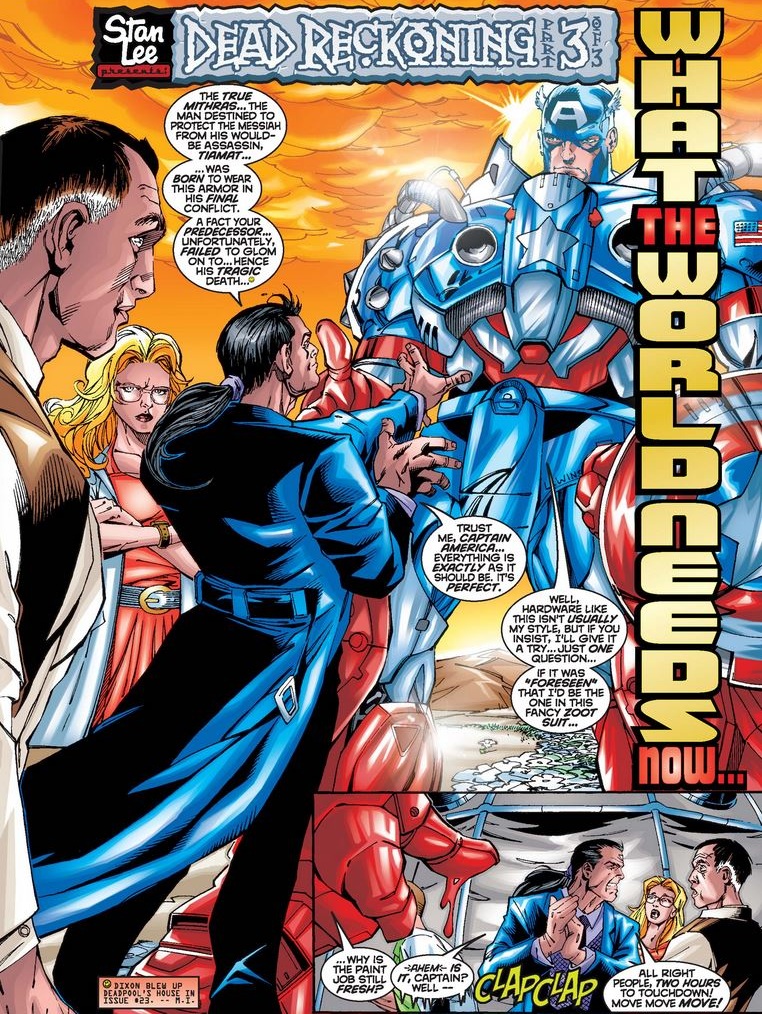
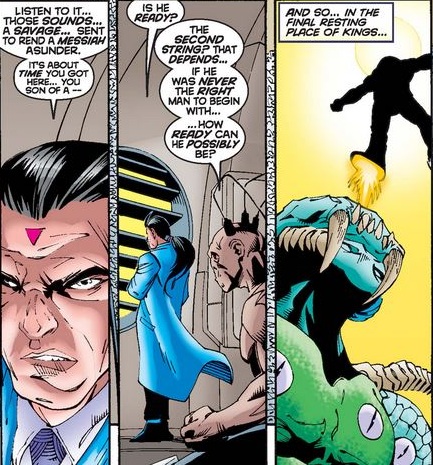
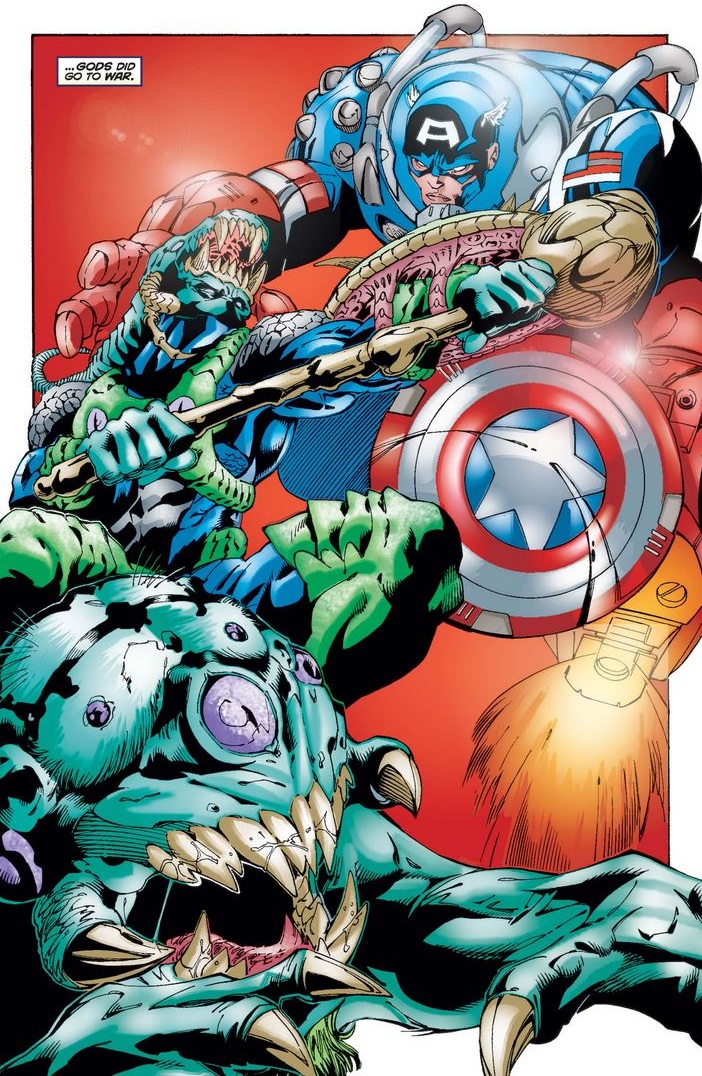
Despite his reservations, Cap descends into battle with Tiamat…
…as seen in the striking image below.
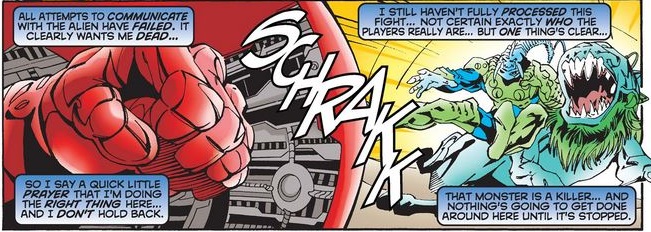
Cap still isn’t quite sure what’s going on and who’s behind it all, so he focuses on the battle at hand.
As he often does, Cap sees a fellow soldier and respects their dedication to their own cause, which makes him afraid for Tiamat’s life when he sees the bombers flying overhead.
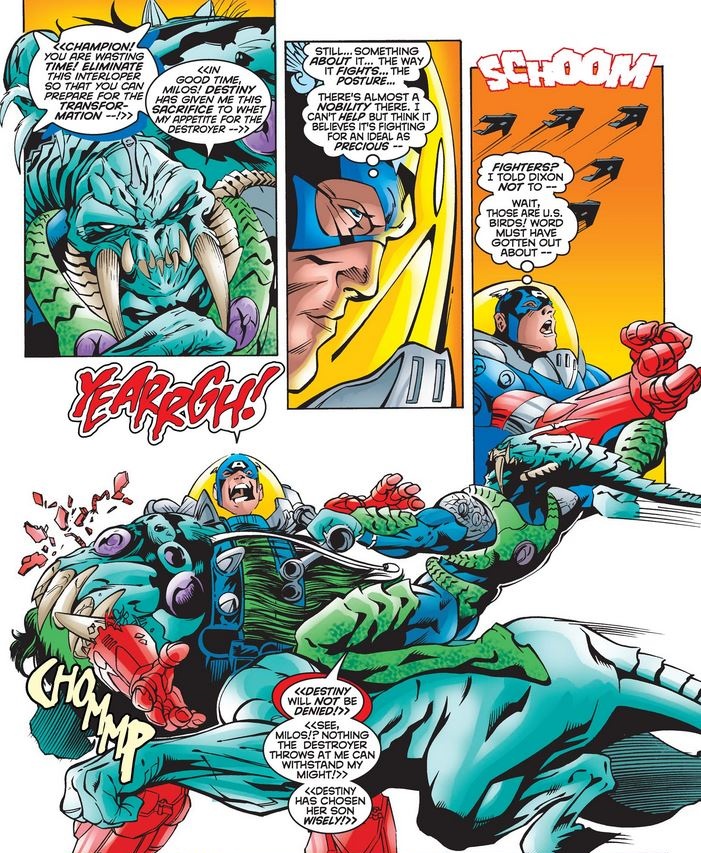
Just when Cap seems down for the count…
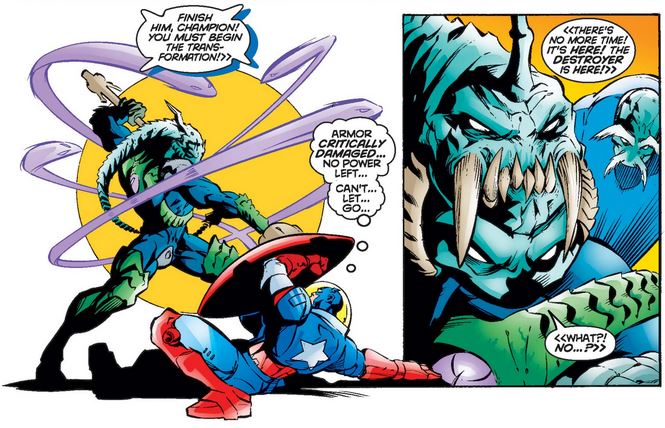
…the messiah arrives, much to Dixon’s glee.
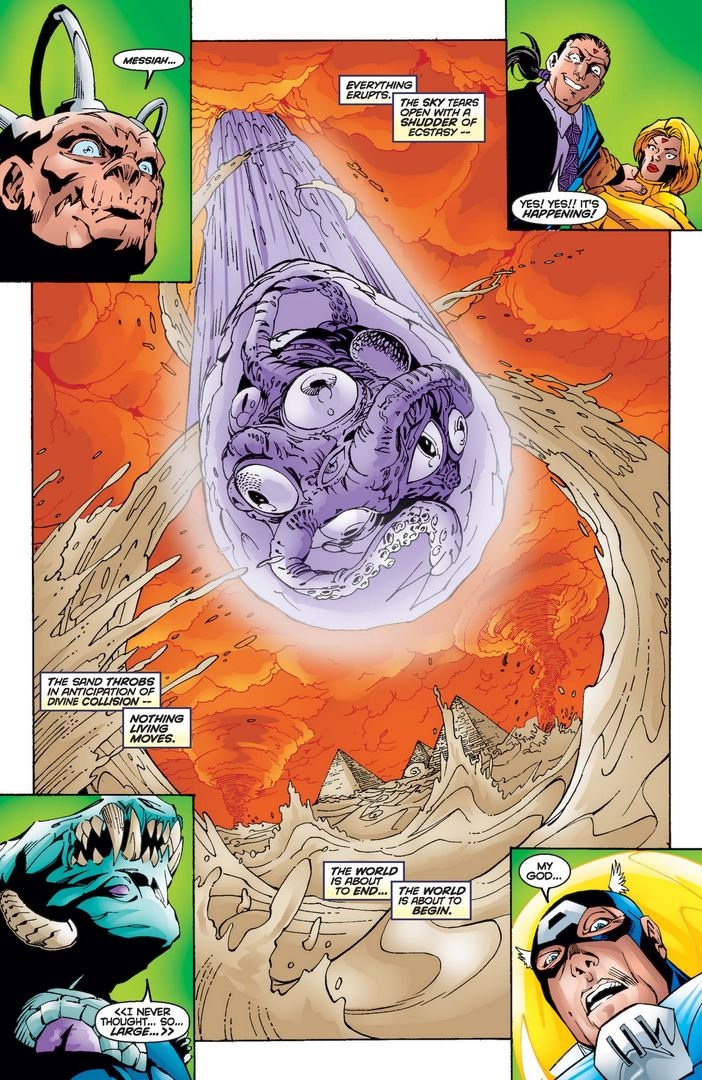
Of course, to Tiamat the messiah is “the destroyer,” but he is distracted in his mission by the title character of the book, who will finally get a chance to interact (minimally) with Captain America.
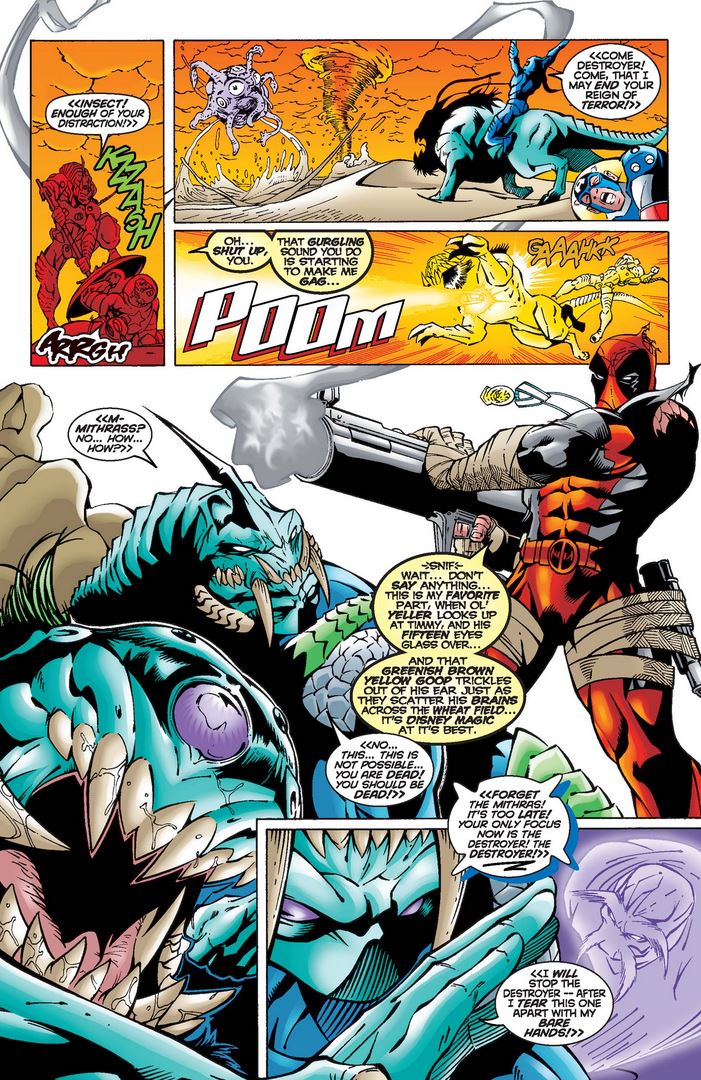
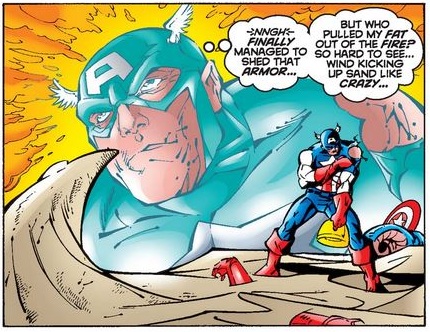
Much to Cap’s relief, he gets to take the armor off…
…but in the meantime, Tiamat’s masters let Deadpool know that the messiah will bring about world peace only by robbing humanity of its free will, and they make him their new champion to fight the messiah. Unfortunately, the messiah has also taken over Cap’s mind, and his biggest fan Deadpool would rather ask him—”the only dude within a thousand mile radius with a clean moral barometer”—for advice than fight him, but fight him he must.
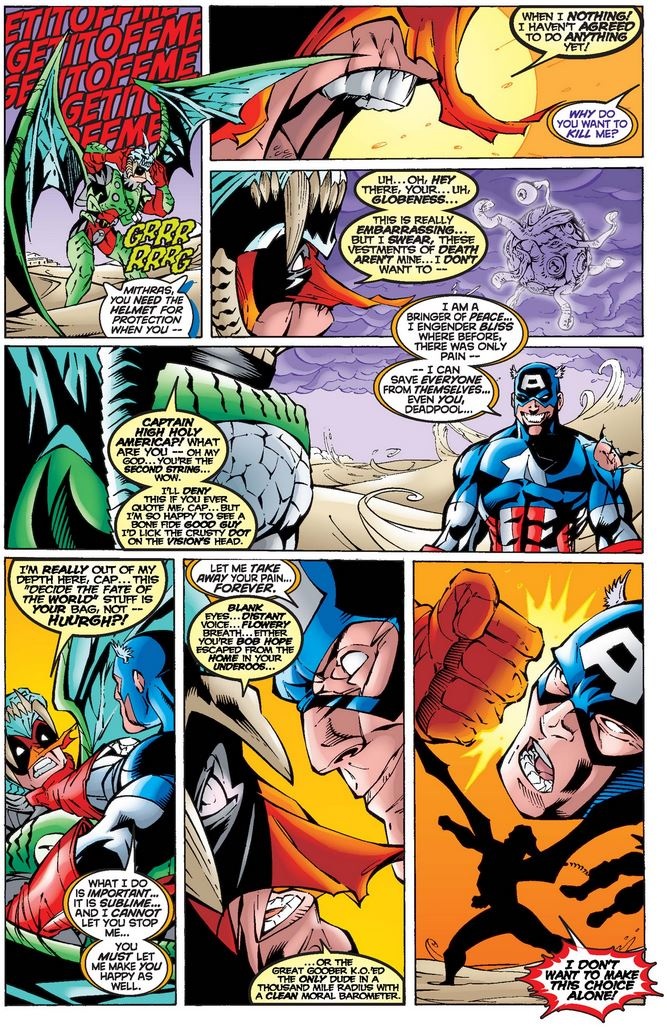
Under the control of the messiah, Cap sounds just like the fascists he often fights, who decry free will and autonomy as the bane of humanity, making their lives harder and more miserable than if they let someone else to make their choices for them.
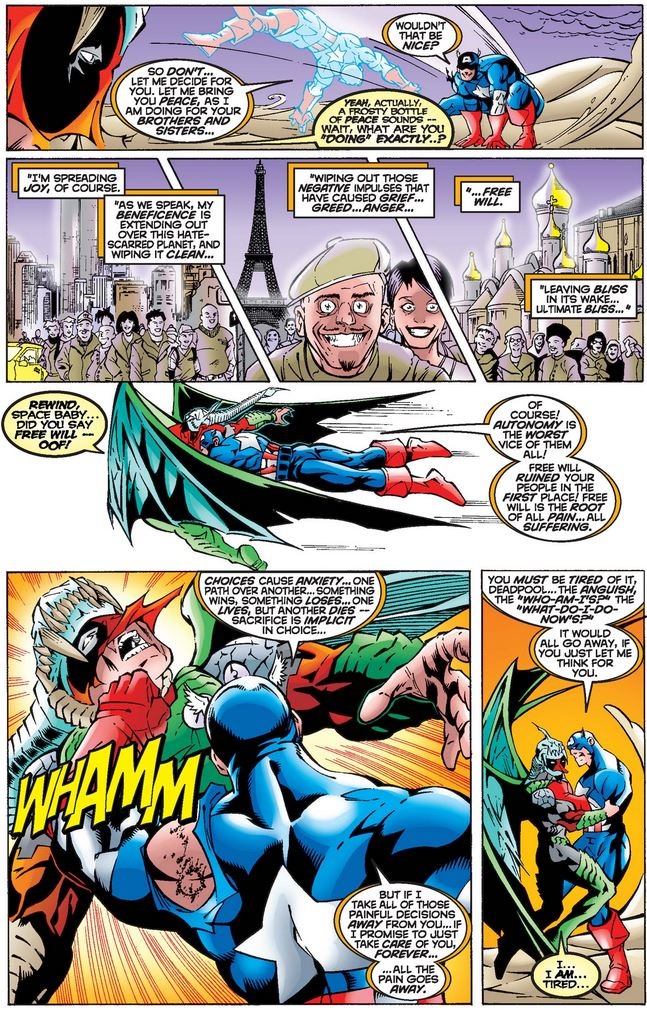
Deadpool seems convinced by the pitch for happiness from submission, but Tiamat’s masters argue for the emotional and creative advantages of free will. Deadpool is hesitant to deny humanity what the messiah promises to be happiness…
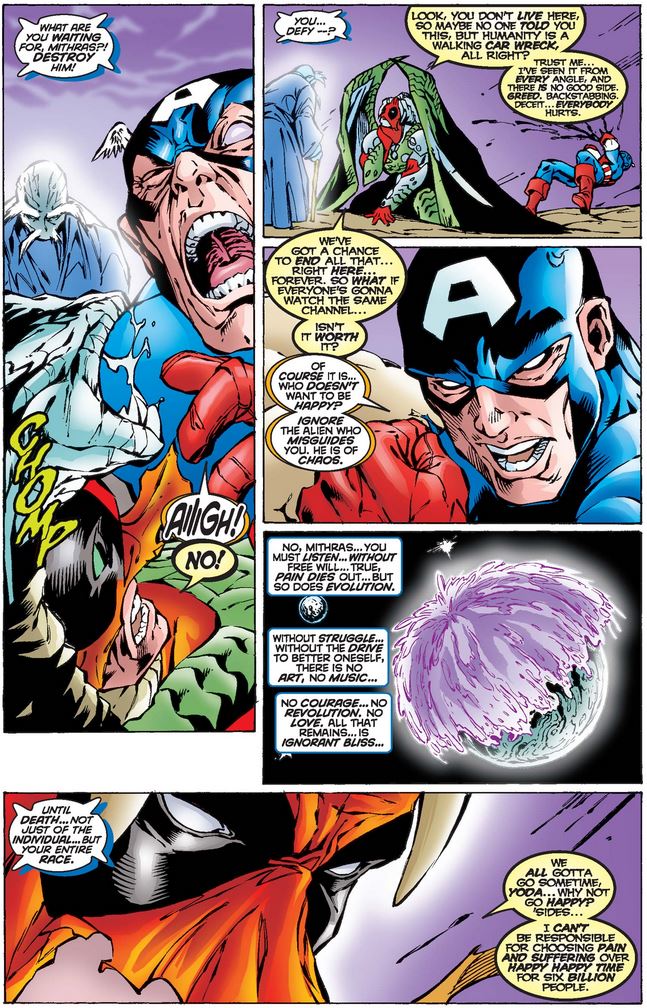
…and the messiah, through Cap, is ready to accept, but Deadpool has some sort of epiphany.
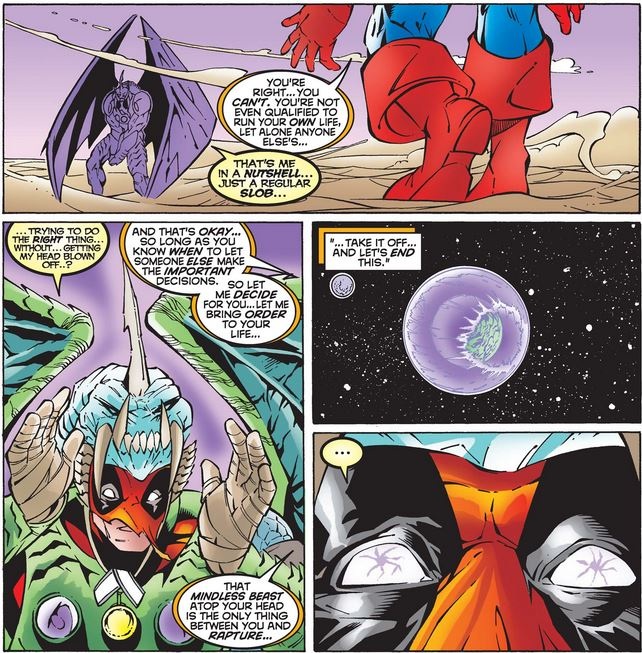
Deadpool has a game to suggest first…
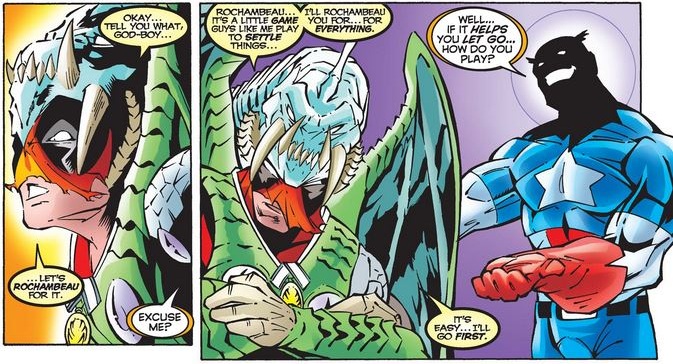
…this game. (Cap’s gonna wonder what happened when he regains control.)
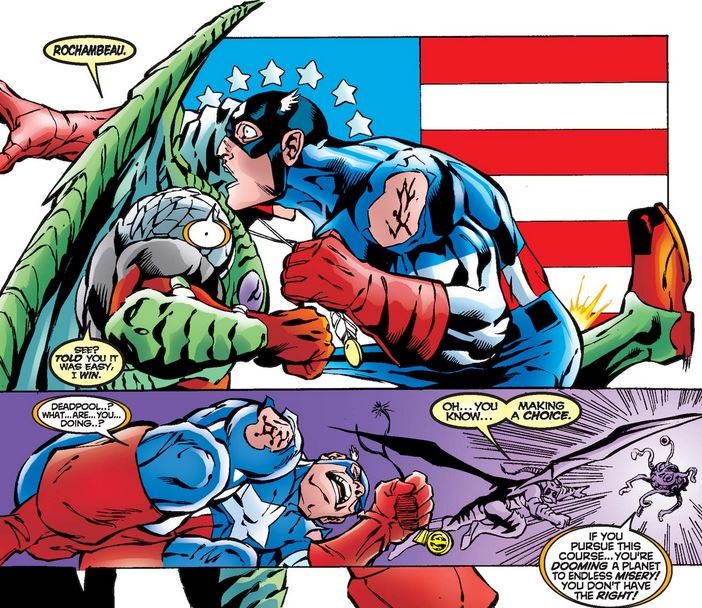
Amazingly, Cap doesn’t seem to be sore in his southern states, but he definitely is confused. (I get that.)
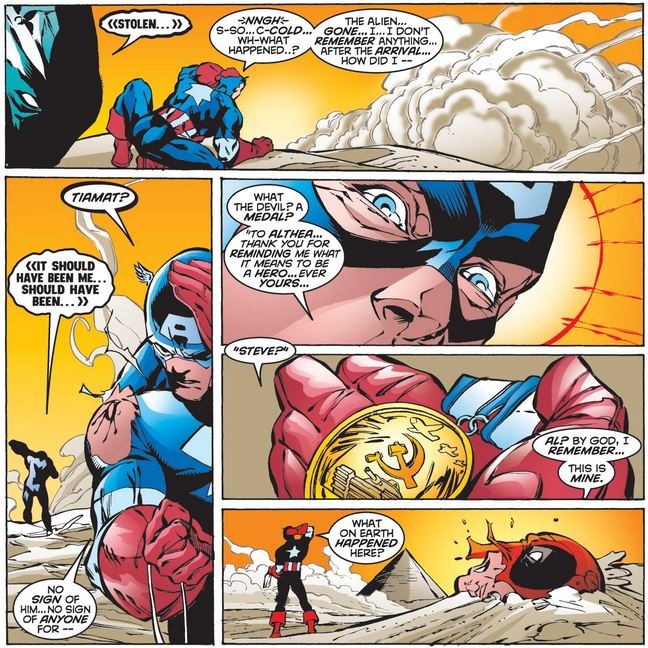
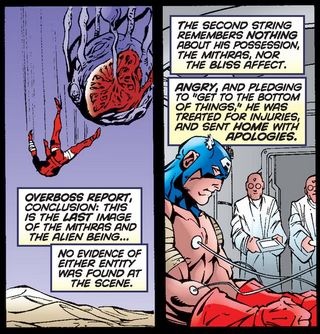
I trust he will be more skeptical the next time someone comes to him with a pitch to be the mithras to protect a messiah. (“Fool me once” and all.)
ISSUE DETAILS
Deadpool (vol. 3) #23, December 1998: Joe Kelly (writer), Walter McDaniel (pencils), Andy Lanning (inks), Matt Hicks (colors), Richard Starkings and Comicraft (letters). (More details at Marvel Database.)
Deadpool (vol. 3) #24, January 1999: Joe Kelly (writer), Walter McDaniel (pencils), Whitney McFarland (inks), Matt Hicks (colors), Richard Starkings and Comicraft (letters). (More details at Marvel Database.)
Deadpool (vol. 3) #25, February 1999: Joe Kelly (writer), Walter McDaniel (pencils), Walden Wong (inks), Matt Hicks (colors), Richard Starkings and Comicraft (letters). (More details at Marvel Database.)
Collected in: Deadpool Epic Collection: Dead Reckoning.
ALSO THESE MONTHS: Captain America #12 and Thor #6 (December 1998), Avengers #11 and X-Man #46 (December 1998), Captain America: Sentinel of Liberty #4 (December 1998), Avengers #12, Thunderbolts #0, and Amazing Spider-Man #1 (December 1998-January 1999), Avengers Forever #1-3 (December 1998-February 1999), Captain America #13 (January 1999), Captain America: Sentinel of Liberty #5-6 (January-February 1999), and Captain America #14 (February 1999)
 THE VIRTUES OF CAPTAIN AMERICA
Leave a comment