 This issue takes a break from the ongoing storyline to tell a wonderfully poignant story of courage and heroism amidst the horrors of war, written by current writer Dan Jurgens and penciled and inked by Jerry Ordway, one of my favorites going back to All-Star Squadron, my favorite comic when I was a kid. (Recently, Ordway wrote and drew Avengers #16-18 and the Domination Factor: Avengers mini, the latter in collaboration with Jurgens.) As the cover suggests, the story itself plays tribute to the brave soldiers who fought for freedom and democracy without the benefit of super-soldier serum, Vita-Rays, or a mighty shield (and in this way stands as a predecessor to the Captain America: Theater of War one-shots published nearly a decade later).
The issue begins with the introduction of Cameron Klein, demanding to see Captain America on Nick Fury’s orders.

Luckily for the young man, Cap happens to be in today (despite having stepped down from active membership in Avengers #25), and while he has doubts, he agrees to go with Klein…
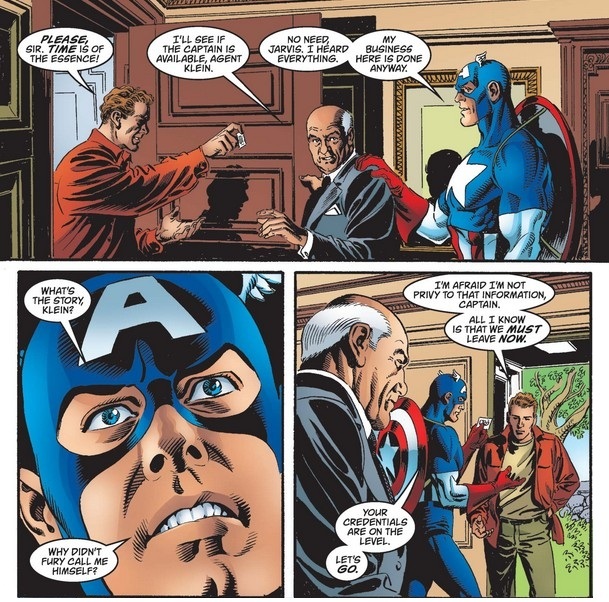
…if only to figure out what’s really going on. After Klein fails every test Cap throws at him, our hero throws something else.
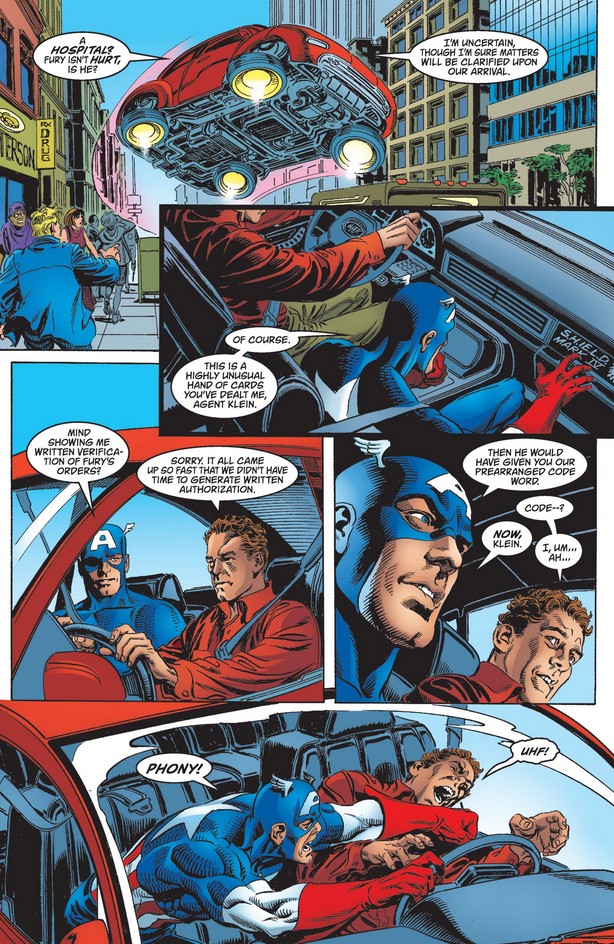
As Cap tries to steady the hovercar while relieving Klein of his weapon, he reveals that he knew something was up when the young man flashed his badge at the mansion. Before Klein has a chance to answer Cap’s accusations, though, Nick chimes in to clear everything up.
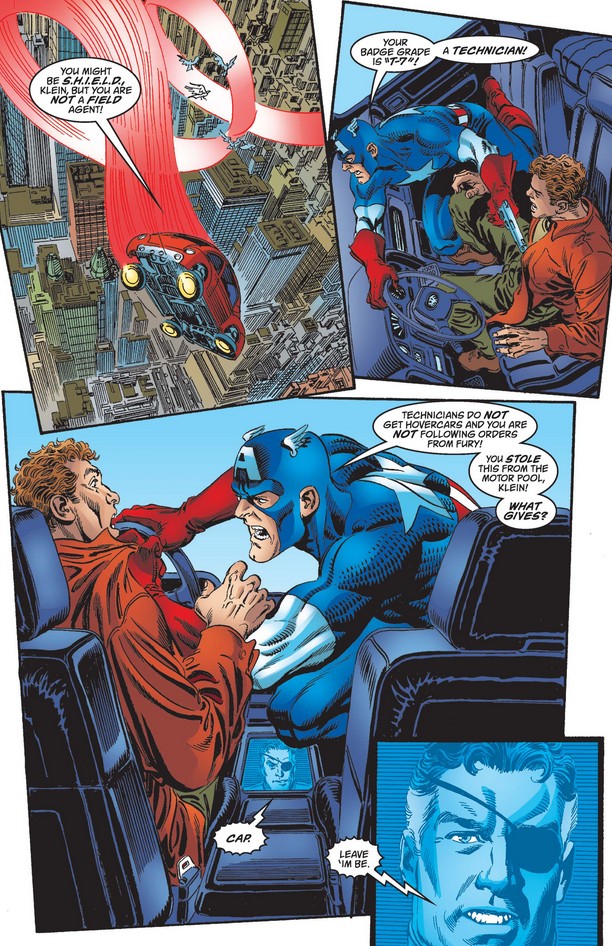
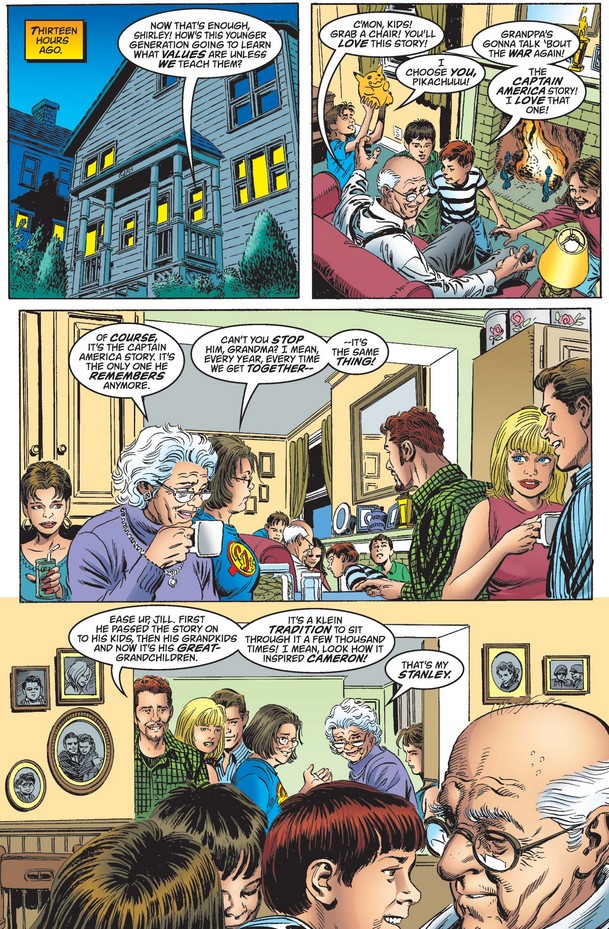
After Nick tells Cap to meet him at the hospital, saying only that it has to do with “old business… from the war,” we turn back a few hours to a man beginning to tell his family a story of Cap, Bucky, and the Howlin’ Commandos from over fifty years ago.
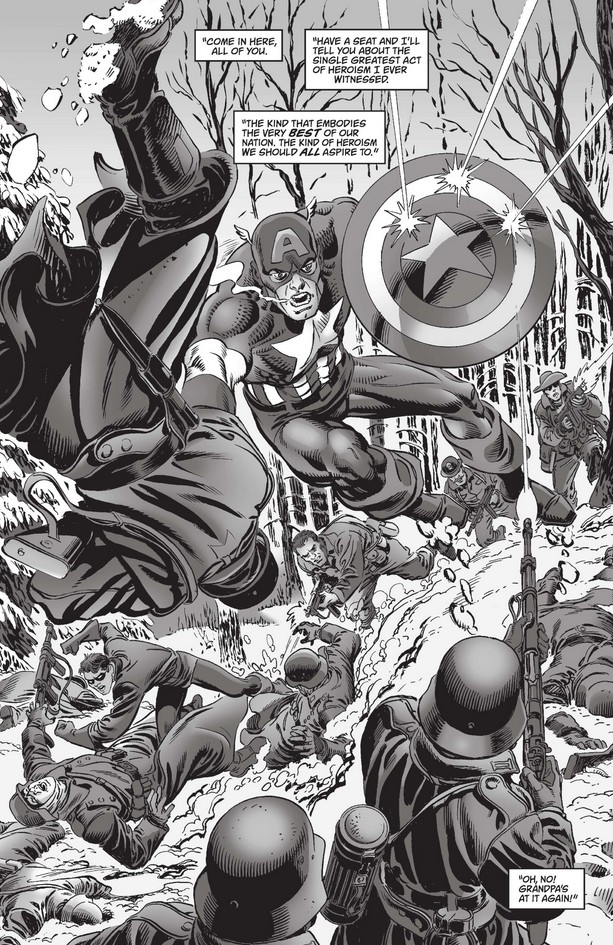
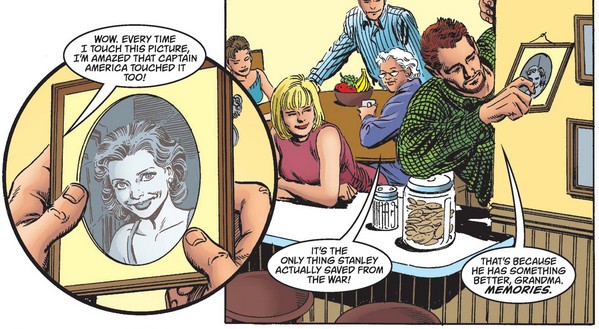
Amidst the family discord regarding hearing a familiar story yet again, we learn that the storyteller is Stanley Klein, the grandfather of our young SHIELD technician. (I’m partial, of course, to the first point about using Cap’s adventures to teach ethics.)
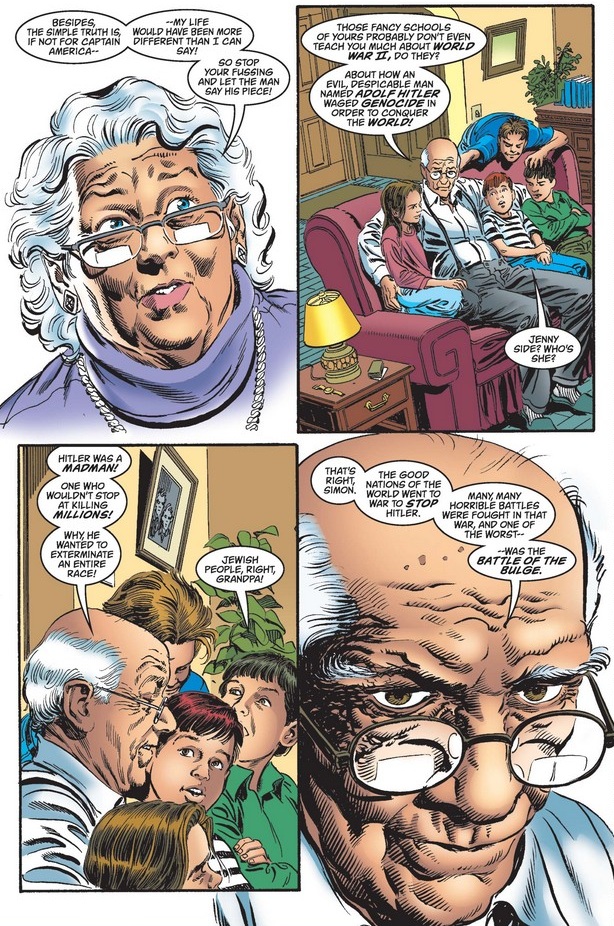
Shirley stands up for his husband, adding her own appreciation for what Cap did that day, and Stanley introduces his great-grandchildren to the Allied forces’ battle against Hitler and his genocidal agenda before recounting his experiences in the Battle of the Bulge, a decisive yet enormously costly battle near the end of World War II.
The elder Klein describes what the physical and psychological conditions were like for American troops in December 1944, particularly the 106th Infantry (whose story is told here).

His picture of Shirley is very popular with his fellow soldiers, which inspires the men to share their plans after the war as well as their reasons for fighting, ranging from the idealistic to the practical.

Tragically, few of them would see the end of war; Stanley was one of the few survivors of the blast, disoriented and watching his only picture of his love float away.

When he found a soldier barely breathing, Stanley did all he could, with what little he had, to keep his friend alive.

Klein does not shy away from the horrors of war, and the expression on his face below is a clear illustration of the damage such horrors do to one’s mind.
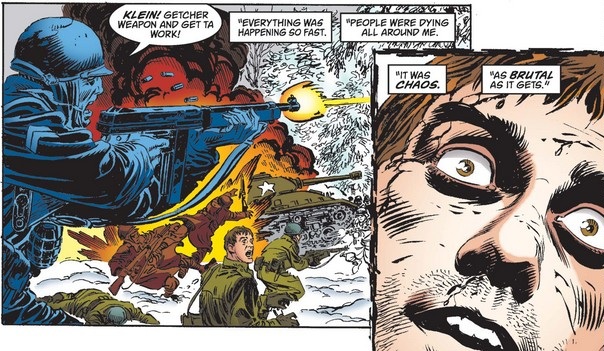
For Klein and the rest of the survivors, the battle continued on the ground.
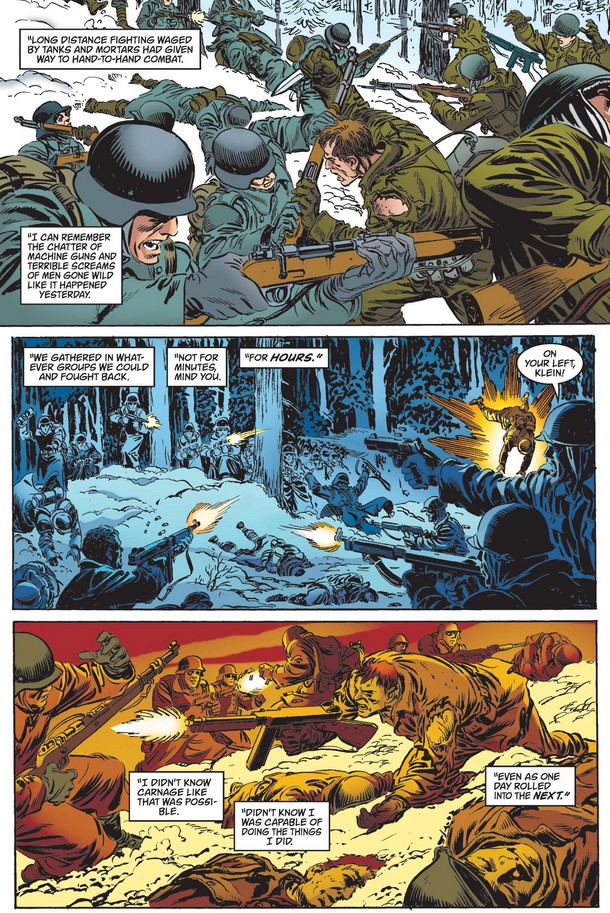
Above, Klein reflects on the brutality and inhumanity he witnessed. His statement about “the things I did” could be read several ways, either astonishment at his perseverance or shame over what he had to do to survive, both of which would be reasonable thoughts about a completely unreasonable situation.
What he says below, though, definitely points to the latter interpretation, as Klein sinks into despair while he holds onto Doyle and weighs what one bullet can do for a man with few acceptable prospects.

In addition to the physical and psychological injuries suffered by veterans, much has been written in recent years about the moral injury resulting from the inhumane conditions of war and the things soldiers must do in battle that conflict with their personal moral code, about which many remain tortured for years after returning to civilian life. For more on this, see The Moral Injury Project at Syracuse University and philosopher Nancy Sherman’s book Afterwar: Healing the Moral Wounds of Our Soldiers.
If you or someone you know is suffering from moral injury, the VA has resources to help.
Just when Klein realizes and begins to accept that the end is coming, he and his fellow soldiers get a reprieve…

…as our heroes are joined by more, some of them distinctly more colorful.

Klein is amazed that Cap and Bucky were there, fighting with “ordinary” soldiers like him—hopefully this helped him realize that every soldier is extraordinary when risking everything to fight for a just cause.

When the battle is over, Cap hails Klein’s courage, resolve, and heroism, despite being exhausted and despondent in the worst of conditions.

When he hears Klein’s first name, Cap pulls out a photo he found, and Stanley is reunited with his reason for being…

…which becomes a treasured memento for him and Shirley after they reunited and married following the war.
Before the family has a chance to enjoy the silence of satisfied children, one alerts them to Stanley’s silence as well…
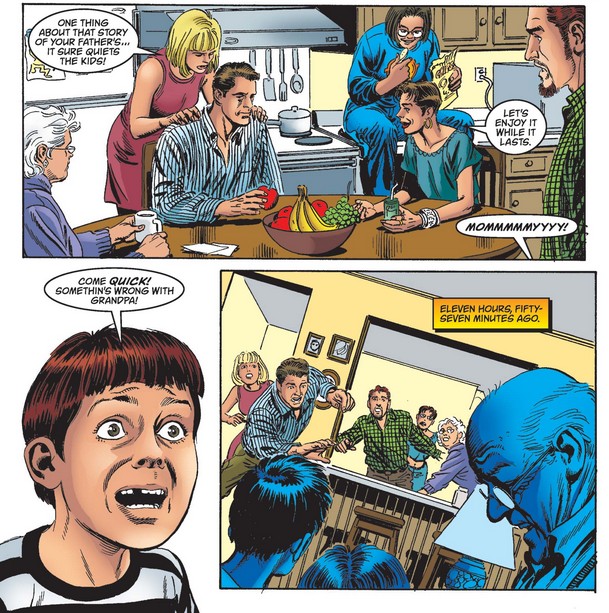
…which brings us back to the present as Cameron arrives at the hospital with Cap and Nick, who rush to the side of their fellow veteran.

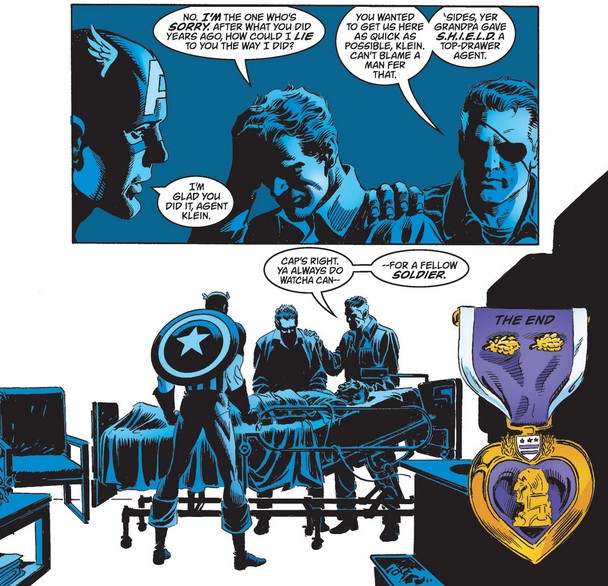
If you didn’t yet realize it, Stanley reminds us that he and Shirley ran into Cap several issues ago, and thanks Cap for the five decades he gave the Kleins and their family.

It is not difficult to imagine, based on Cap’s expression as he holds Stanley’s Purple Heart, that he is thinking of all the brave soldiers that sacrificed so much for the sake of democracy and liberty.
Stanley expresses his gratitude one last time before leaving this world…

…and Cap and Nick both assure Cameron that he did the right thing bringing them here, even if his means were not entirely honest.
Thank you to Dan Jurgens, Jerry Ordway, and everyone involved in telling this story, and thank you to everyone who has ever served in the United States military.
ISSUE DETAILS
Captain America (vol. 3) #32, August 2000: Dan Jurgens (writer), Jerry Ordway (pencils and inks), Gregory Wright (colors), Todd Klein (letters). (More details at Marvel Database.)
Collected in: Captain America by Dan Jurgens Omnibus.
PREVIOUS ISSUE: Captain America #31 (July 2000)
NEXT ISSUE: Captain America #33 (September 2000)
 THE VIRTUES OF CAPTAIN AMERICA
Leave a comment