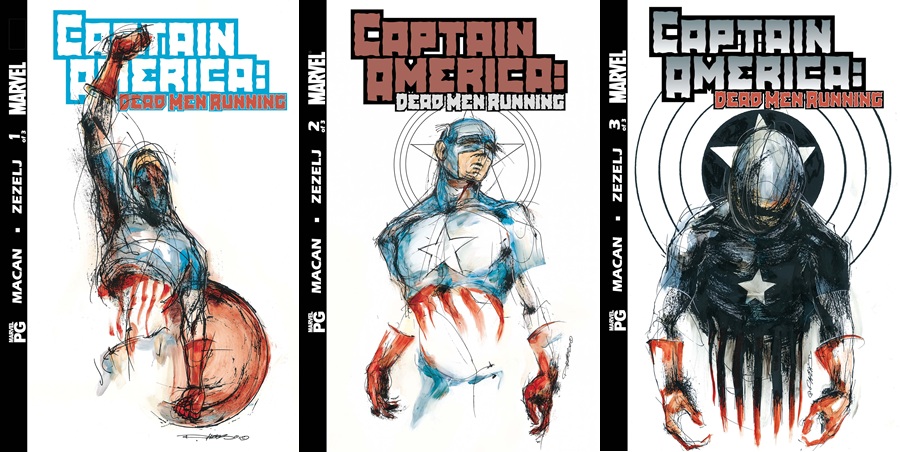
One long month since his untimely passing—as previewed in that very comic—Captain America returns to the land of the living in the Dead Men Running miniseries. These three issues deal with a group of soldiers trapped with a bunch of children in the Colombian jungle on a mysterious mission, as narrated by Sergeant Solo, who presumes from the beginning that they’re already dead (hence the title).
Soon after the opening of issue #1, the guys await a surprise airdrop.
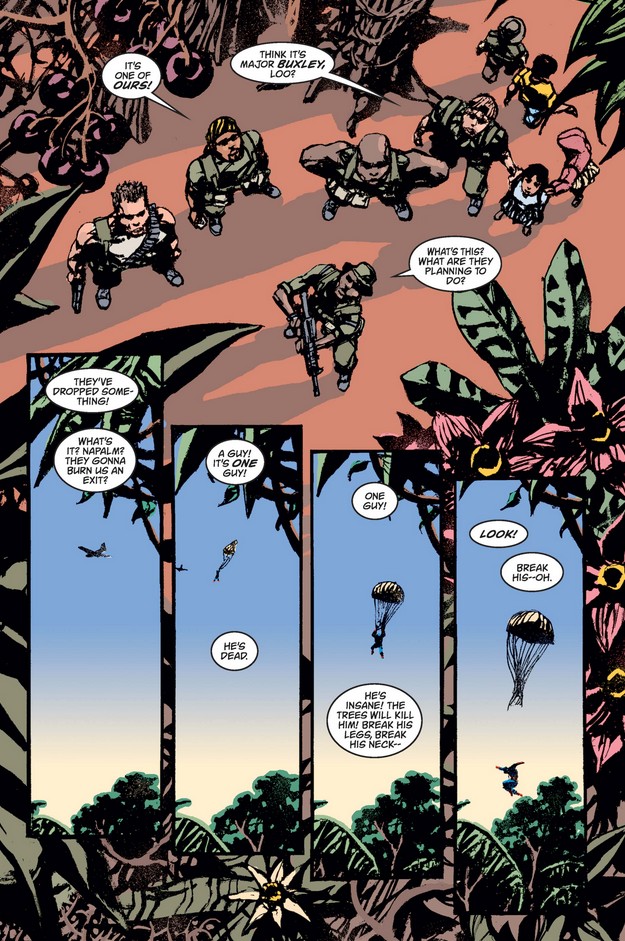
Naturally, they prepare for the worst, but are quickly put…
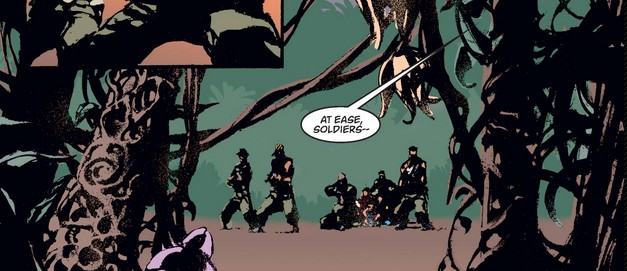
And he’s back!
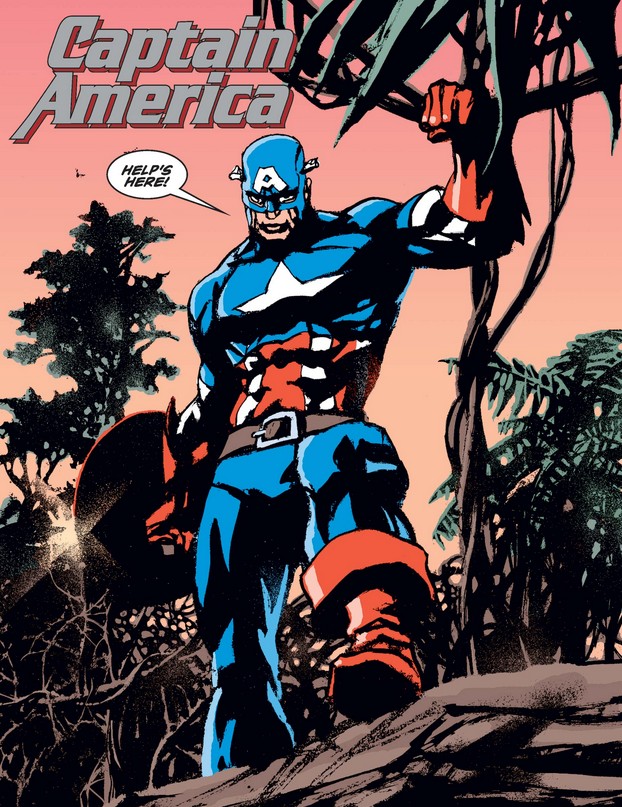
The troops hurry to introduce themselves, none more quickly than Nystrom, the most starstruck of them all.
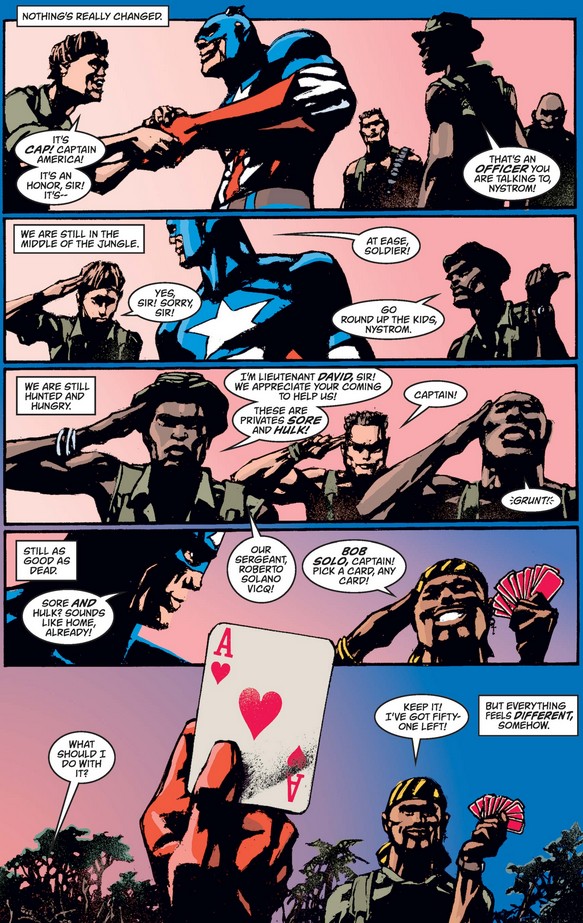
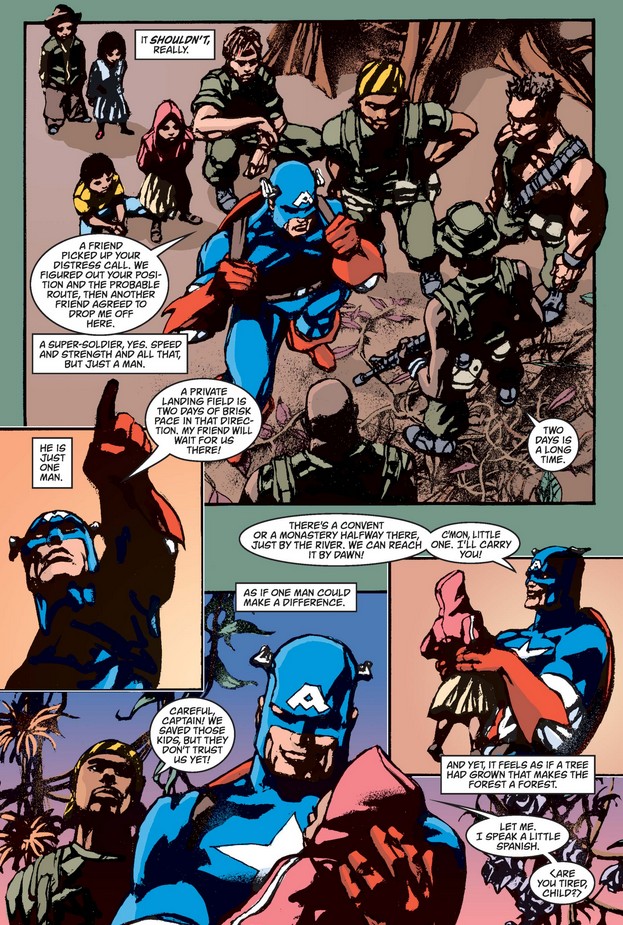
Solo wonders how Cap will turn things around, but can’t help thinking that he will, while Cap explains how he got there, details how they’ll get out, and comforts the children with their native tongue.
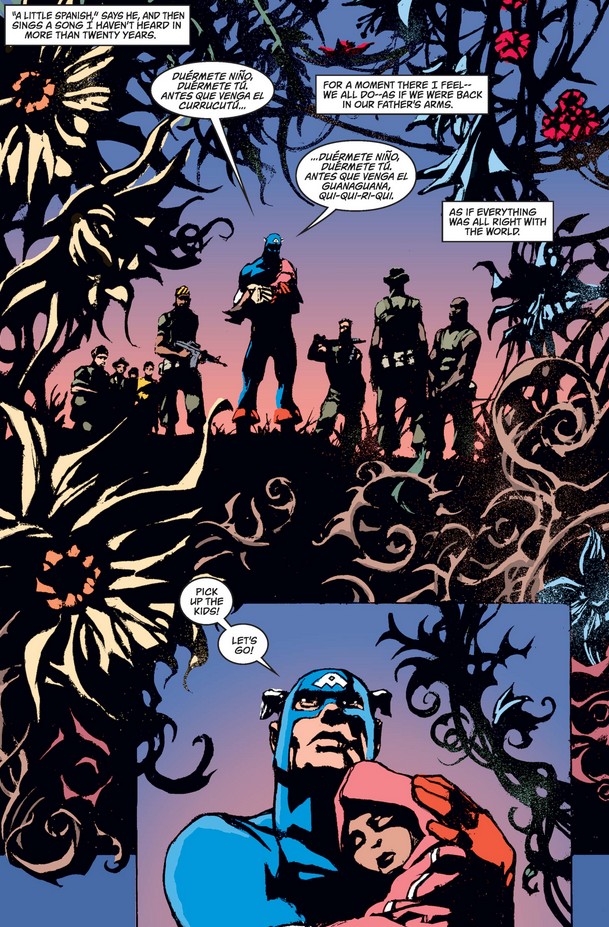
Not only does he speak Spanish, but he turns into Ol’ Blue Eyes (or maybe Nat King Cole) and sings a Colombian lullaby before leading the troops onward, calming the children and even summoning a little optimism from Solo.
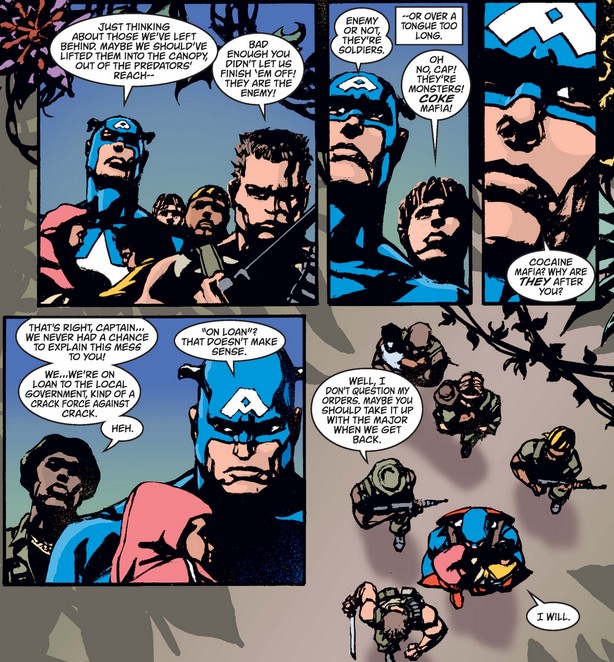
After the men subdue an armed ambush, Cap is concerned about the survival of their attackers left unconscious in the jungle, a compassion his compatriots do not share, but which leads to more details about their mission.
As they near the convent, Cap turns his attention to the children…
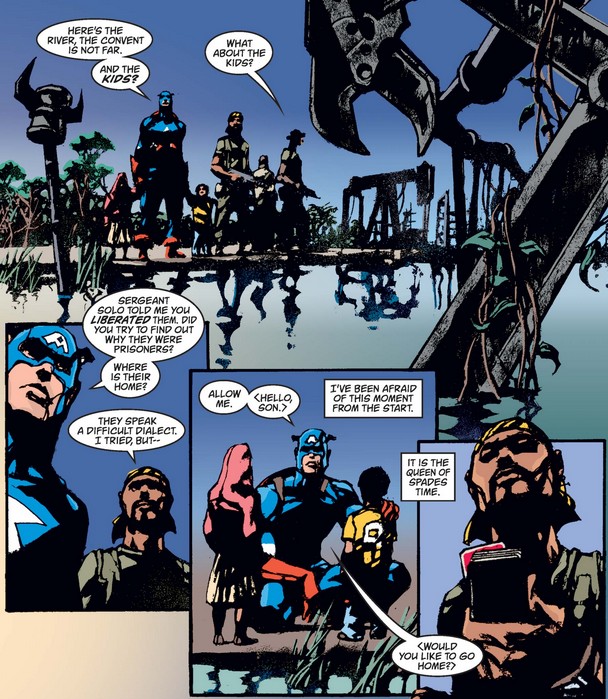
…just before a helicopter descends over them and demands the kids be returned (with one of them saying “Papa?!”). A shootout ensues, and after Cap takes a bullet in the shoulder, the man they call Hulk—presumably because he only grunts, never speaks—throws the shield into the chopper, causing it to crash and explode.
Afterwards, Cap tries to figure out what’s going on when Solo gives him a shot that is more than promised…
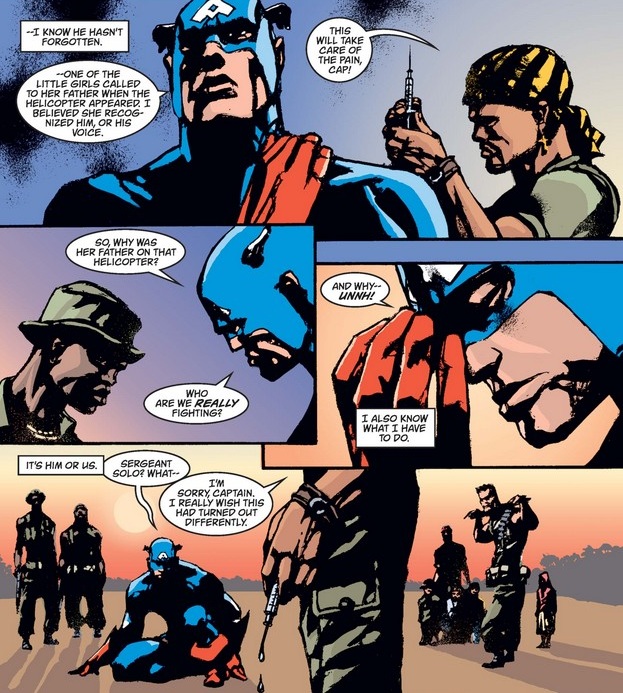
…amidst his ominous narration.
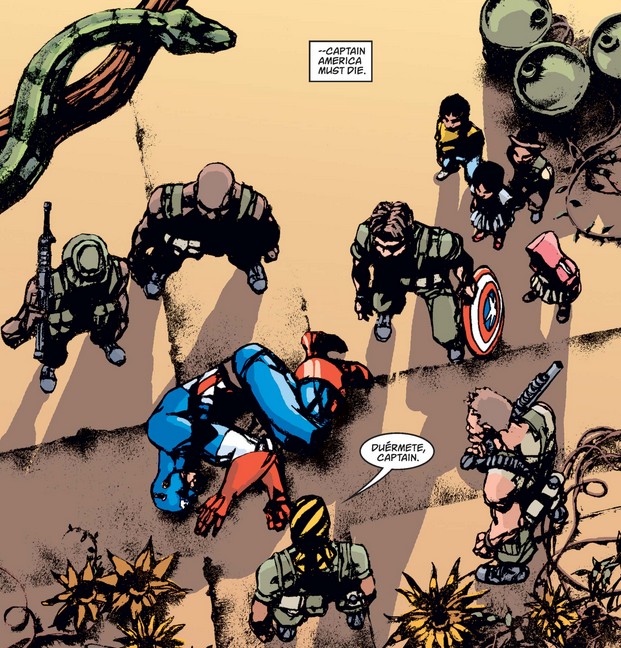
Issue #2 opens with the group arriving at the convent with a makeshift stretcher holding Cap, whom the sister greeting them recognizes, remembers, and appreciates as “a good man” and “a man of God.”
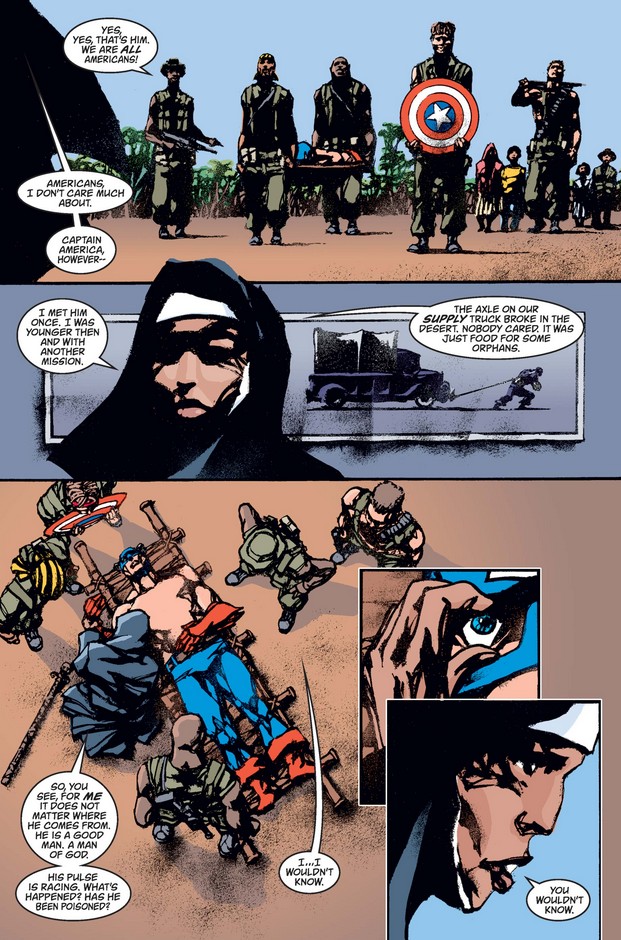
After his men kill the convent’s guards, Lieutenant David holds the sister at gunpoint to gain access, with only Nystrom, symbolically clinging to Cap’s shield and asking what he would do, while David reveals he’s only keeping Cap alive for strategic value.
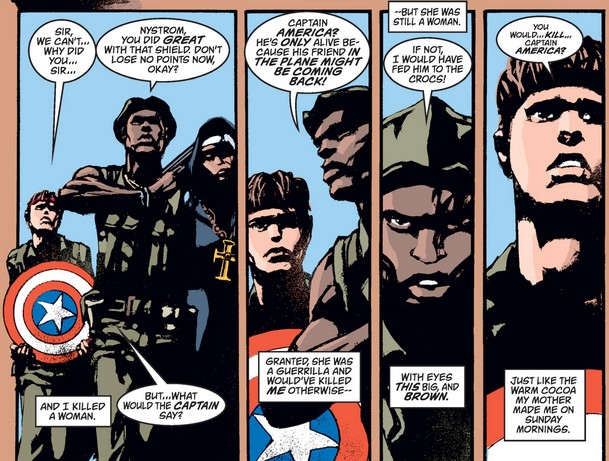
While Cap flirts with consciousness, Nystrom begs David to stop, but the lieutenant only reminds the younger man who’s in command and suggests an order…
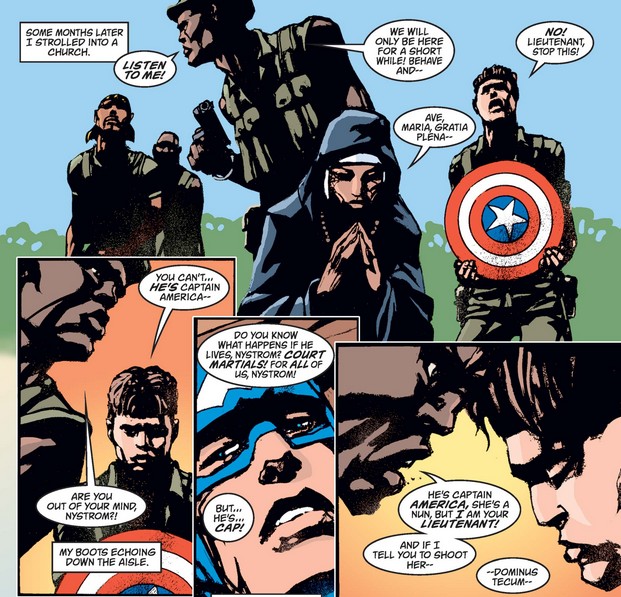
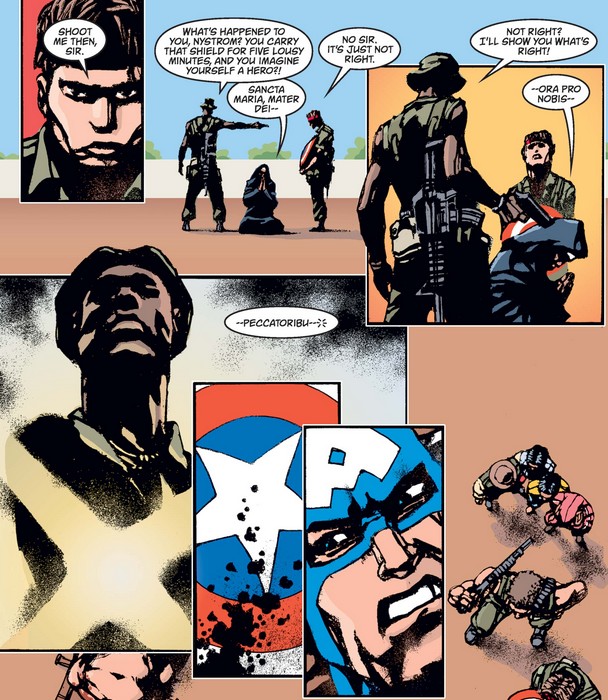
…that Nystrom finds unacceptable and holds firm in what’s right, as his hero would do. David kills the sister anyway, and unfortunately Cap is awake to witness it.
After the men settle into the convent, Private Sore stands over Cap and recounts his great-grandfather’s World War II stories about the super-soldier…
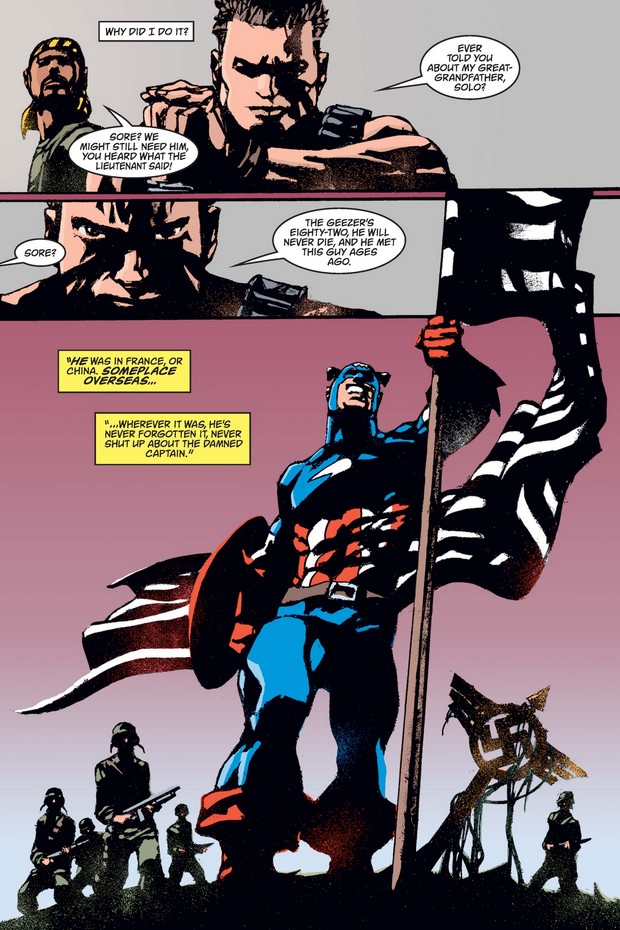
…and how he expected his great-grandson to emulate him, but using methods contrary to what Cap stands for.
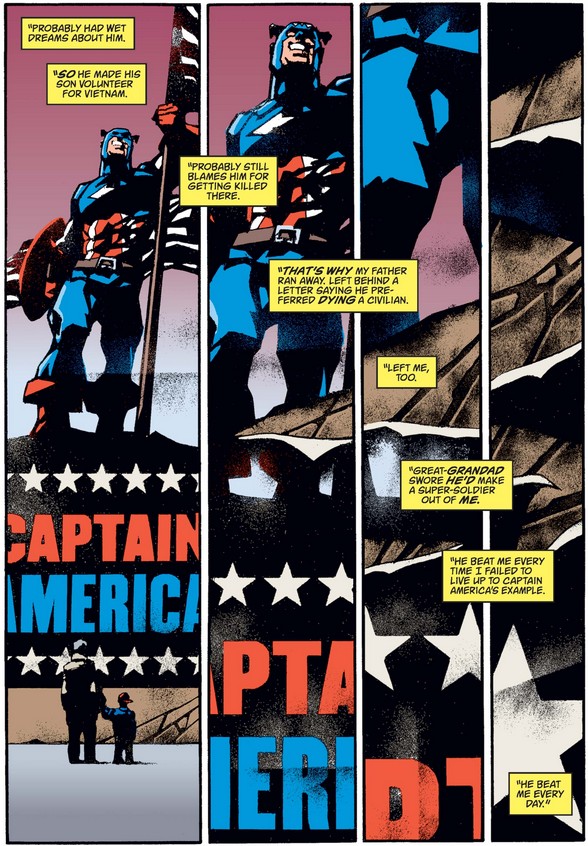
As a result, Sore grew to resent the man his great-grandfather held up as an unattainable ideal of martial perfection rather than a moral exemplar, and now he takes the chance to work out his anger.
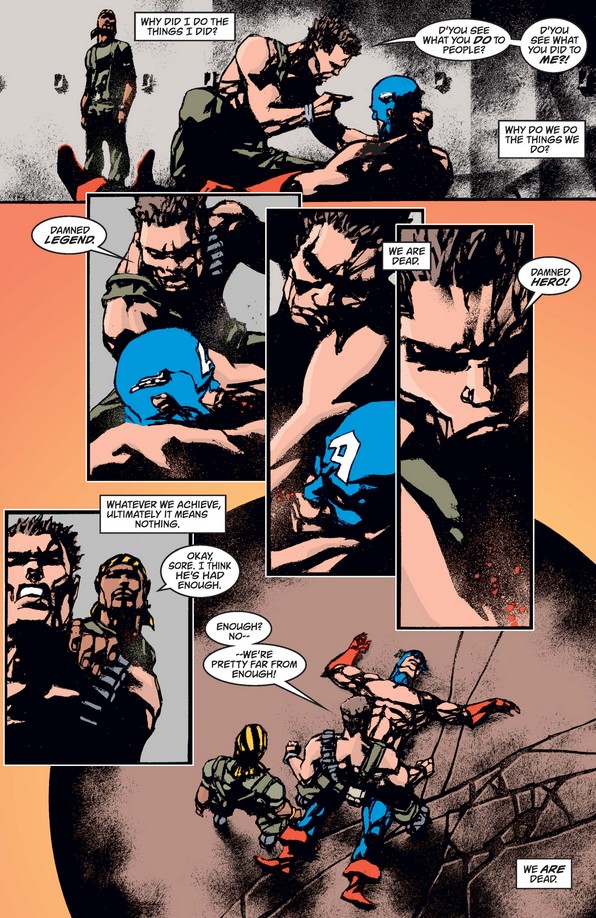
As Sore pursues gratification, he removes Cap’s cowl and sees a “pretty boy” underneath, assumes he’s wealthy with loving family, and claims his own background condemned him to his current fate.
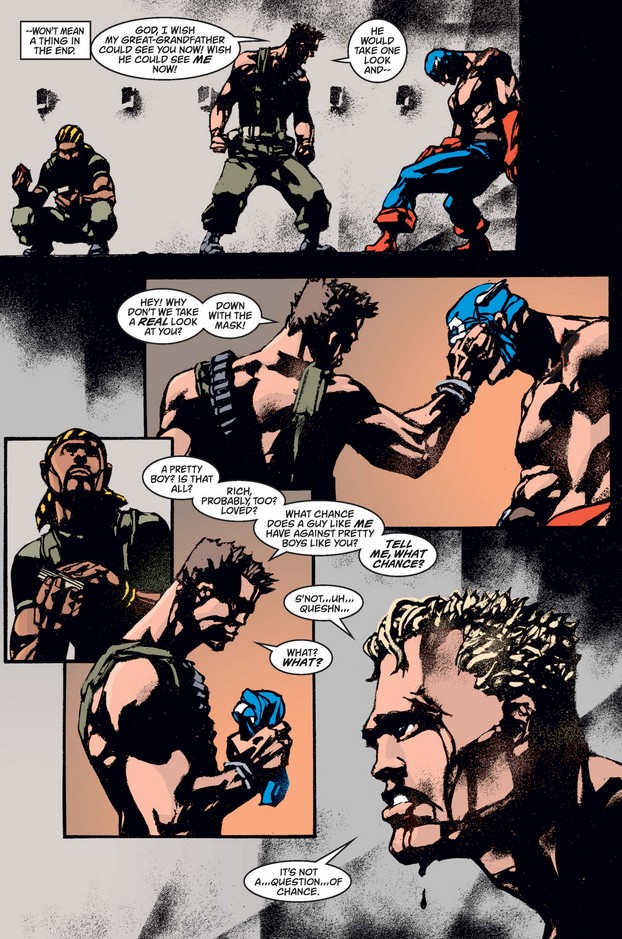
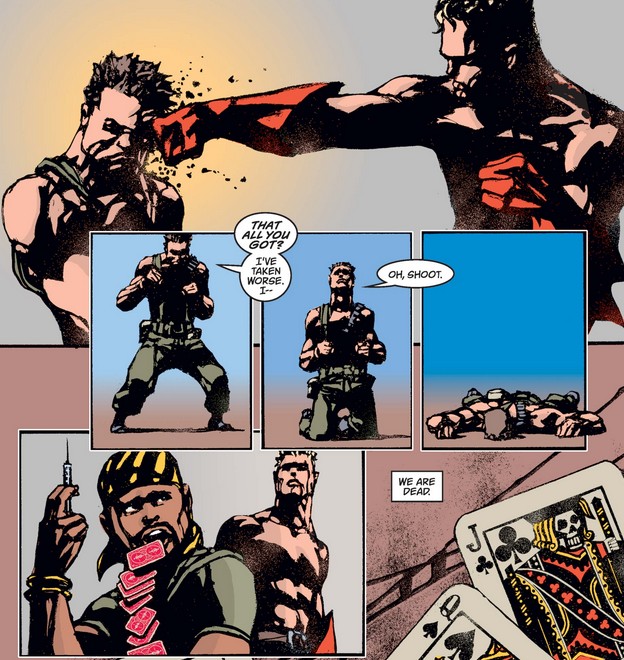
But Cap disagrees, saying that regardless of how we began, we always have the choice to be better. Sore takes it badly, and throws a punch…
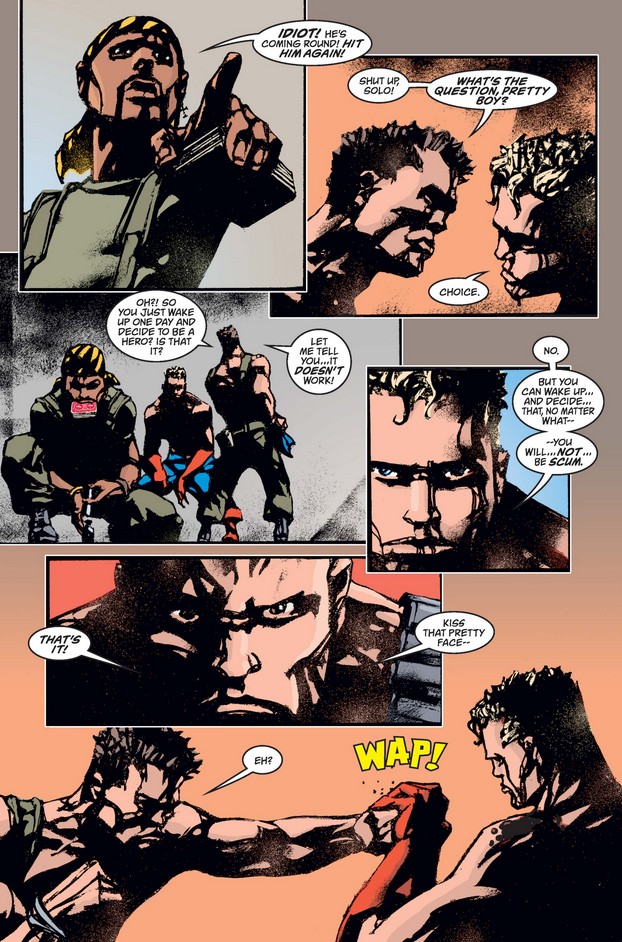
…which Cap returns to much more effect.
The issue ends with two fighter jets firing missiles into the convent as Lieutenant David holds the shield in front of him, and as issue #3 opens we see him knocked on his back, his bones shattered by the blast and his head impaled by the shield. Solo pulls it out and starts away with it, but someone calls out from behind him.
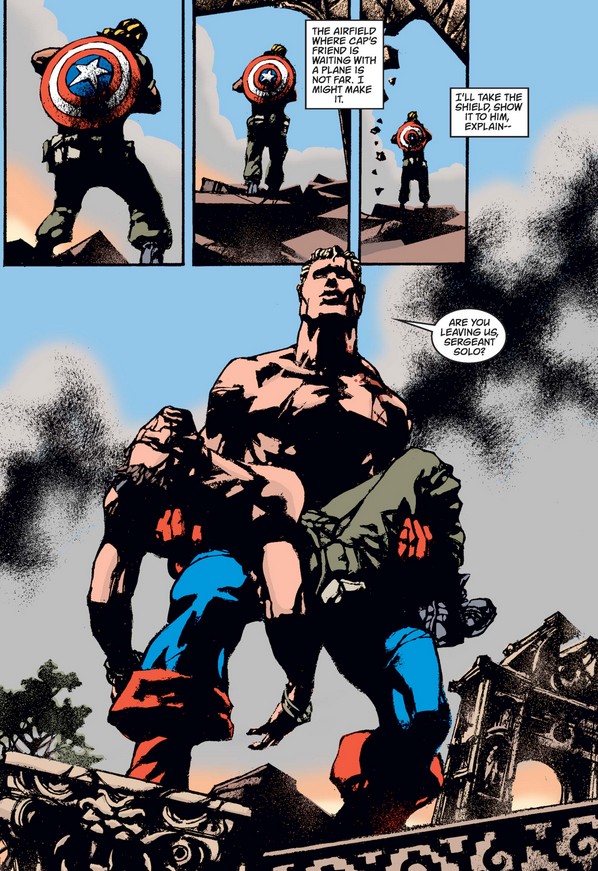
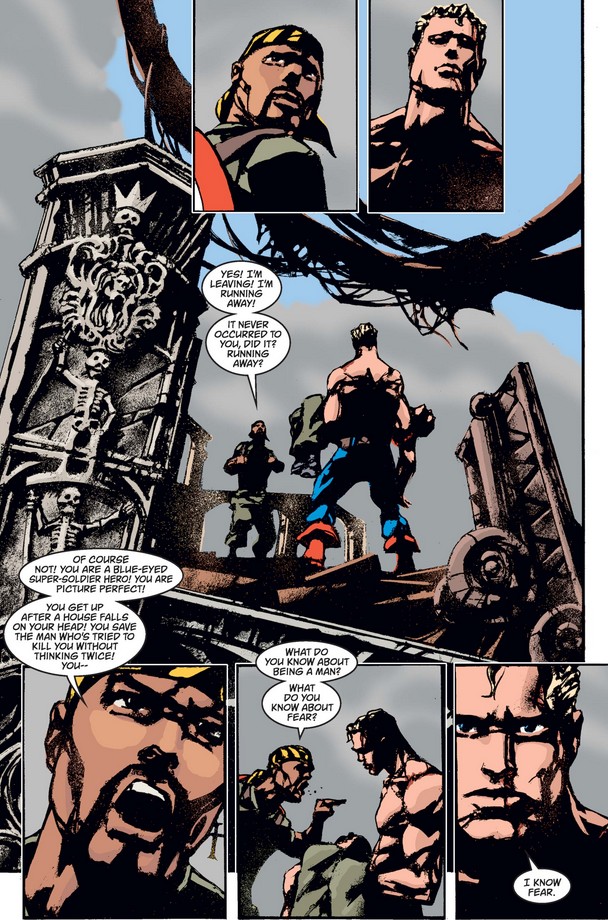
Solo confronts Cap, accusing him of being perfect and not knowing fear—or what it means to be a man, by which I assume he means a person with flaws and doubts, as opposed to a symbol of human perfection.
Cap teaches Solo the Stoic point that, although you don’t need to deny your fears, you can’t let them have too much influence over your actions. Then he shares his greatest fear and how he acts nonetheless, but Solo isn’t having it.
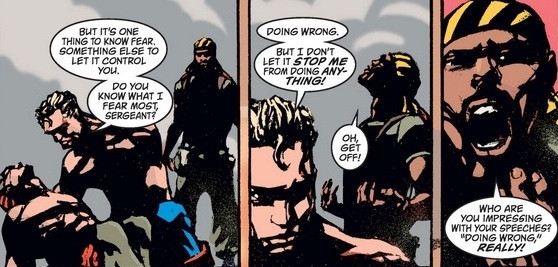
He pulls out the old canard about the world not being black-and-white any more, but hard and dark and complex, and now it’s Cap’s turn to push back.
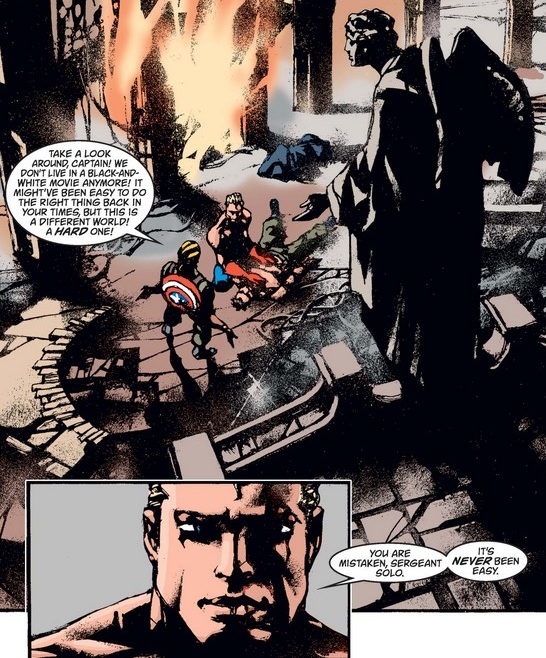
Cap explains that the world has always been full of horrors, especially in war, and even among those widely believed to be the “good guys.” He finishes in a Kantian mood by asserting each person’s duty and responsibility to make their own choices (in the name of autonomy), to make the right decision and do the right thing, no matter what anyone else does.
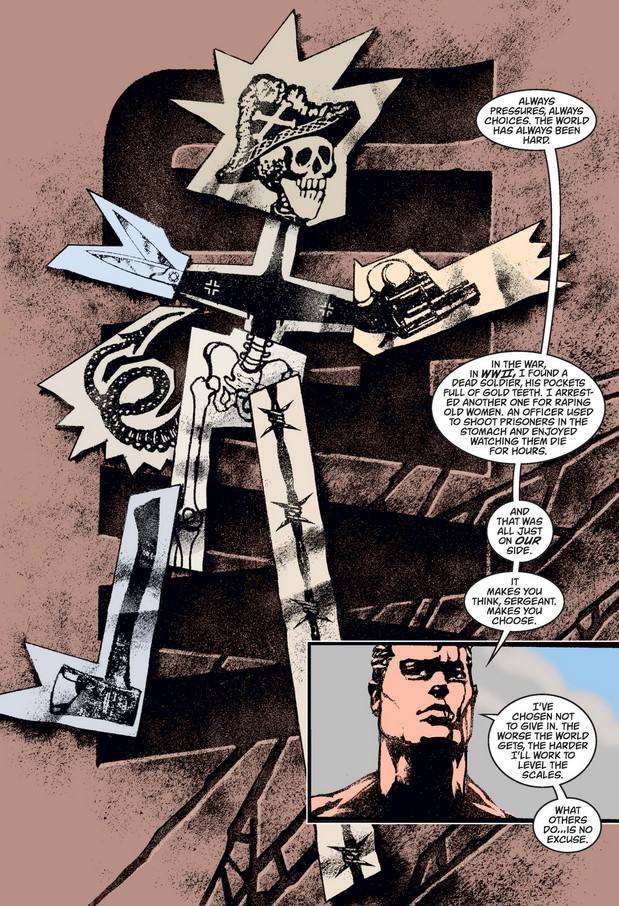
Without speaking, Solo shows he understands, that even claiming they’re all dead and the game is almost over doesn’t mean you shouldn’t do the right thing with the last chance you have left.
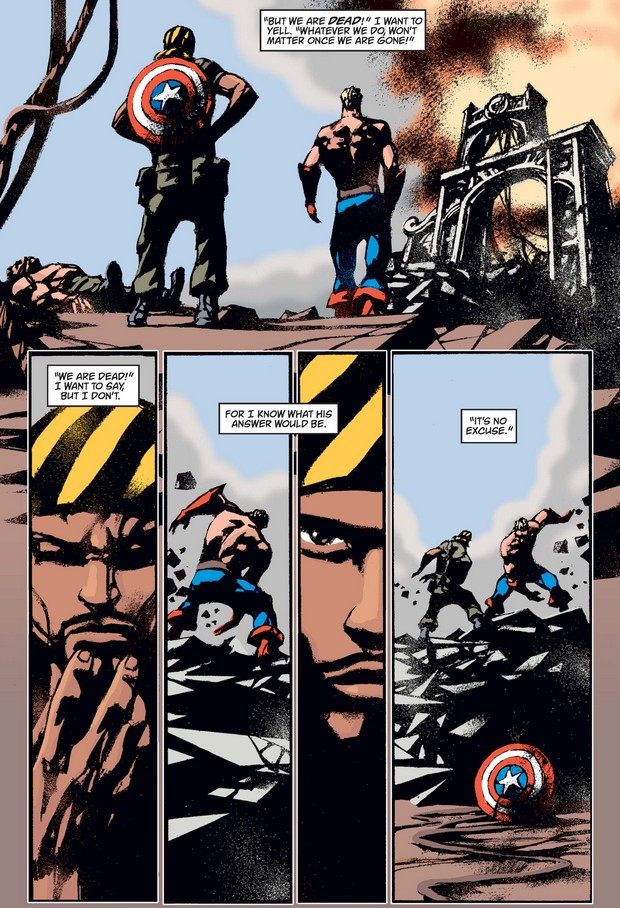
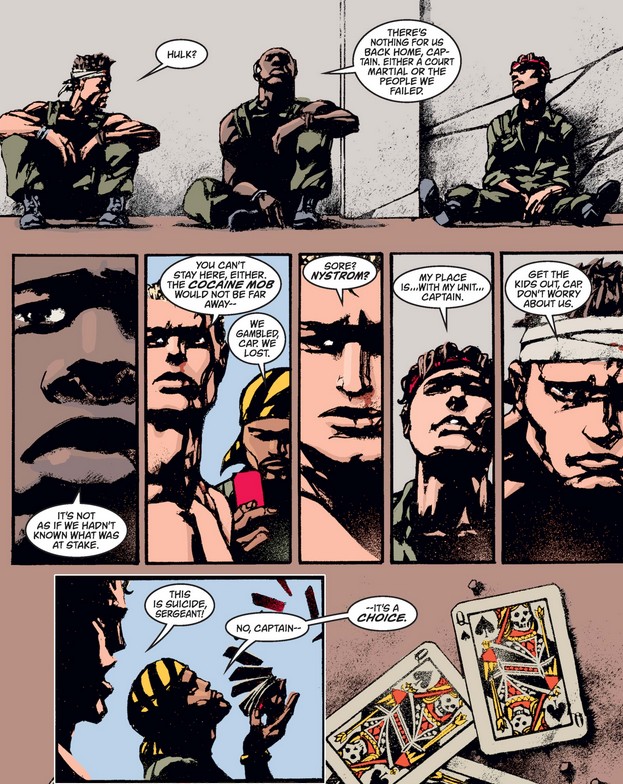
The men and children reconvene to consider their next step, with Cap recommending they all try to make it to the airfield and his awaiting friend, but Hulk speaks his first real word of the story.
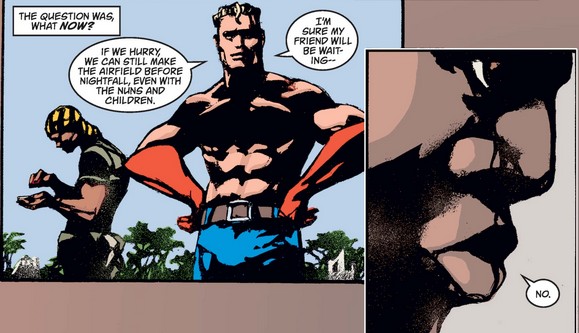
He references their mission on behalf of a corrupt Major Buxley, which they all accepted freely, and then they all agree to stay and face the consequences while Cap gets the kids and nuns to safety. When Cap reveals what this means for them, Solo shows he heard Cap’s words earlier.
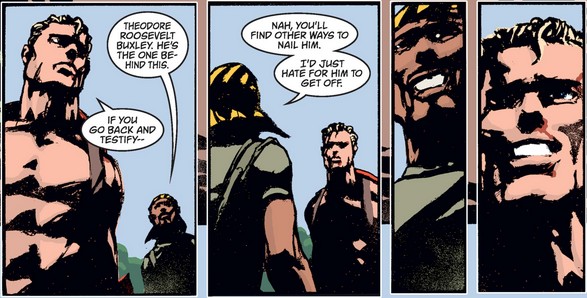
Before Cap leaves, Solo tells him the major’s full name, trusts him to hold him to account, and offers a smile. Cap returns the gesture in the spirit of recognizing honorable behavior, which he never doubted was possible even in a “dark and complex” world.
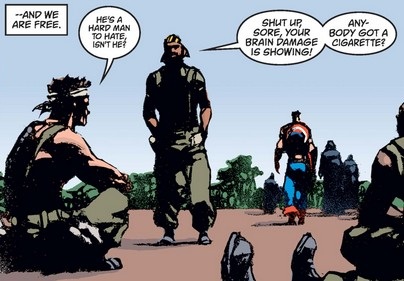
Even Sore has to admit that Cap has grown on him…
…to the extent that when they are confronted by their enemies, he pulls on Cap’s cowl and honors his great-grandfather’s wish.
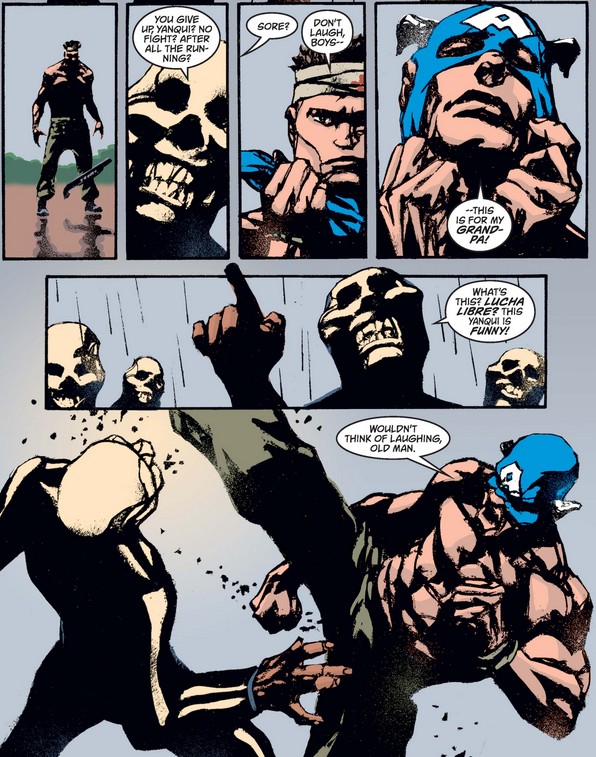
When he finally falls, Cap seems to know, and silently pays tribute before boarding the plane home…
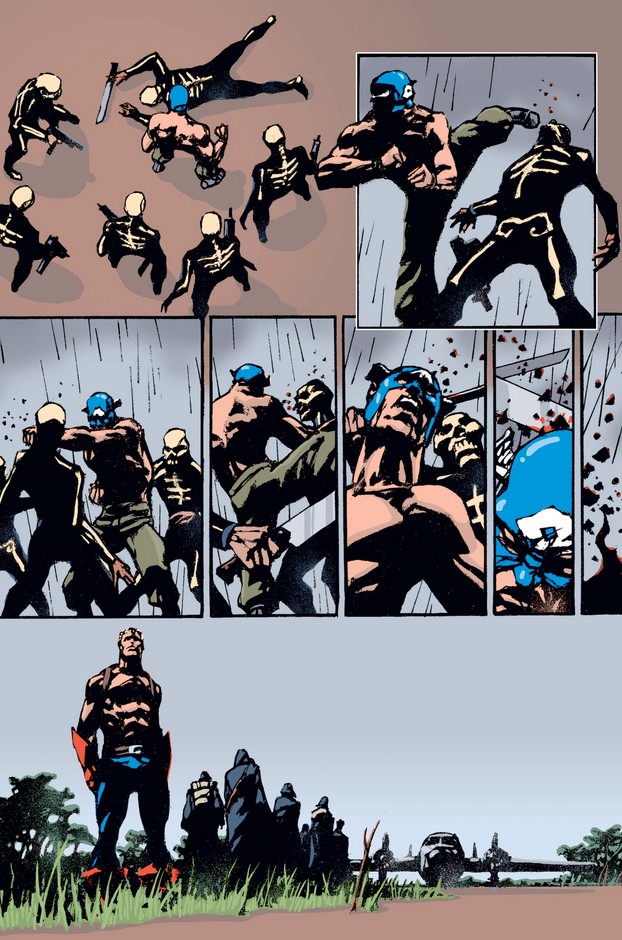
…to confront the horrors of September 11, 2001, more substantively than he did here, in the first issue of volume 4 of Captain America.
ISSUE DETAILS
Captain America: Dead Men Running #1, March 2002: Darko Macan (writer), Danijel Zezelj (pencils and inks), Matt Madden (colors), Todd Klein (letters). (More details at Marvel Database.)
Captain America: Dead Men Running #2, April 2002: Darko Macan (writer), Danijel Zezelj (pencils and inks), Matt Madden (colors), Todd Klein (letters). (More details at Marvel Database.)
Captain America: Dead Men Running #3, May 2002: Darko Macan (writer), Danijel Zezelj (pencils and inks), Matt Madden (colors), Todd Klein (letters). (More details at Marvel Database.)
Not yet collected.
ALSO THESE MONTHS: Avengers #50 (March 2002), Alias #5 (March 2002), Avengers #52 and Tigra #1 (May 2002), and The Order #2 (May 2002)
 THE VIRTUES OF CAPTAIN AMERICA
Leave a comment