 After over 500 posts, I finally get to write about Captain America #1, thanks to the “Heroes Reborn” reboot that gave us new volumes of this title, Avengers, Iron Man, and Fantastic Four. (You’ll no doubt remember that the first volume of Captain America began with #100 in April 1968, continuing the numbering of Tales of Suspense.) These runs only last a little over a year, and after the first issues of Captain America and Avengers, I will cover them mostly in batches, focusing on how Captain America is portrayed within, and not on the myriad other differences between this new reality and our familiar 616 universe.
I’ll spend even less time on the behind-the-scenes drama of how the Image creators, who stormed out of Marvel just a couple years prior, ended up helming four of their biggest titles… until they didn’t. For this, see the resources at the end of the Onslaught: Marvel Universe #1 post, as well as the relevant parts of these two documentaries: Sequart’s “The Image Revolution” and episode 6 of “Robert Kirkman’s Secret History of Comics.” (Full disclosure: I appear briefly in episode 4 of the latter, providing the background for “Civil War.”)
Speaking of Onslaught: Marvel Universe #1, recall that Cap, the Falcon, and most of the rest of the Avengers (Thor, Giant-Man, Wasp, Hawkeye, Scarlet Witch, and Vision), along with the Fantastic Four, Bruce Banner, and Doctor Doom, flew or ran into Onslaught’s energy field before it was destroyed by the X-Men, after which they were presumed dead. In actuality, they were “reborn” in a new reality, later revealed to have been created by Franklin Richards to save his parents and the other heroes from death. (Hence all the focus on him and his shiny new ball at the end.) True to the concept of rebirth, the heroes do not remember their past lives, they are much younger, and their histories and status quo were changed. (Janet van Dyne is even human again, as shown in the upcoming Avengers #1, while Tony Stark is an adult again, albeit younger than he was when he died in Avengers #395.)
What about Cap? The issue opens with noble images of our hero in action, with narration from by the Pledge of Allegiance, which culminates in the shot below, highlighting the most significant departure from the classic costume: the eagle replacing the “A” on his forehead.

(His cowl also has curves or points under his eyes or on his cheekbones, like a certain caped crusader—this is prominent in the next image.)
But we soon learn these scenes are in one man’s head… a man who has no waking memories of any of this.

Instead, Steve Rogers is enjoying a quiet family life in Philadelphia with wife Peggy and son Ricky. (Yes, his name is Ricky Rogers.)

Based both on Peggy’s joke above and Steve’s later comments to his work friend Nathan, he is very much the optimistic patriot—but when he mentions his dreams to Nathan, his “work friend” makes a mysterious call, reporting “a problem” that is followed up on at the end of the issue.
Meanwhile, on the other side of town, we meet a young woman named Rebecca “Rikki” Barnes, who was actually introduced in the Wizard Magazine Heroes Reborn #½ issue as the (new) Bucky in this reality. But for the time being, she is only a frustrated dance student…
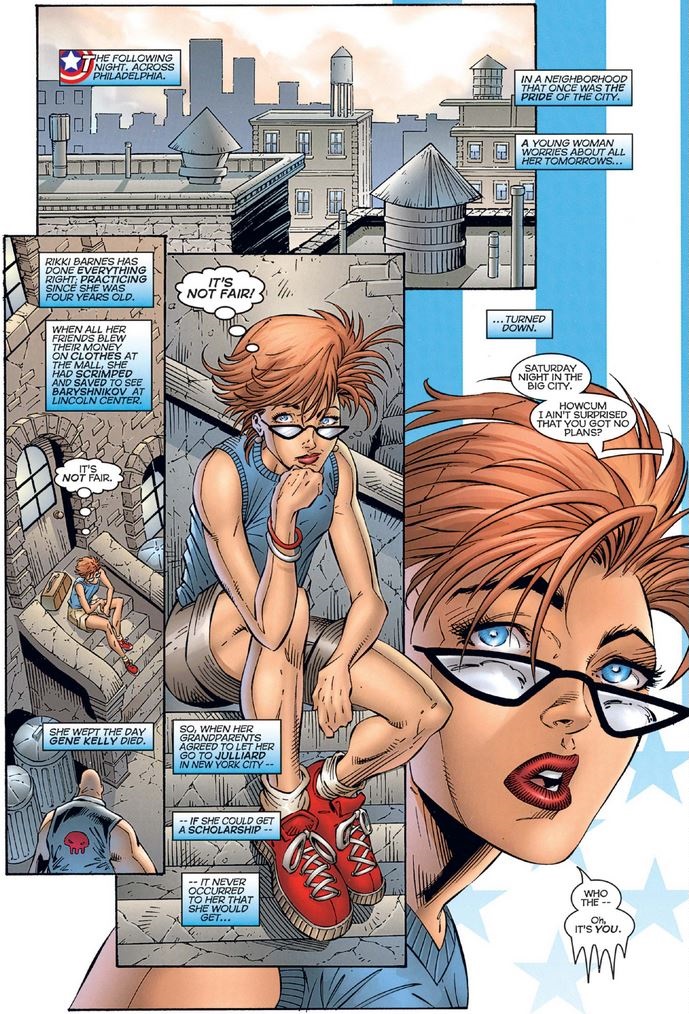
…with a brother John who has joined the World Party, a white supremicist/neo-Nazi group operating in the United States, led by this reality’s version of Master Man.
When Steve goes out for a stroll to think about his strange dreams and his discomfort with hiding them from his wife, he is greeted by an older man he saw earlier, who seems to know him as “Captain” something-or-other…

…but also knows his real name and tells Steve he’s needed again, “more than ever.” As the man leads Steve into an abandoned house, he gives his name as Abe Wilson and implies some involvement with Steve in World War II, which comes as quite a surprise to a Steve Rogers who probably thinks he was born long after V-Day.

Abe has a surprise for Steve, and says the name “Captain America” for the first time.

As Abe explains how he found the shield in Berlin and took it, hiding it for the day its proper wielder would return, World Order agents arrive and fire explosives into the house. But out of the wreckage, a shield rises…
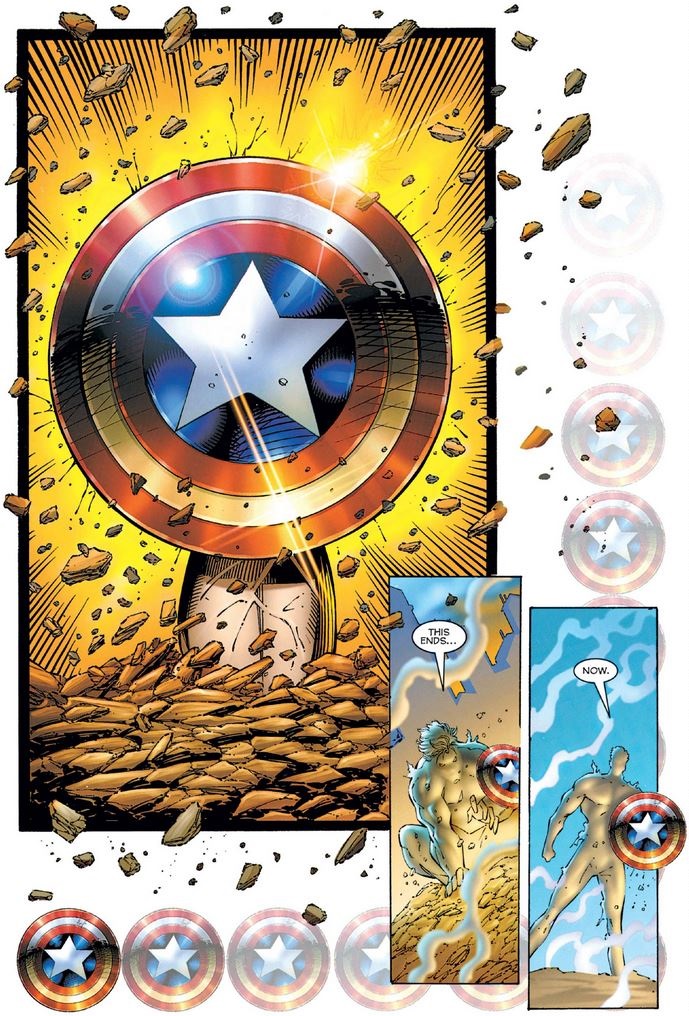
…and Captain America with it.

While he battles the neo-Nazis, Steve speaks eloquently about the duty to stand up and fight for others, which sounds familiar and very welcome.

And then, suggesting that this reality has wildly different laws of physics, he throws the shield vertically. (Just kidding: As I obsessively insist on pointing out, he does this regularly in the 616 universe as well, although less often in recent years.)
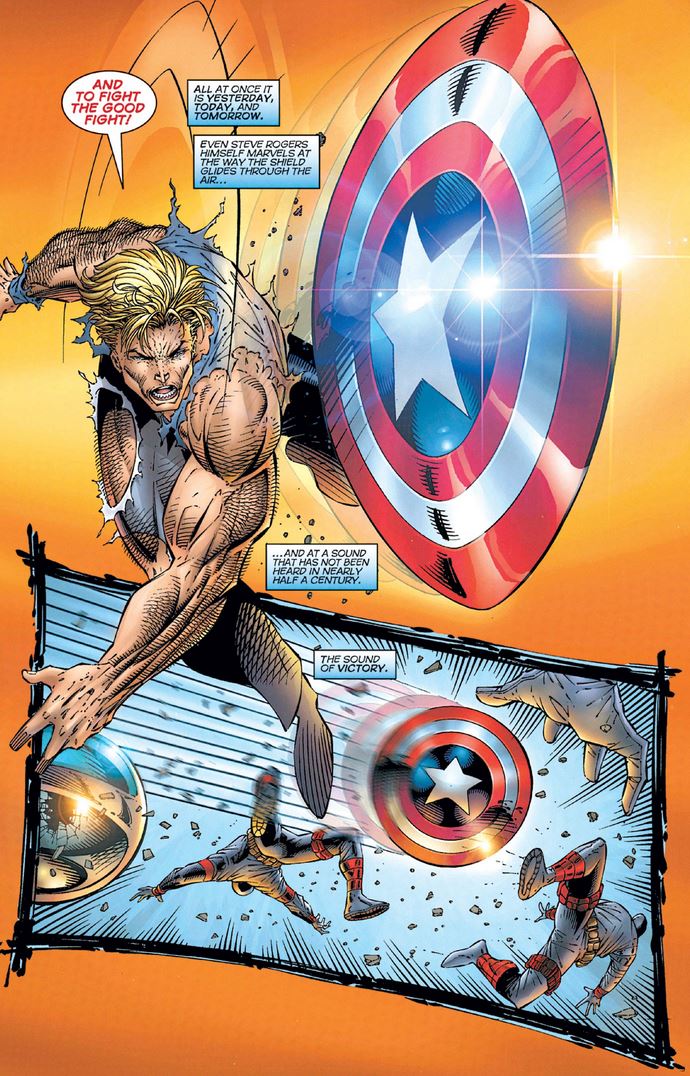
The next two pages continue to verify that, despite his faulty memories and uncertain history in this reality, Steve Rogers still possesses the same virtues that made him a legend in his old one.


At the end of the battle, it seems Captain America is back and all is right with the world…

…except Abe, who with his last breath lets Steve know his wife and son are in danger.

Steve mourns a fallen comrade’s death, which he promises to avenge. (Gee, what a good name for a team…)

The next page features an extreme close-up of Steve’s face, teeth fully gritted, set against a passage from famed jurist Oliver Wendell Holmes, Jr., drawn from an address on May 30, 1884, explaining the importance of Memorial Day and emphasizing the need for commitment, dedication, and resolve—and a touch of faith—when fighting for something you believe in.

In the final pages of the issue, we are introduced to this reality’s versions of Nick Fury, Dum Dum Dugan, and Sharon Carter, who have become aware, thanks to Nathan’s phone call, that “the patriot is awake”—and Fury demands that he be found and brought in, implying that things did not go well the last time they worked together.
There are many more revelations to come in the next issues, four of which will be covered in the next post. (And watch out also for Avengers #1, which was released a couple weeks later in our world but seems to takes place some time later in the story, after Cap has acclimated to his new/old role to some extent.)
ISSUE DETAILS
Captain America (vol. 2) #1, November 1996: Rob Liefeld and Jeph Loeb (writers, with assist from Chuck Dixon), Rob Liefeld (pencils), Jon Sibal (inks), Brian Haberlin and Extreme Color (colors), Richard Starkings and Comicraft’s Dave Lamphear (letters). (More details at Marvel Database.)
Collected in: Heroes Reborn: Captain America.
ALSO THIS MONTH: Avengers #1 (November 1996)
NEXT ISSUES: Captain America #2-5 (December 1996-March 1997)
 THE VIRTUES OF CAPTAIN AMERICA
Leave a comment