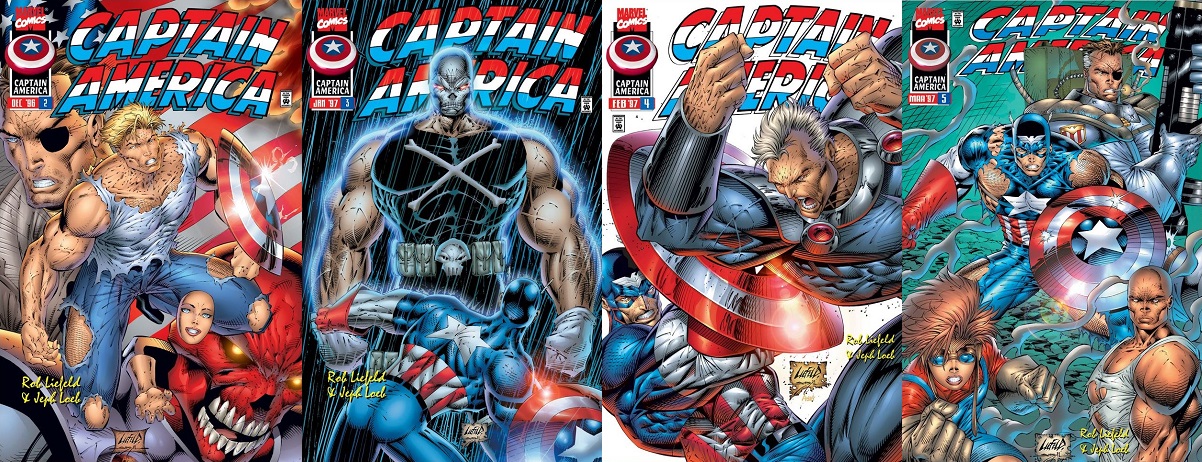
These four issues continue the “Heroes Reborn” run of Captain America, the background of which was reviewed in the post on the first issue. There, following the final battle with Onslaught, we meet Steve Rogers in a new reality, living in Philadelphia with a wife Peggy and a son Rick, and with no memory of having served in World War II as Captain America. An elderly man named Abe Wilson finds him and gives him the shield, after which they are attacked and Abe is killed, using his last breath to tell Steve his family is in danger; meanwhile, SHIELD has become aware that Cap was “woken up,” and are out to find him.
In issue #2, Steve rushes home to find his family there…
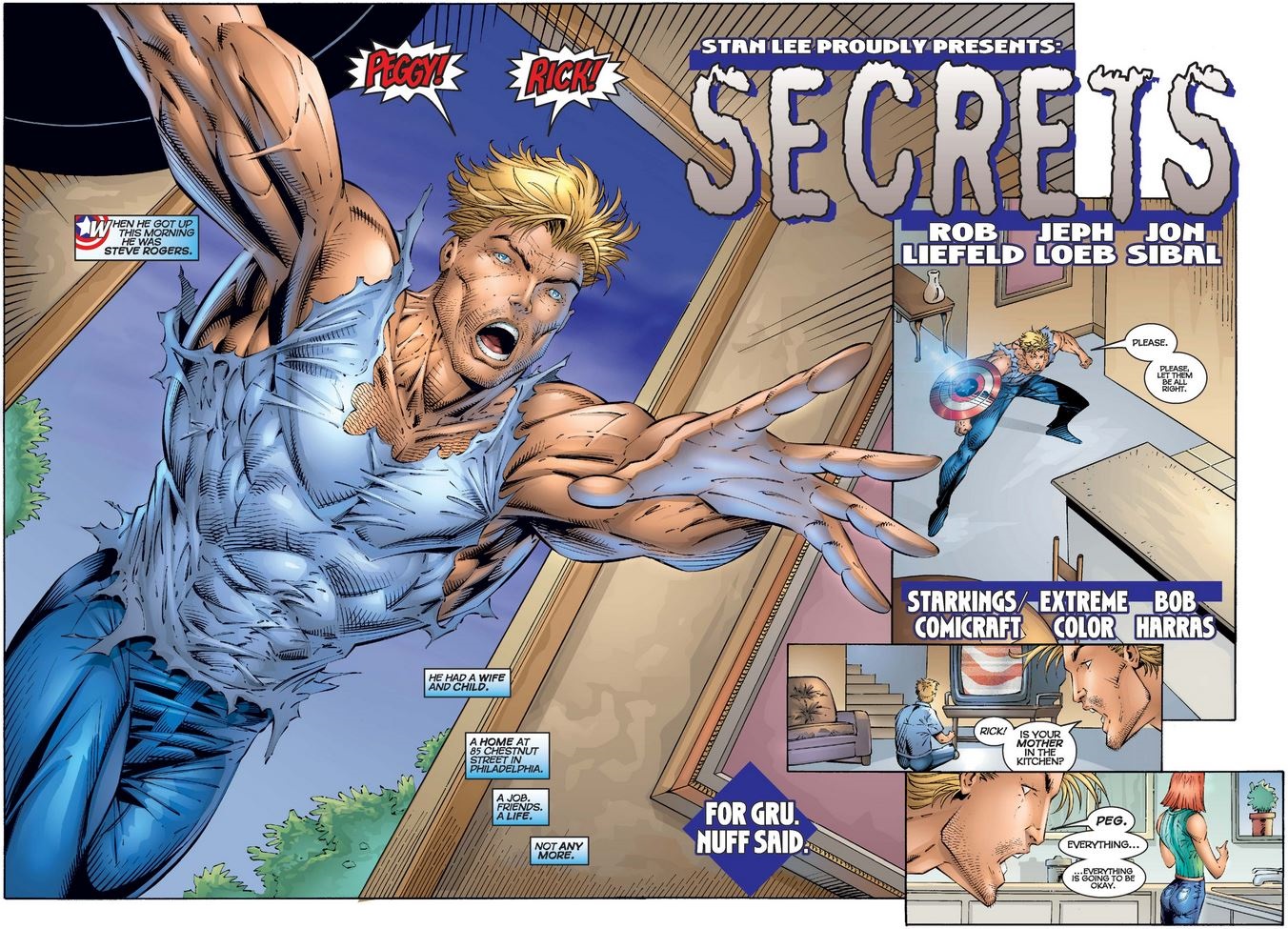
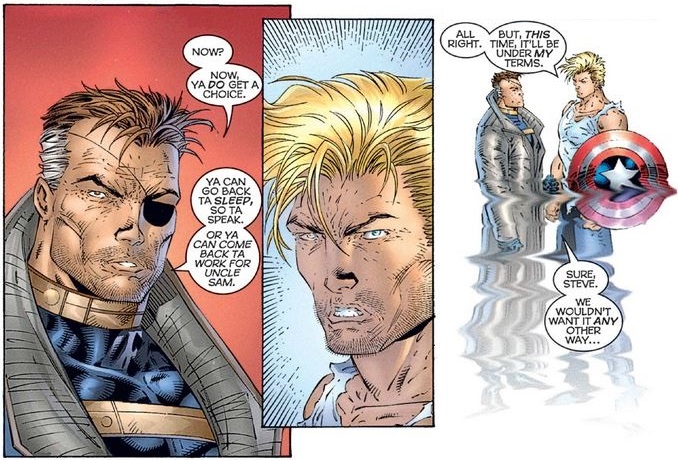
…but apparently frozen, not moving at all. He also finds Nick Fury, reminding him of an oath he took decades before, but Steve knows nothing about either.
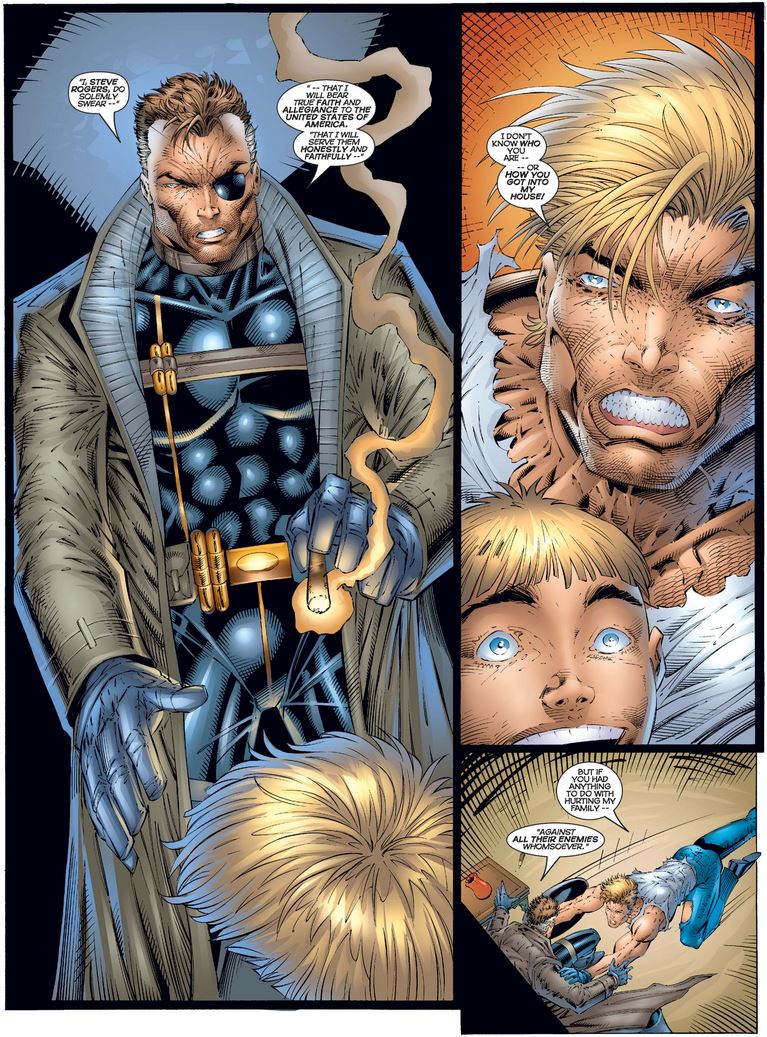
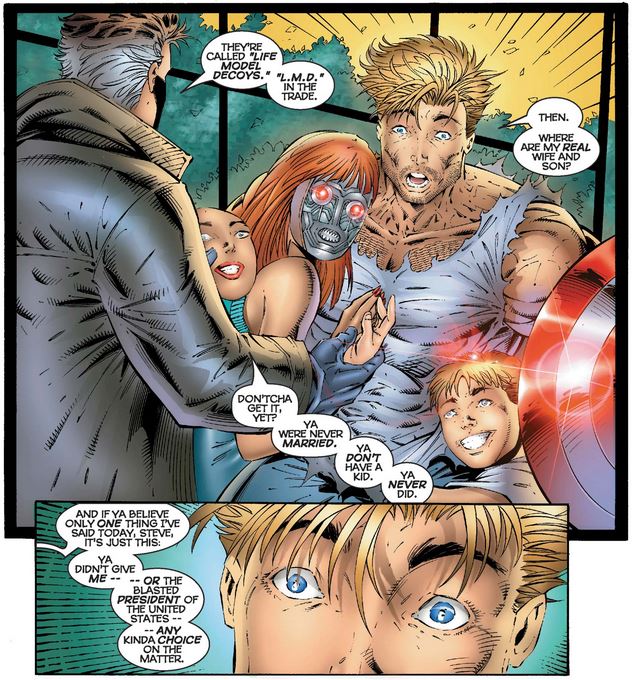
Even though he’s hurt that Steve doesn’t remember him—or maybe because of it—Nick starts to dismantle the life Steve thought he had, starting with the truth about Peggy and Rick, and hinting to a previous incident with a United States president (which is detailed in the next issue).
Before we get to that, though, we have another Wilson to meet, one with a familiar codename.
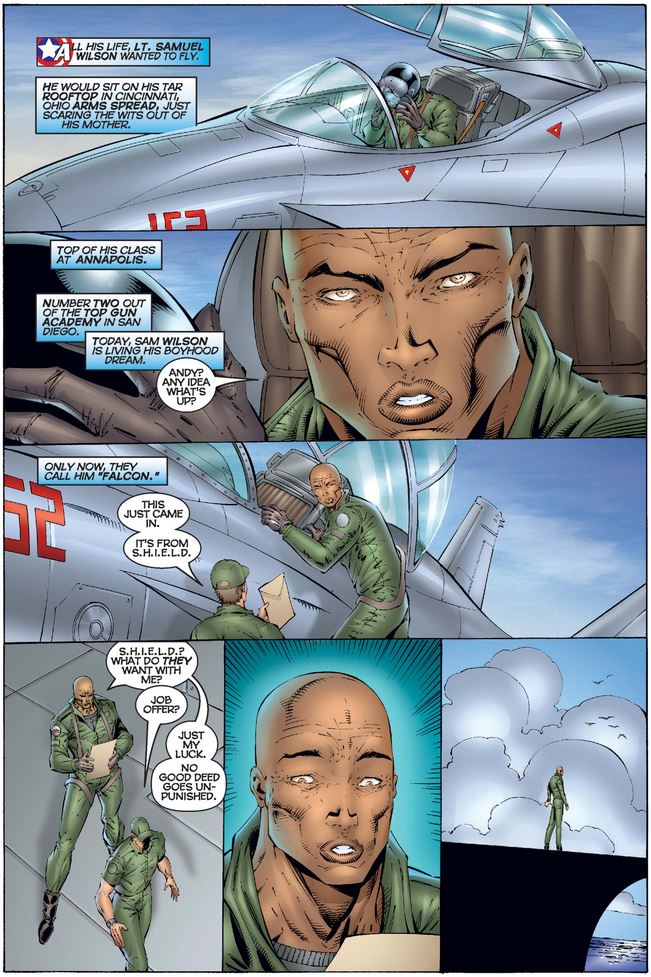
We also learn at the end of this issue that this reality’s version of the Red Skull is behind the World Party, the neo-Nazi organization introduced in the last issue. (We will see him soon.)
In issue #3, Nick tells Cap the full story about him and POTUS, starting with the fact that, in this version of events, Cap survived the end of World War II, after which FDR’s successor, Harry S. Truman, expresses his appreciation for the Sentinel of Liberty, who predictably deflected the praise to those he feels truly deserve it.
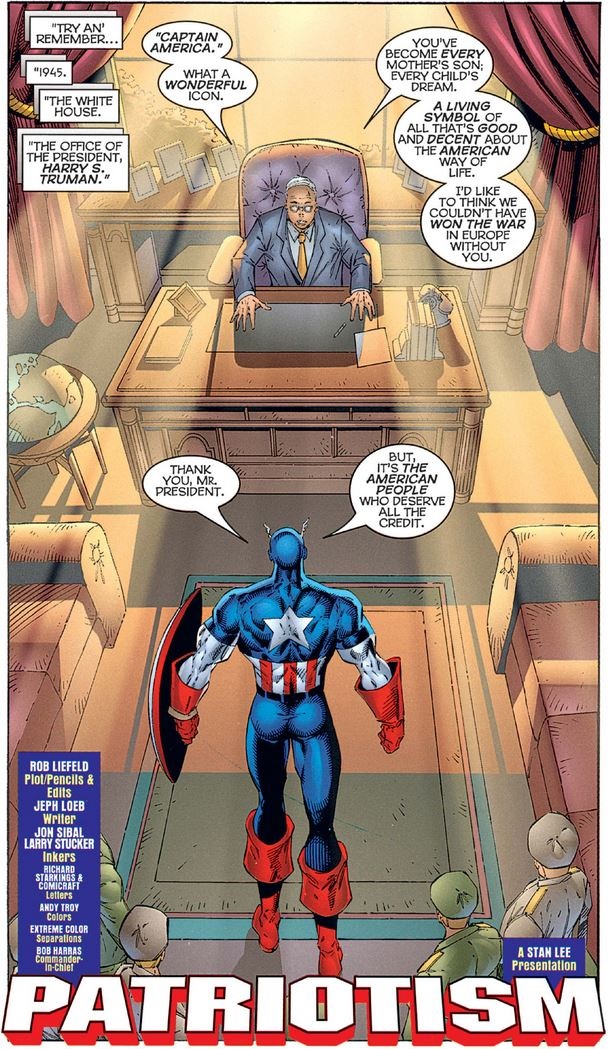
Truman tells Cap about the atomic bomb the United States dropped on Hiroshima on August 6, 1945—thirteen hours ago, as he says below—and the statement he is prepared to issue—which he did, three hours later. But when Truman asks Cap to publicly support this decision, Cap says no (with respect).
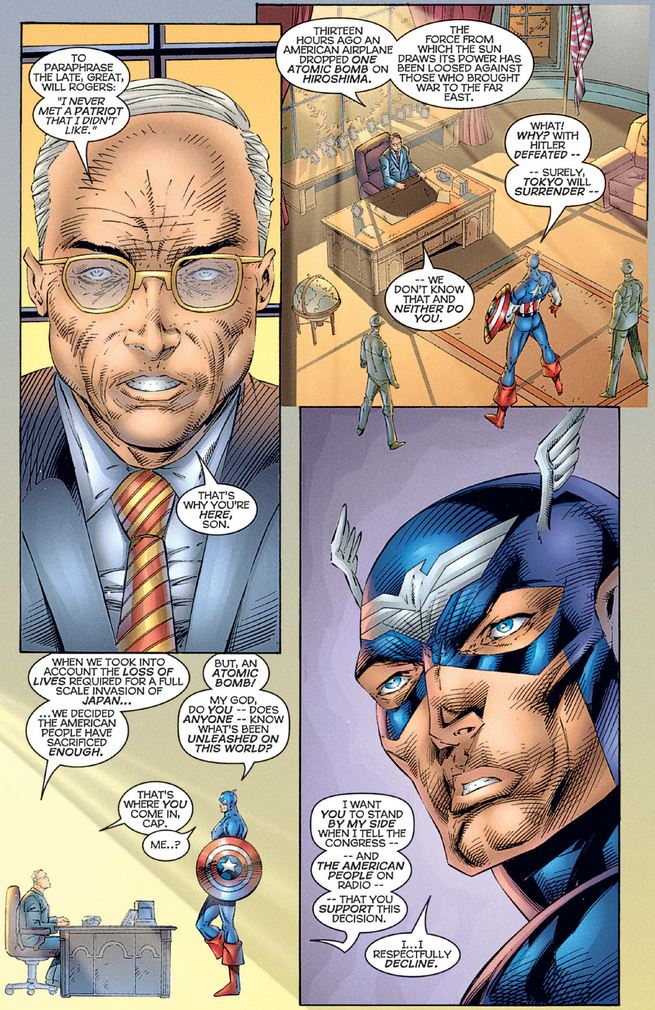
This position is consistent with Punisher – Captain America: Blood and Glory #1 and Daredevil #233, where he alluded to the horrors of that day (and the bombing of Nagasaki several days later), neither of which he witnessed in the standard version of events, having “died” several months earlier, but about which he still felt intense regret and sadness. (His discomfort was also clear when he traveled back in time to witness the first test of the atomic bomb in Bicentennial Battles — thanks to loyal reader Chris for the reminder!)
Here, though, Cap focuses more on issues of conscience and free speech, reaffirming that he does not support this action and will not speak in favor it, without suggesting that he will come out publicly against it either (although he does hint toward “consequences,” whatever they might be).
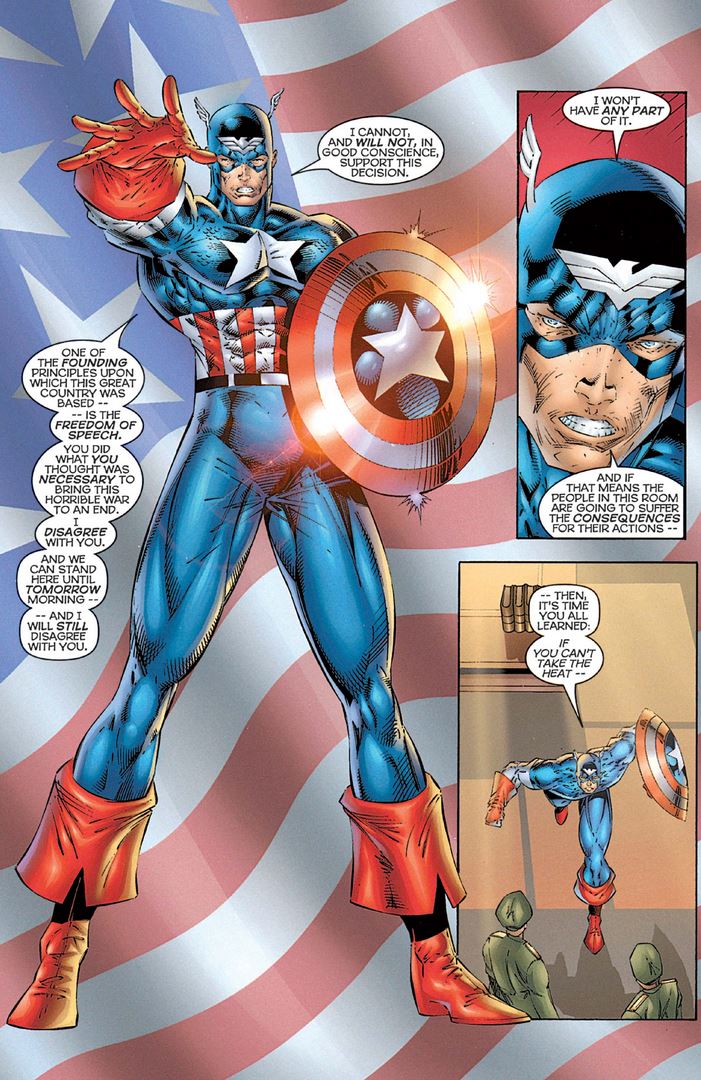
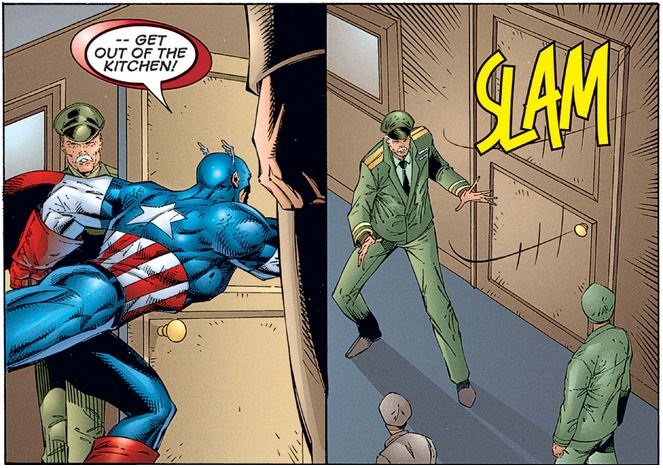
(I don’t think that last part came off as dramatic as he hoped.)
After Cap stormed out, General Ross (yes, that Ross) introduces the president to a young Sergeant Nicholas Fury, head of a new secret task force named SHIELD, who promises to make the Cap problem go away: putting him on ice metaphorically speaking, taking him out of the box from time to time when they needed him, and also assigning him to various civilian roles. (We don’t need the snark, Nick!)
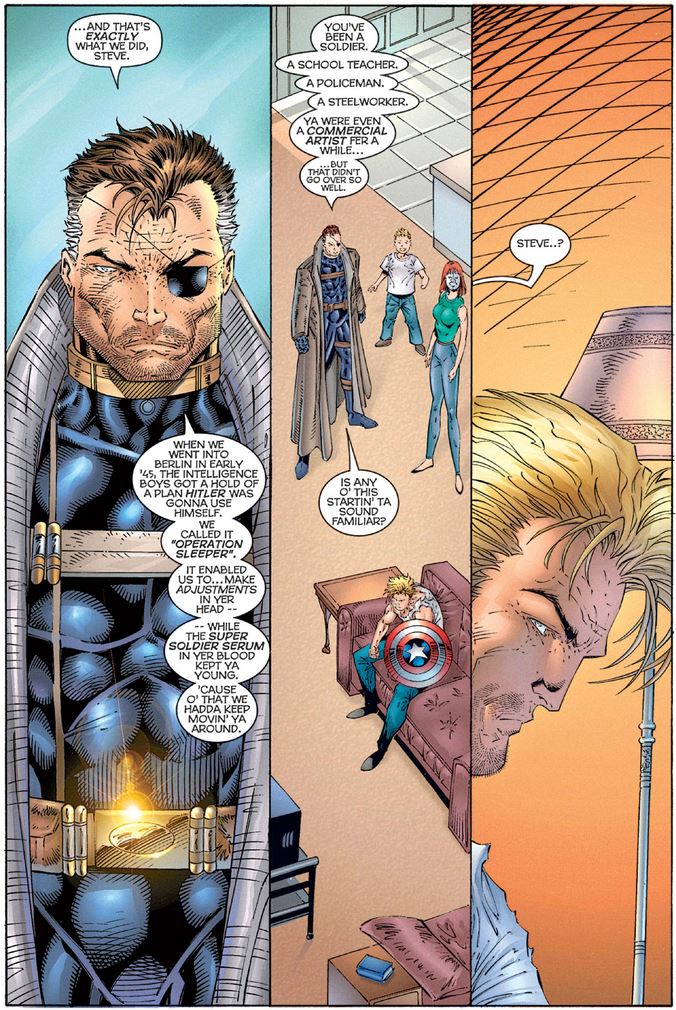
Naturally, Cap doesn’t take this news very well, and when Nick offers a feeble excuse for what he did, Cap throws it back in his face.
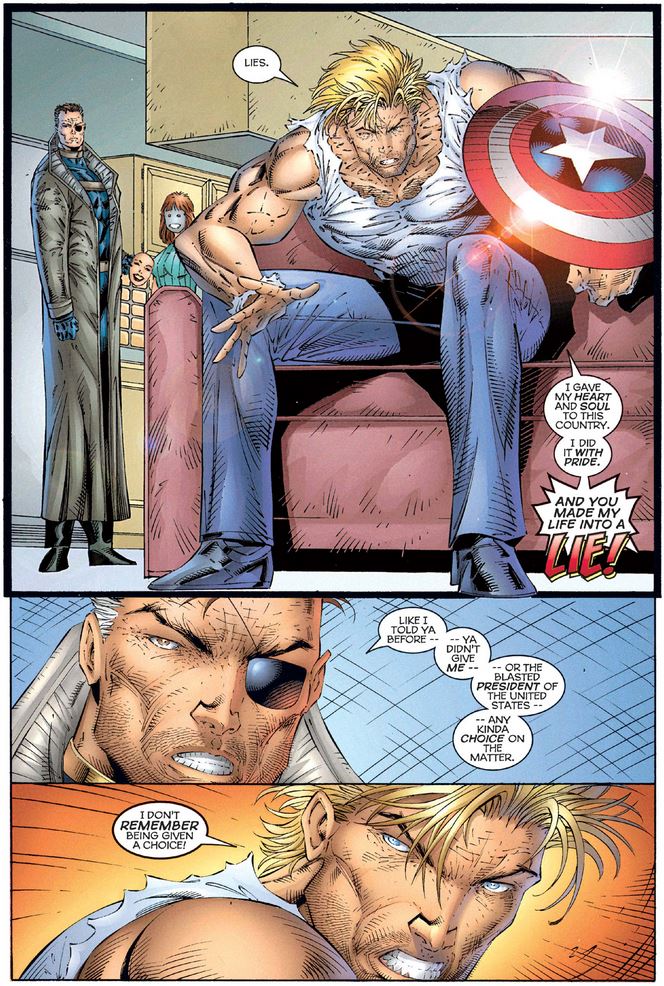
So Nick plays the “it was different time” card, echoing the president’s argument, but once again Cap has the perfect comeback, showing that he will always side with the American people over the American president when he thinks the latter is wrong.
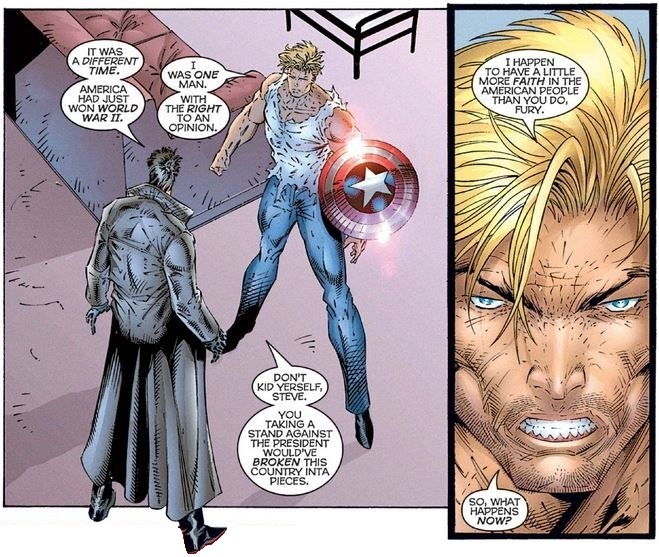
Nonetheless, Cap does re-up, noting that he will not necessarily follow orders—which I suspect Nick disregards, despite his halfhearted agreement.
After he is transported to the helicarrier and meets this reality’s versions of Sharon Carter and Dum-Dum Dugan, neither of whom he has apparently met before (or at least does not remember), Cap receives a new outfit, which he puts on after a shower while realizing this is a beginning of a new life (as far as he remembers).
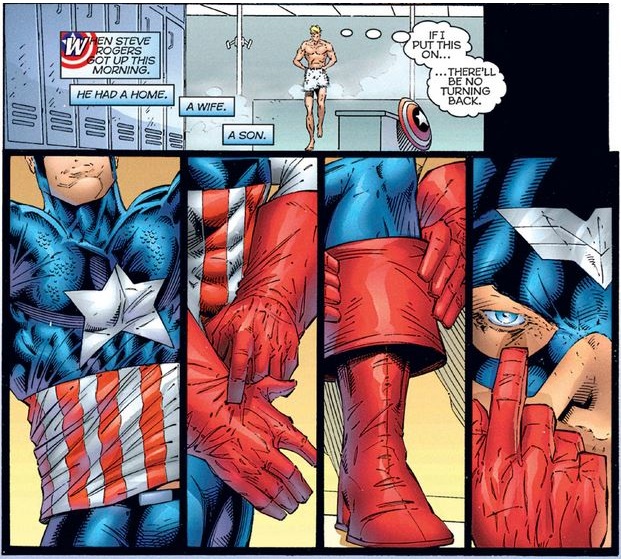
(His top isn’t very long—how does it stay tucked in when he raises his arms? And I realize he’s pulling the mask part of his cowl down in the last panel, but it looks like he’s putting in a contact lens, ha.)
The result is this striking image of a once-again reborn Captain America…
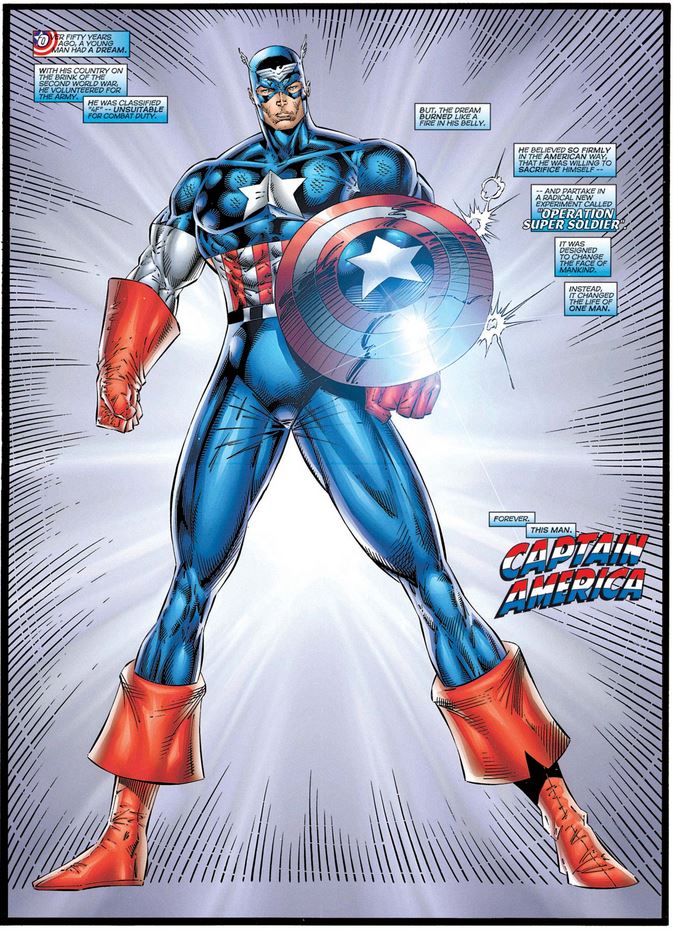
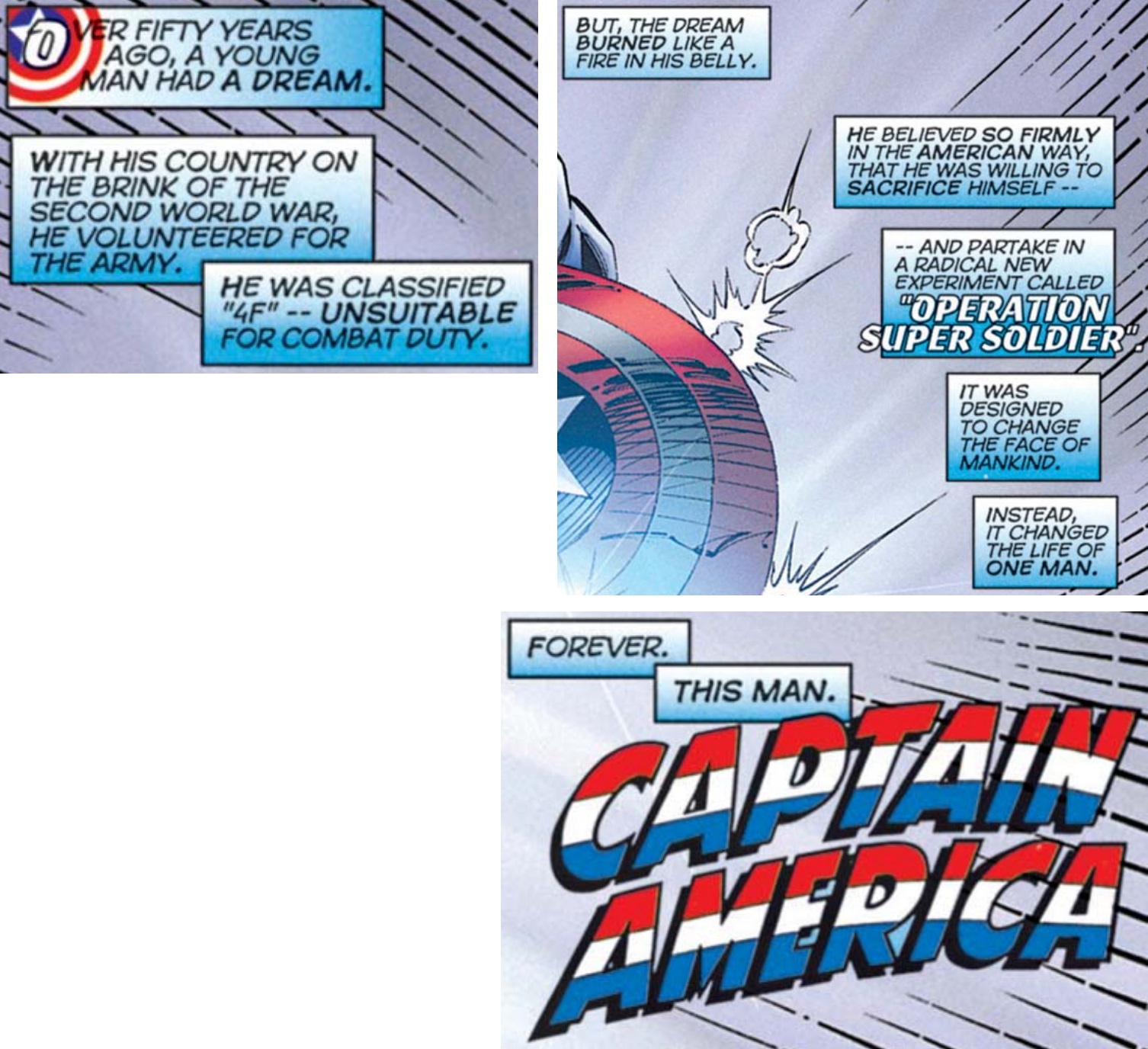
…with the text boxes magnified below, revealing the broadest details of his origin in this new reality, which are roughly the same (other than the name of the “radical new experiment”).
After Nick invites him into the Avengers initiative (not in those exact words), Cap seeks out Sam Wilson, finding him at the grave of his father Abe—but when Cap tries to express his condolences, Sam lashes out, blaming Cap for Abe’s death.
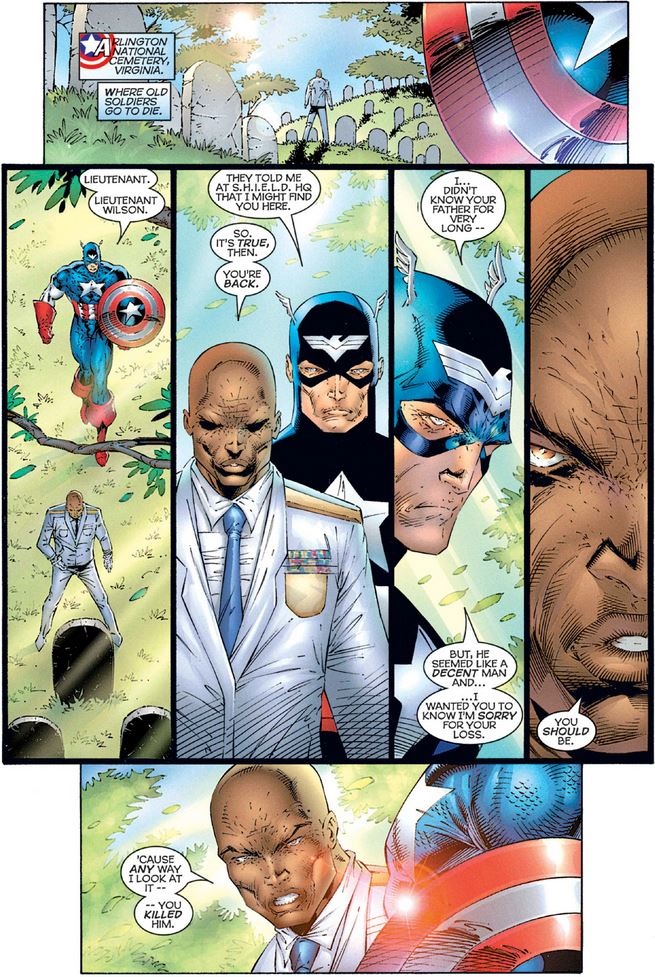
Cap lets the grieving son get a shot in before asking him to explain, which Sam is very willing to do, revealing his resentment at a father more concerned with looking for Captain America than looking after his own family.
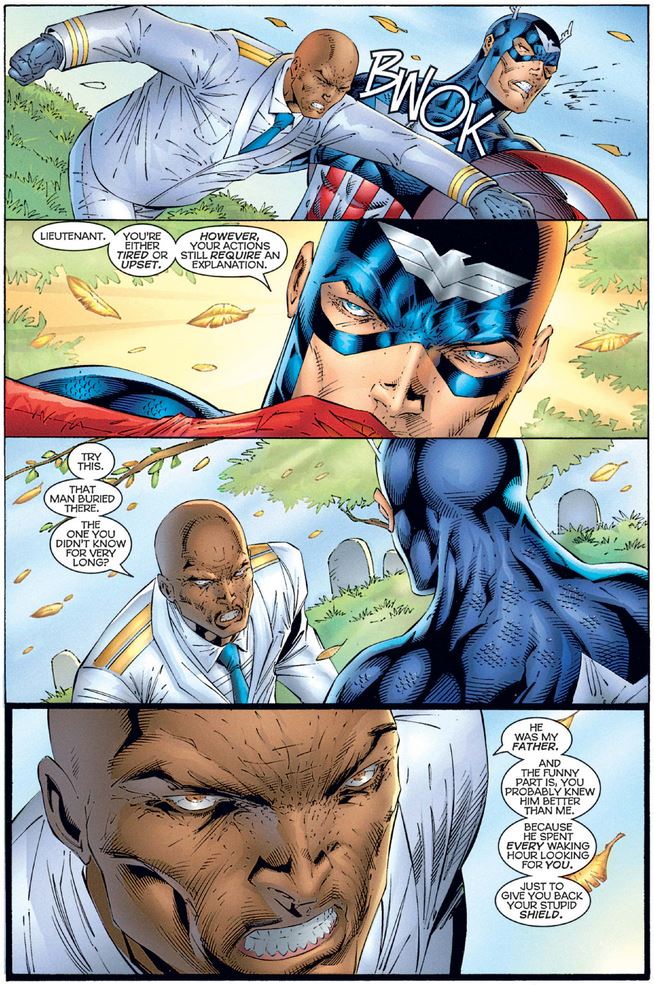
Even though, like Cap himself, Sam is a transplant from the 616 universe, his military status and family history are much different, having more in common with James Rhodes than the Sam Wilson we know.
While he goes on, agents from the World Party—the neo-Nazi organization introduced in issue #1—arrive, along with their field leader, this reality’s version of Crossbones…
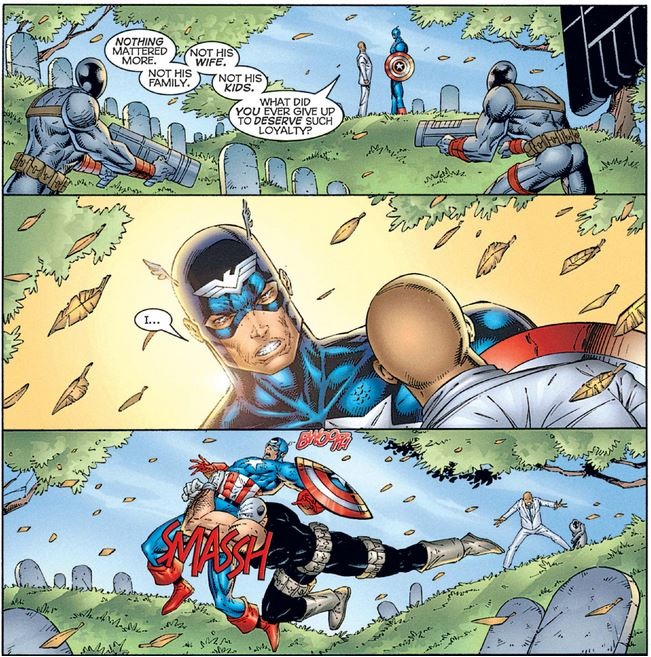
…who manages to subdue Cap at the end of the issue.
Issue #4 opens on Rebecca “Rikki” Barnes, whom we met in the first issue, who has followed her brother to World Party headquarters, where she learns Cap is being held as well…
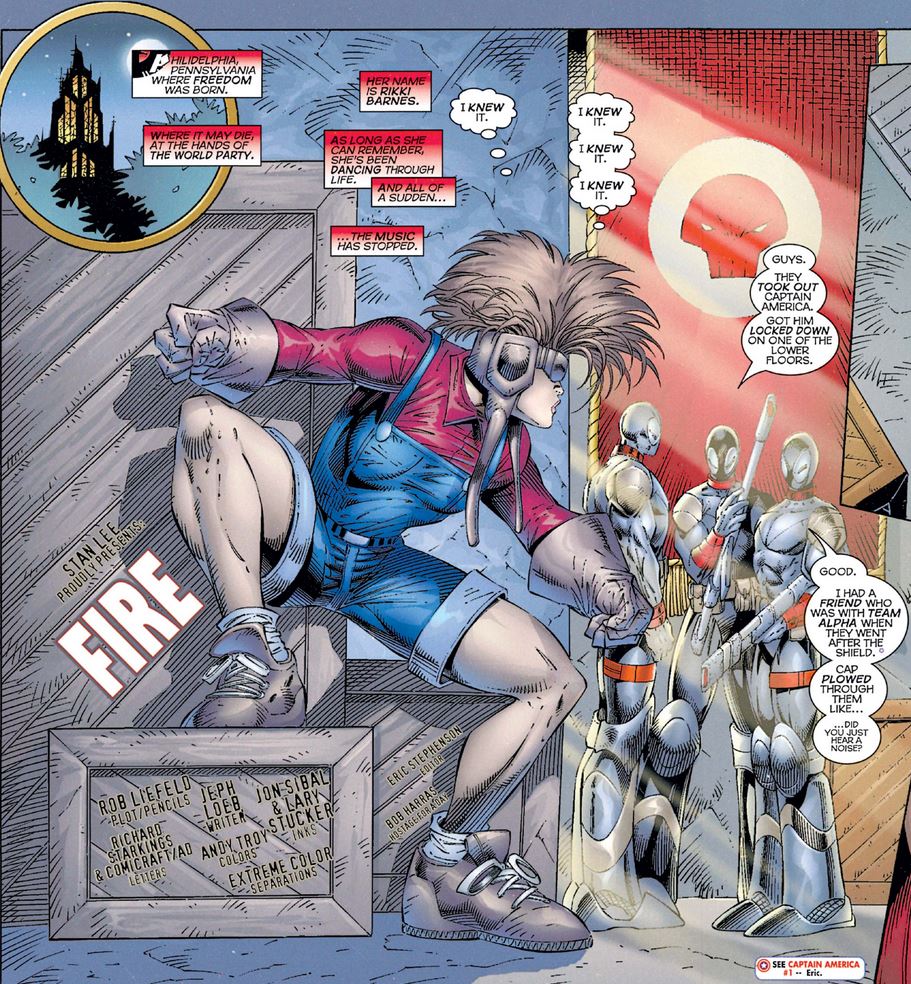
…before being discovered and captured by the Red Skull himself.
When we first see Cap in this issue, he is apologizing to Sam, chained up next to him, for getting him involved in this…
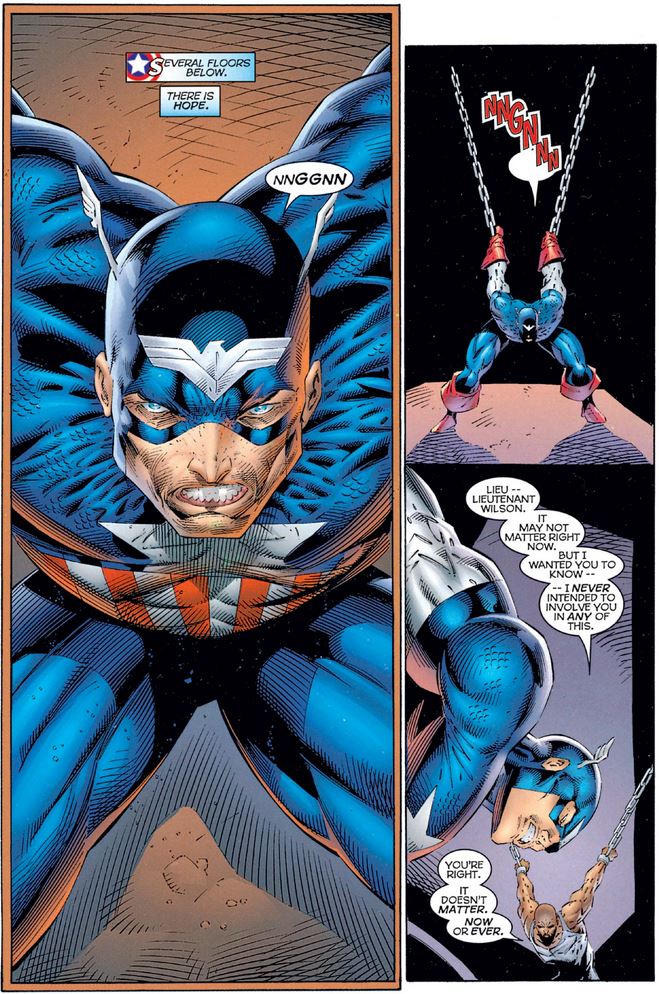
…but this only feeds Sam’s resentment about his father and cynicism toward his belief in the Sentinel of Liberty’s mission.
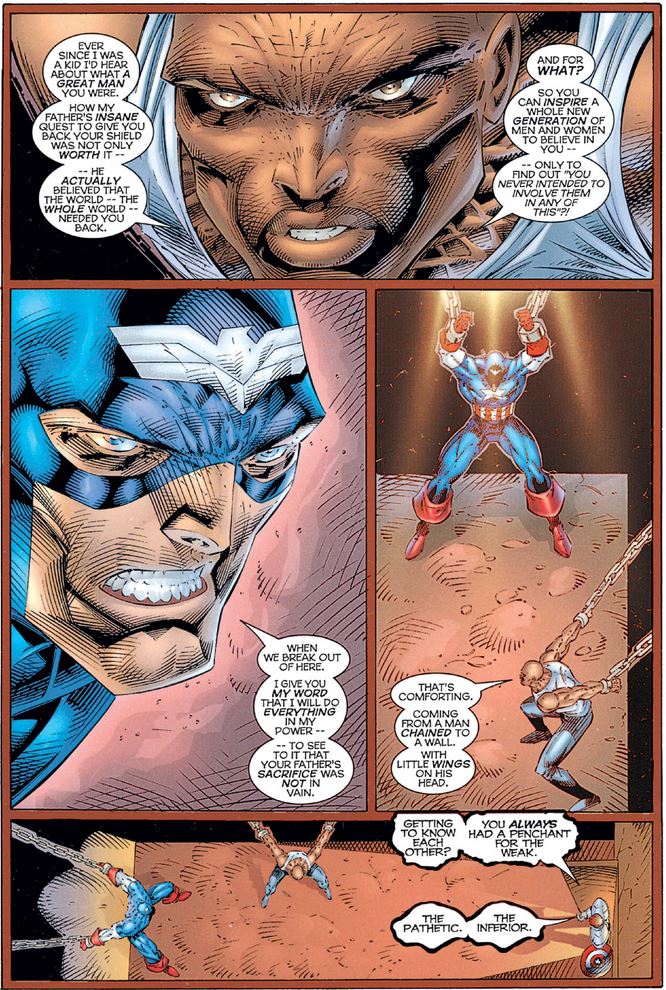
The Red Skull greets Cap and Sam with none-too-subtle comments on their races. More interesting, Cap apparently remembers him, which could mean either that his memories of his history in this reality are returning, or his memories of his previous 616 life are coming back, or simply that Nick briefed him of his possible involvement with the World Party, even if he was presumed dead. (Like DC Comics’ “New 52” relaunch, “Heroes Reborn” tended to be frustratingly light on details.)
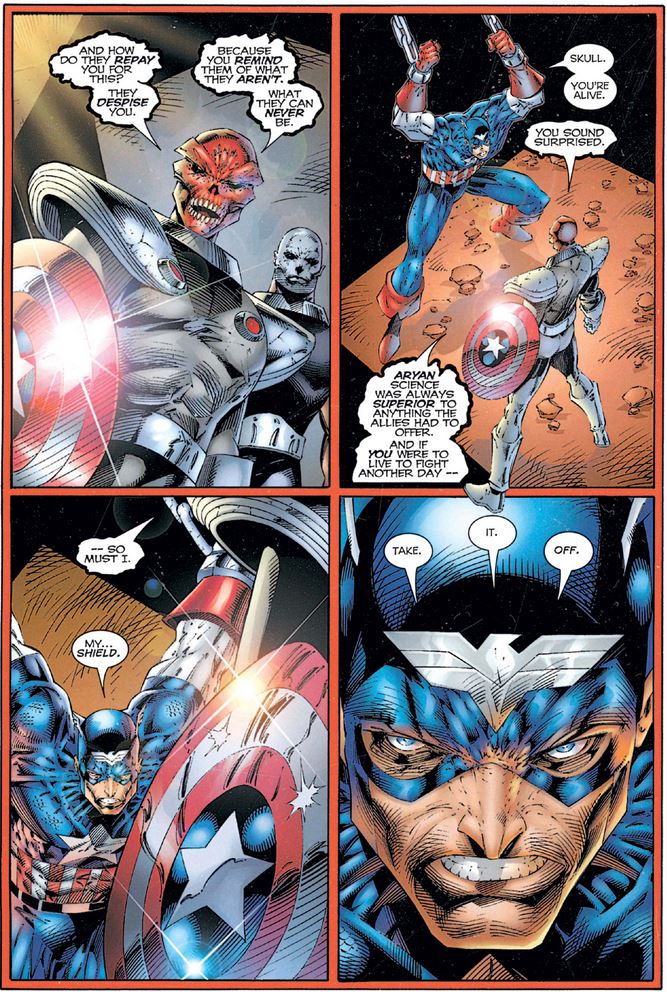
The Skull launches into his usual speech about the failure of the American project of strength through diversity and hails Cap as the Aryan ideal (which I discussed briefly here, and is consistent with his 616 counterpart having once had a body cloned from Steve Rogers, as explained in the back-up story in issue #350).
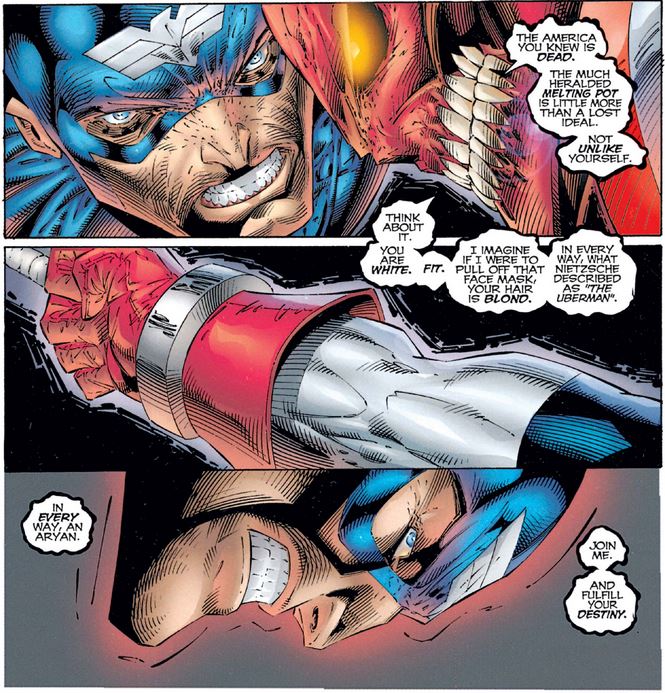
Of course, Cap breaks the chains binding him and strikes back, first against the Skull and then Crossbones, while explaining that the American ideals of equality and liberty can survive any threats from those who fear and resent them…
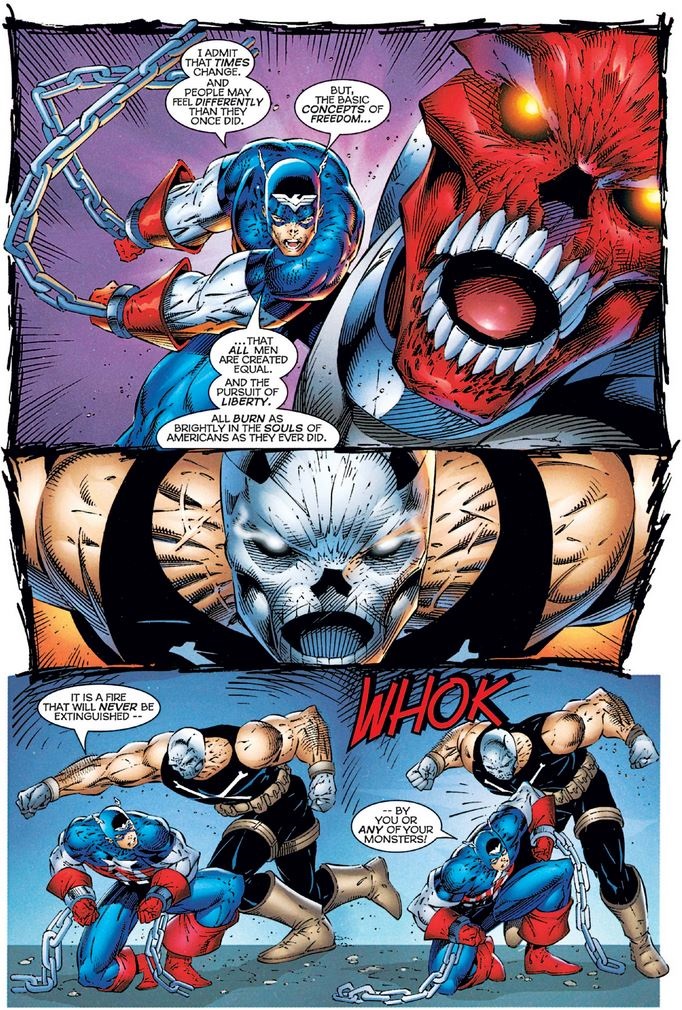
…especially as long as he’s around.
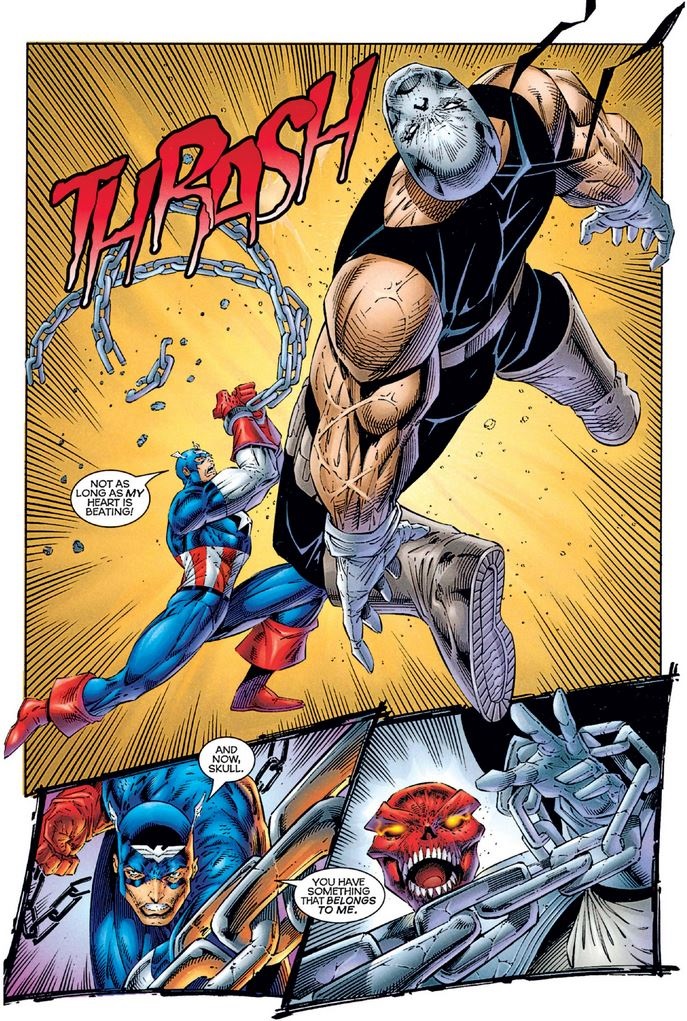
After he reclaims his shield, Cap frees Sam, who shares his nickname (to an underwhelming response).
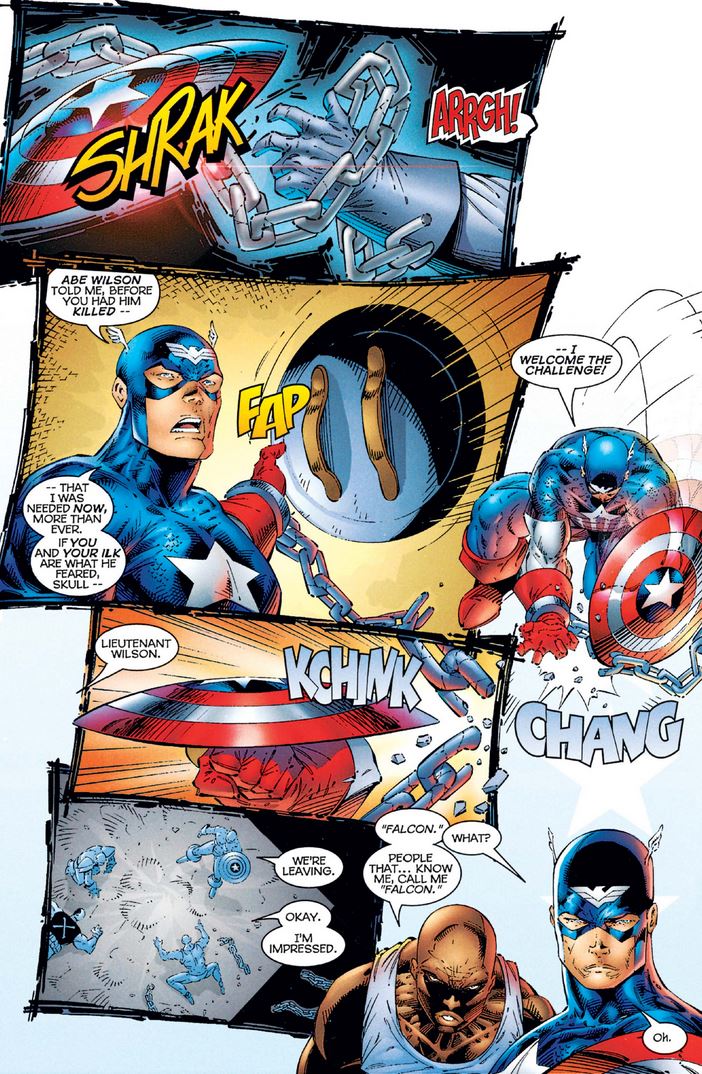
But we’re not done: Master Man emerges with World Party agents, who shoot Sam several times in the chest, and elsewhere in the complex, Rikki finds herself ties to a nuclear missile while her neo-Nazi brother cackles with glee.
Our story concludes in issue #5, where Cap is busy fighting Master Man while disputing his white supremacist rhetoric…
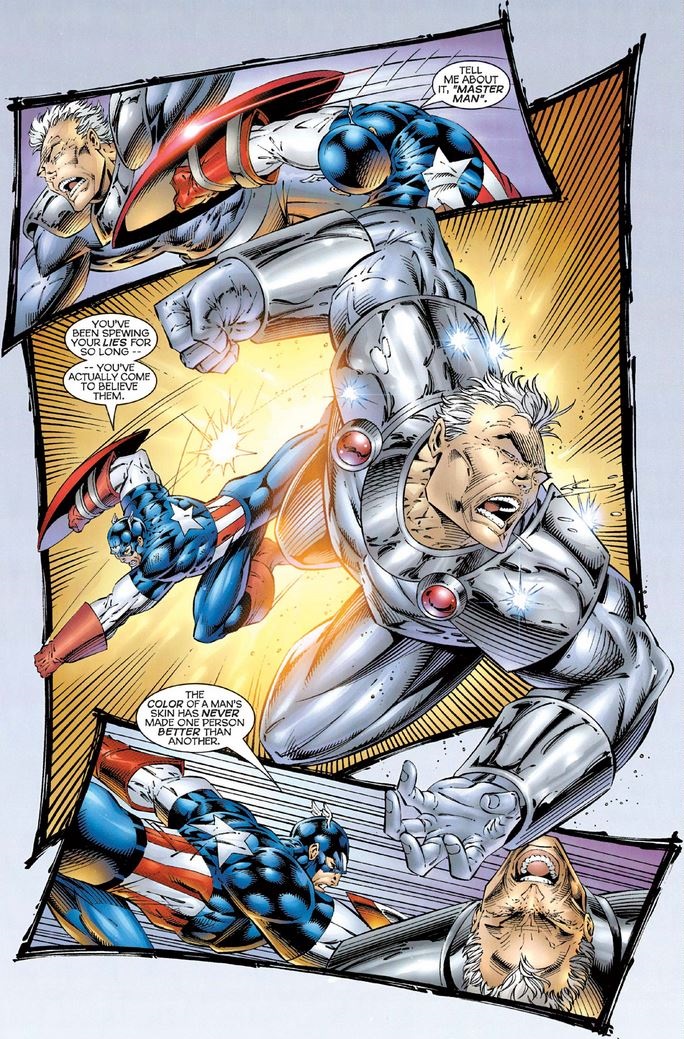
…no matter how popular it may be with some.
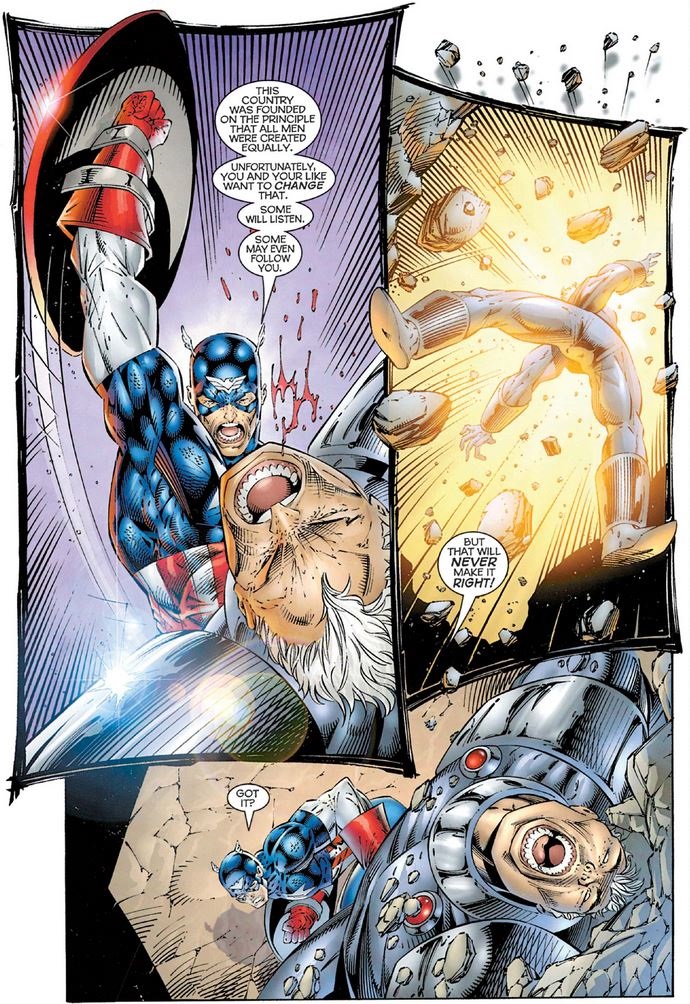
Next, he turns to Sam, who tells him to finish the job while admitting he understands his father’s devotion—the same father Cap owes his life to, and he knows just how to return the favor.
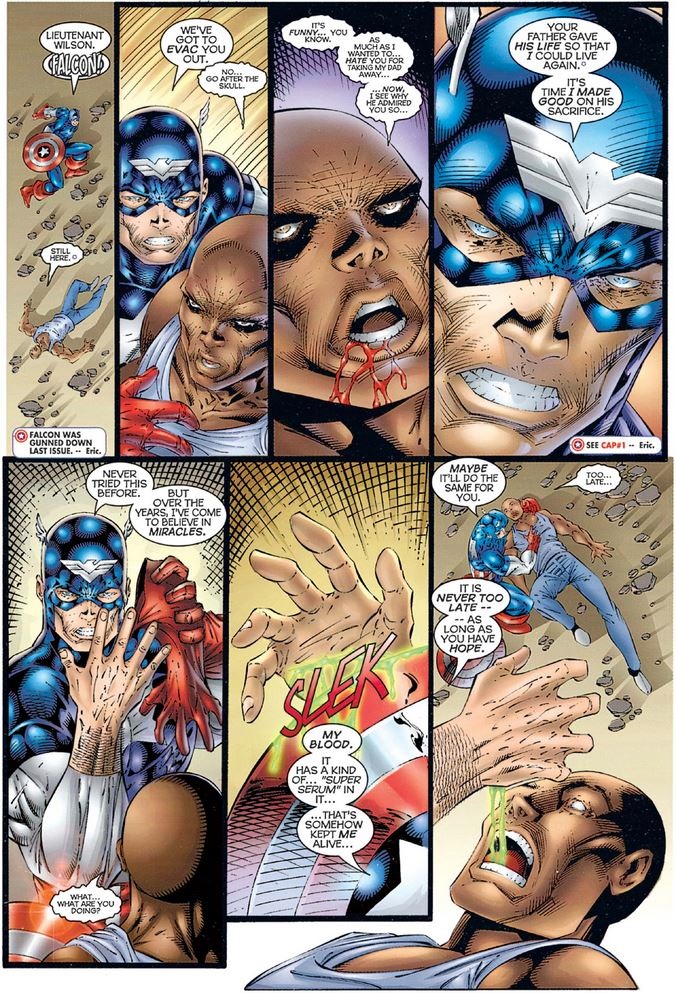
Well that certainly is new: not just that his super-soldier-serum-endowed blood is green and glowy, but that it might be able to restore life to the nearly dead while delivered orally, not even through blood transfusion. (I’m sure little Franklin Richards, who brought this reality to life, thought that would be really cool, but… no.)
Cap looks up to see his foes have fled, so he leaves Sam to look for them, reflecting on his new life, same as his old life, which is the only way he would have it. (And I have to believe the image of Cap running is an homage to Ron Garney’s cover to issue #445.)
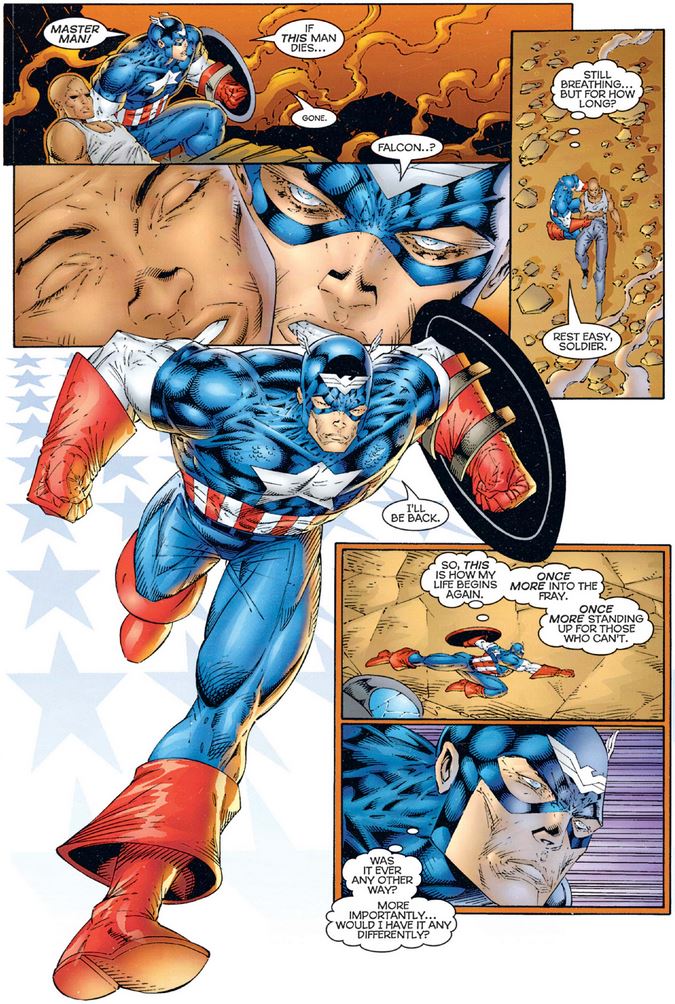
Let’s turn to Rikki and her current predicament, in which Cap soon finds her…
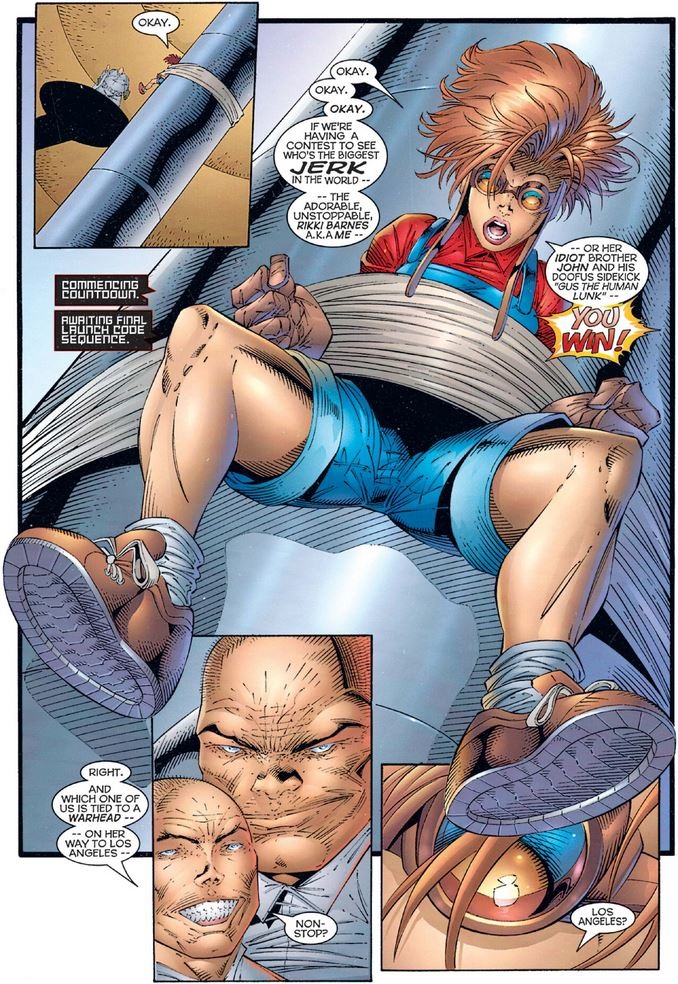
…and from which Cap frees her before confronting Master Man once again.
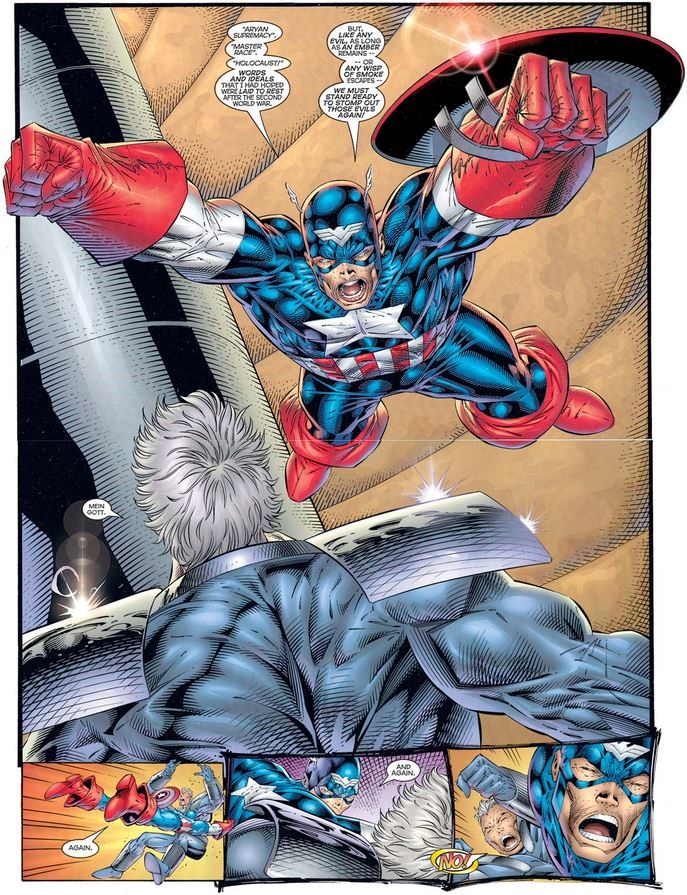
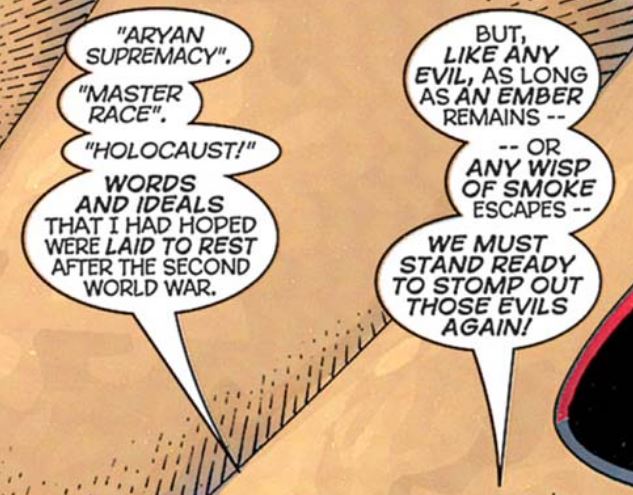
His words are familiar but cannot be repeated often enough.
Rikki lives up to her last name (as well as the colors of her outfit, wink wink) as she lends Cap a foot…
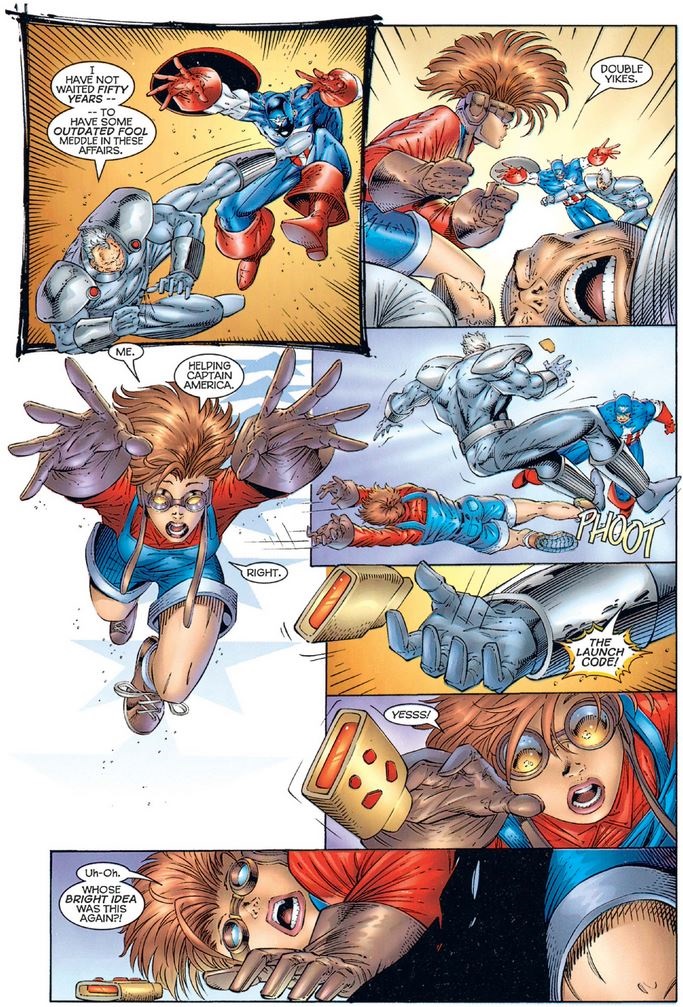
…after which a very hale and hearty Sam Wilson rises to join Cap in taking out Master Man once and for all.
And guess who shows up in the nick of time (sorry) to clean up and let Cap know he has more to do… which he does not look unhappy about.
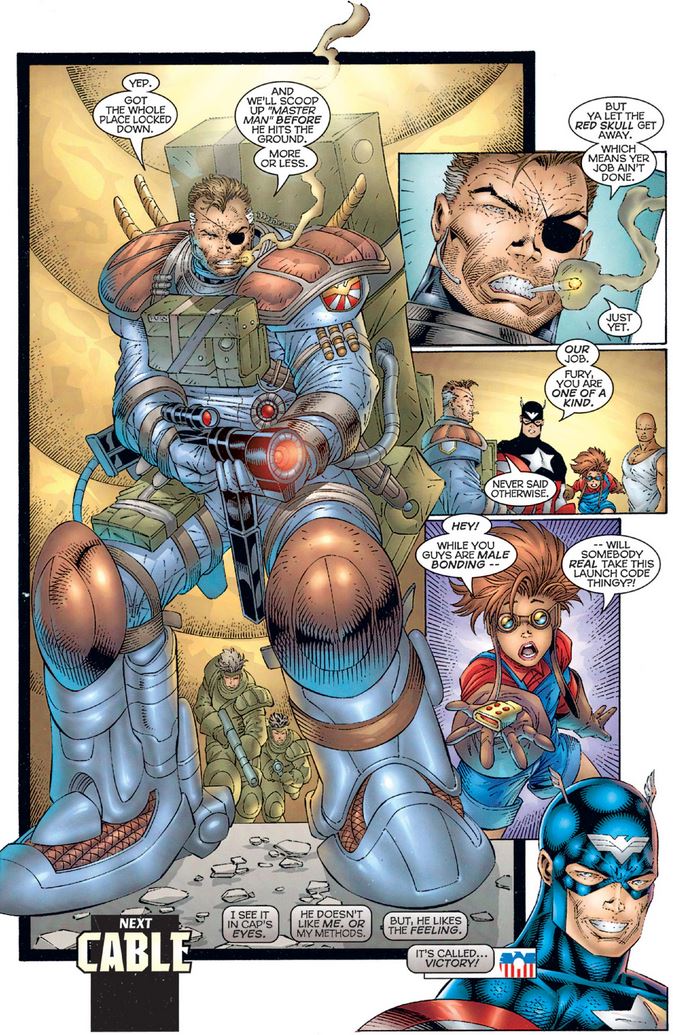
Wait, Cable? From the 616 universe? An interesting twist, which we will cover in the next post as we head into the first “Heroes Reborn” crossover.
ISSUE DETAILS
Captain America (vol. 2) #2, December 1996: Rob Liefeld and Jeph Loeb (writers), Rob Liefeld (pencils), Jon Sibal (inks), Brian Haberlin and Extreme Color (colors), Richard Starkings and Comicraft (letters). (More details at Marvel Database.)
Captain America (vol. 2) #3, January 1997: Rob Liefeld and Jeph Loeb (writers), Rob Liefeld (pencils), Jon Sibal and Lary Stucker (inks), Andy Troy and Extreme Color (colors), Richard Starkings and Comicraft (letters). (More details at Marvel Database.)
Captain America (vol. 2) #4, February 1997: Rob Liefeld and Jeph Loeb (writers), Rob Liefeld (pencils), Jon Sibal and Lary Stucker (inks), Andy Troy and Extreme Color (colors), Richard Starkings and Comicraft (letters). (More details at Marvel Database.)
Captain America (vol. 2) #5, March 1997: Rob Liefeld and Jeph Loeb (writers), Rob Liefeld (pencils), Jon Sibal and Lary Stucker (inks), Andy Troy and Extreme Color (colors), Richard Starkings and Comicraft (letters). (More details at Marvel Database.)
Collected in: Heroes Reborn: Captain America.
PREVIOUS ISSUE: Captain America #1 (November 1996)
ALSO THESE MONTHS: Avengers #2-5 (December 1996-March 1997) and Fantastic Four #3 (January 1997)
NEXT ISSUES: Captain America #6, Avengers #6, and Iron Man #6 (April 1997)
 THE VIRTUES OF CAPTAIN AMERICA
These 5 issues weren’t perfect, but they certainly have things to appreciate. Cap’s stance on the bomb will be echoed several years hence in Volume 4 where elements of the government will literally put him on ice. To the Daredevil and Punisher references I would also add Cap’s reaction to the bomb in Kirby’s “Bicentennial Battles”. In fact, many people at the time were opposed to the dropping of the bomb including a large number of scientists involved in the Manhattan Project and 6 of the 7 five-star officers including General Eisenhower and Admiral Leahy. What I also find interesting about this story is the later “Winter Soldier” epic’s similarity to it. It’s actually more tragic here since Cap is “put on ice and thawed” (figuratively) by elements of his own government to fight in actual U.S. wars instead of a cliched, long-gone enemy like the Soviets (who, in reality, didn’t have an assassination of foreigners program to use Bucky for anyways). Of course, Rickki seems to be influenced by Carrie in Miller’s “The Dark Knight Returns”.
LikeLike
Thanks for the reminder about Bicentennial Battles, Chris — I inserted a note about that into the post, as well as the upcoming post on issue #7, where this point is repeated (along with the very Winter Soldier-ish treatment of the Cap over the following decades, another great point).
LikeLike