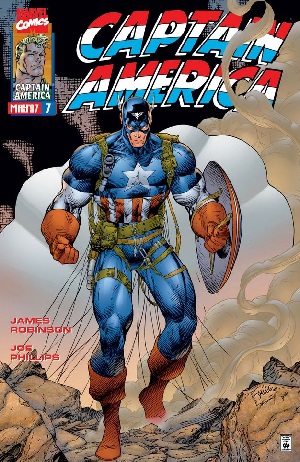
 Coming at the halfway point of the “Heroes Reborn” period, his issue serves as a reset of sorts for Captain America himself, as we’ll see in the story below, and behind the scenes as well, as responsibility for the title changes hands within Image Comics from Rob Liefeld’s Extreme Studios to Jim Lee’s Wildstorm.
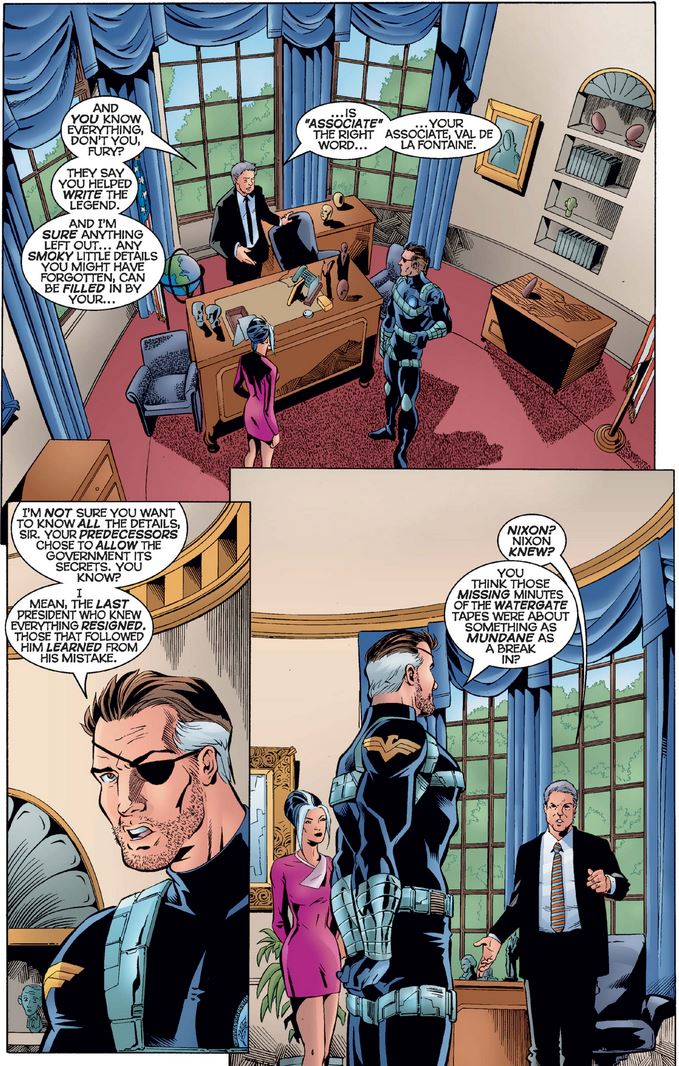
Most of the issue deals with filling in the details of Cap’s history in this universe, explained by Nick Fury and the Contessa Valentina Allegra de la Fontaine after President Bill Clinton demands answers.

Nick makes sure the president really wants to know, reminding him of what happened to the last occupant of his office that knew (linking that president to Cap in a very different way than in the 616 universe).
Nick and Val try one more time to convince Clinton to stay in the dark, with Nick even going so far as to use what amount to fightin’ words in these parts (meaning this here blog).
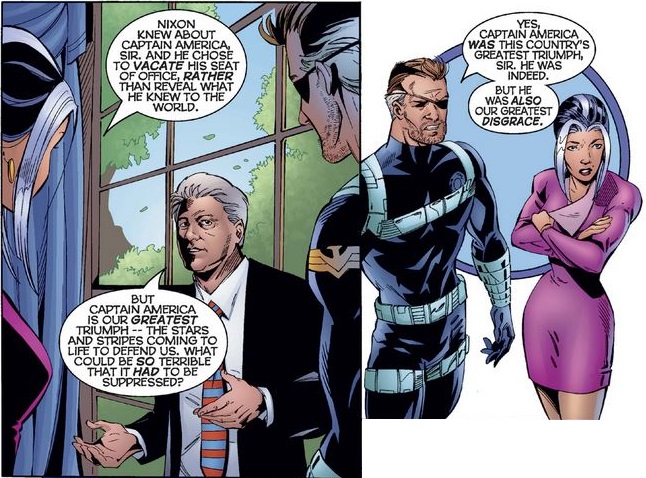
So let’s see what Nick is so a-feared of… but it’s not the version below, which draws as much from Superman’s origin as Cap’s.

Nick quickly explains that this is the legend everyone knows in this world, but it’s not the truth, as Nick and Val prepare to explain.
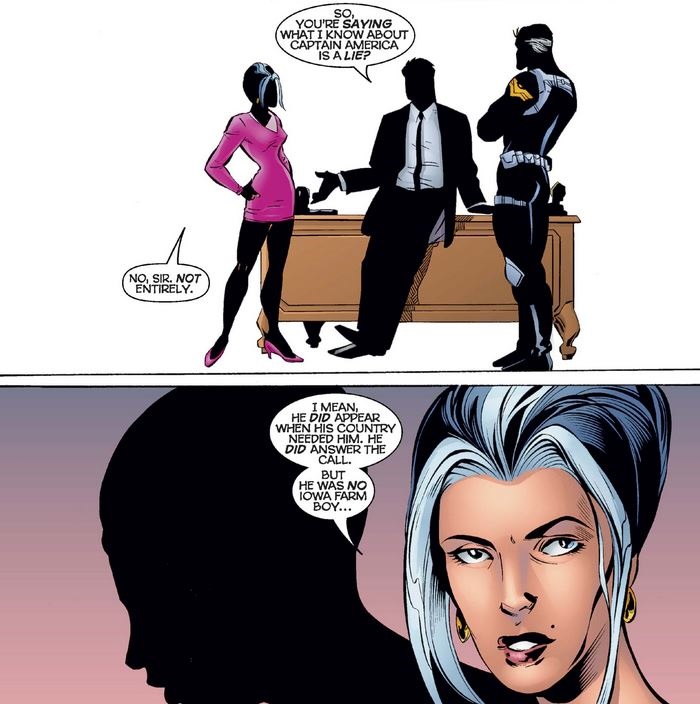
The truth starts out fairly close to the standard version, with scrawny Steve Rogers desperate to fight for his country and democracy against the growing Nazi threat overseas—a key difference being that here the serum was tested on other men before Steve.

Once Steve became Captain America, he fought this world’s Red Skull, plus two new villains never mentioned again: Colonel van Wagner and the Valkyrie. (It looks like he told the latter to go away and never come back, so that explains that.)

This is where things get more interesting, as the president goes through a number of theories about Cap’s disappearance after the war, one of which is basically what happened in the 616.

But Nick knows the truth, and he seems ashamed of it.
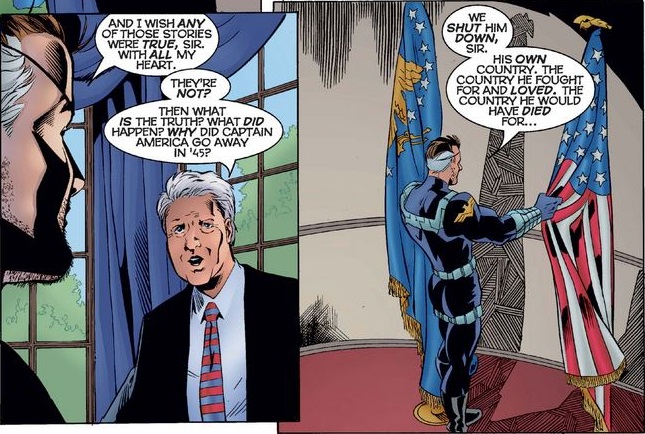
Then Nick tells the president what he told Cap in issue #3: Cap refused to publicly support the American government’s plan to drop atomic bombs on Hiroshima and Nagasaki in August 1945. This is consistent with sentiments expressed in Punisher – Captain America: Blood and Glory #1 and Daredevil #233, both in the 616 universe where he didn’t learn about the bombing until decades after the fact, as well as his discomfort watching the first atomic bomb test in Bicentennial Battles (thanks to time travel).
Clinton sees his point but is surprised that at the time they felt they had to “shut him down,” and frankly wondered how they would do that anyway.

Nick explains how the newly formed SHIELD had developed a process of suspended animation, which Cap was uniquely able to survive, so in essence they took their G.I. Joe out of the toy box when they wanted to play with him (like they did with Bucky in the later Winter Soldier storyline and movie—an insight due to a comment from Chris, thanks!). Even worse, they tried to brainwash him into accepting morally objectionable orders…
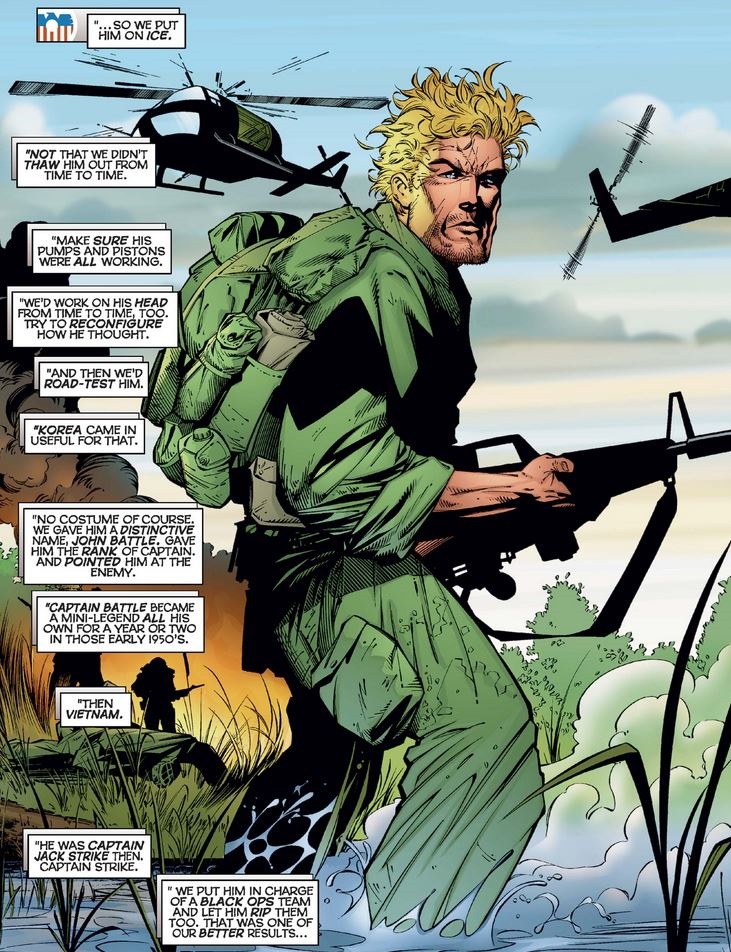
…but every time, his true character broke through, until they finally gave up on him for military use. (Should we assume it was something about his Vietnam experience that triggered Nixon’s resignation?)
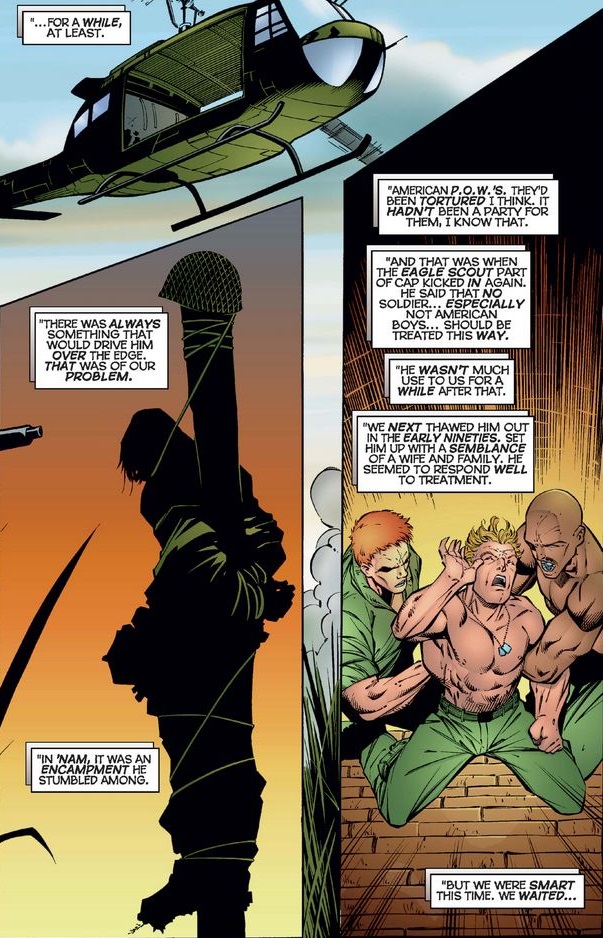
As we know from issue #1, they gave him a quiet life with a fake wife and son in Philadelphia, which lasted until Abe Wilson gave him back his shield and SHIELD reactivated him, which brings us to the current day (and his stories so far in the “Heroes Reborn” age, summarized in the double-page spread below).
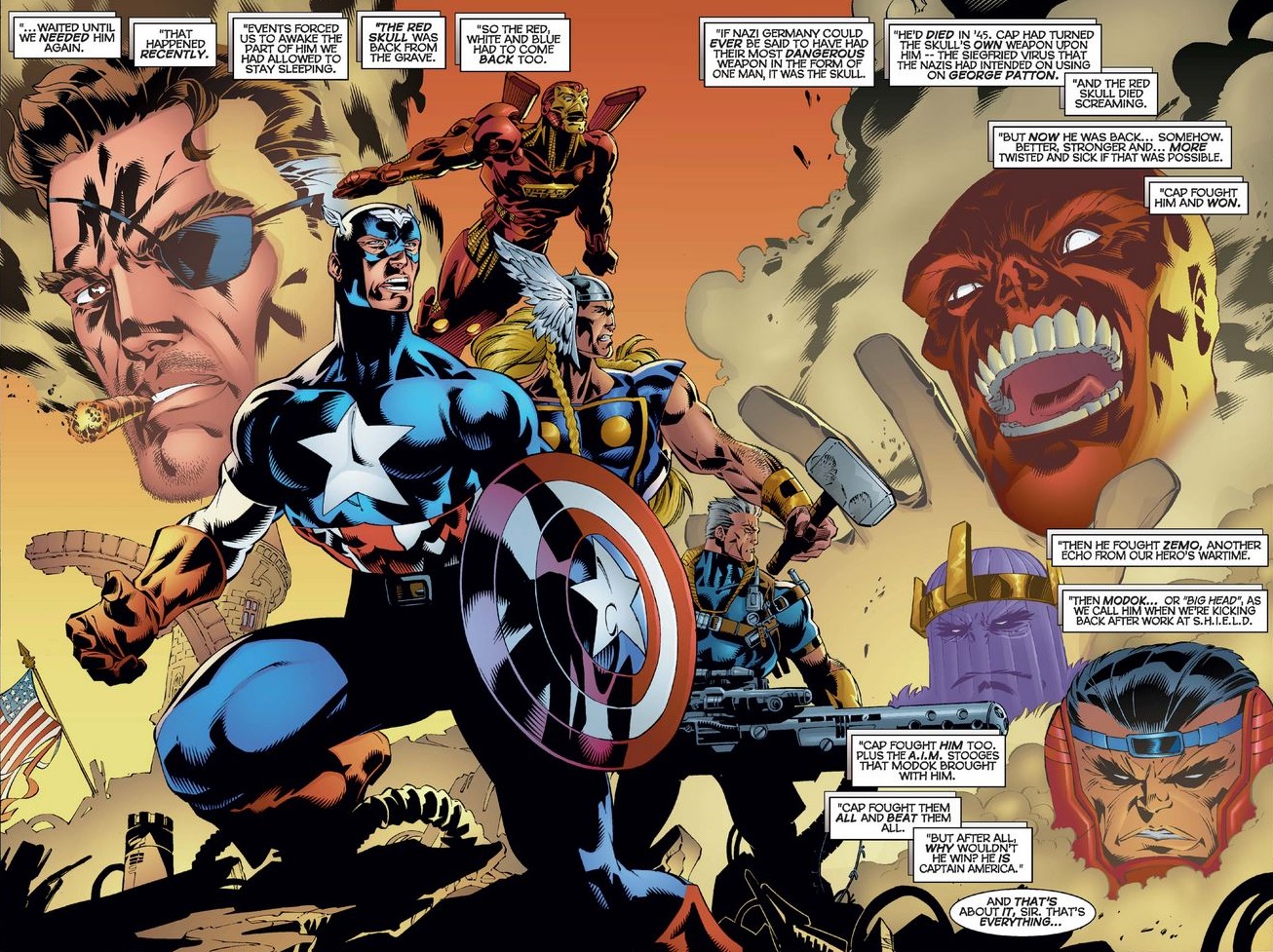
The last speech bubble above comes from someone who has just joined the party and introduces himself to this president (for the first time, I assume), who reveals that it was Cap who called this meeting to put on the record his objection to his treatment over the last few decades.

Nick offers a half-hearted defense, not even getting to the “just following orders” part before Cap criticizes him for it (although Nick’s silence in the middle panel seems to confirm that Cap was on target).

Then we get a scene reminiscent of one we’ve seen several times in the 616 universe, as Cap formally breaks with SHIELD and the American government and affirms his devotion to the country itself (which we can assume means the American people and the American dream).

Most important, though, he takes that silly eagle off—although you have to wonder why, because it’s hardly suggestive of the US government in particular, like a badge would be. (Did anyone ever think Wonder Woman’s original eagle design on her chest connected her to the U.S. State Department?) More likely, he figured out that there was a SHIELD tracking device in the eagle, as we learn later.
Cap basically dares Nick and Val to stop him, and then blackmails them into leaving him alone to rediscover America. (Is it just me or does he look with John Walker in the second panel below?) To add insult to Nick’s injury, President Clinton gives Cap his full support, cementing it with a salute, which Cap returns.

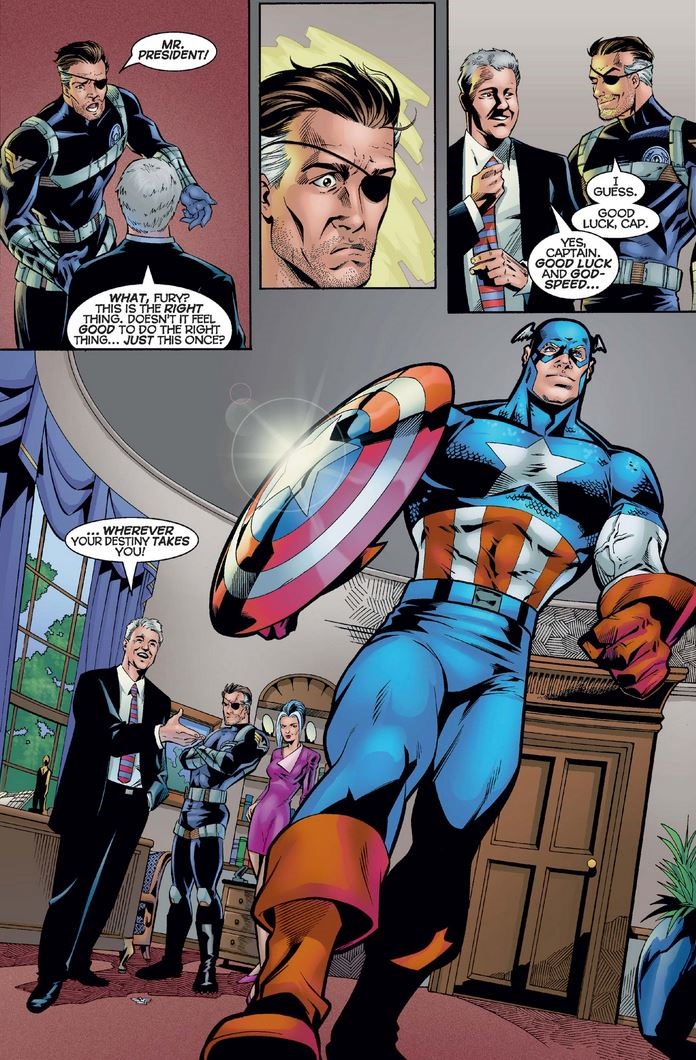
The final page is dominated by a magnificent shot of a newly liberated Sentinel of Liberty striding out of the oval office, but I get a kick out of the president schooling Nick on doing the right thing, “just this once,” which Nick thinks about, as if for the first time, and then says, simply, “I guess.”
What about the famous “A” on his forehead, you ask? Come back for the next issue to see…
ISSUE DETAILS
Captain America (vol. 2) #7, May 1997: James Robinson (writer), Joe Phillips and Travis Charest (pencils), Homage Studios (inks), Wildstorm FX (colors), Richard Starkings and Comicraft (letters). (More details at Marvel Database.)
Collected in: Heroes Reborn: Captain America.
PREVIOUS ISSUES: Captain America #6, Avengers #6, and Iron Man #6 (April 1997)
ALSO THIS MONTH: Avengers #7 (May 1997)
NEXT ISSUES: Captain America #8-9 (June-July 1997)
 THE VIRTUES OF CAPTAIN AMERICA
The part where Steve’s “Eagle Scout kicked in” and “he wasn’t much use “ as a soldier “after that” confused me at first. Why would seeing Americans mistreated make him refuse to fight the people who mistreated them? Now, if Steve had stumbled on a My Lai type massacre, then that might have driven him to refuse to fight. Then I realized it does make sense if seeing the tortured soldiers made him turn against the whole idea of war in general since it inevitably leads to such barbarism on both sides.
LikeLike