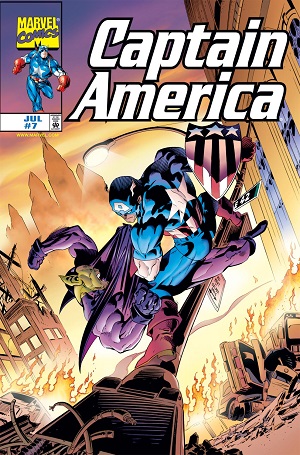
 This post wraps up the “Power and Glory” storyline in which Skrulls have encouraged and magnified the “Capmania” that preceded our hero’s return from the “Heroes Reborn” universe. This plan culminated in his capture and replacement by the Skrull leader, who then instilled fear and chaos among the American people, lying to them about a large-scale Skrull invasion and causing them to doubt and turn on their neighbors.
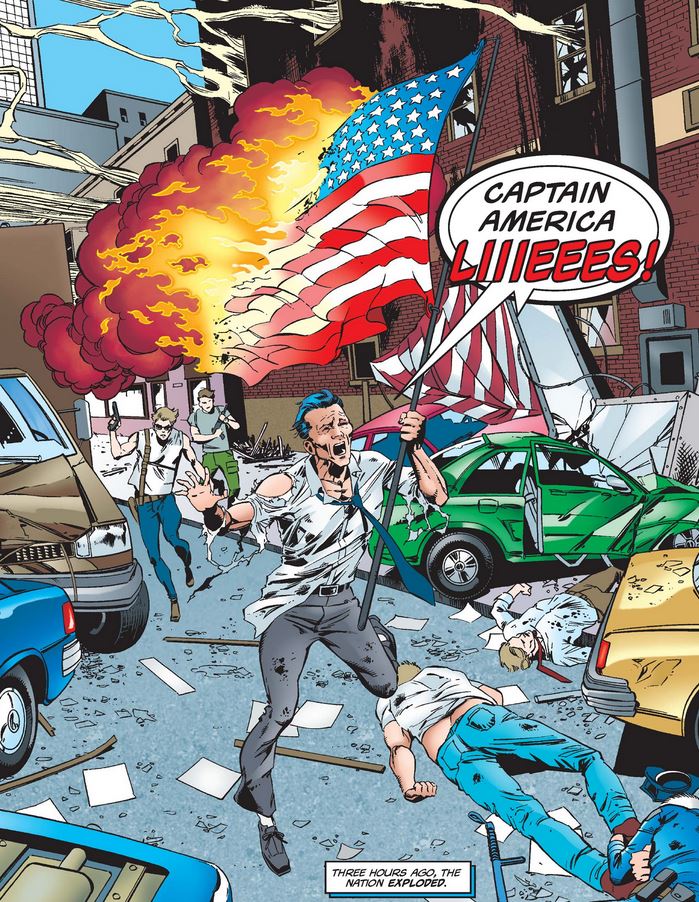
Our current issue opens with the striking image below, although it is unclear whether the man with the flag is upset that Captain America disappeared after warning of the Skrull invasion, or running from the armed men behind him who presumably suspect him of being a Skrull. (In either case, I don’t understand why he’s holding the flag, all obvious symbolism aside.)
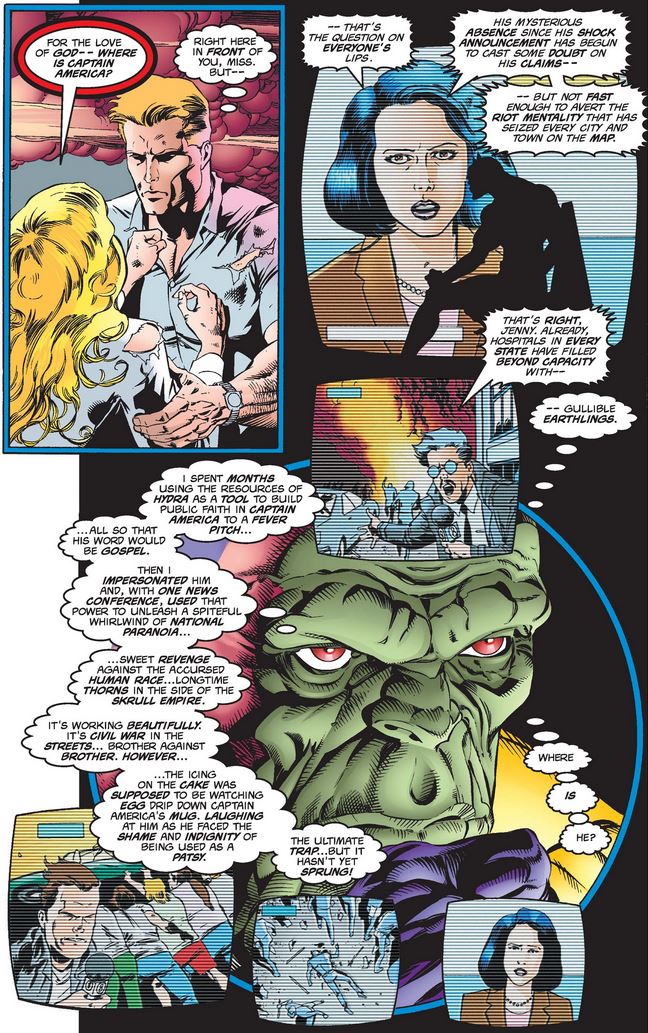
The next several pages show visceral examples of Americans attacking each other based on their race, religion, or simply the way they dress, all inspired by the Skrull leader’s lies (in the spirit of the fascist strategy of division and destabilization). In one case, we see a man with a garbage lid intervene, countering the panic with words of calm, only to hear that it is his absence that is contributing to the chaos.

The woman makes an urgent plea, but Cap has his reasons for staying out of view—reasons that matter little to the Skrull impersonating him, whose plans are being frustrated by his foe’s disappearance.
Cap also has the Avengers and Reed Richards working behind the scenes, with an admirable lack of visible regret for having to ask for help. (Does Tony think Reed doesn’t know he’s Iron Man?)
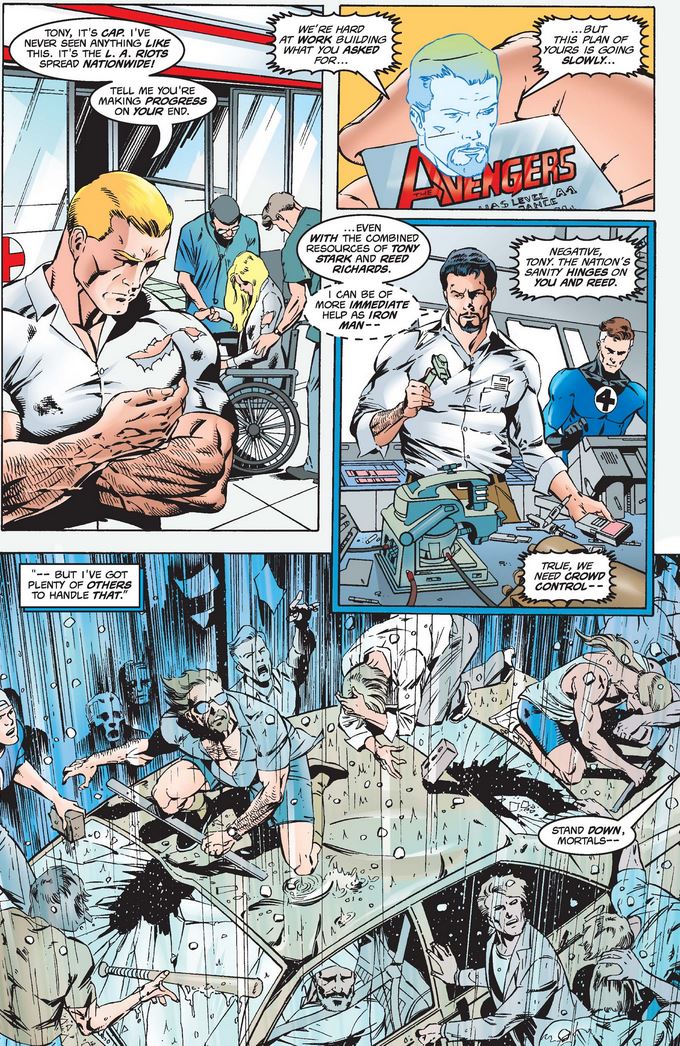
It may just be me, but the shot of Thor below reminds me (again) of Daredevil #233, in which Ben Urich attributes to Cap a “voice that could command a god.”

Clint’s horrible joke goes unacknowledged (wisely) by Wanda, but he does acknowledge the excessive level of obedience and deference given by people—including his fellow heroes—to Cap, which played an integral role here (as well as in the recent “Secret Empire” storyline, as discussed in the new edition of my book).

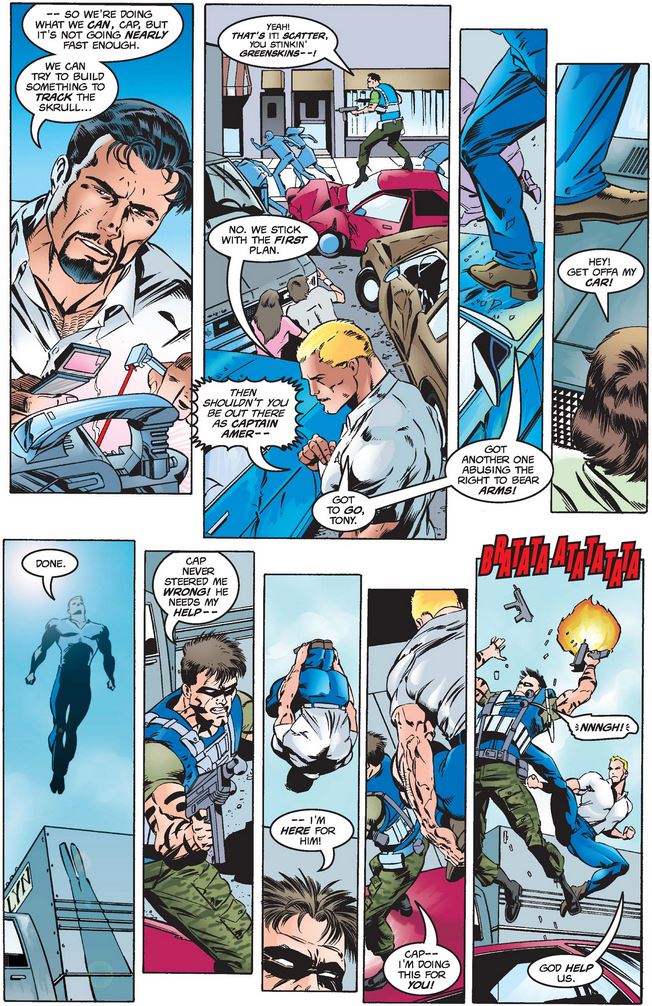
After conferring with Tony, Cap outlines the scope of the Second Amendment while stopping a gunman who claims to act in his name, implicitly trusting anyone who claims and appears to be Captain America.
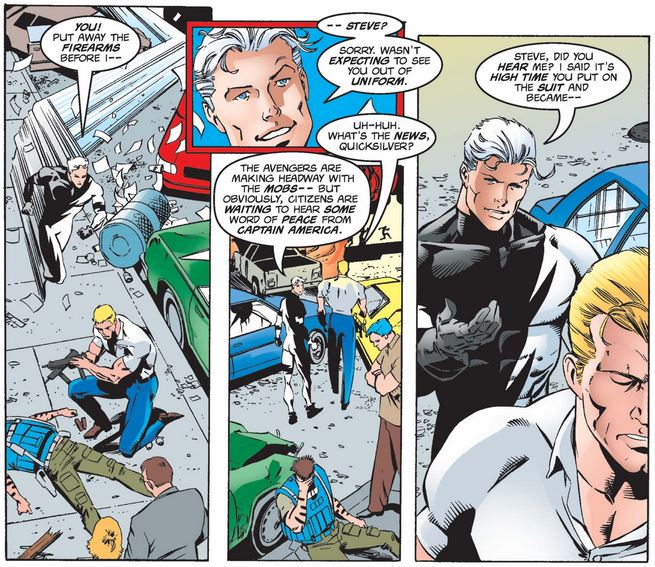
Quicksilver obviously intends to make the same legal point before he recognizes the legendary biceps that helped win World War II, and he adds his recommendation to Tony’s that Cap suit up and address the nation.
I like to think that Pietro stands in for Tony when Cap loses it below, expressing his own frustration at not being able to defend his name out of concern it would only make things worse and having to wait until he can bring in the Skrull himself.
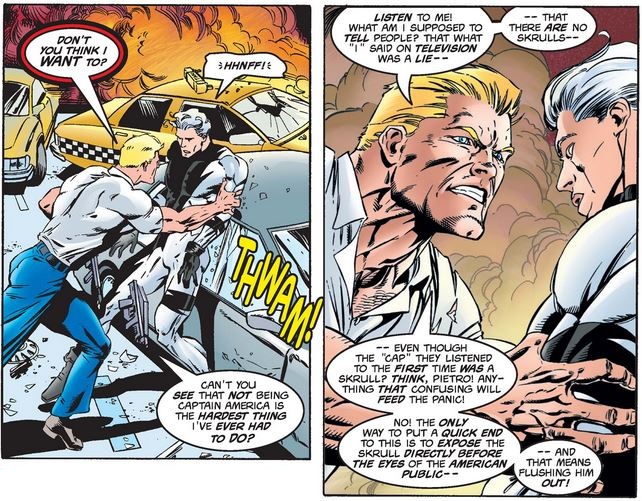
The fact that we rarely see Cap act like this shows how deeply having his reputation abused has affected him.
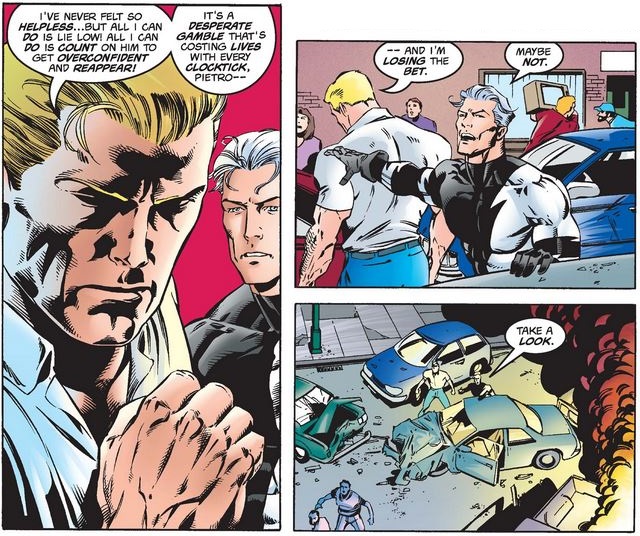
“But soft!” says fair Pietro. “What light through yonder window breaks?” He points to a jumbotron on a nearby building showing Skrull-Cap about to give a speech, and Cap tells Tony it’s time to move (never mind that Tony’s not ready).
As Skrull-Cap escalates his false warning of an invasion and calls for a citizens’ attack on Washington in response, he is interrupted by a blast that reverts him to Skrull form. He pleads that he is still Captain America…
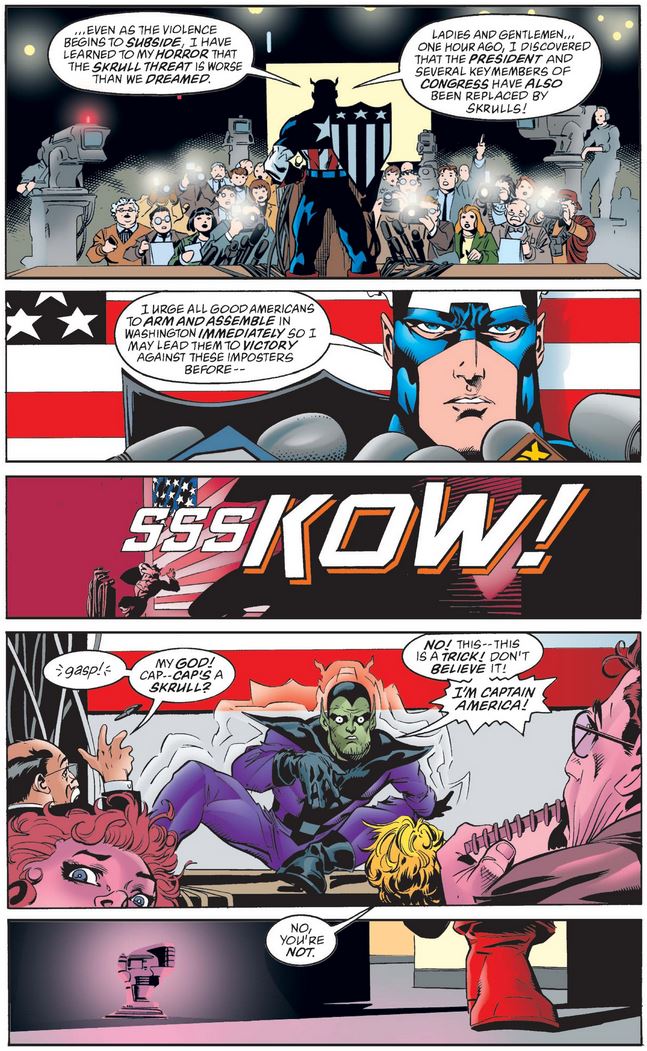
…but this is quickly proven false as well.
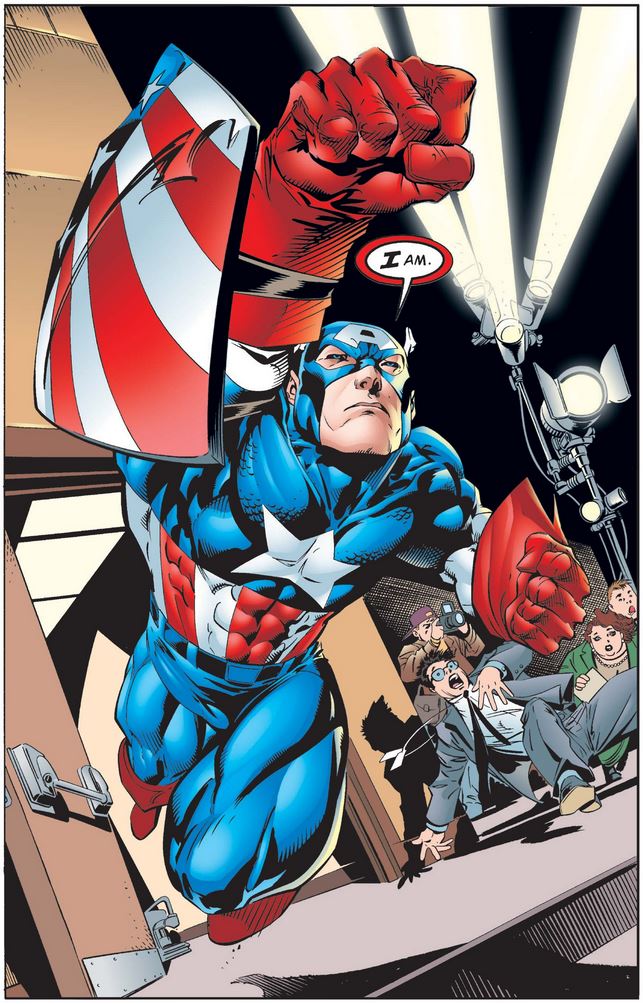
Cap fights the Skrull on national TV, making the grand declaration he was waiting for for everyone to see.
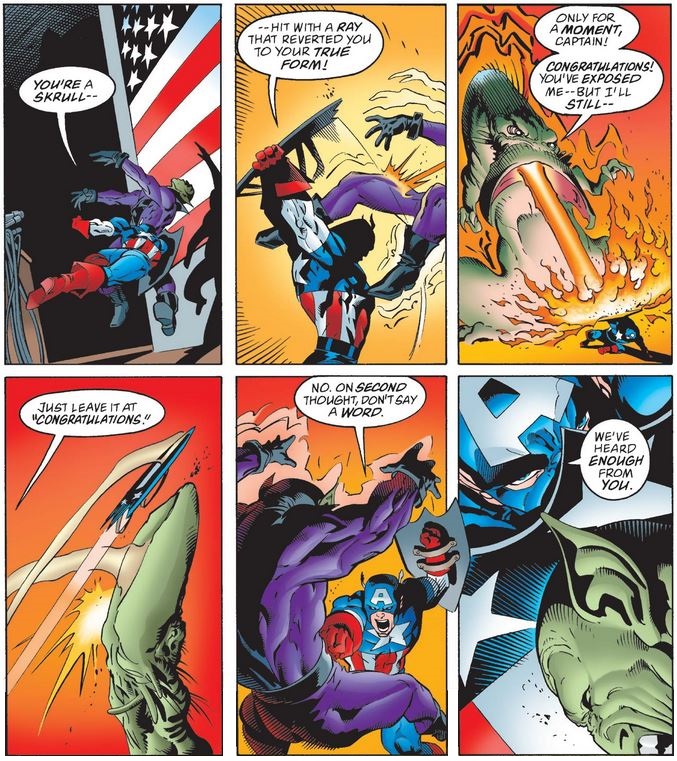
After Reed reiterates to the gathered press that everything the Skrull said was a lie, the ever-lovin’ blue-eyed Thing gleefully joins Cap in a one-two punch.
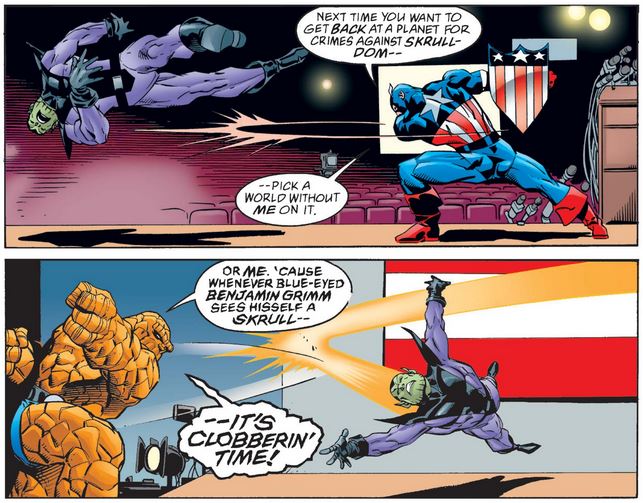
After Thor gives scary face, the Skrull tries to flee…
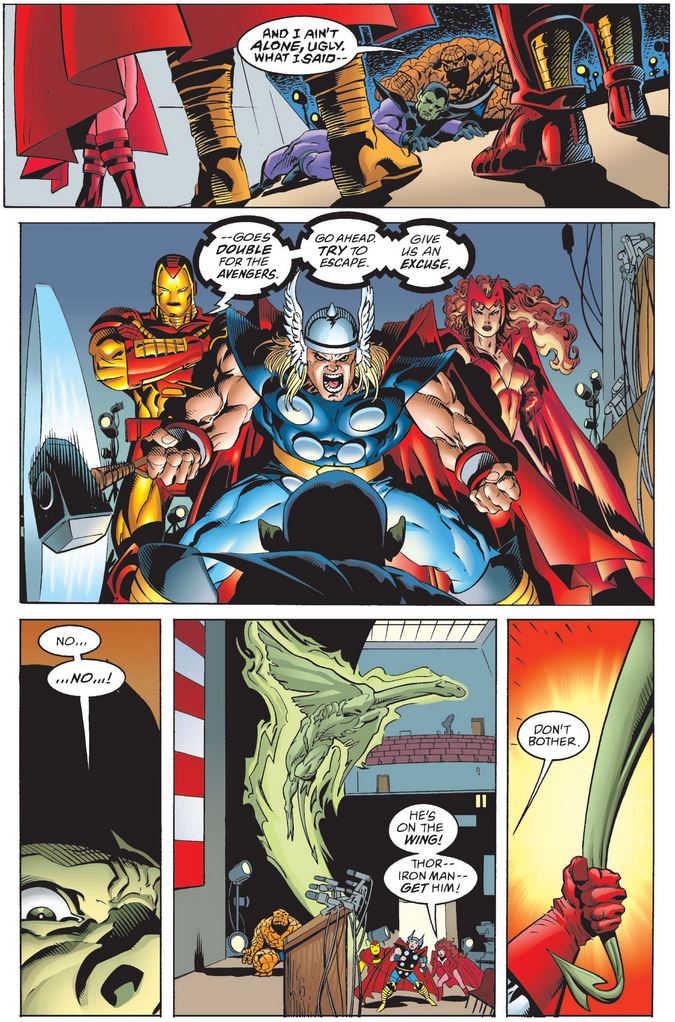
…but Cap gets the final blow.
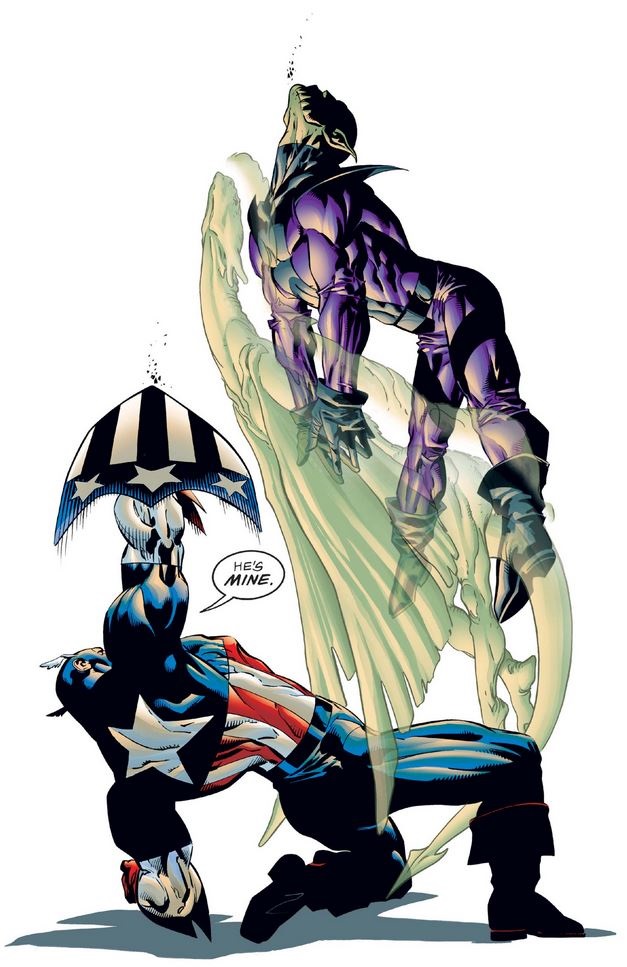
(You have to wonder how much force Cap can wield from that pose, but never mind.)
The next page begins in the middle of Cap’s address to the nation, as he finishes explaining what the Skrull had done and assures everybody there was never a Skrull “invasion” per se (just one renegade with a couple flunkies). When the members of the press ask about the people’s trust in him and Capmania…
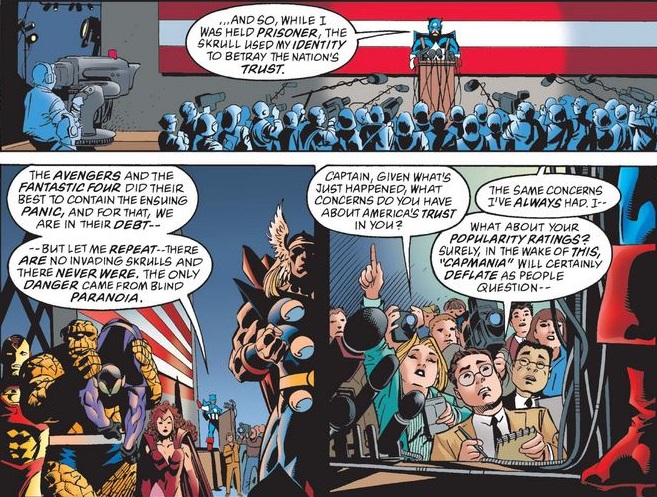
…he admits that Capmania eventually went to his head (which I still maintain is overly harsh, at least based on what we saw). Then he turns to the question of why so many were willing to give the Skrull-Cap “blind allegiance” despite the fact that the things he said and asked for were out of Cap’s established character, and takes responsibility for that as well.
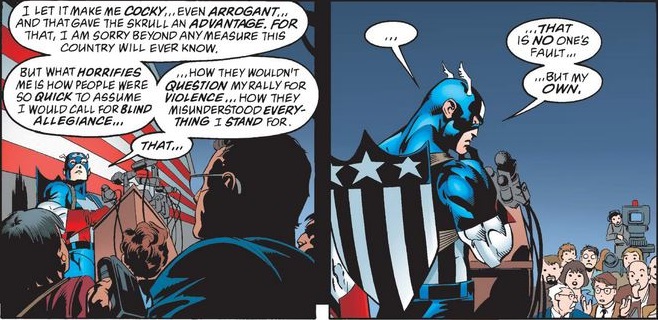
He moderates that position as he goes on, vaguely suggesting that people need to stop elevating each other to the level of unquestionable icons or saviors and take a critical stance toward everything anyone says, even people whom you usually and justifiably extend the benefit of the doubt. (OK, most of that comes from me, but I think it’s consistent with what he says here and after the recent “Secret Empire” incident—I talked about it a bit more in a recent podcast with the Captain America Comic Book Fans.)
In the end, he once again takes most of the hit, before falling silent for a moment…
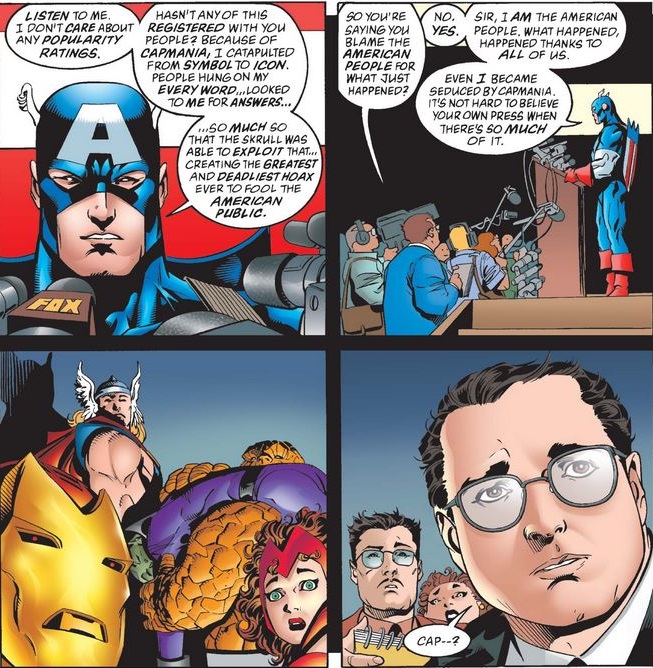
…and then launching into a lengthy monologue. (He obviously needed to take a breath first.)
He starts by confessing to a crisis of identity that mirrors the country’s own, and then prepares for a new declaration, elaborating on his vow in issue #3 to become more proactive (against Hydra in particular).

(I don’t remember a pervasive sense of national ambivalence or uncertainty in 1998, but we have been through a lot since then.)
He starts by refining the nature of his call to service, considering himself a soldier in the broad and positive sense of protector rather than warrior, but when he does fight he prefers to fight for important societal causes rather than against costumed goons. (To be fair, though, some of his “supervillains,” like the Red Skull, threaten social ideals as well.)
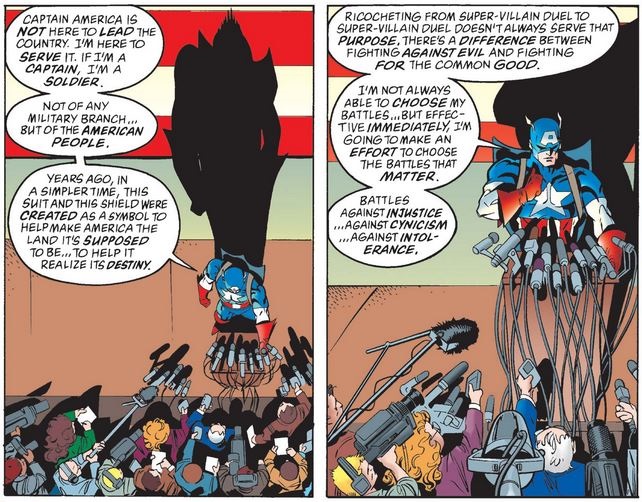
Next he rejects the title of “superhero,” not just in reference to silly supervillain battles but also in reaction to Capmania and the pedestal it placed him on. He wants to assure the American people he is one of them, and together they will solve the problems plaguing the country.
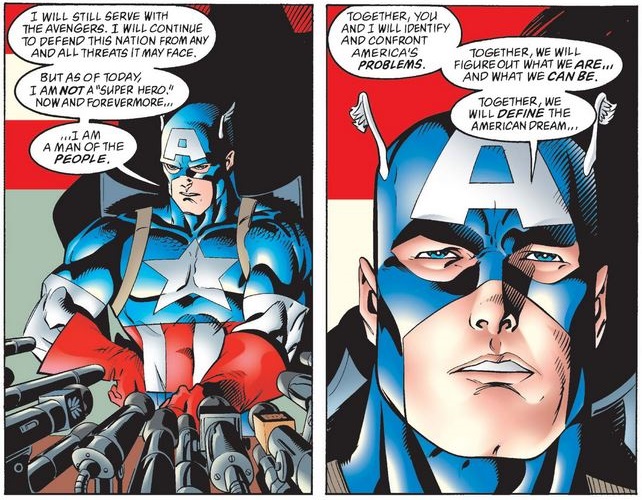
He finishes with the idea, which I associate with writer J.M. DeMatteis’s classic run, of making the American dream the American reality, before the “camera” pans out on our hero standing in the torch of “the most beautiful girl in all the world.”

ISSUE DETAILS
Captain America (vol. 3) #7, July 1998: Mark Waid (writer), Dale Eaglesham and Andy Kubert (pencils), Scott Koblish and Jesse Delperdang (inks), Joe Rosas, Jason Wright, and Digital Chameleon (colors), John Costanza and Todd Klein (letters). (More details at Marvel Database.)
Collected in: Captain America: To Serve and Protect and Captain America: Heroes Return–The Complete Collection Vol. 1.
PREVIOUS ISSUE: Captain America #6 (June 1998)
ALSO THIS MONTH: Avengers #6, Marvel Universe #2, and Thor #1 (July 1998)
NEXT ISSUE: Captain America #8 and Avengers #7 (August 1998)


Over the years Mark Waid has introduced some excellent ideas into his Cap stories. He knows how to entertain that’s for sure (even if that requires sacrificing logic & character consistency on occasion), but he also has some interesting insights at times. I have always liked this story. The “Capmania” idea was a stretch but quite acceptable in service of a worthwhile story. Comicdom was full of Punisher-mania and X-men/Wolverine-mania and Spawn-mania..but definitely not Capmania. This had nothing to do with patriotism one way or the other and everything to do with Cap not being “edgy” and “dark” enough (Thank God). Anyway I like the premise of this story. Fear and scapegoating of “the other” is a topic that never gets old- literally, just look at the world we live in (and have always lived in). Certainly, as the premiere anti-fascist hero, Cap is well suited to address this issue. Most of all I always loved the speech at the end. Cap’s pledge to create a better America never bore much fruit in subsequent stories and maybe it couldn’t. Working for the common good requires one to be proactive. To build rather than battle- and that isn’t what comics have traditionally been about.
LikeLike