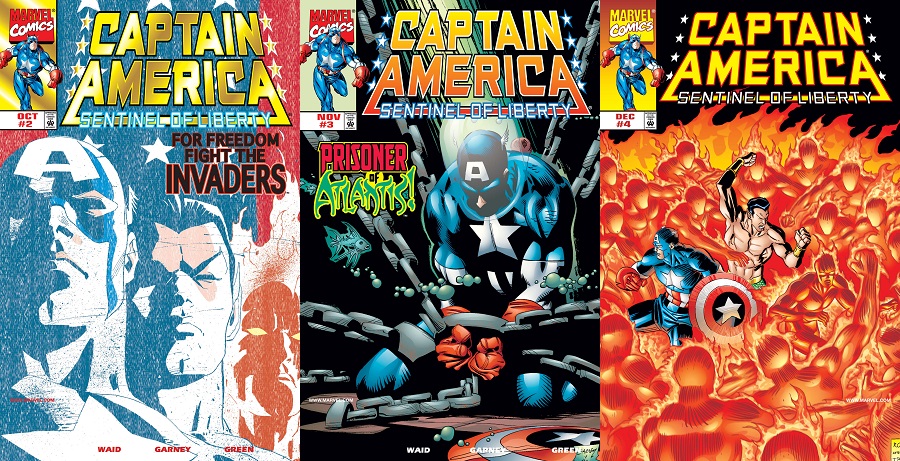
These three issues comprise a fantastic Invaders story set in 1942, narrated by Captain America—to whom is not clear, but he does note it’s “nearly sixty years” later, so he is probably telling this story in 1998 (or even 2001, when the last issue took place for some reason). Anyway, Grandpa’s war story gives us a welcome look into his thoughts about his two colleagues, Namor and the Human Torch (Jim Hammond), casting a well-deserved (and all too rare) light on the latter.
Issue #2 opens with a record scratch scene of Cap and Namor held captive by underwater Nazis, before backing up a week to explain how they got there. We start with an apparently random Invaders mission, in which Cap establishes the fire-and-ice-water relationship between the other two.
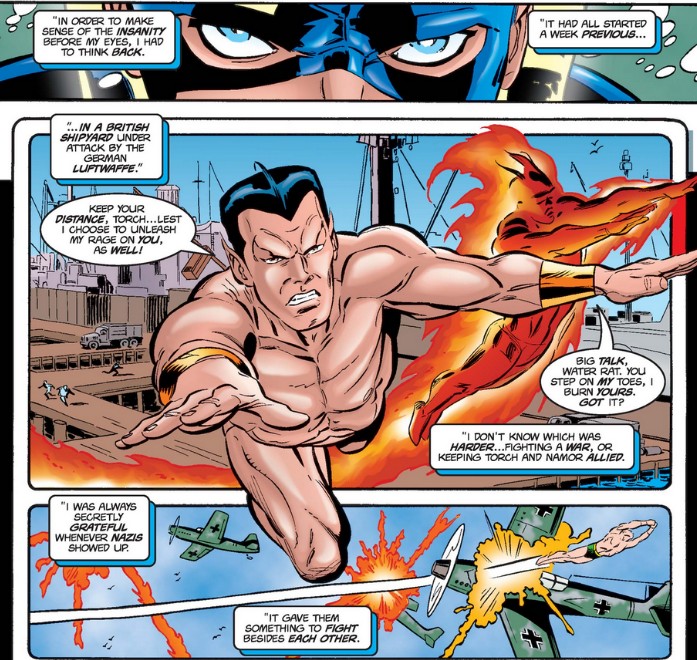
(This goes back to their first meeting—also the first meeting of two superheroes from different strips—in 1940’s Marvel Mystery Comics #8.)
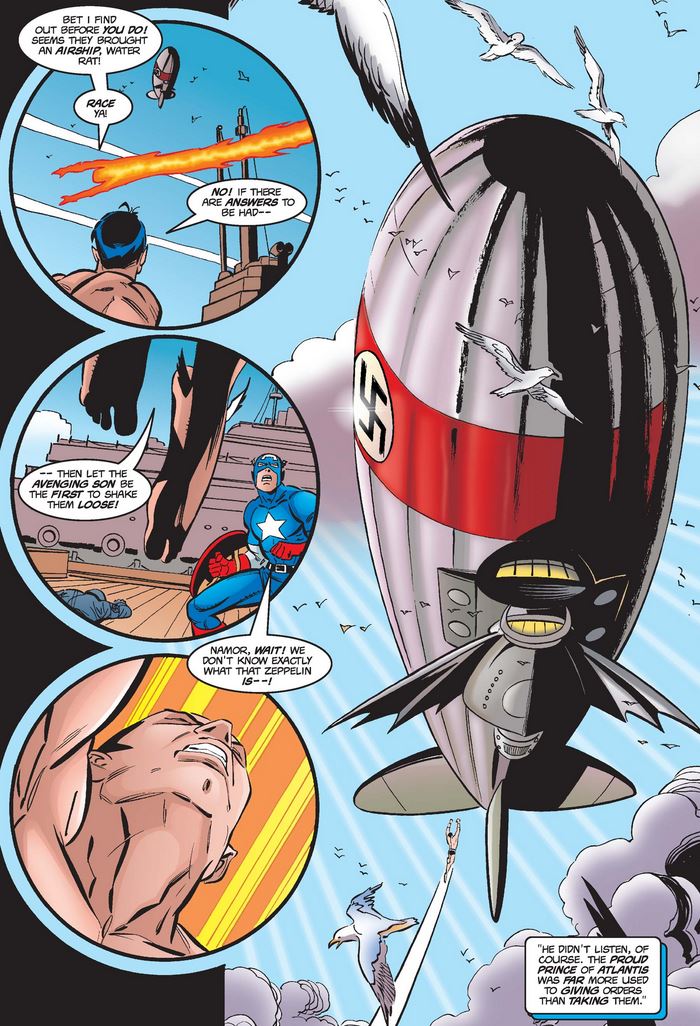
As Cap begins to suspect there’s more to this shipyard attack than it seems, a zeppelin appears overhead and the two rascals try to beat each other to it, much to the dismay of the adult in the room. He focuses on Namor’s pride at first…
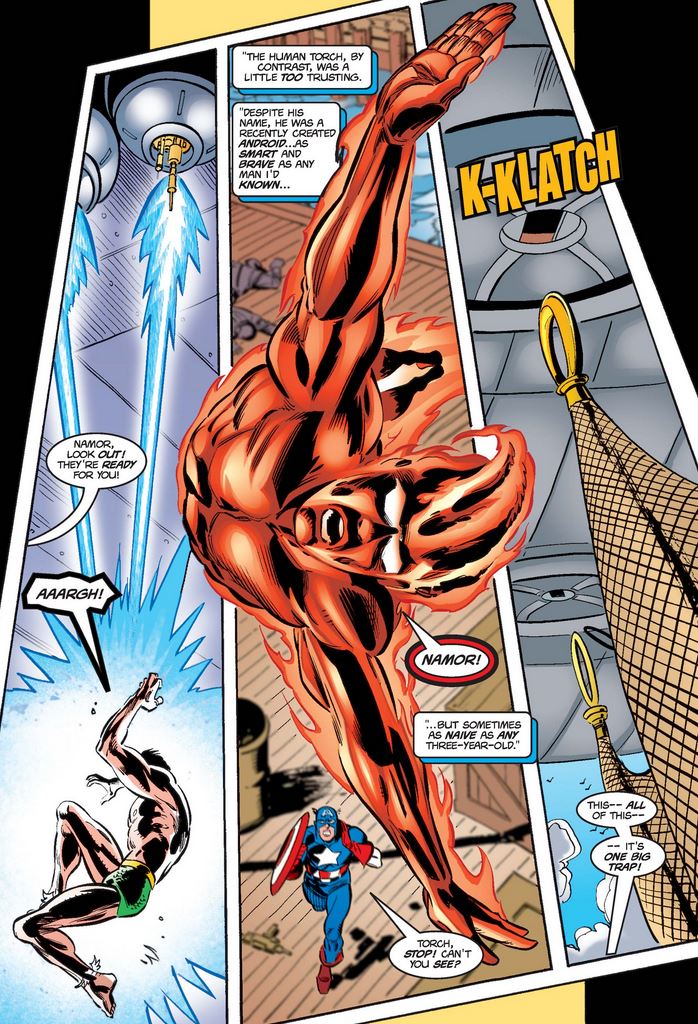
…before turning to Hammond, whose child-like enthusiasm he appreciates while noting its downsides (especially when fighting Nazis).
The craft hidden under the zeppelin dives into the sea with its “catch,” and Cap finds himself explaining the episode to General Phillips, who acknowledges that the Invaders fulfilled their basic mission but failed to stop the Nazis from achieving their true goal…
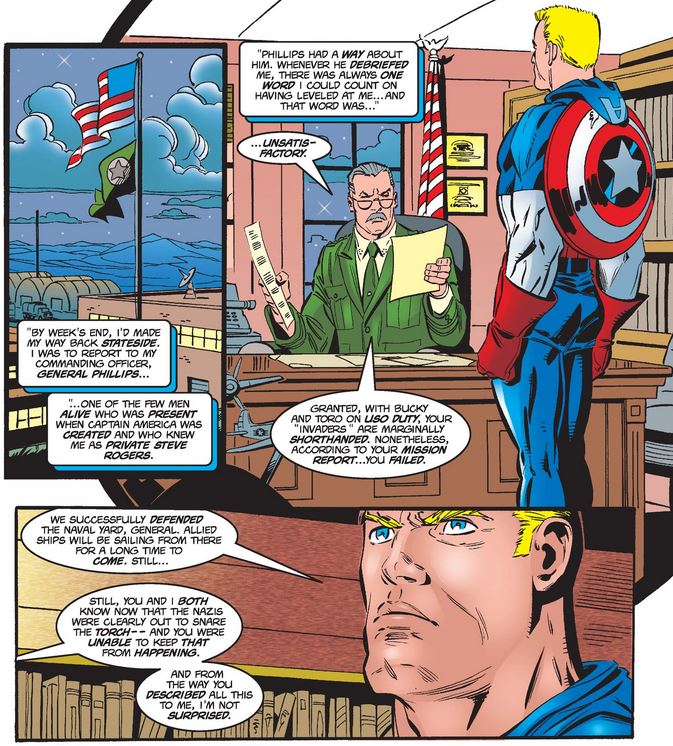
…and then drives the knife in a little farther before getting to the heart of the problem.
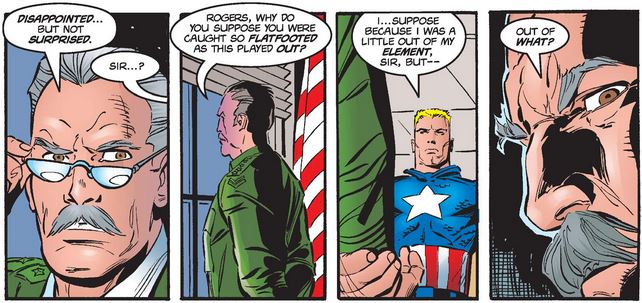
Phillips imparts a very important lesson to this young Steve Rogers, one that will be particularly useful when he soon finds himself captured and held underwater.

In hindsight, Cap can see that he was angry and cocky, needing occasional dressing down like this, which only drove him harder.
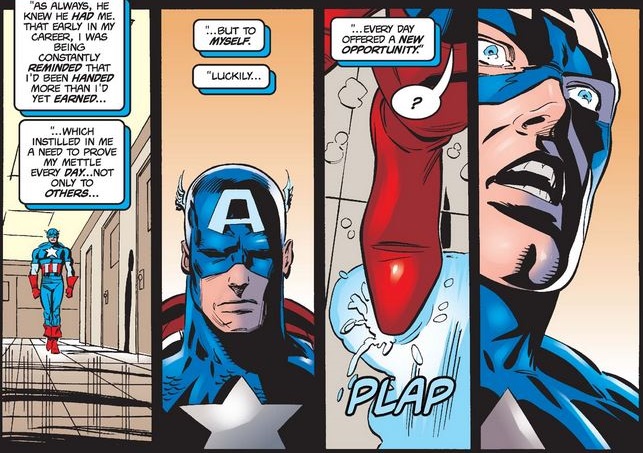
When Namor shows up with a frosty summons, Cap has a million questions, and is surprised that for once the Sub-Mariner is not answering.
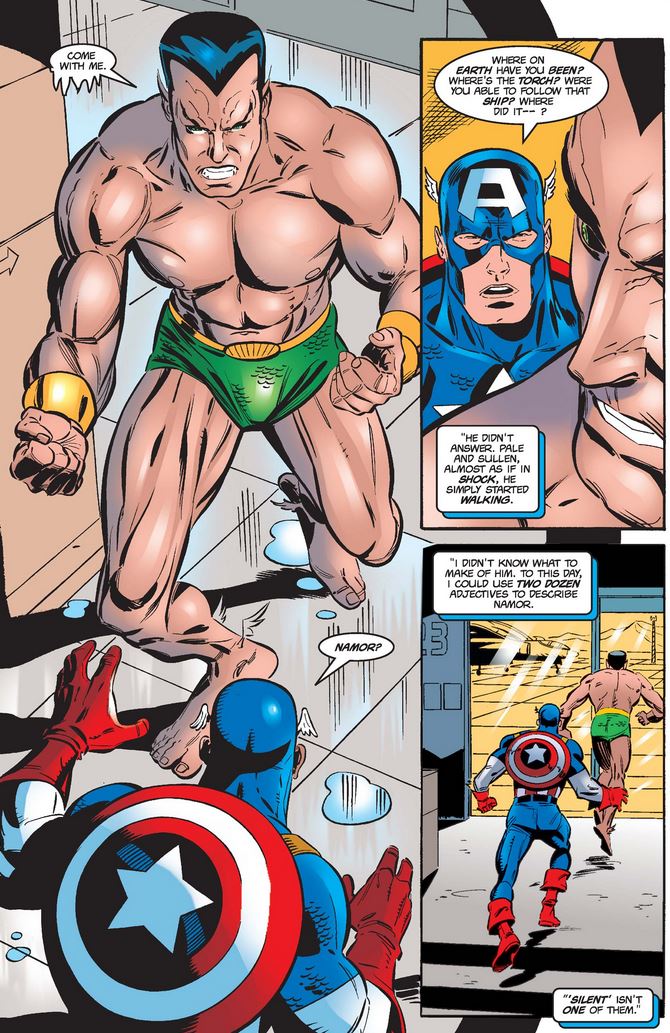
Two dozen adjectives, wow… maybe his name is actually Steve Roget’s!
<crickets>
On the way to Atlantis, Cap speculates about the source of Namor’s “personality,” such as it is, but chooses wisely (as he recognizes).
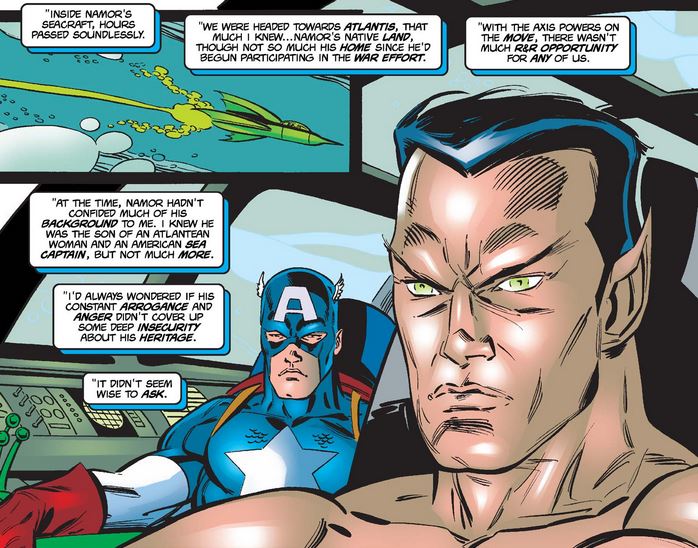
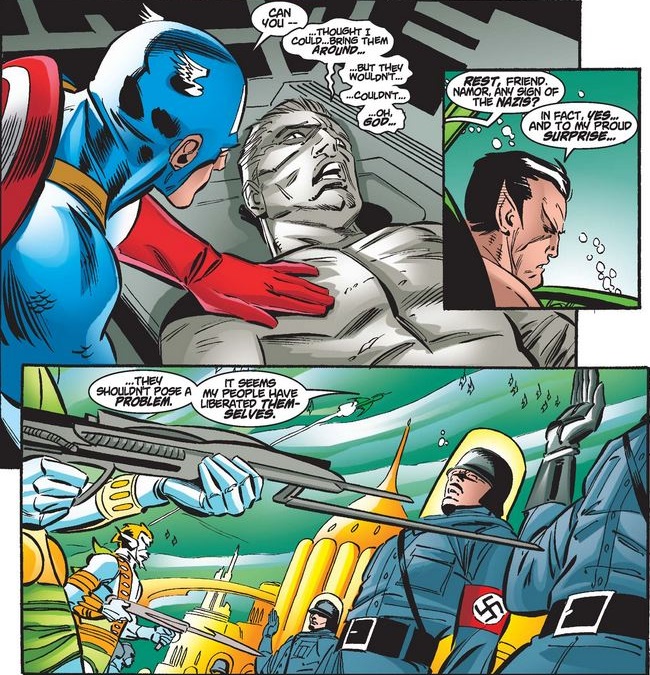
He soon realizes a more immediate reason for Namor’s mood when he sees Atlantis ahead with swastikas plastered all over it, and Namor tells him that, in his absence, the Nazis lied to his people about an American threat to the undersea kingdom to gain access to Atlantean technology. But luckily, Namor has a plan.
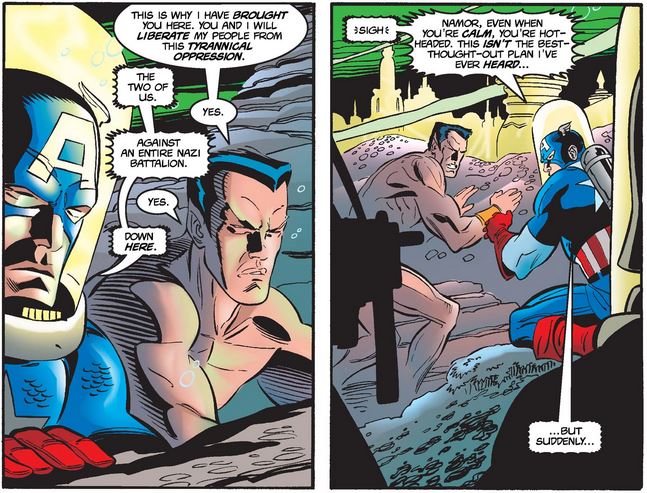
Cap admits, “I don’t have a better one,” while jumping into the fray…

…and when we zoom into the exposition in the lower left-hand corner and the panel below it, we see Cap remembering how that jump was not well-considered, finding himself distinctly “out of his element.”
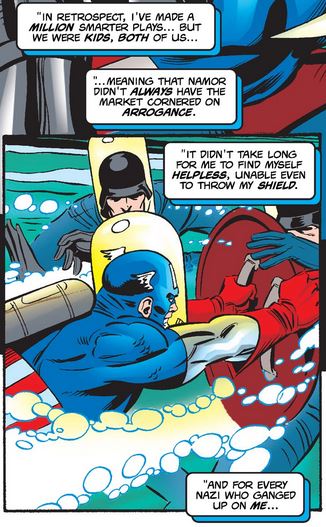
As Cap and Namor fought the Nazis, the Atlanteans began to question their allegiance, when suddenly the Human Torch appears, giving the Nazis a chance to “protect” the Atlanteans from the threat they created (as fascists typically do). In the end, Cap and Namor are captured by the Nazis under the command on the woman seen below, to whom Namor seems awfully deferential… and then Cap learns why.

Issue #3 opens with a great illustration of Cap’s legendary defiance (more surprising at this stage of his life) as two Atlanteans reiterate all the deprivations they’ve imposed on him, and yet…

…his response never changes.

He remembers this behavior coming from youthful arrogance, but it continues throughout his “career,” though perhaps deriving more from earned confidence and simple perseverance by then.

He takes Phillips’s words to heart, using his circumstances to his advantage, including his opponents’ underestimation of him.
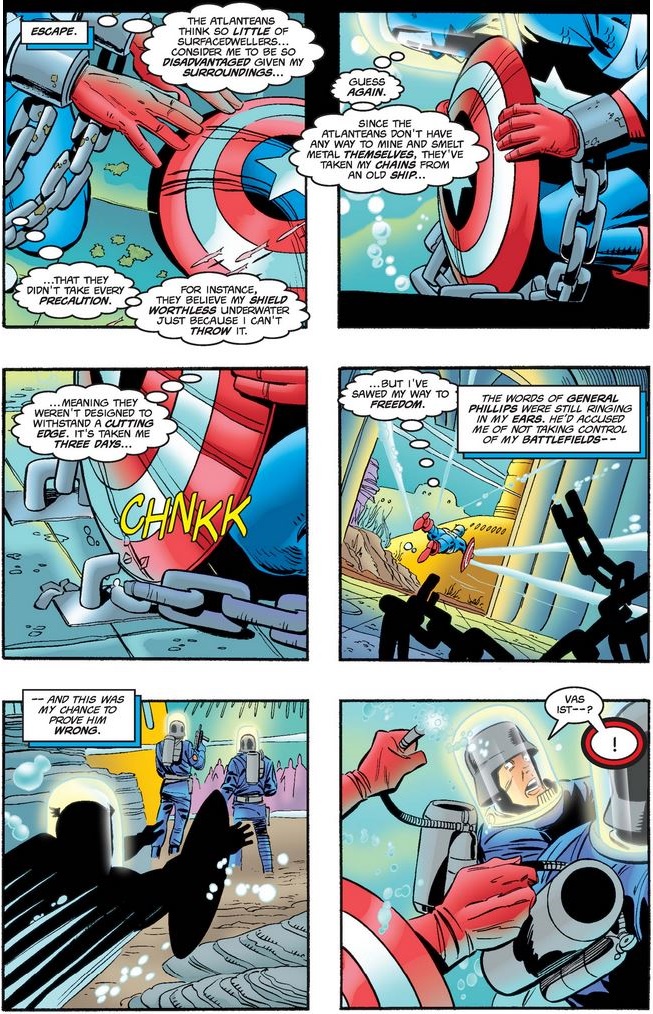
Once free, Cap turns the tables on the Nazis, who are presumably even less well suited to underwater life than he is…

…and definitely less well-versed in aquatic life (although, to be fair, one of them does know what’s going on, but too late).

When Cap finds the Nazi scientist who warped the Human Torch, he is able to use the shield as intended…
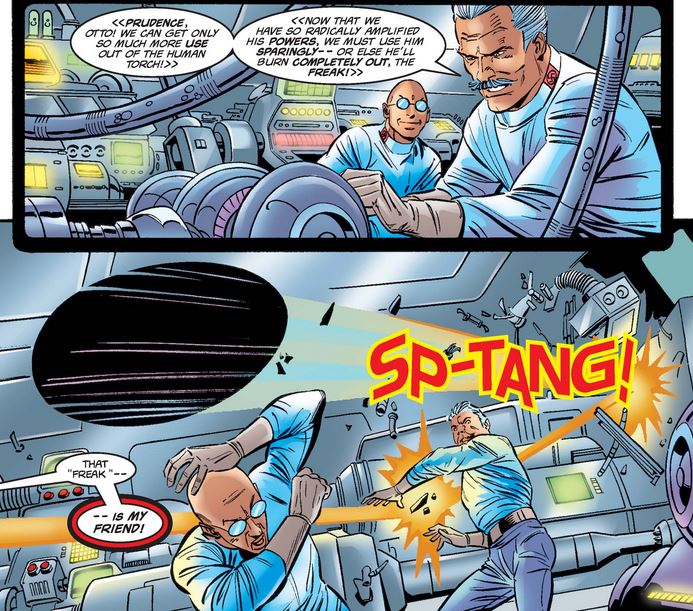
…as well as his German lessons. But when he thinks he’s found Hammond, he actually finds something far more disturbing.
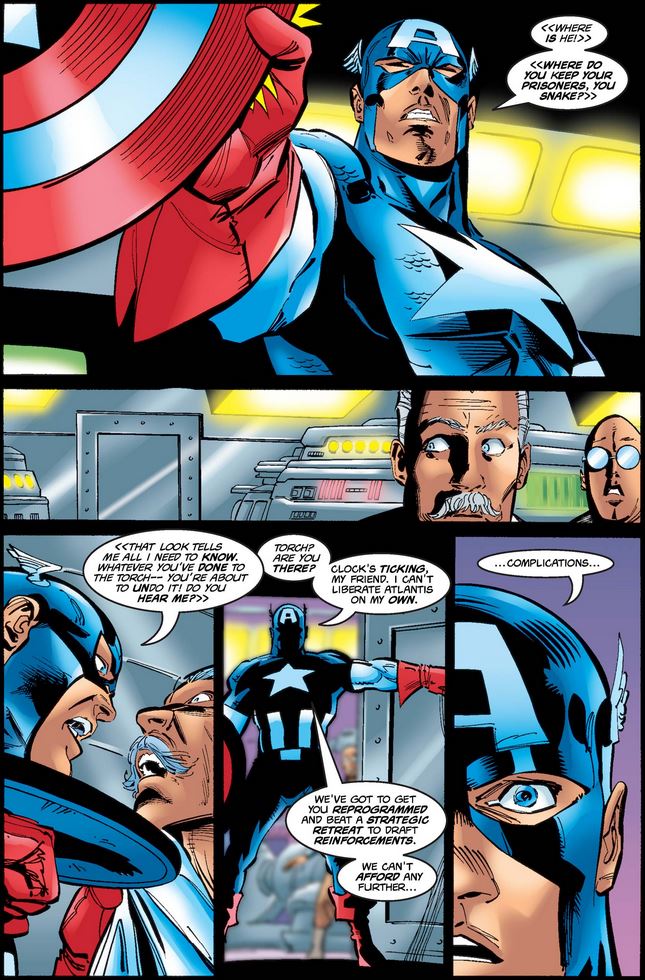
Given that this story takes place in 1942, it is safe to assume Cap hasn’t seen the Nazi concentration camps in Europe yet, nor many POWs at all.

Meanwhile, Namor is trying to convince his mother the Nazis are using her and that not all surface-dwellers are bad. She reminds him that she too has been on the surface, including meeting his father and bringing their son back, where he was accepted despite his “handicap.”
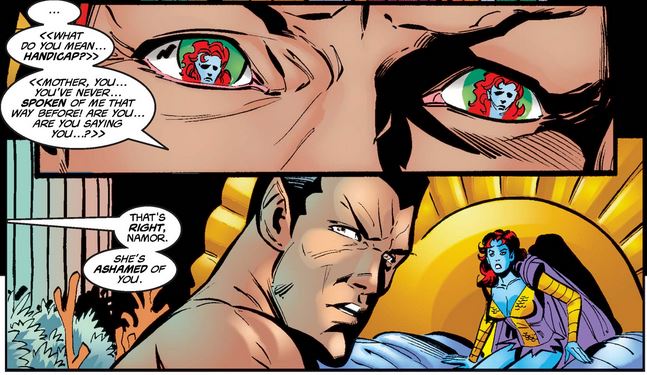
Cap uses her words—or even just her tone—to try to break through to Namor, and she helps by leaning into them more.
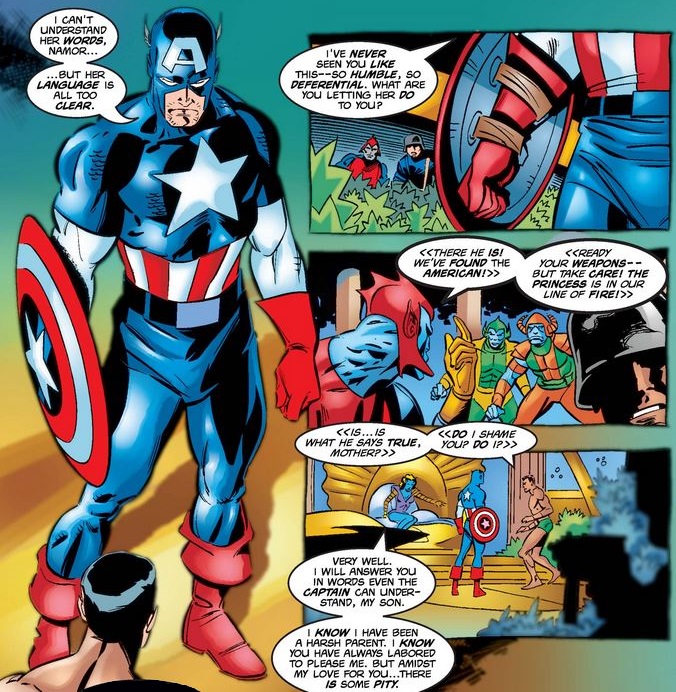
When she goes too far, saying nothing good came of her liaison with Namor’s father, Cap cleverly interprets her in a way that empowers Namor to fight back, setting the plight of the prisoners against his maternal loyalty (which is sorely tested by this point).

Namor’s decision is made clear after an Atlantean guard shoots a flaming harpoon at Cap, who is glad to see his friend is back.

Of course, there is still one Invader unaccounted for, and when he attacks the other two, Cap realizes he is close to burning out and needs to reach him as quickly as he did Namor.
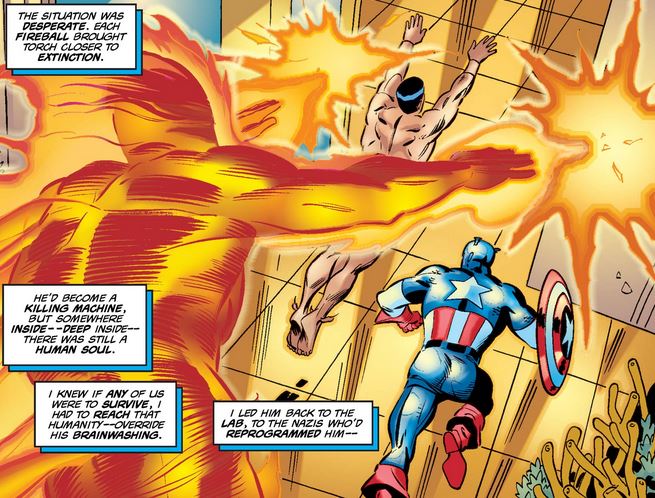
After the Torch lashes out against the scientists responsible for his modifications—although we don’t know if it was intentional, conscious revenge or simply blind rage—Cap takes a huge risk to try to get through to the Jim Hammond he knows (and a risk similar to the one he took in 1998 with the Japanese terrorist in Captain America #1 after returning from the Heroes Reborn world).
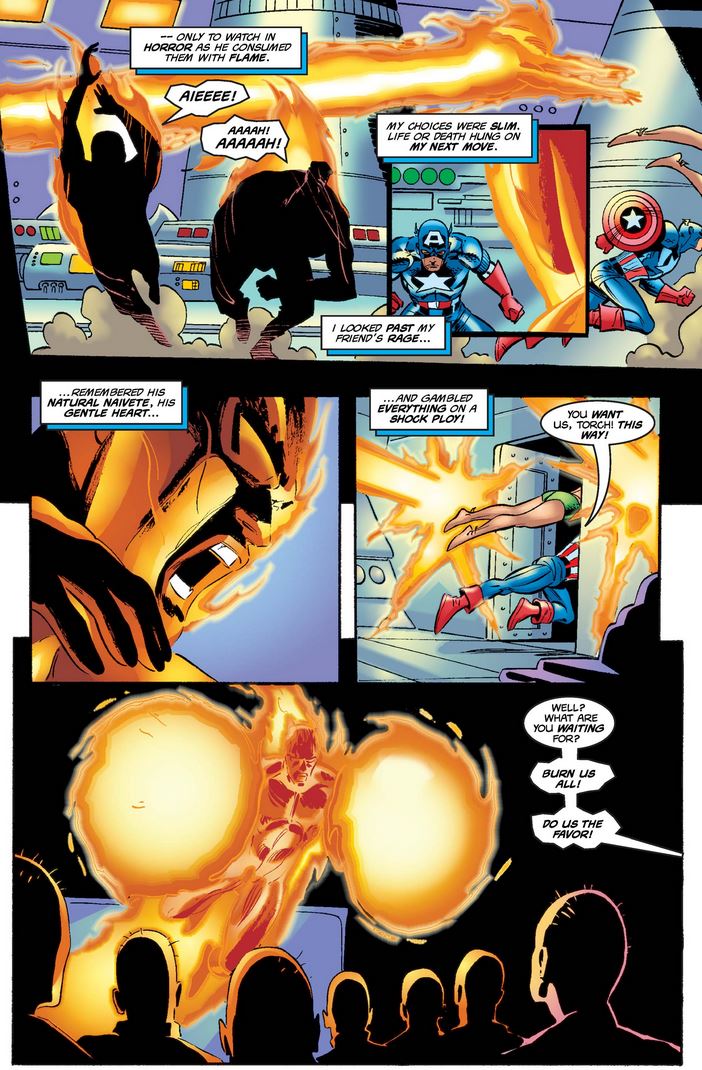
Cap explains what the Nazis did to the POWs and Hammond’s coerced complicity with it…
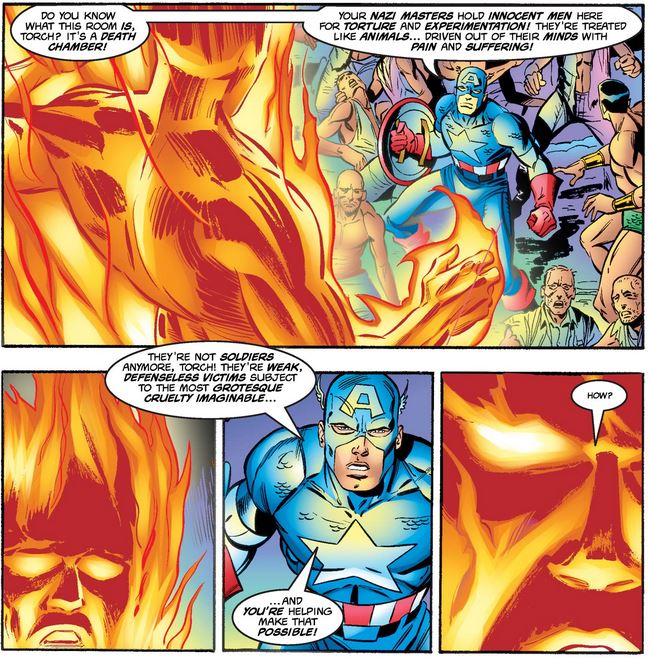
…which snaps Jim of his trance to wonder how humanity can sink so low.
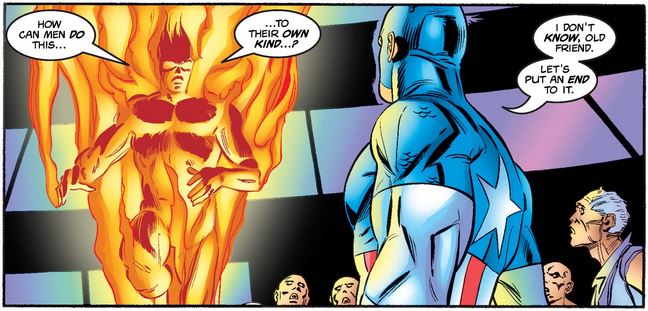
His words foreshadow the next part of the story, which begins with the last page of this issue, showing an army of Human Torches built by the Nazis based on Hammond.
In issue #4, Jim goes berserk trying to stop the flaming army, despite Namor’s warnings that he’s putting his own life in danger. As if things couldn’t get worse, the lab starts taking on water, leaving Namor and Jim (in blue rather than red—those damn Nazi scientists!) wondering where Cap is… until they find out.

On a destroyer in the Antarctic, General Phillips and Admiral Tyler watch as the Human Torches fill the skies, followed by the Invaders, under orders from Captain America…
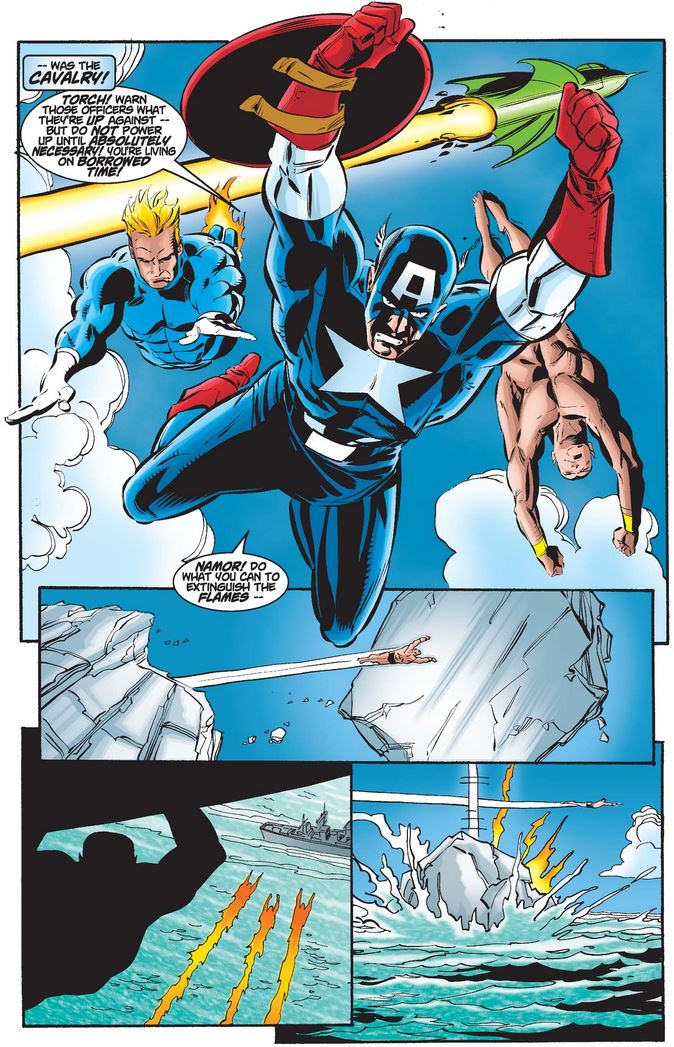
…that continue below, as the Human Bowling Bowl knocks down some flaming pins and Jim cleverly uses his abilities defensively (preserving his limited power for later).
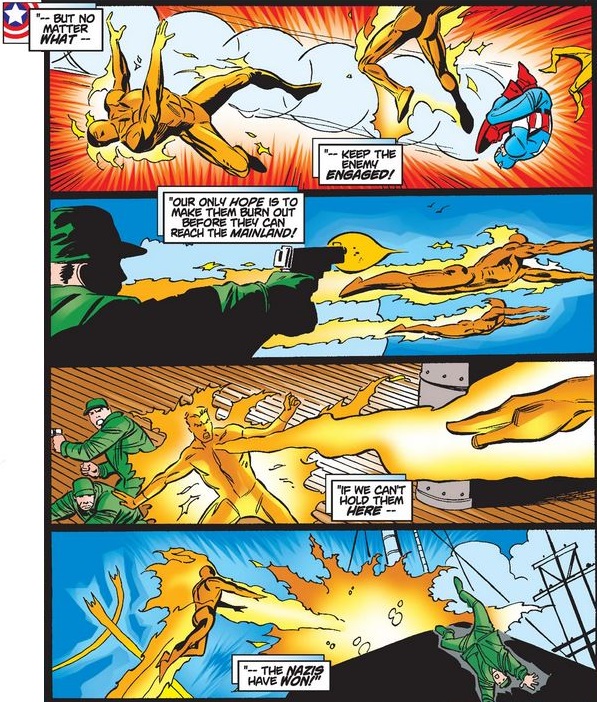
Cap grows despondent, but once again Phillips’ words lead Cap to a solution.
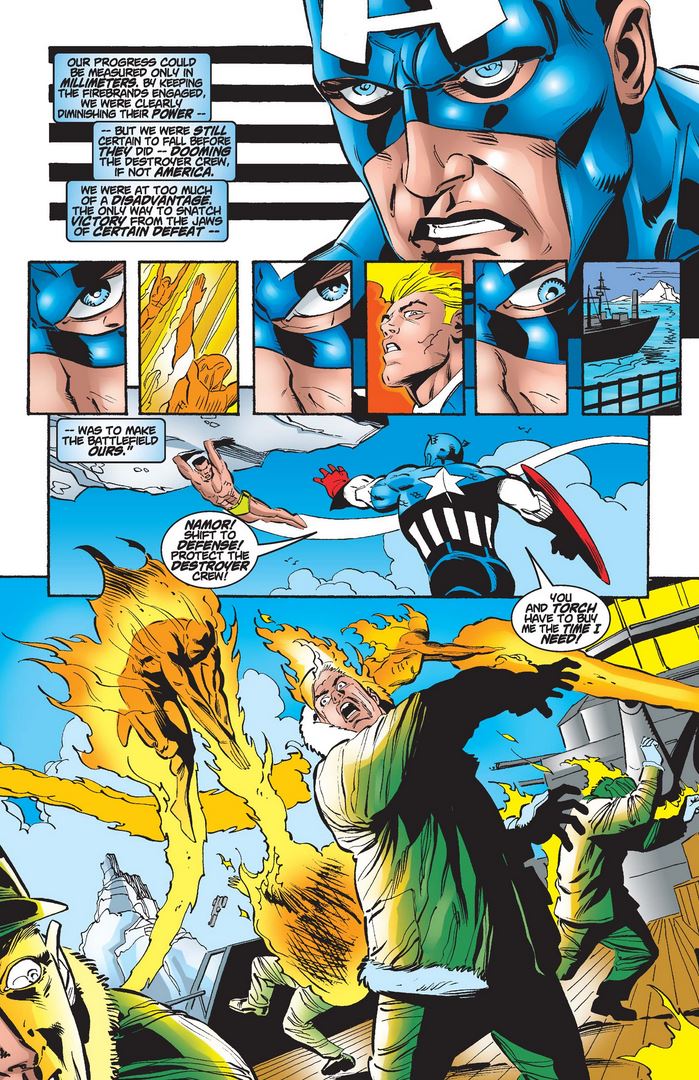
As Cap gives orders to Tyler as well, Phillips makes clear he sees what Cap’s planning and discourages it, and Cap can only let him know he got the point (which Phillips’s salute affirms).
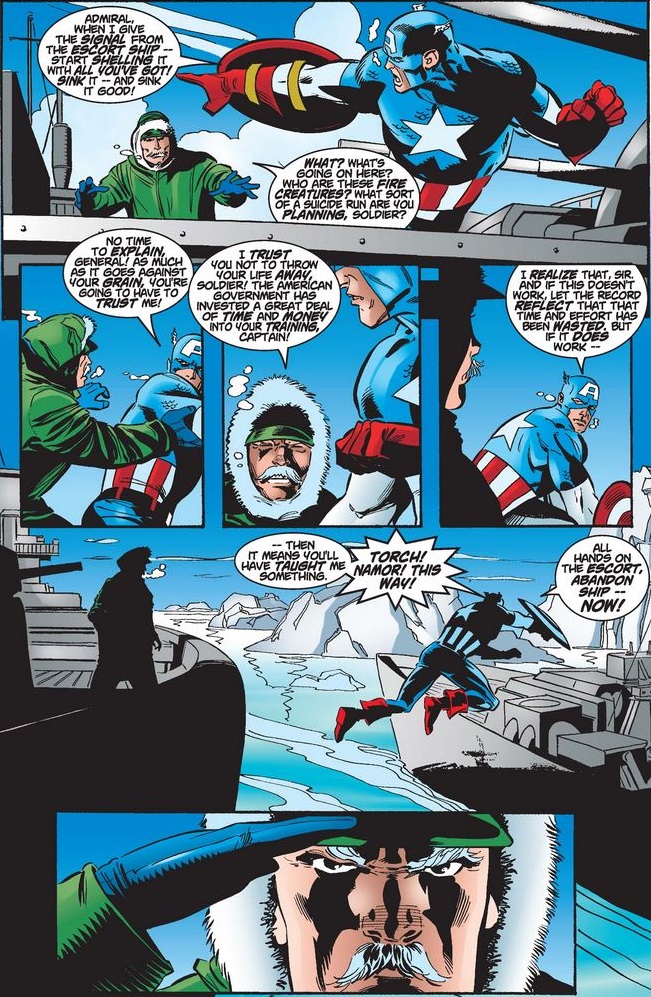
The Invaders lead the Torches into the destroyer’s escort ship, with Cap serving as chief lure…
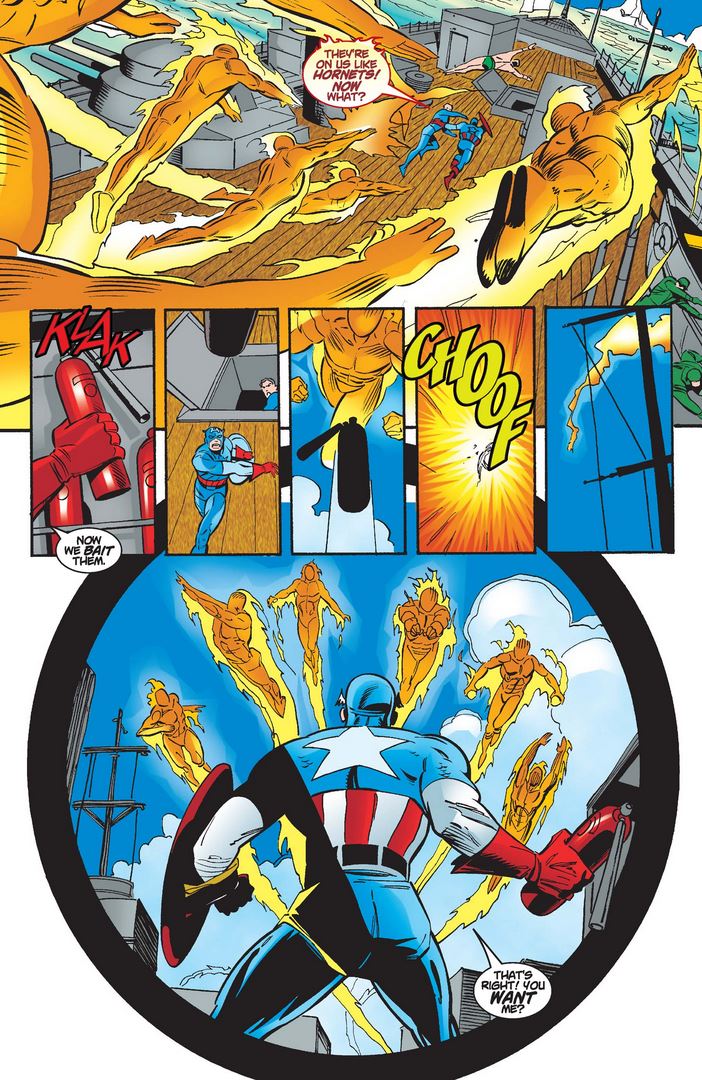
…while his two friends would like to be in on the plan as well, which is working well as far as Cap is concerned.

When Cap does reveal his plan, though, Hammond is appalled, and Cap uses some questionable metaphysics to argue that, unlike Jim, the Nazis’ Torches are killing machines that lack the humanity Jim demonstrates through his heroism and compassion, even though its source remains mysterious. (This issue arises often in the modern age with the Vision, who has his own complicated ties with the Human Torch.)
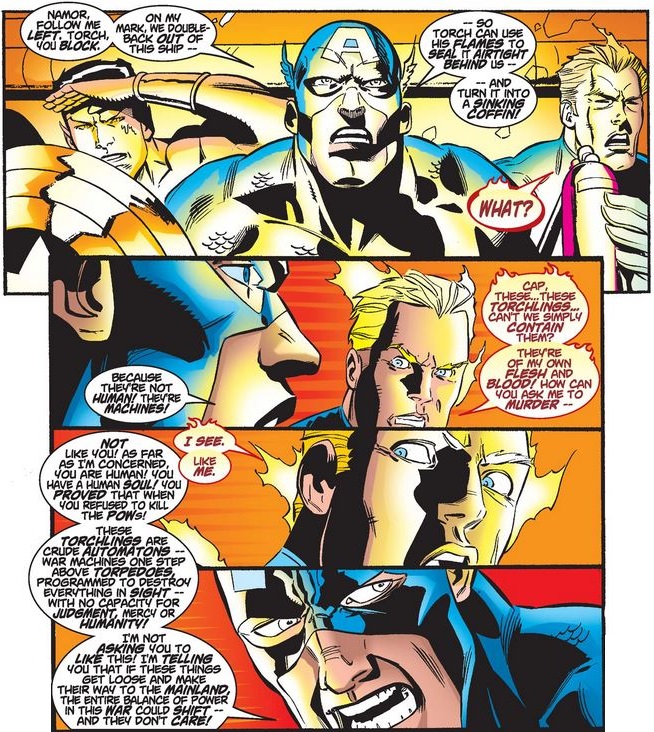
Hammond is convinced and fights back against the other Torches, while Cap finds a way out…
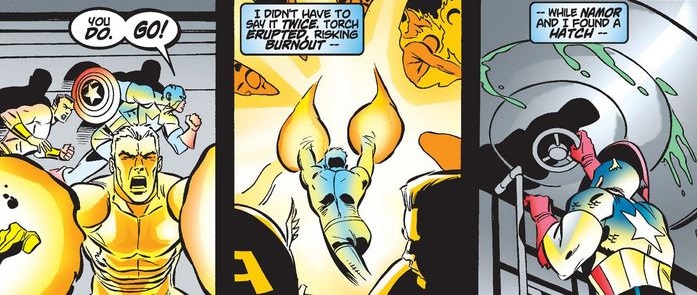
…and discovers Jim has not given up on his “brothers” yet.
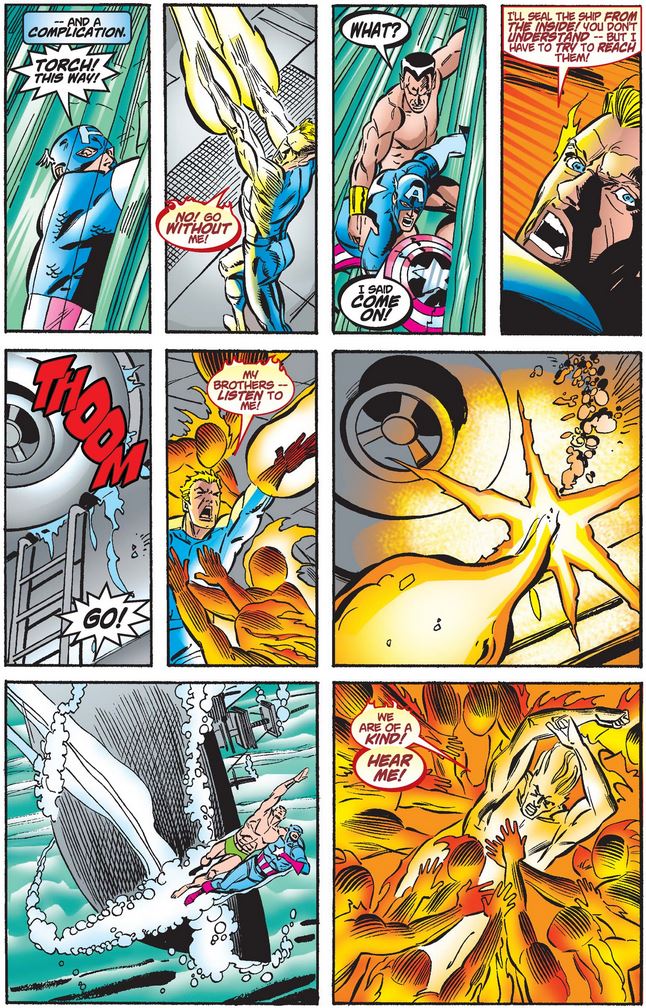
As Namor takes Cap to the surface, Jim pleads with the other Torches, trying to convince them of what Cap said about him, that they are more than just machines…

…but in the end it is for naught, and Jim fires up to blow up the escort ship with him and the other Torches inside. Cap and Namor watch in horror from the surface of the water outside, and after Cap sees a burnt out Hammond float to the surface, Namor flies him back to Atlantis, which has recovered nicely from their Nazi problem.
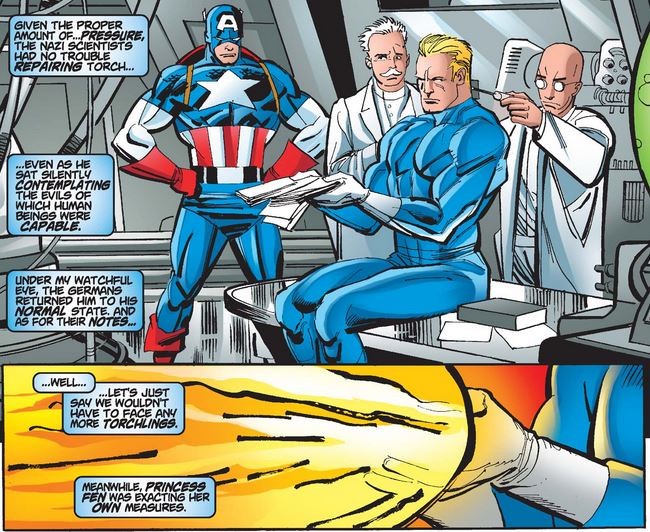
Cap makes sure the Nazi scientists restore Jim to normal (although still dressed in blue, like another Torch I know), and while they are poorly suited to restore his faith in humanity, he does make sure they don’t make any more inhuman Torches. (Note the small “i”: I didn’t mean the Inhumans, nor the brief period that other Torch spent with them.)
Afterwards, Namor stops his mother from executing the Nazis, demanding Atlantis follow the rules of war and return the captured soldiers to their country. (The most well-known Geneva Conventions were not adopted until after the war, but there were predecessors, including one from 1929 that covered prisoners of war.)
In the end, Cap sees positive signs of mutual appreciation between his two fellow Invaders, and even if they are not BFFs, they do share a disgust for Nazis, which affects their impression of humanity in general… except for one shining example.
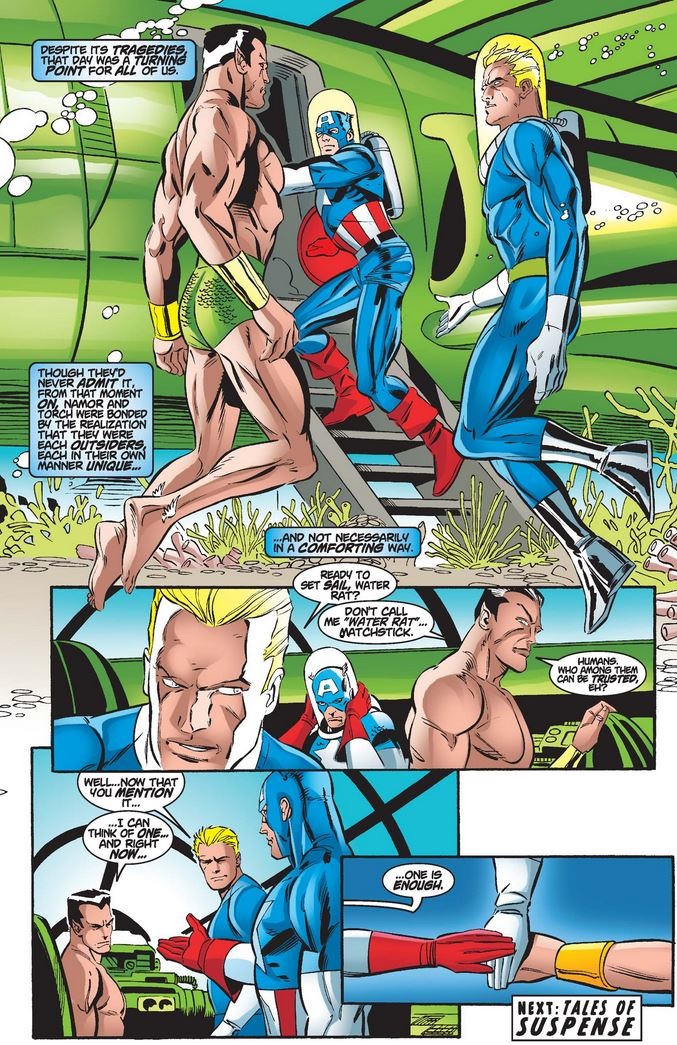
(Yes, the next two issues feature Iron Man in a story that takes place in the days when he and Cap shared the Tales of Suspense title, starting with issue #58.)
ISSUE DETAILS
Captain America: Sentinel of Liberty (vol. 1) #2, October 1998: Mark Waid and Ron Garney (writers), Ron Garney (pencils), Dan Green (inks), Tom Smith (colors), John Costanza (letters). (More details at Marvel Database.)
Captain America: Sentinel of Liberty (vol. 1) #3, November 1998: Mark Waid and Ron Garney (writers), Ron Garney (pencils), Dan Green (inks), Shannon Blanchard (colors), John Costanza (letters). (More details at Marvel Database.)
Captain America: Sentinel of Liberty (vol. 1) #4, December 1998: Mark Waid and Ron Garney (writers), Ron Garney (pencils), Dan Green and Klaus Janson (inks), Matt Hicks (colors), Richard Starkings, Emerson Miranda, and Comicraft (letters). (More details at Marvel Database.)
Collected in: Captain America: Sentinel of Liberty.
PREVIOUS ISSUE: Captain America: Sentinel of Liberty #1 (September 1998)
ALSO THESE MONTHS: Captain America #10 and Excalibur #125 (October 1998), Avengers #9 (October 1998), Captain America #11-12 and Thor #6 (November-December 1998), Avengers #10-11, Iron Man #10, Quicksilver #13, The Incredible Hulk #470, Silver Surfer #146, and X-Man #46 (November-December 1998), Deadpool #23 (December 1998), Thunderbolts #0, and Avengers Forever #1 (December 1998)
NEXT ISSUES: Captain America: Sentinel of Liberty #5-6 (January-February 1999)
 THE VIRTUES OF CAPTAIN AMERICA
Leave a comment