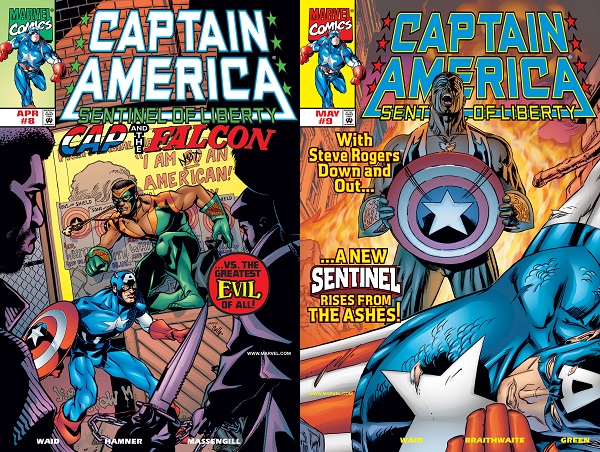
This two-parter takes place in the old Captain America and the Falcon days, specifically between issues #139 and #144 (for reasons we’ll see below). It not only features Sam Wilson’s first time as Captain America, long before ascending to that role on a permanent basis in 2014, but also previews the more nuanced discussion of the two men’s attitudes toward race that we saw in the Sam Wilson: Captain America title, as discussed in the new edition of my book as well as a series of recent Psychology Today posts based on it:
- Exploring the Virtues of a New Captain America
- How Important Is Race to the New Captain America?
- Sam Wilson’s Parents and His Approach to Captain America
- Sam Wilson’s Proactive Approach to Being Captain America
Back to the comics: Issue #8 opens with Cap and Sam guarding a mayoral candidate’s speech in Harlem against suspected militant activity during a time of heightened racial tensions, as indicated by Sam’s narration pointing out both the color of the captured terrorists and many of his neighbors’ disapproval of his own running partner.

To make things worse, the white supremacist group known as the Sons of the Serpent have rebranded as the Sons of the Shield, imputing their own odious views to Captain America, as made clear by their leader, John Mason.
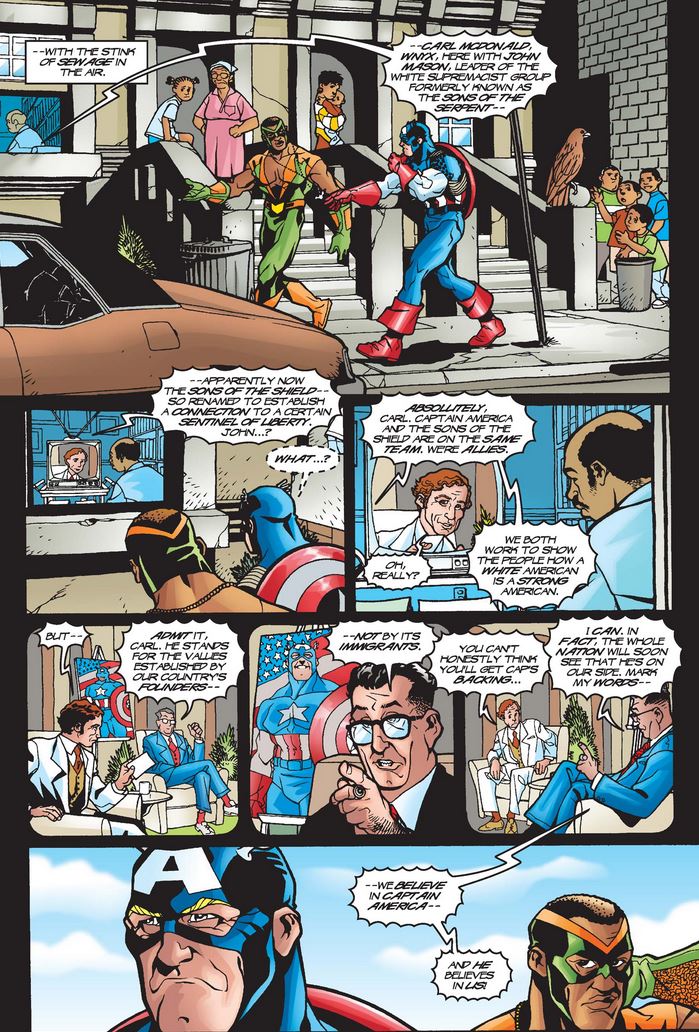
Cap’s expression of disgust above is no surprise at all.
Sam gets it too, of course, and goes on to mention the first thing that dates this story: NYPD officer Steve Rogers, a short-lived status that began in Captain America #139. Below, Steve assures Sam that he has faith in the American people to dismiss Mason’s pitch, but he still stands ready to take action if things go far if things go too far in the wrong direction (similar to what he had to do in the modern day in his main book after a Skrull impersonated him).

Sam points out the race of most of the militants they’d recently arrested, which Steve hadn’t noticed; this, again, doesn’t surprise Sam, but it does point out the facile nature of saying “I don’t see race” even when race is relevant (whether to the identity of criminal conspirators, such as here, or more generally to issues of discrimination or social justice).

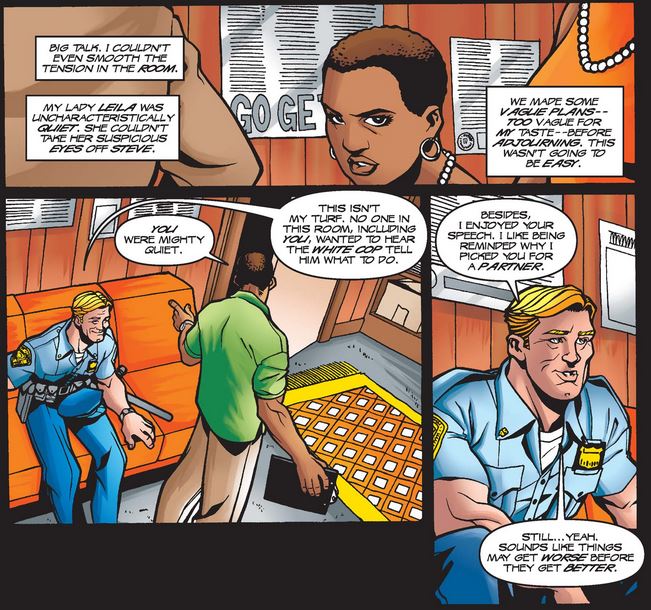
Steve isn’t completely clueless on this front, however. He’s in the room as Sam Wilson, social worker, gathers community leaders to organize a response to the Sons of the Shield and swears to do whatever he can to keep them out of Harlem. Realizing his input may not have been appreciated at this particular juncture, Steve simply listens in pride, and offers a rather pessimistic assessment when it’s over.
After Ajanii Jackson, a Black man secretly working with the Sons of the Shield, bombs a local church on their behalf, Sam urges his community to remain calm, but Jackson only encourages them to violence, calling the Falcon and Captain America into service—but if Sam Wilson couldn’t convince the residents of Harlem to remain calm in the face of racist violence, Captain America is unlikely to do much better.
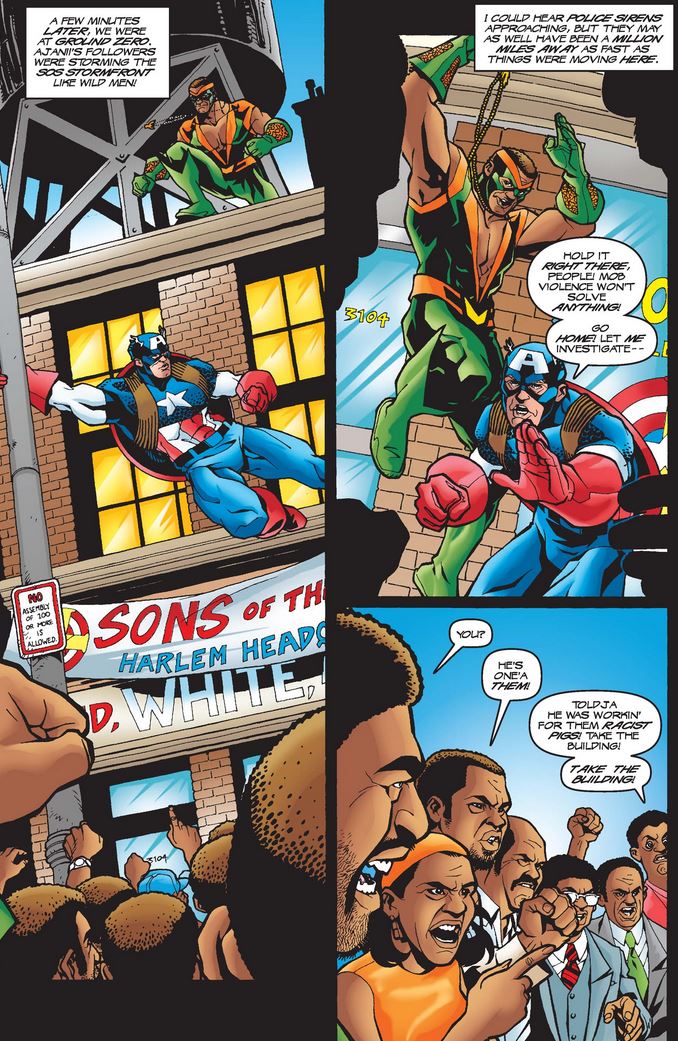
Sam tries to hold his neighbors back and notices the press arriving suspiciously early, while Cap nobly tries to save everybody…

…which gets misrepresented by the conveniently present media.

After Cap uses his shield to unleash a rooftop water tower on the crowd, the Sons stop up their campaign by activating the weapons they had Jackson distribute to the Harlem residents, one of whom accidentally shoots Cap in the back…

…which Mason uses to “prove” his beliefs about the Black community before playing up the death of Captain America for propaganda purposes.
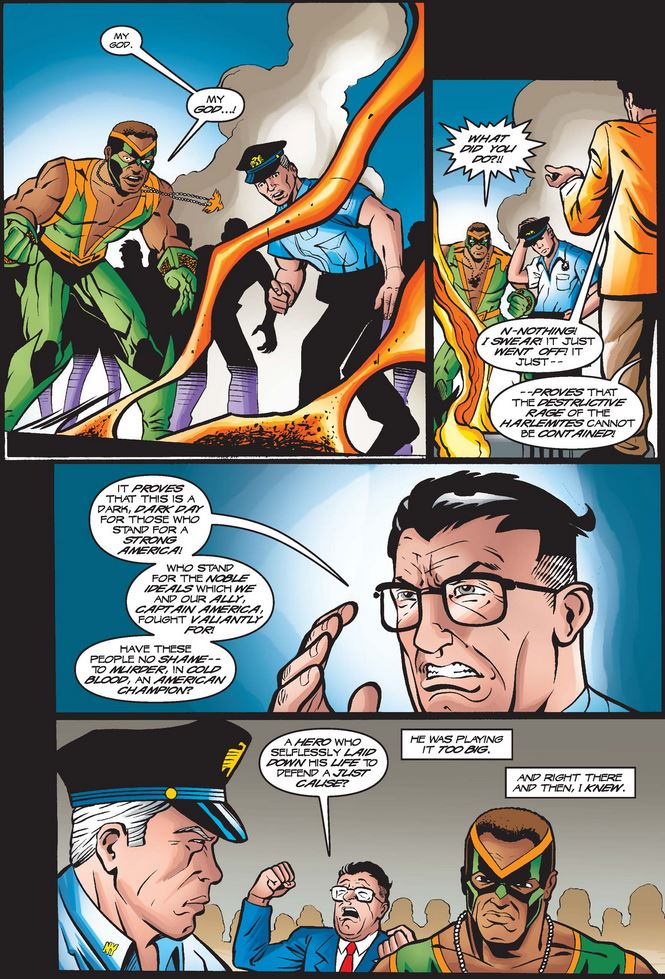
When he puts it all together, Sam loses it, which only plays into Mason’s hands as he continues to twist the meaning of Captain America to his own ends.

So Sam decides to take back that name and restore its true meaning, which Steve had spelled out earlier in the issue…

…while adding anther layer to it entirely.

In issue #9, we see Sam dealing with individuals attacks from the Sons of the Shield, who are surprised to see him under the mask…

…not that he cares in the least.

The media helps to make Sam’s message clear…

…though the Cap at the bottom of the page looks more like Steve than Sam (due to what I assume was an unfortunate coloring error).
Despite his nonchalance in front of the white supremacists, internally Sam isn’t completely comfortable wearing the costume…
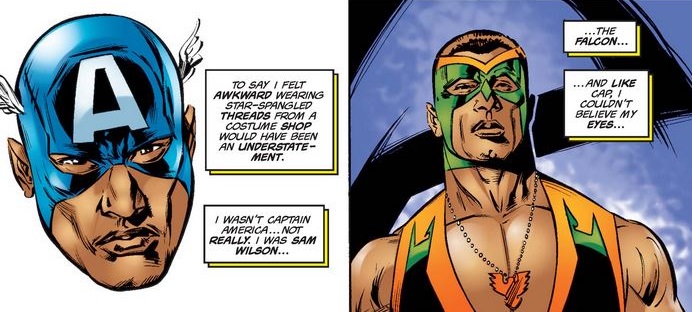
…yet he continues the work, albeit in a slightly different way than Steve did, especially when he finds Jackson.

He paints this as a difference between the methods of Captain America and the Falcon, not different ways of being Cap—and it seems the Falcon acts much more like Daredevil or Batman than Cap. (Watching his dive, you’d almost think he had the winged Cap costume he would adopt in 2014.)

After dropping Jackson on his fellow militants, Sam jumps into the fray…

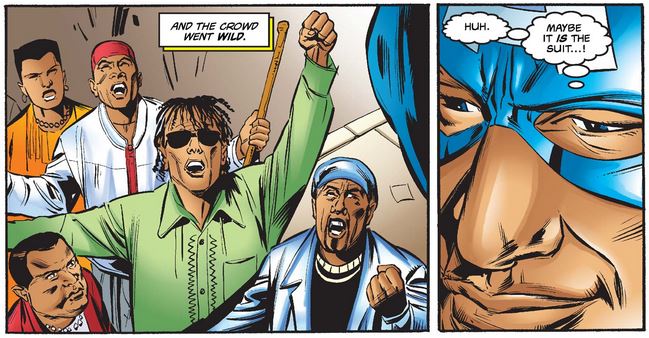
…but soon learns that the costume speaks louder than his skin.

Sam remembers that Captain America’s true superpower is making speeches…

…a power that Sam believes is due to the suit, but is actually based on the person who wears it well and righteously.
With the help of Redwing—or should we call him Bucky now?—Sam follows Jackson back to the Sons’ lair, where Mason reveals his true plans when he inflicts a deadly gas on Jackson engineered to work only on people of color. Sam arrives and stops the gas before he is attacked by thugs who seem awfully well trained…

…and then he sees why (or by whom).

After their secret Taylor Swift codeword fails to work, they keep fighting, and when Mason sees an angry group of Harlem residents ready to storm the place, he releases the gas… but learns its effects are much more egalitarian than he hoped. Sam stays to find a way to stop the gas while fighting Mason, who doubles down on the white supremacy while invoking the concept of honor to support it, which Sam cannot abide.

(On the two senses of honor, a negative one linked to pride of status and a positive one to integrity, see chapter 4 in my book.)
After sustained exposure to the gas, Sam spends his last bit of energy trying to shut it off…
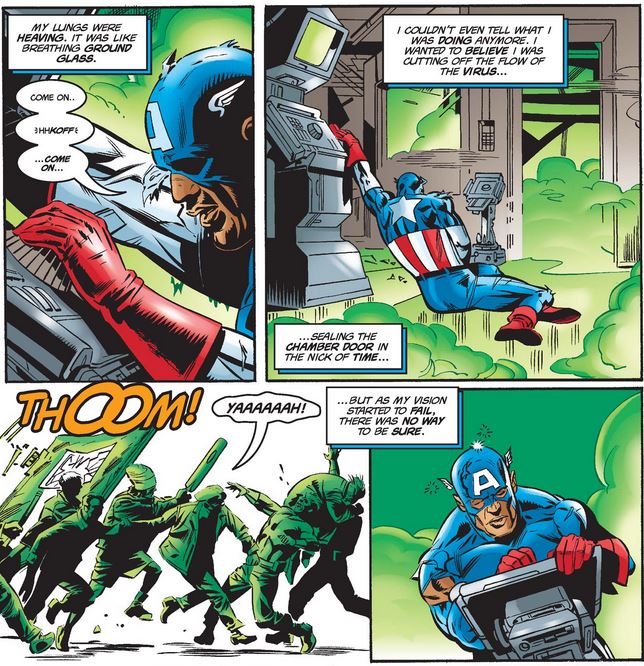
…and after collapsing, he looks up to see a friendly face.

As Steve carries his partner out of the Sons’ lair, he happily acknowledges what Captain America did that day…

…including what he did for the title, restoring its honor and reputation.

By the way, Sam abandoned his green costume when he broke from Cap in Captain America #144, providing a nice tight five-issue window where this story must have taken place.
ISSUE DETAILS
Captain America: Sentinel of Liberty (vol. 1) #8, April 1999: Mark Waid (writer), Cully Hammer and Scott Elmer (pencils), Nathan Massengill and Scott Elmer (inks), Matt Hicks (colors), “Bullpen” (letters). (More details at Marvel Database.)
Captain America: Sentinel of Liberty (vol. 1) #9, May 1999: Mark Waid (writer), Doug Braithwaite (pencils), Dan Green (inks), Matt Hicks (colors), John Costanza (letters). (More details at Marvel Database.)
Collected in: Captain America: Sentinel of Liberty.
PREVIOUS ISSUE: Captain America: Sentinel of Liberty #7 (March 1999)
ALSO THESE MONTHS: Captain America #16 (April 1999), Avengers #15 (April 1999), Avengers Forever #5-6 (April-May 1999), Cable #66-67 (April-May 1999), Captain America #17 (May 1999), and Avengers #16 and Magneto Rex #1 (May 1999)
NEXT ISSUES: Captain America: Sentinel of Liberty #10-12 (June-August 1999)
 THE VIRTUES OF CAPTAIN AMERICA
Leave a comment