
This issue of Captain America sees our hero investigate a private prison with atrocious conditions and brutal treatment of inmates, where persons who run afoul of immigration law are sent and denied any contact with relatives, legal representation, or due process. Despite obvious parallels to current events, there are important differences too (as we shall see), but what shines through is Captain America’s disappointment and disgust at abuses of the criminal justice system at the same time that affirms the importance of its processes and purpose. (Also, note the similarities to the cover of Captain America #260, in which Cap also looks into a prison but for very different reasons.) When we’re done, we see a couple pages from Marvel’s latest “let’s make ’em fight” contrivance, Contest of Champions II, clearly an essential sequel to the original.
After two pages illustrating the revolting conditions in the prison in question, we turn to a cheerier scene of Steve Rogers cutting a rug with Connie Ferrari, displaying skills I really can’t see him having learned “back in the day” as a sickly boy raised in poverty (unless he watched lots of movies with Fred Astaire and Ginger Rogers).
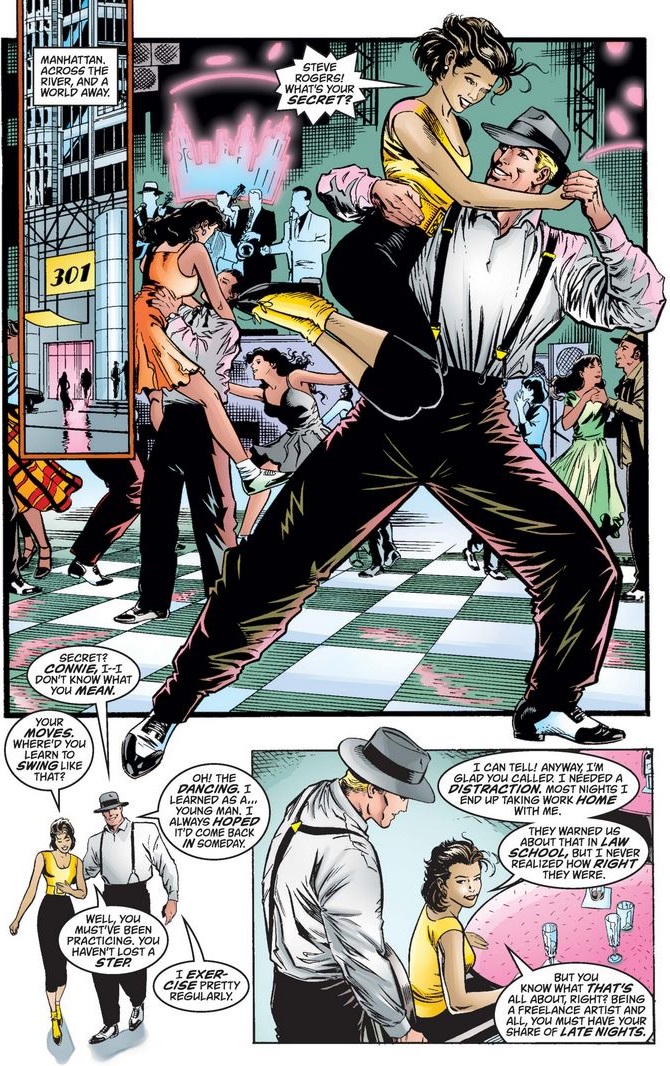
After name-checking his “day job” (always welcome), Connie tells him about Madan Chakara, who discovered the immigration papers he bought were fake when he was arrested by immigration authorities. (Connie learned this from his brother Kanu in issue #21.) Instead of being put in a standard detention facility, Madan was sent to the private prison referenced above, and Steve promises to use his “government contacts” to check it out.
On his way to do just that (in the left half of a two-page spread), Cap reflects on the issues with sharing his other life with Connie, given her brother’s experience in the military (as explained in issue #20 and referenced below), as well as the recent foul-up with Sharon (in issue #19).

Once in Washington (on the right half, hence the awkward hand and foot in the shot), Cap quickly finds out that the FBI is already investigating this prison as well as the government personnel who conspired with its owners to send detainees there—an investigation he strongly wants to join.

So Cap goes undercover as “Buck Jones” (a tribute to his two former sidekicks, I assume), putting on a “tough guy” act in a successful attempt to impress Mosley, the warden, played here by Edward G. Robinson. (“Jones, I think you’re going to fit in just fine, see?”)

Cap tries to simply observe the horrible conditions in the facility, but soon feels he has to intervene to stop a fellow guard from beating an inmate—and finds out why the real guards are working there.

Eventually Cap comes across a small box and discovers Madan inside, broken and twisted into hating the country that did this to him.

When the other guards attack him for freeing Madan, he finds out how flimsy the uniforms are…

…and concludes, quite reasonably, that his disguise is no longer effective.

In case there is any doubt how Captain America feels about this enterprise, the people who run it, and what it does to the people held there:
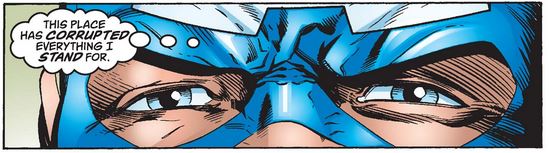
His investigation presumed complete, Cap introduces himself to the warden and expresses his unyielding faith in the legal system…

…a faith that ignores the fact that Mosley works, in a significant extent, within that system and knows how to manipulate it to his advantage (“see?”).
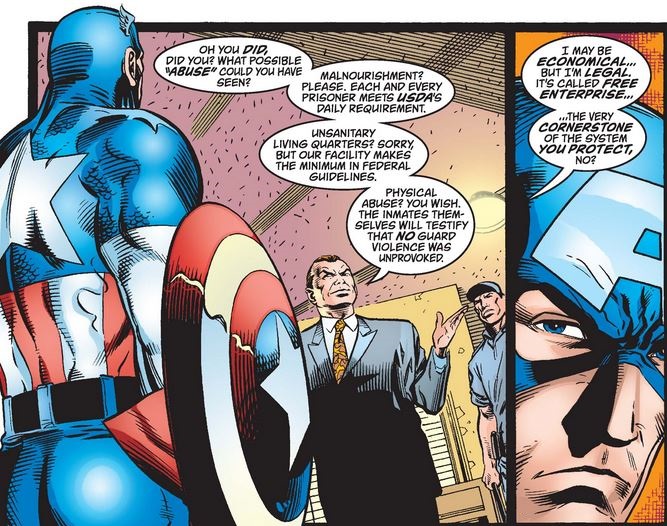
Now he’s making me mad with his non sequitur about free enterprise, which ideally works within a fair and just legal system that protects the rights of all involved. “Free enterprise” is never a defense for illegal or immoral activity, especially when that activity is enabled and encouraged by forces within the government itself. (This touches on the debate over privatization or corporatization of public services, which can be beneficial as long as the cost savings do not compromise the purpose of the services themselves, which do not often appear on an income statement.)
Cap turns Mosley’s “free enterprise” defense back on him in a different way when the inmates revolt and the guards flee for better terms of employment elsewhere. Cap finds himself forced to protect Mosley himself, both because he’s a human being and also a wrongdoer who deserves justice in a court of law (where he will receive the due process denied his inmates).

Below, Cap expresses sympathy for the inmates, but jumps to the conclusion that they’ve all been duly convicted—but he knows for a fact that Madan hasn’t, and surely he is not the only one.

Cap now has to protect the inmates from the guards’ automatic gunfire, while they see him, as Madan did, on the side on the warden (especially since he gets individualized protection)…
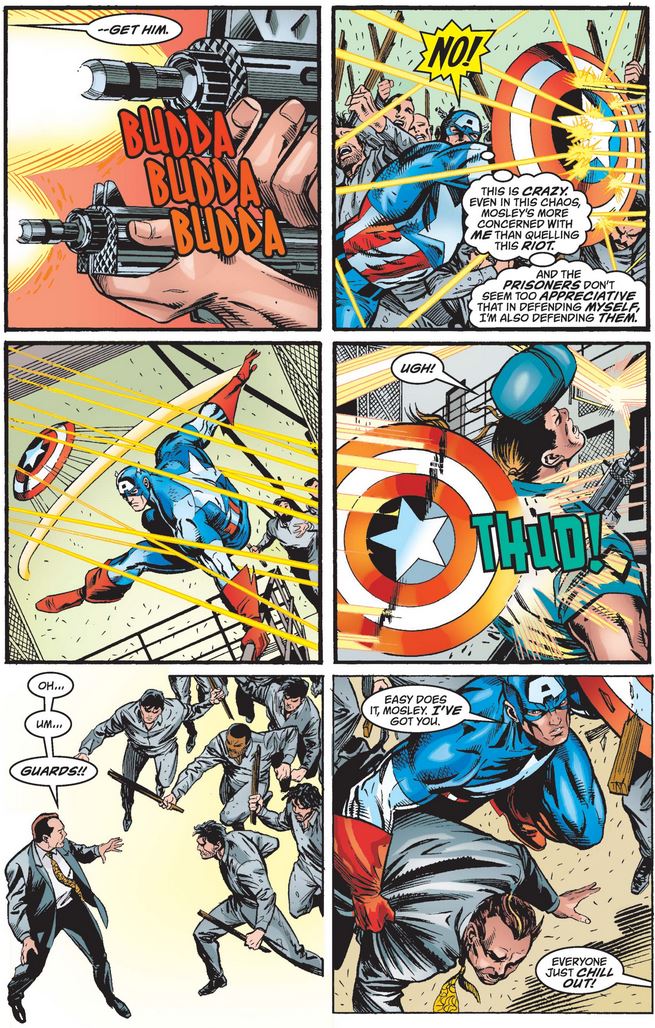
…and Cap carries him like Spider-Man does on the cover of his first appearance.
When another guard threatens the inmates directly, Cap has to let Mosley go…
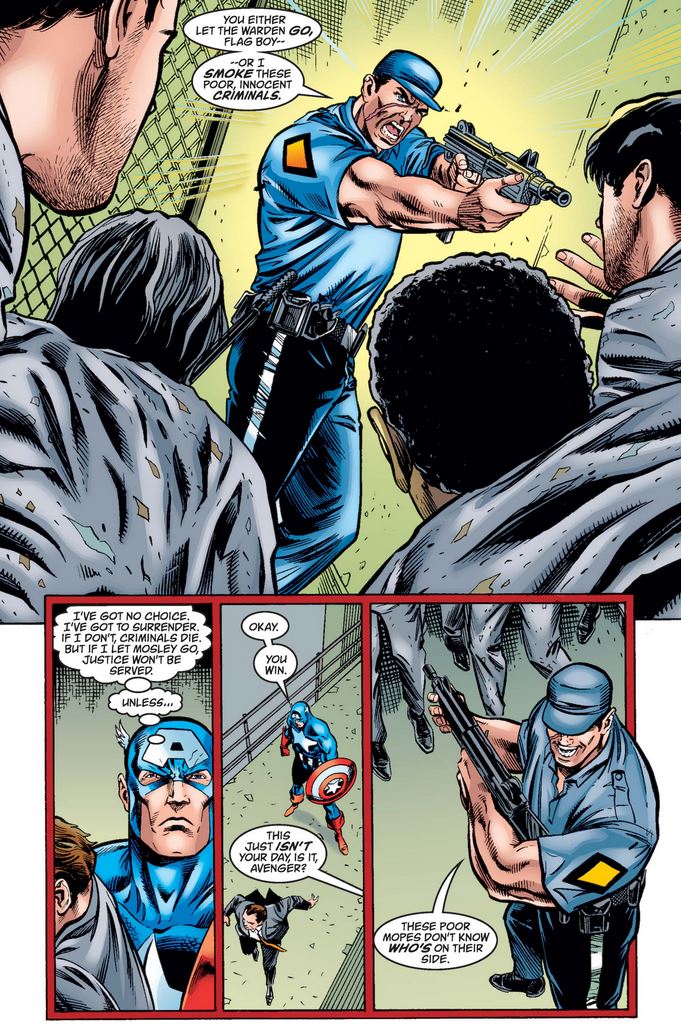
…but when the guard makes the same observation Cap made (albeit less sympathetically), the inmates help Cap prove him wrong.

Our hero gets a chance to show how grateful he is to have his old shield back when he uses it to corral the warden…
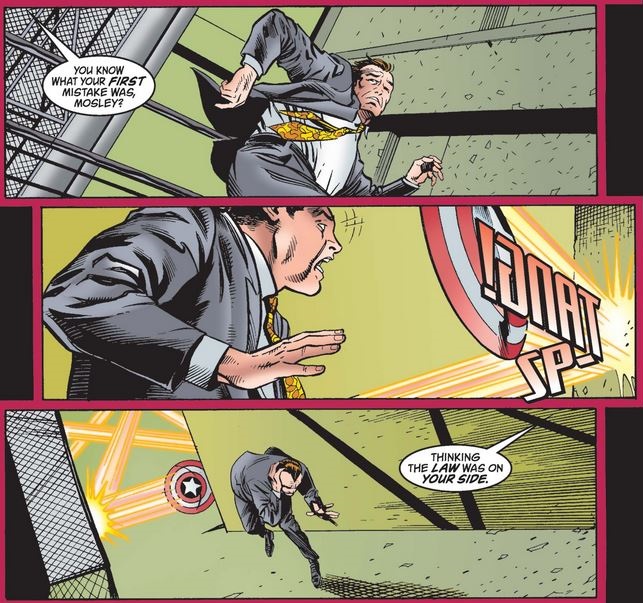
…into the same holding container Madan was in, all while explaining to him how he abused the system of justice he profited off of.

“Mother of mercy… is this the end of Mosley?”
When it’s all over, Connie wonders how a mild-mannered reporter freelance artist could have freed her client’s brother from a corrupt private prison and made sure he received due process for his immigration violations, restoring his faith in the land of opportunity.

I’m sure there’s an analogy in there about hot dogs being messy and complicated and not always pretty but still amazing, but this has been a heavy enough post as it is!
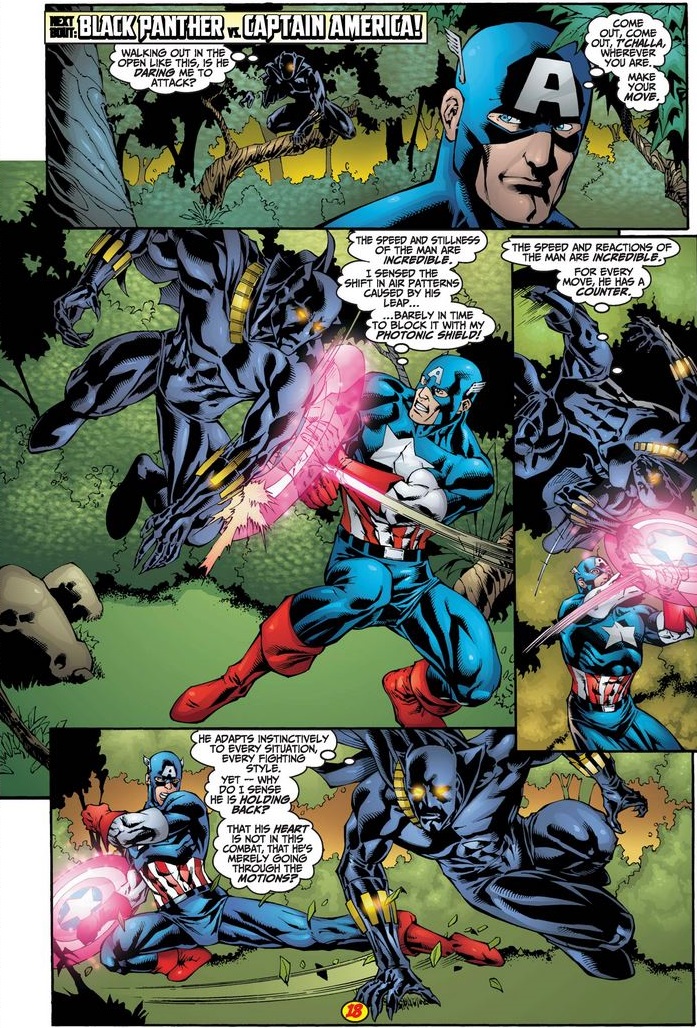
Hot dogs admittedly have little to no nutritional value, which leads us nicely into Contest of Champions II and its fourth issue’s cover-hyped bout… which receives all of two pages inside. Of interest to us are the two friends’ impressions of each other’s skills as well as their mutual hesitance to fight each other…
…on which Cap is first to capitalize (although it easily could have been either one).
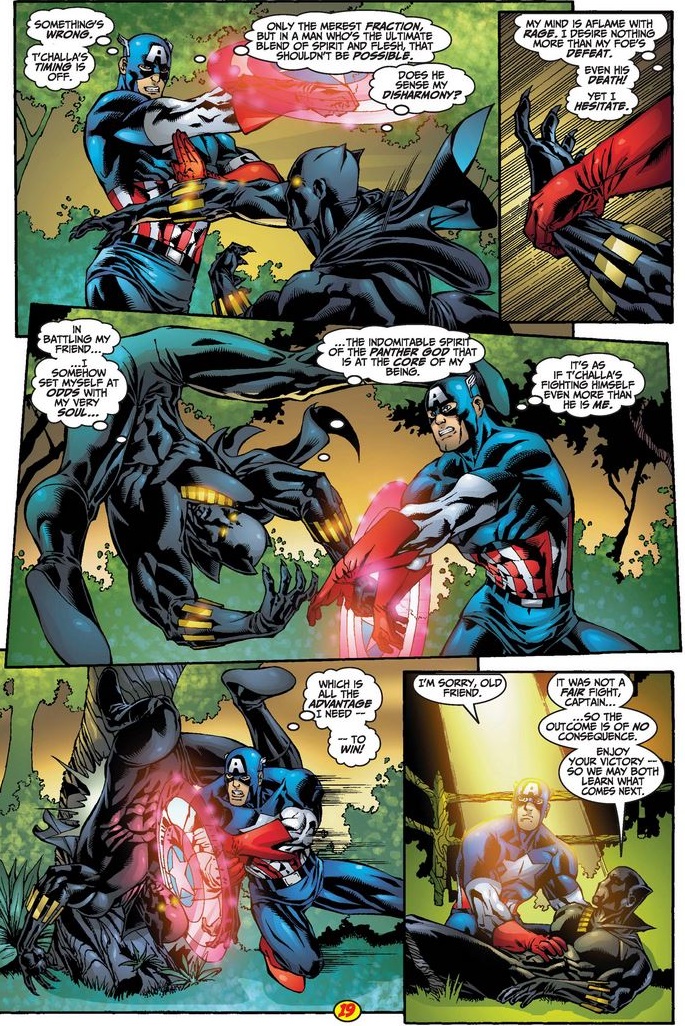
I’m happy to see they both have the same attitude toward this as I do!
ISSUE DETAILS
Captain America (vol. 3) #23, November 1999: Mark Waid (plot), Jay Faerber (script), Partick Zircher (pencils), Denis Rodier (inks), Gregory Wright (colors), Todd Klein (letters). (More details at Marvel Database.)
Collected in: Captain America: Heroes Return–The Complete Collection Vol. 2.
Contest of Champions II #4, November 1999: Chris Claremont (writer), Michael Ryan (pencils), John Livesay and Raymond Kryssing (inks), Atomic Paintbrush (colors), Richard Starkings and Albert Deschesne (letters). (More details at Marvel Database.)
Collected in: Contest of Champions II.
PREVIOUS ISSUES: Captain America #20-22 (August-October 1999)
ALSO THIS MONTH: Avengers #22, Galactus the Devourer #3, and Domination Factor: Avengers #1.2 (November 1999)
NEXT ISSUE: Captain America #24 (December 1999)
 THE VIRTUES OF CAPTAIN AMERICA
Leave a comment