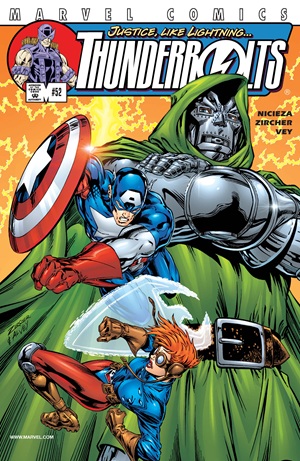
 These five issues of Thunderbolts see Captain America assume leadership of the Redeemers, the government-sanctioned successor to the Thunderbolts, after Hawkeye cuts a deal with the government in issue #50, surrendering to federal custody to guarantee the rest of the Thunderbolts immunity for their unlawful activities. It’s a long story which also involves Jack Monroe, the 1950s Bucky who later adopted the identity of Nomad, as we have seen here a number of times, who now is a new Scourge of the Underworld, albeit under the control of our old friend Henry Peter Gyrich.( Comics!)
In fact, before we see Cap near the end of issue #50, we see Jack abandon the Scourge identity (and hideous outfit)…
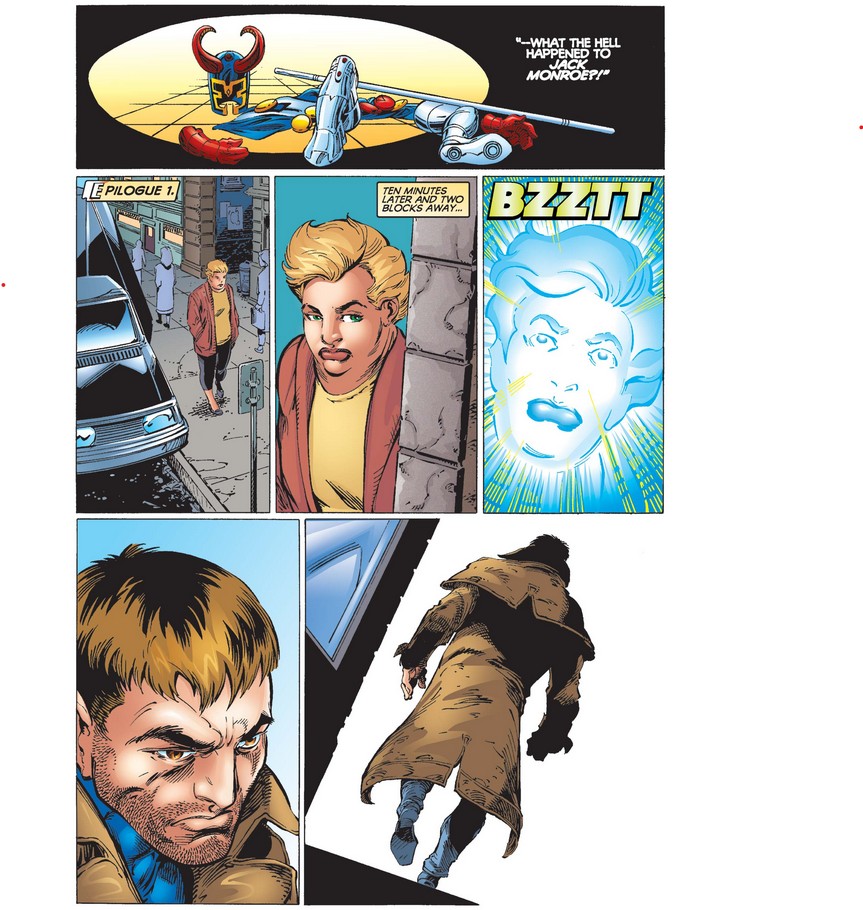
…until he reappears briefly in a few years in Ed Brubaker and Steve Epting’s Captain America run.
When we finally see Cap, he is being introduced to the Redeemers as “the greatest soldier on the planet” and their new leader.

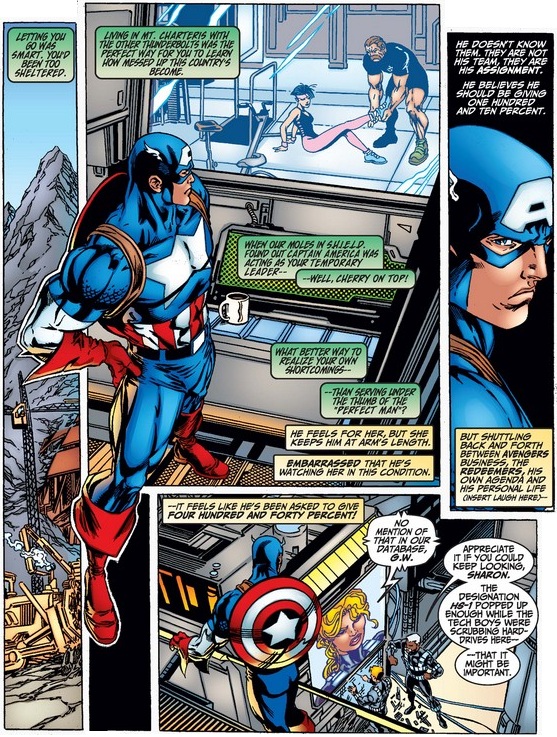
The heart of this post lies in issue #51 and 52, the first of which starts off with what the various ex-Thunderbolts are doing with their time off, while Cap makes himself comfortable in a training session with his new charges.

I’ll break up the busy double-page spread below…
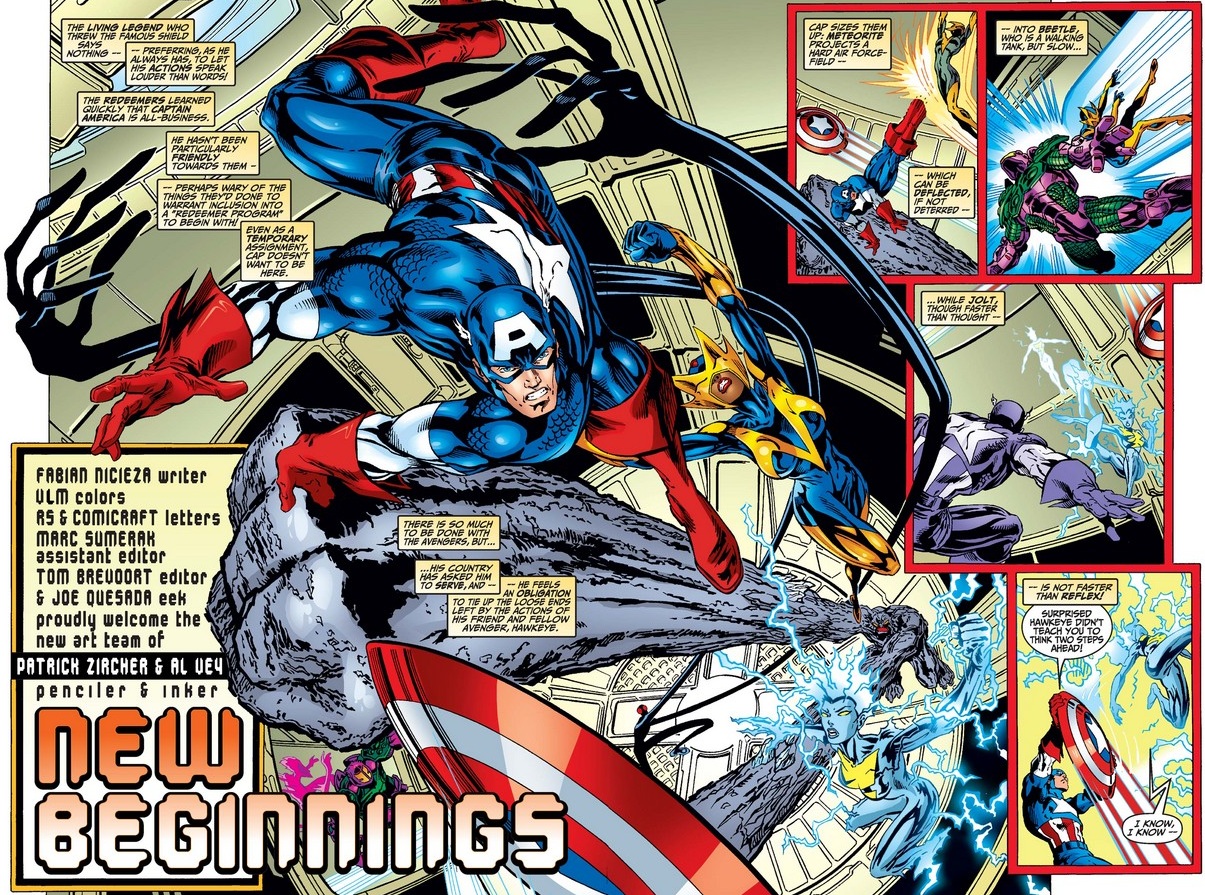
…with the exposition on the left side detailing the pull of duty that led Cap to this mission (particularly related to Hawkeye).
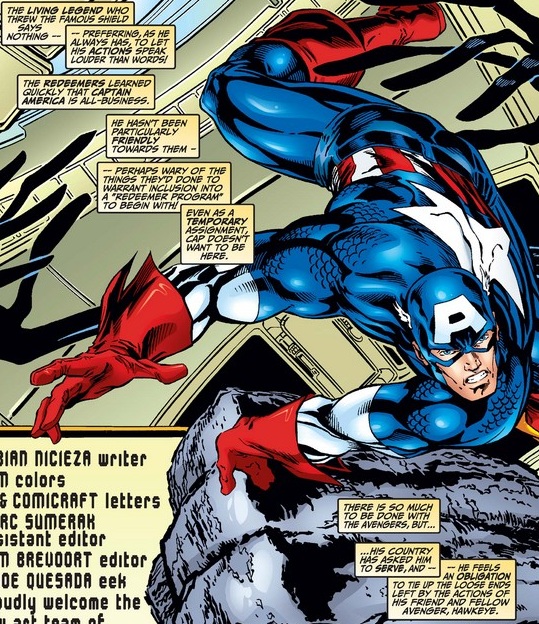
On the other side, he assesses his new “recruits”…
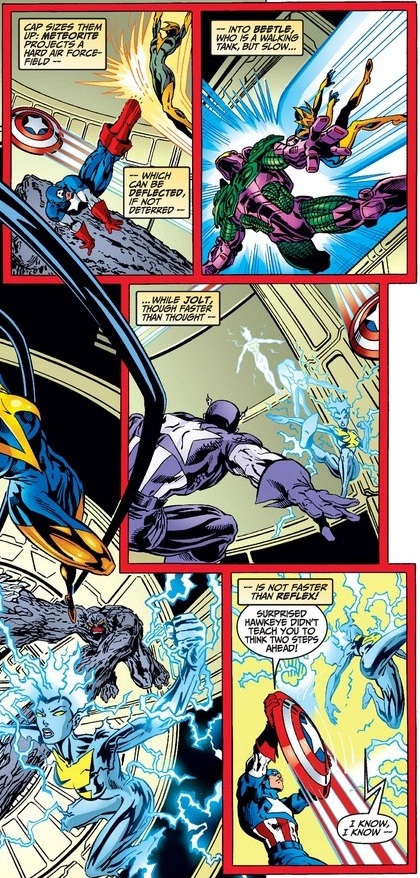
…and is mildly impressed.
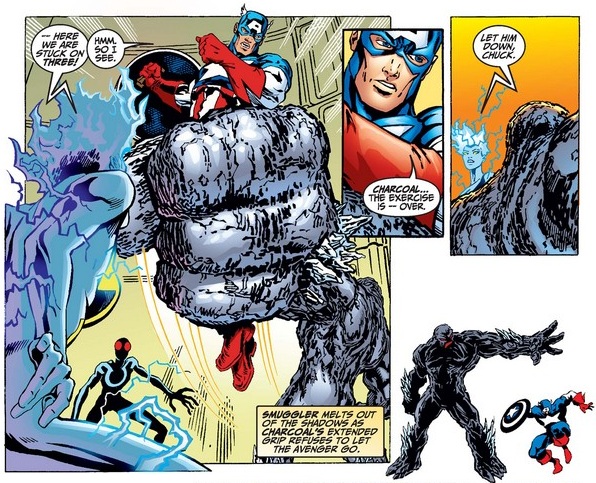
Despite his concerns about their devotion to the cause, he decides to take them on Sharon Carter”s latest mission…
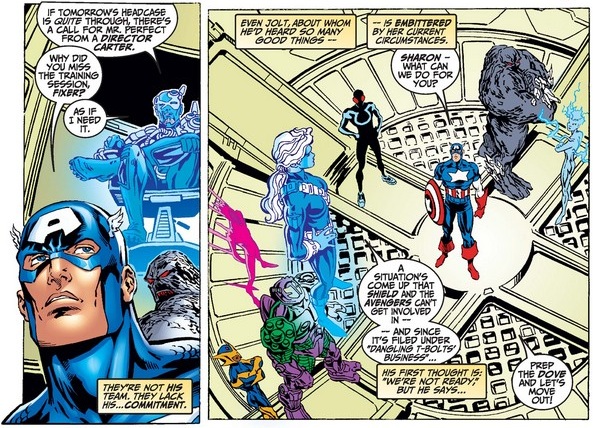
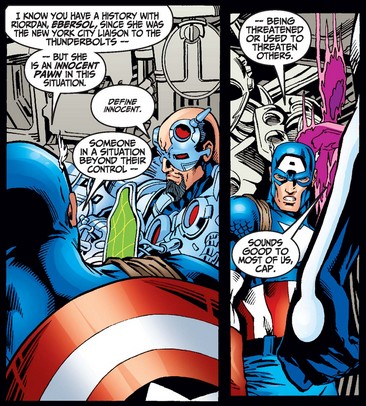
…concerning former Thunderbolts ally (and one-time Citizen V) Dallas Riordan, currently in Latveria. Given her troubled past with the team, Cap has to assure them that she is to considered a victim to be protected, not an enemy.
After an EMP forces their plane down in Latveria, Cap launches into field leader mode.
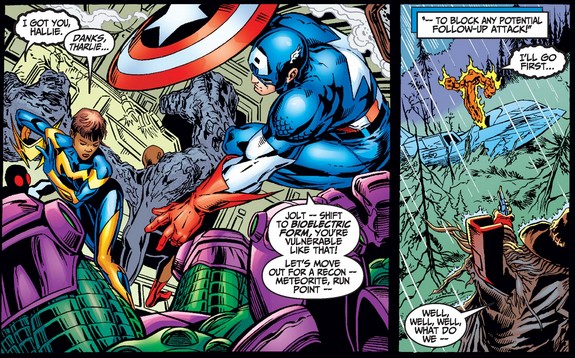
They’re soon attacked by Rebel, a “frenemy” of Tony Stark’s from the Heroes Reborn world who collaborated with him on armors, which would explain Cap’s question below if it wasn’t already answered by…

…this guy, who at the time ruled the Heroes Reborn Earth after moving it into the 616 universe and positioned on the opposite side of the sun (hence, “Counter-Earth,” or he calls it, Planet Doom, because of course he does).
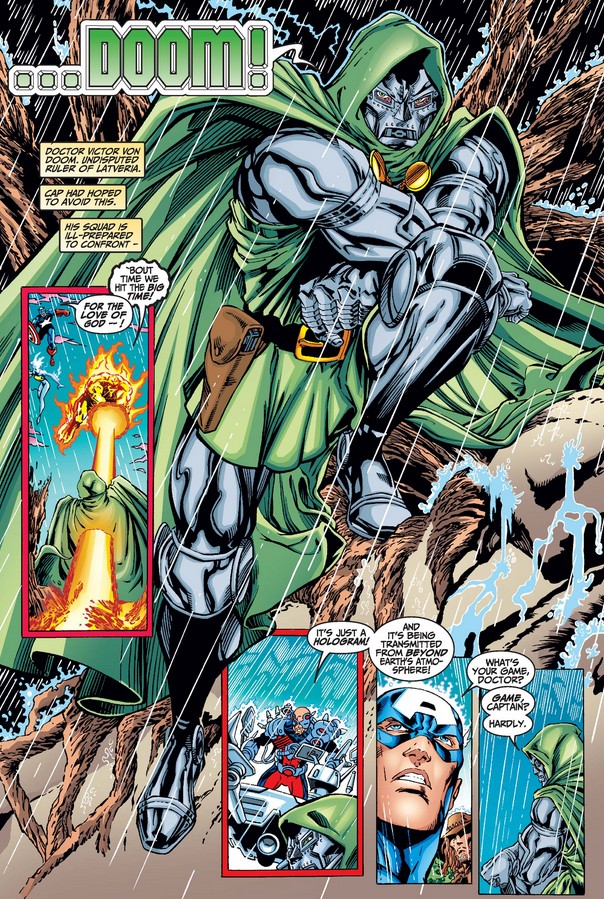
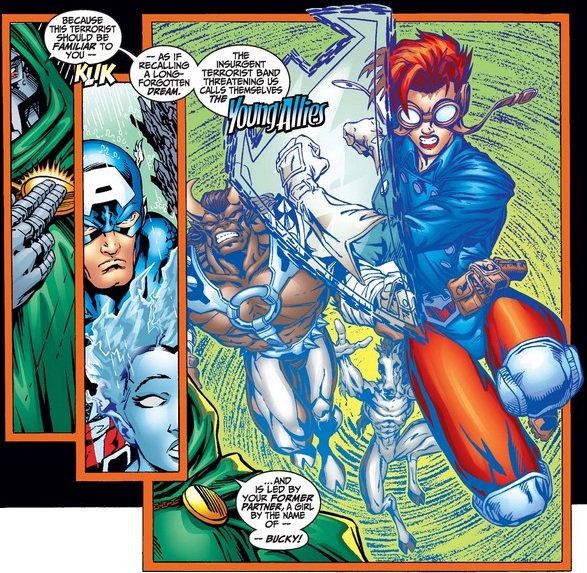
Doom explains he is hunting an eco-terrorist from Planet Doom who has threatened to destroy Latveria. Because Rebel failed to find her, he used Riordan to draw this world’s heroes to help, and is pleased to have attracted Captain America’s attention…

…due to the identity of the eco-terrorist herself, Rikki “Bucky” Barnes, last seen in Heroes Reborn: Young Allies #1, although Cap does not remember her.
When issue #52 opens, Cap, the Redeemers, and Rebel are being attacked by robot drones which presumably were sent by Doom, although they are supposed to be working alongside Doom—and Cap trusts Doom, whether based on an all-too-common belief in the Latverian’s sense of honor (which I dispute here) or a more pragmatic estimate that betrayal this early in the game is not in Doom’s interest.
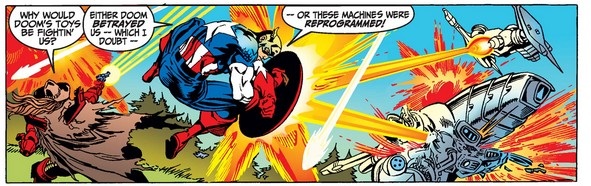
When Jolt asks about Rikki Barnes’ terrorist activities, Cap denies any knowledge of her while naturally condemning any such activities (while the mysterious narrator wonders if he feels responsible, which is also natural).
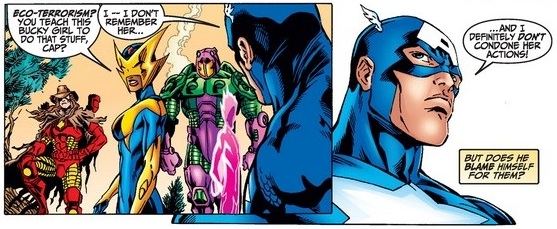
(The accusation is accurate, though: Rikki plans to threaten Latveria with a biological weapon in the hopes of getting Doom to relinquish his rule of Counter-Earth.)
When all the players finally meet, Rikki and Jolt fight (after Rikki asks the young hero if she’s in the Teen Titans, ha) before Cap inserts himself and emphasizes his deontological outlook on moral philosophy. For her part, Rikki is confused, confronted with a man who seems to be her previous mentor but is not quite the same…
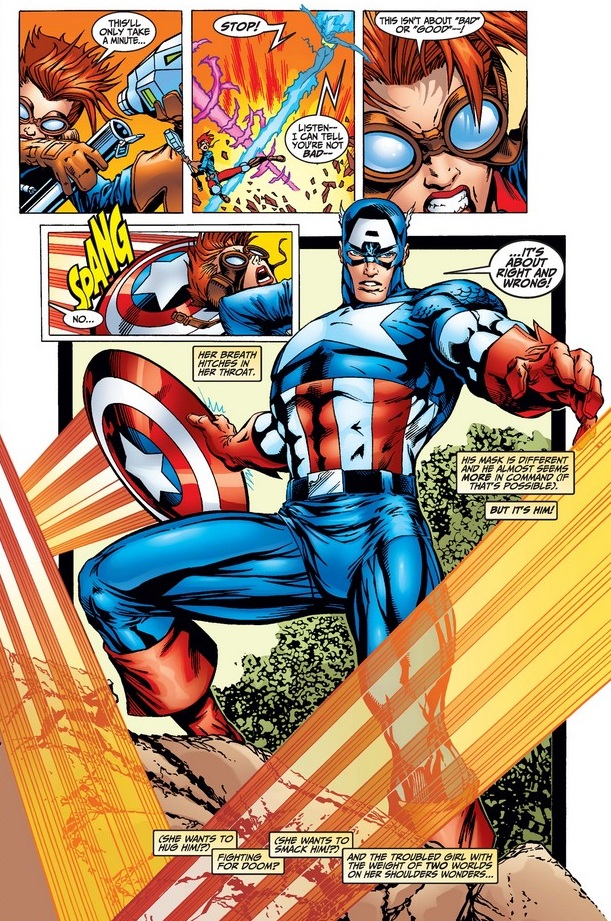
…but she accepts it’s him all the same.
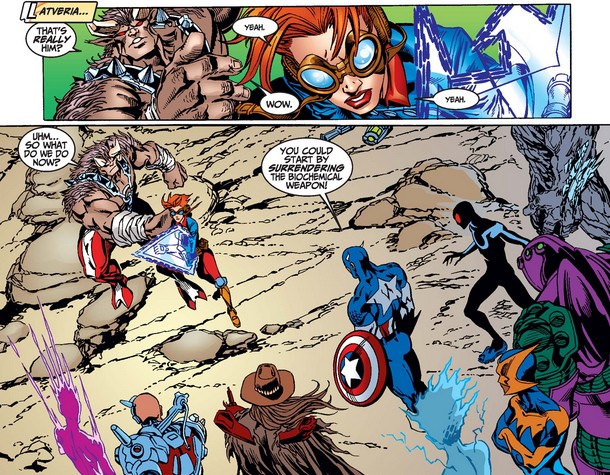
Hostilities break out again soon thereafter, and Cap tries to calm things down by referencing a past he can’t recall…
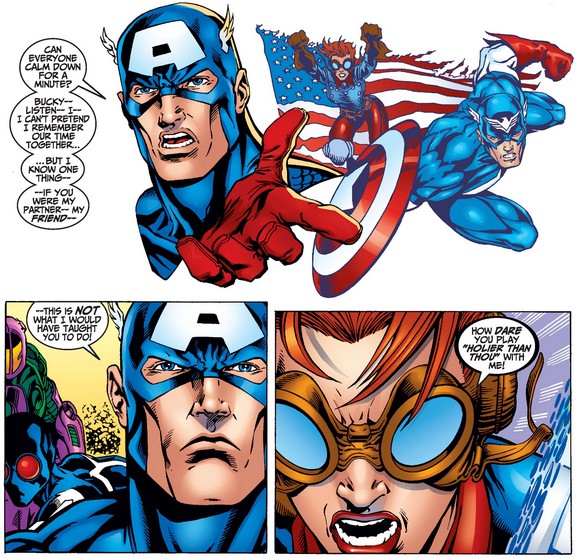
…but RIkki does not take it well, and explains what happens after the Heroes Returned home and why the noble behavior he taught her doesn’t work in their current situation.
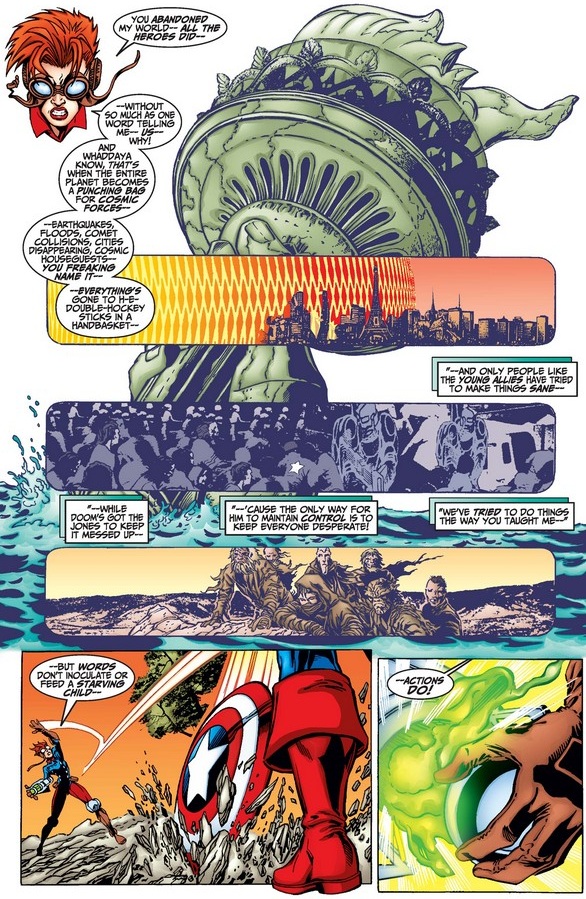
When the heroes breathe the gas and don’t feel dead, Rikki reveals she isn’t as mercenary as she led them to believe—but naively asks Captain America if he has ever had to consider compromising his principles, which we knew full well he is forced to do on a regular basis (as I discuss in chapter 5 of my book).

After Rikki and her Young Allies leave, Cap turns to Doom and continues Rikki’s mission, threatening him with news of other canisters of gas hidden in Latveria unless he loosens his grip on Counter-Earth.
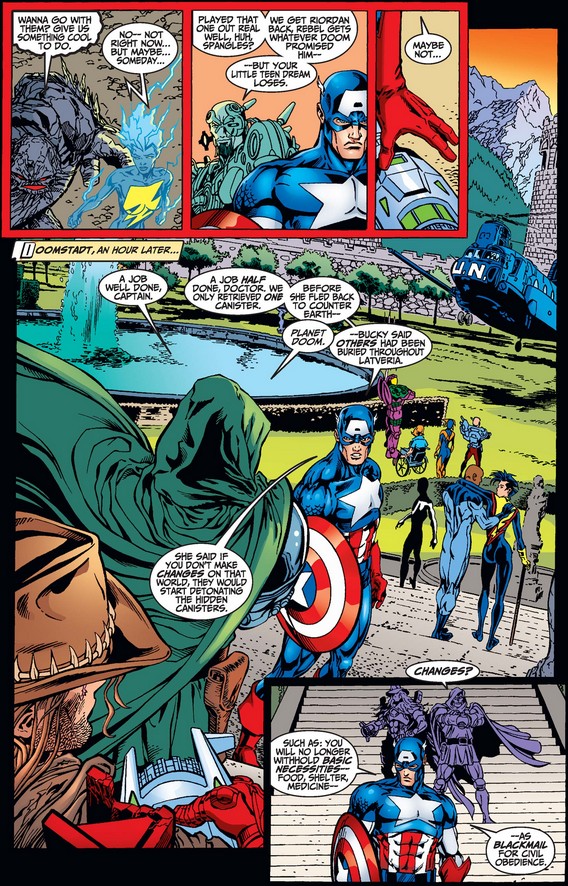
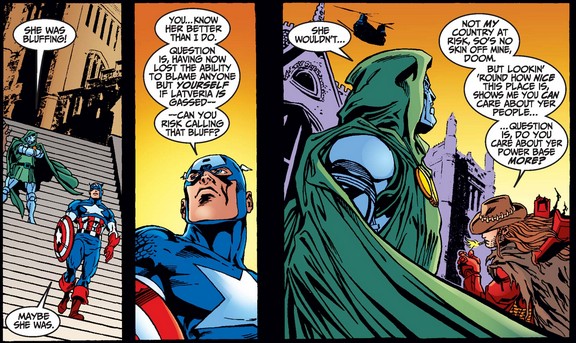
Doom argues that the canister Rikki did release was inert, but Cap asks if he is confident the rest are as well. (I like his slight pause before admitting that Doom knows her better than he does, at least that he remembers.)
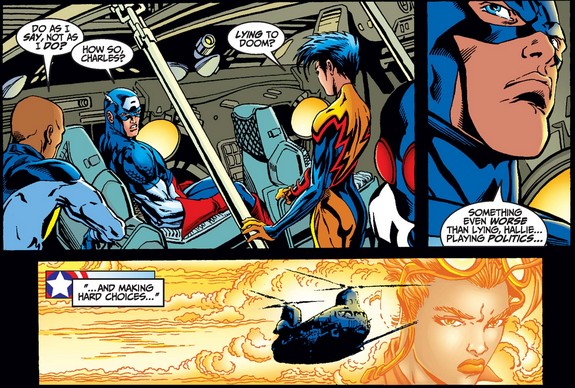
Back in their plane, Cap admits to the bluff he built onto Rikki’s, writing it off as the type of hard choice she challenged him to make. Nonetheless, it is an extraordinary thing for him to do, which he may justify to himself as a last act of loyalty to a protege he cannot recall and whom he feels guilty for deserting.
The last two issues see Cap begin to separate from the team. In issue #53, Cap feels torn between his current “assignment,” his real team, and his nonexistent private life (which he has also been mourning in the last several issues of his own book).
The evil omniscient green narration belongs to the father of Charcoal below, a minor figure in a revived Secret Empire that abused and experimented on his son, and whom, just now, his son refused to give up his own “redeemed” life to save.
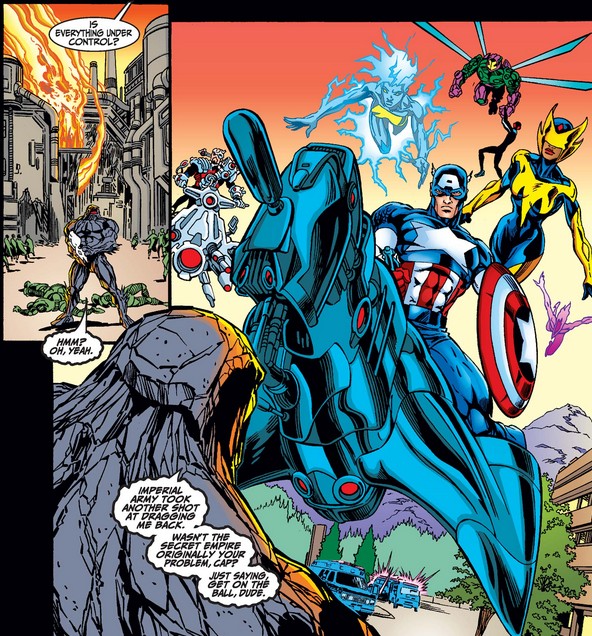
Charcoal embellishes the story just a bit to Cap, who is sympathetic to the young hero.
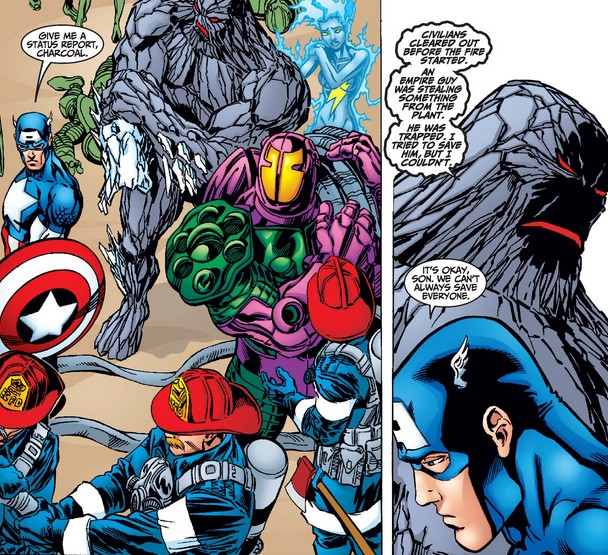
Would he have shown the same sympathy if he knew the truth? Perhaps he would have, given his capacity for understanding and forgiving the moral failings of others, which he would never do for himself.
Finally, in issue #54, Cap relinquishes leadership of his team to Citizen V, whom he believes is John Watkins III, grandson of the original two Citizens V and son of the third…
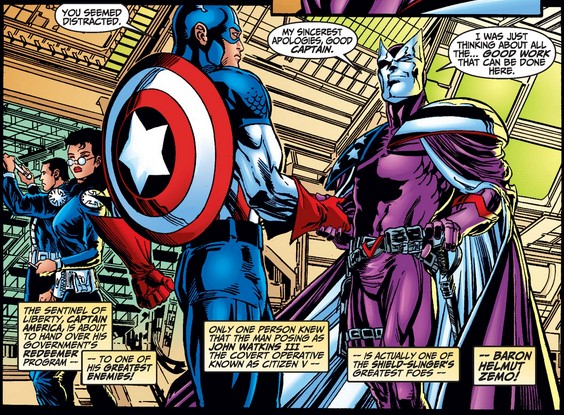
…but is actually the original founder of the Thunderbolts, Baron Zemo, in disguise.
Cap gives a sitrep to a surprisingly snarky “Citizen V,” who presumes himself a man of honor.
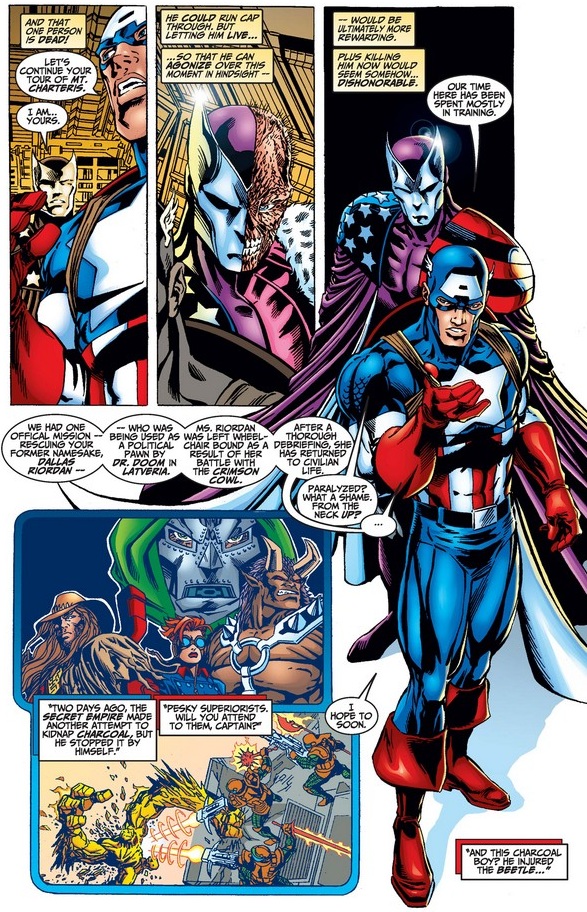
Cap continues reviewing the members of the team, focusing on Jolt in particular, whom he compares to his fellow Avengers Firestar and Justice and expresses optimism for her future prospects.

As Cap says farewell to his team, he gives each an encouraging final message, including their new leader…
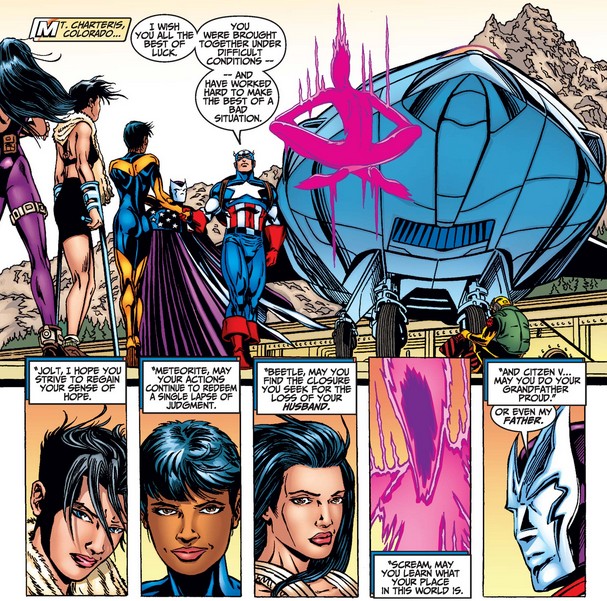
…whom we can assume was referencing his real father, the original Baron Zemo, whose death he has long blamed Cap for.
ISSUE DETAILS
Thunderbolts (vol. 1) #50, May 2001: Fabian Nicieza (writer), Mark Bagley (pencils), Greg Adams, Scott Hanna, and Al Vey (inks), VLM (colors), Richard Starkings and Saida Temofonte (letters). (More details at Marvel Database.)
Thunderbolts (vol. 1) #51, June 2001: Fabian Nicieza (writer), Patrick Zircher (pencils), Al Vey (inks), VLM (colors), Comicraft (letters). (More details at Marvel Database.)
Thunderbolts (vol. 1) #52, July 2001: Fabian Nicieza (writer), Patrick Zircher (pencils), Al Vey (inks), VLM (colors), Comicraft (letters). (More details at Marvel Database.)
Thunderbolts (vol. 1) #53, August 2001: Fabian Nicieza (writer), Patrick Zircher (pencils), Al Vey (inks), VLM (colors), Comicraft (letters). (More details at Marvel Database.)
Thunderbolts (vol. 1) #54, September 2001: Fabian Nicieza (writer), Patrick Zircher (pencils), Al Vey (inks), VLM (colors), Comicraft (letters). (More details at Marvel Database.)
Collected in: Thunderbolts Epic Collection: Redemption.
ALSO THESE MONTHS: Captain America #41-43 and Iron Man #42 (May-July 2001), Avengers #40-44 (May-September 2001), Black Panther #30 (May 2001), Fantastic Four: The World’s Greatest Comics Magazine #4 and #8 (May and September 2001), Captain America #44 (August 2001), and Captain America #45 and U.S.Agent #2 (September 2001)
 THE VIRTUES OF CAPTAIN AMERICA
Leave a comment