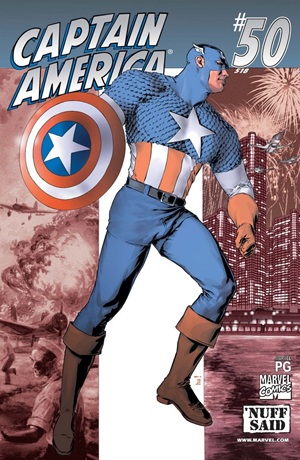
 The final issue of volume 3 of Captain America may the first example we’ve covered here of something which by now has become a regular occurrence: the oversized anniversary issue, either based on issue number or calendar years, containing a number of shorter stories commemorating the title character(s). DC Comics had been doing this for a while, with Superman #400 often heralded as one of the best. (Detective Comics #500 is also a contender, as is Justice League of America #200, although it is a single long story. Incidentally, I still own my original copies of all three from when I was a wee small boy.) But this is no mere celebration, as one of the stories has possibly catastrophic implications for the future of Captain America… if it had stuck (if it was even meant to).
This issue also coincides with the “‘Nuff Said” quasi-event, based on one of Stan Lee’s classic phrases, in which most of the Marvel books in late 2001 and early 2002 published stories with no dialogue to demonstrate the artists’ storytelling skills (based on the writers’ plots). Avengers #49, which did not feature our hero and so was not covered in this post, used this device to illustrate (literally) the surrender of the Earth to Kang (while Captain America was busy elsewhere), while Fantastic Four #50 was a similar oversized celebration to the issue at hand.
The first story in Captain America #50 is the speechless one, and is both plotted and penciled by the departing Dan Jurgens. It deals with Lloyd Grunnell, a man with a wife and two small kids who gets laid off from his corporate job at Christmastime and faces the prospect of disappointing his family—yet still drops a fin in a charity bowl on his way home. While shopping for his kids, he stumbles into a fight between Cap and Crusher Creel, the Absorbing Man…
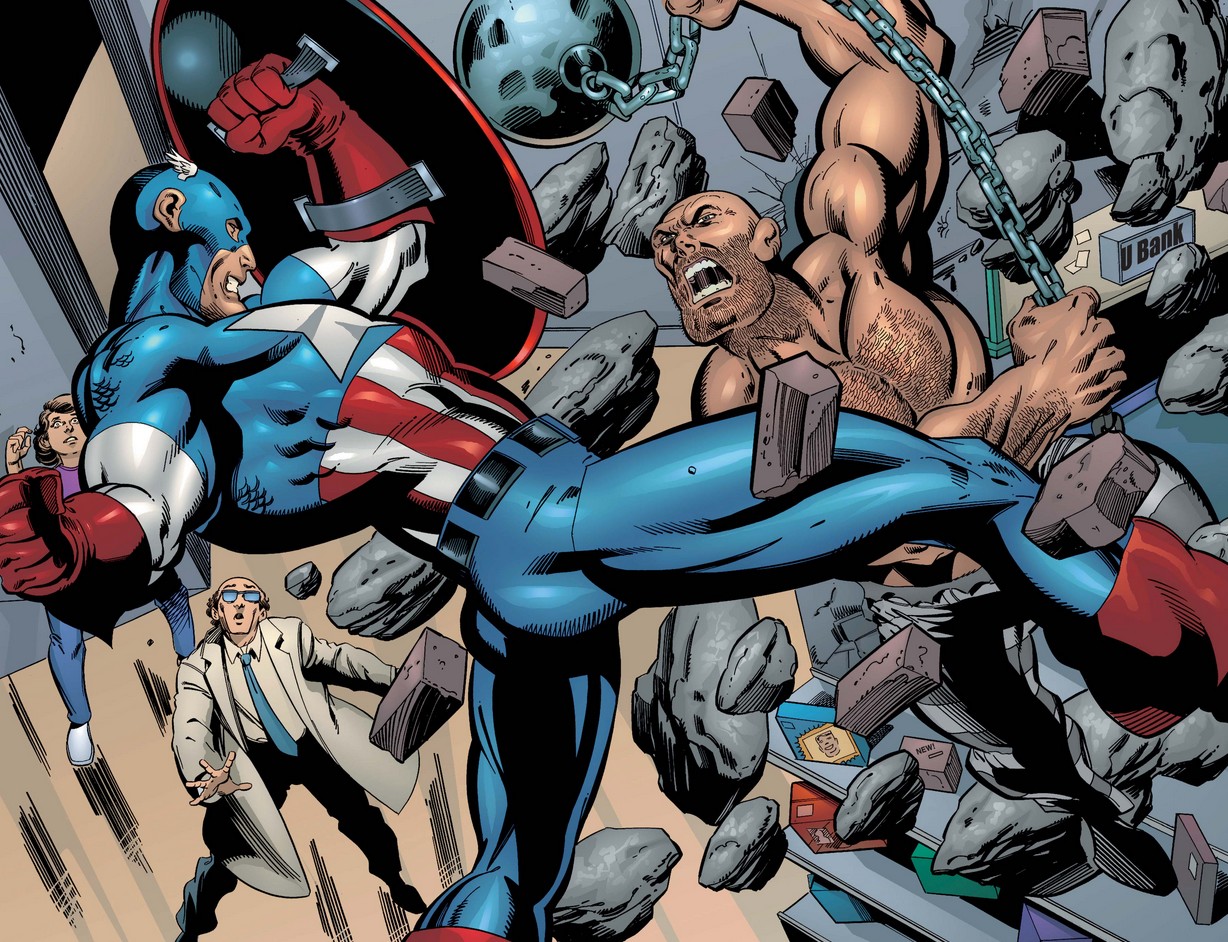
…and he sees a way to help.
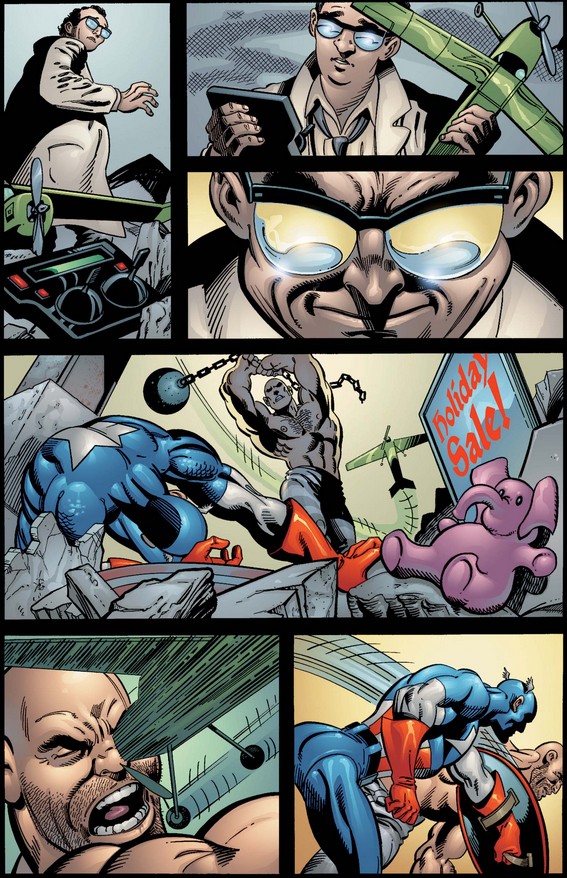
As his family watches the scene on live TV, Floyd does it again, tricking the Absorbing Man into taking on the properties of cotton balls and allowing Cap to defeat him once and for all.
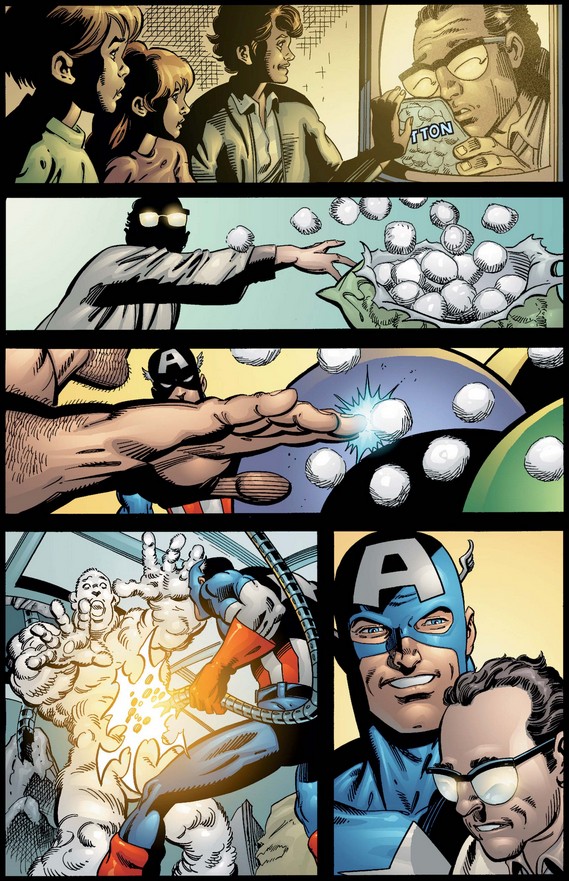
On his way to the police transport, Crusher shows Cap a picture of his wife and tells him he was only trying to give her a better Christmas as well.
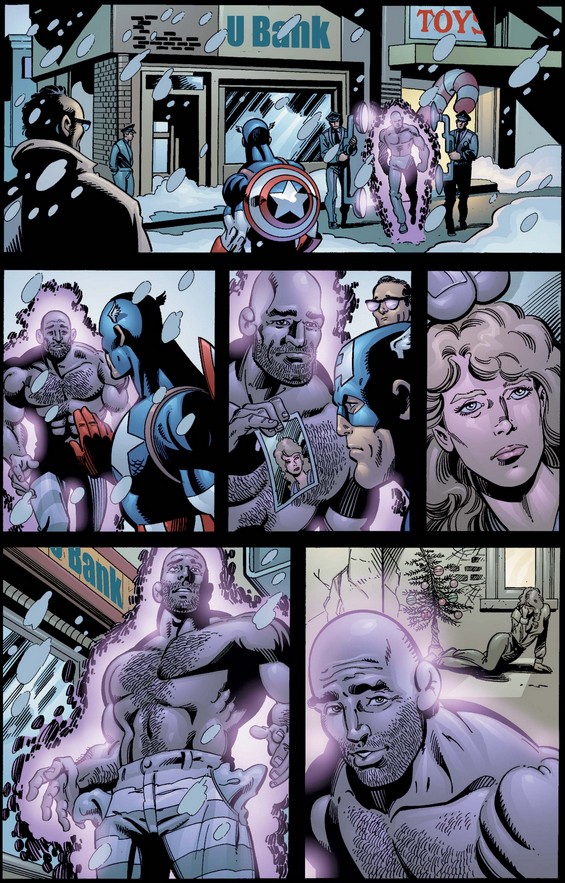
Lloyd is touched by this, and after he receives a hefty reward from the toy store, he joins Cap as his latest sidekick…
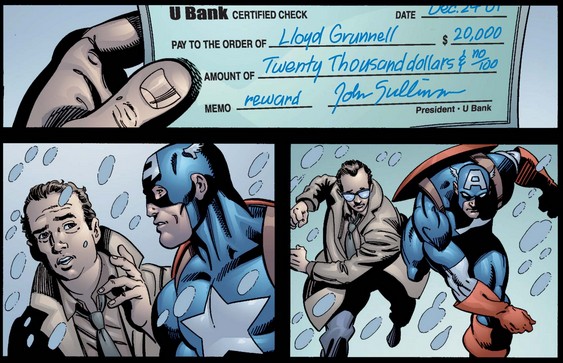
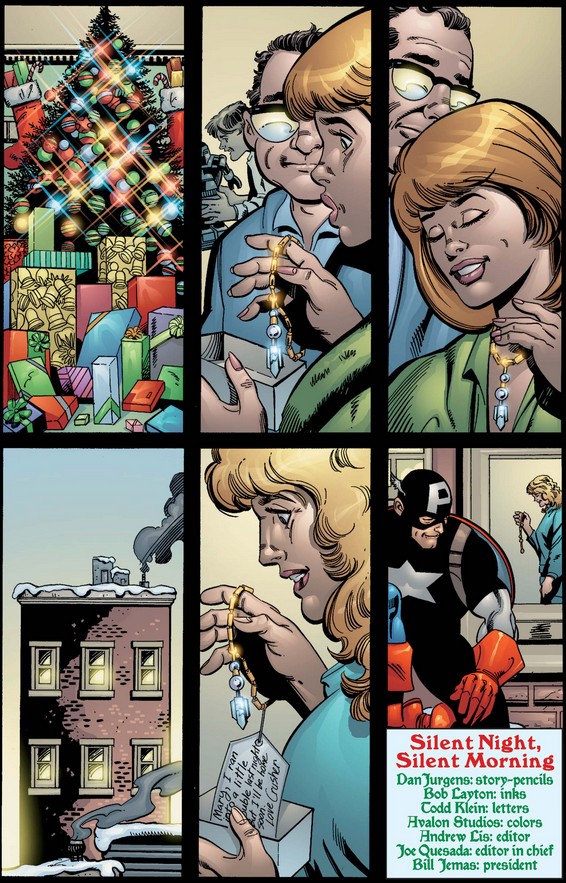
…and they use Floyd’s money to give two families a Merry Christmas.
The second story has less to do with Cap, focusing instead actual soldiers, all the more super for showing bravery and heroism despite not having enhanced abilities. The tale is split between one World War II veteran named Mr. Scott, visiting an elementary school class, and another named Mr. Rogers, visiting France.
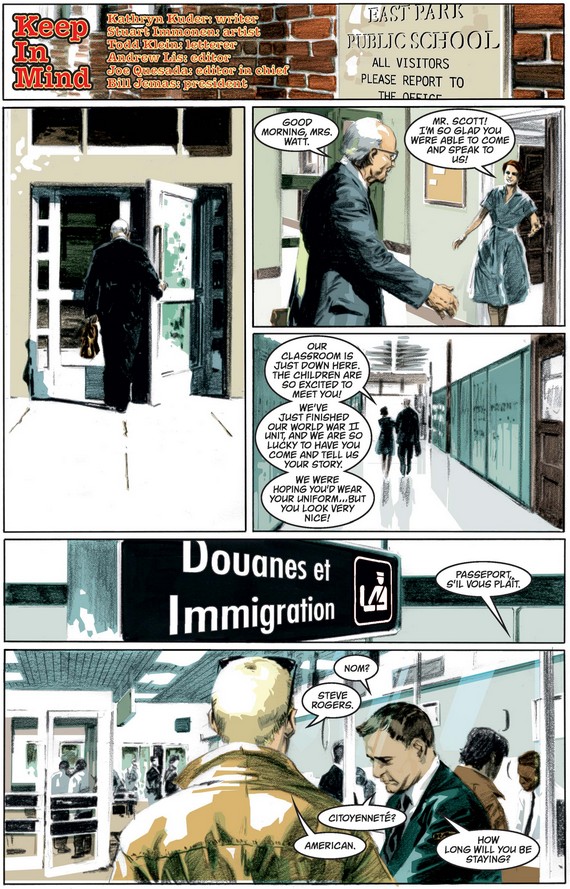
While the latter travels to what I assume is Suresnes American Cemetary and Memorial (and silently judges some tourists taking photos amongst the battle scenes on the way), the former tests his story of serving as a co-pilot on a reconnaissance plane when it was shot down over France, after which he hid in the basement of an abandoned house until being rescued. Below, he tried to impart on the kids the magnitude of the losses born in the war and the quality of character of those who fought in it.
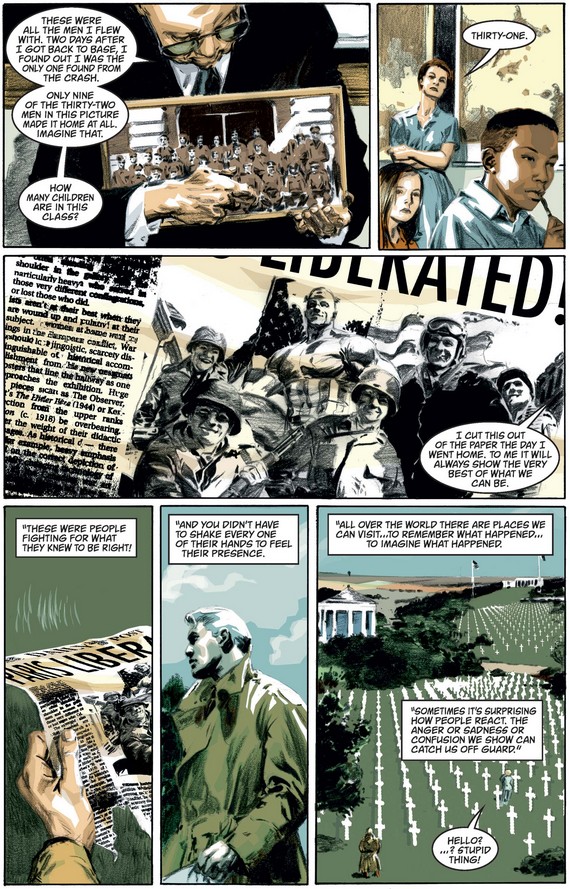
As Steve approaches the graves, he overhears a woman who is suddenly struck by the gravity of where she’s standing and urgently needs to speak to her grandfather, whom she is grateful is not among those laid to rest in front of her. Perhaps it took this sight for her to appreciate what he had gone through decades earlier, and she wants to tell him that while she still has a chance.
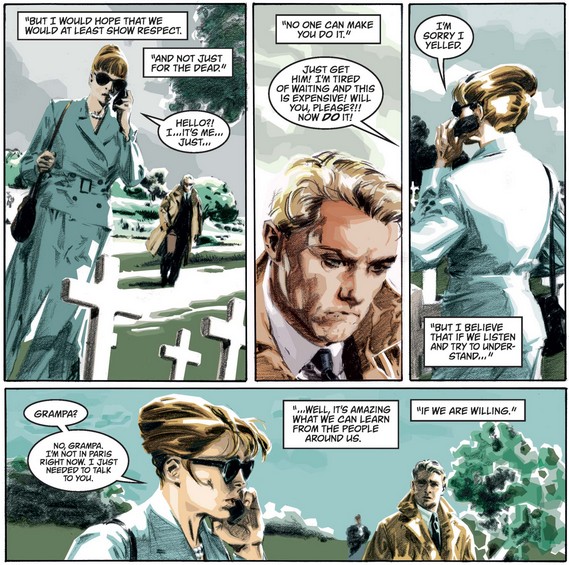
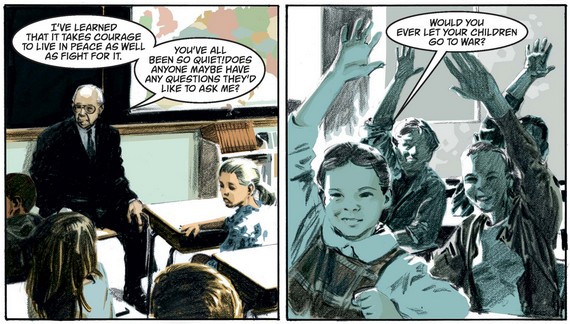
When Mr. Scott is finished, he takes questions from the kids…
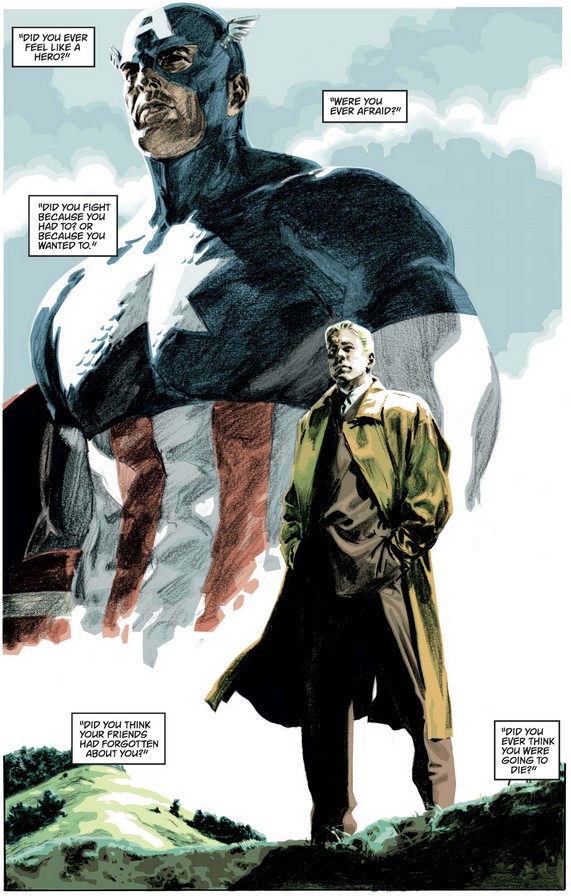
…which frame the last page of the story with a final image of Steve Rogers, who we can assume has been asked the same questions countless times over the years, and may have even asked them to himself from time to time.
In the third story, we return to Cap’s current life as he visits a decrepit old house in Maine in search for “answers” and to prove something to a mysterious voice.
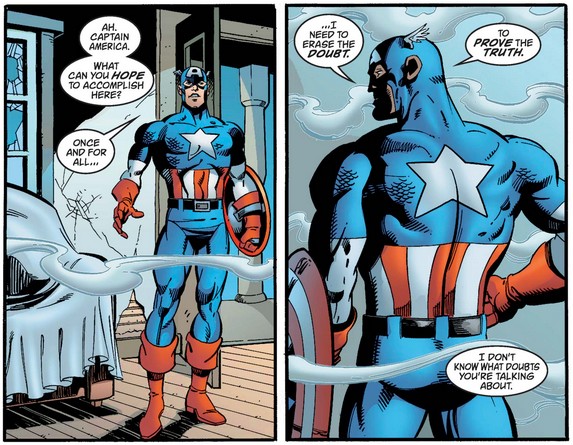
It seems the voice is someone close to him, and he planned his elaborate exercise to make a point, although he’s not sure what will happen…
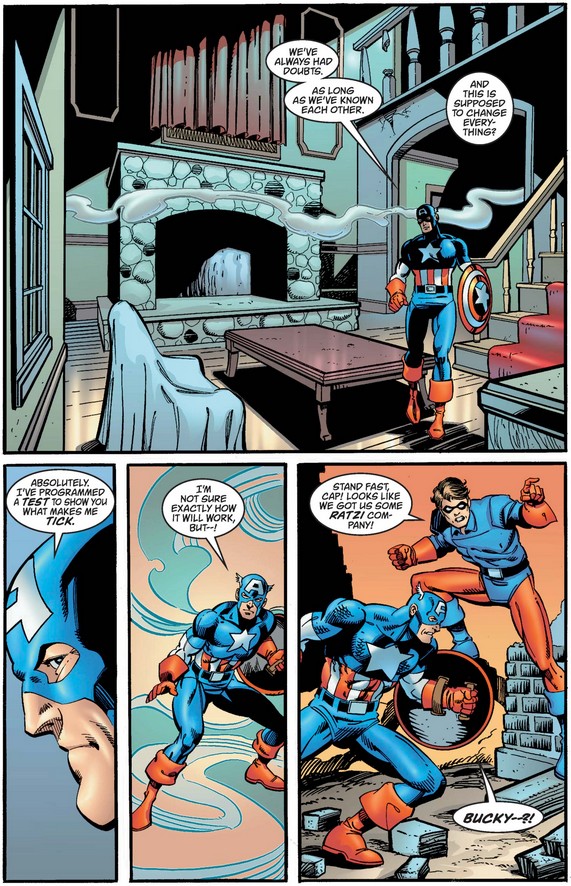
…and was definitely not prepared to revisit key moments in his life (drawn by a number of classic guest artists).
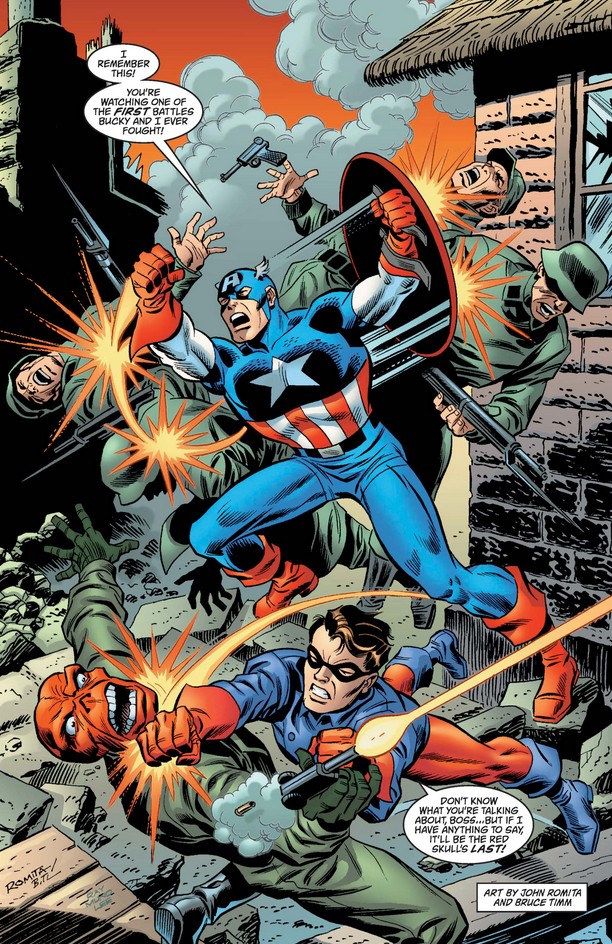
These flashbacks are meant to reveal something to the person he’s speaking to…
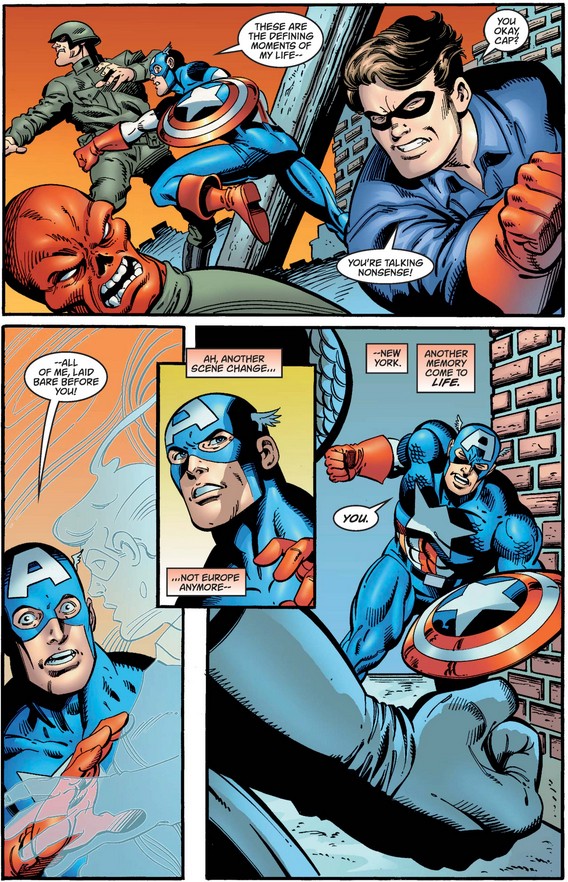
…but at least we as fans get to relive some classic moments with homages to the original artists (in this case, Jack Kirby).
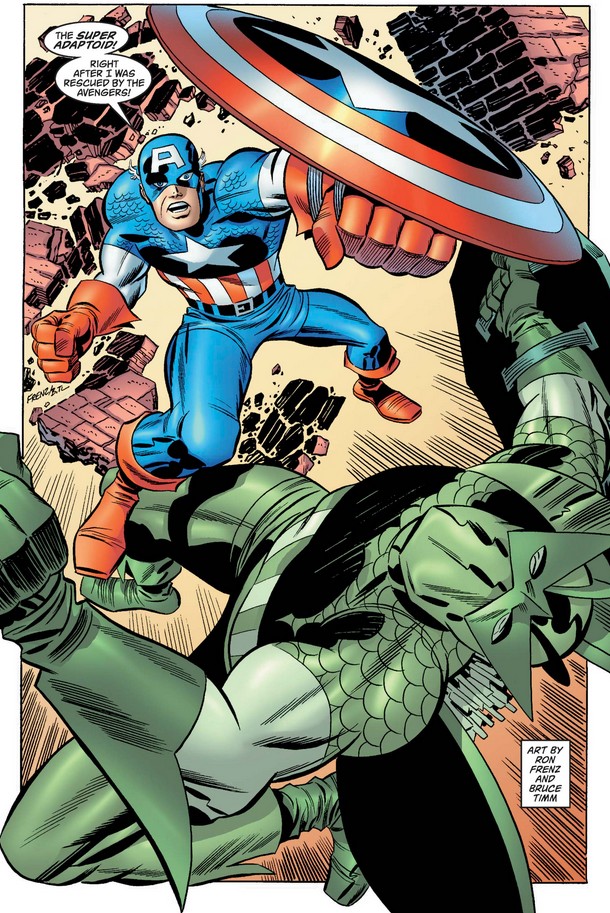
Now Cap hints toward a future with this other person, who apparently knows him fairly well. (They’ve at least been to “the pictures” with him.)
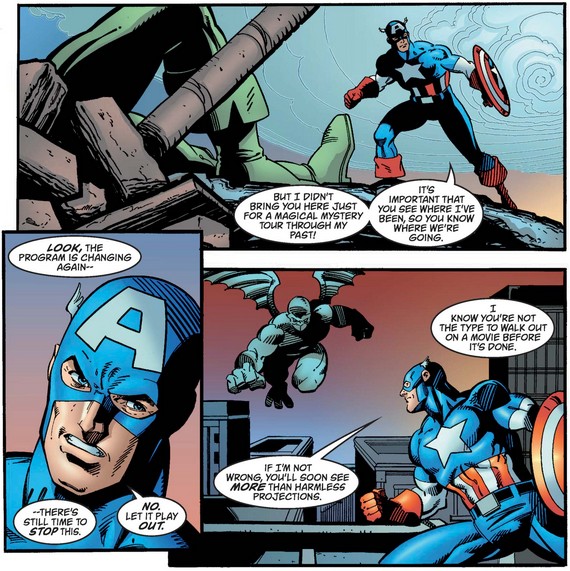
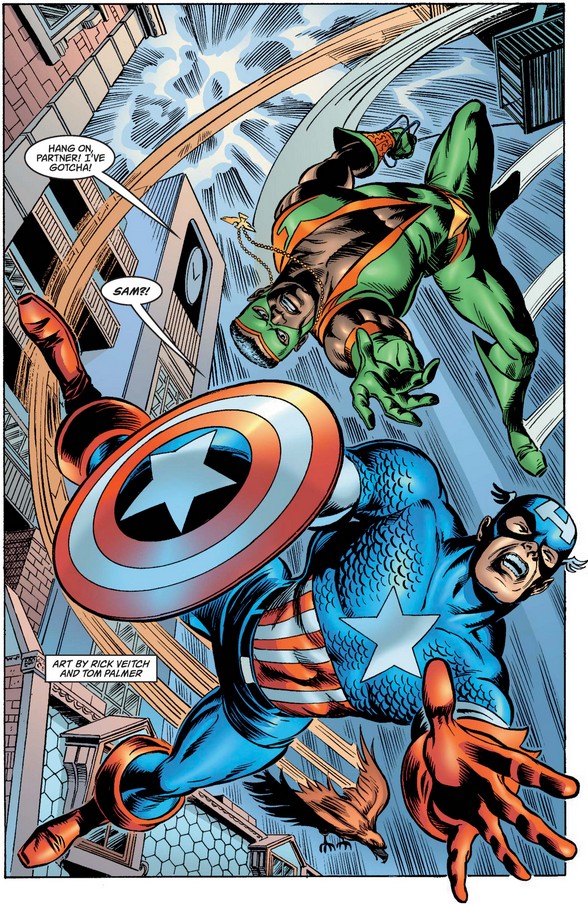
It’s always nice to see Sam in his original green outfit, with a nod to artist Gene Colan.
The visions start to focus on issues of Cap’s identity as we see Roscoe Simons, a wannabe replacement for Cap while the real article was Nomad during the Secret Empire affair, in an homage to Gil Kane’s unforgettable cover to Captain America #183.
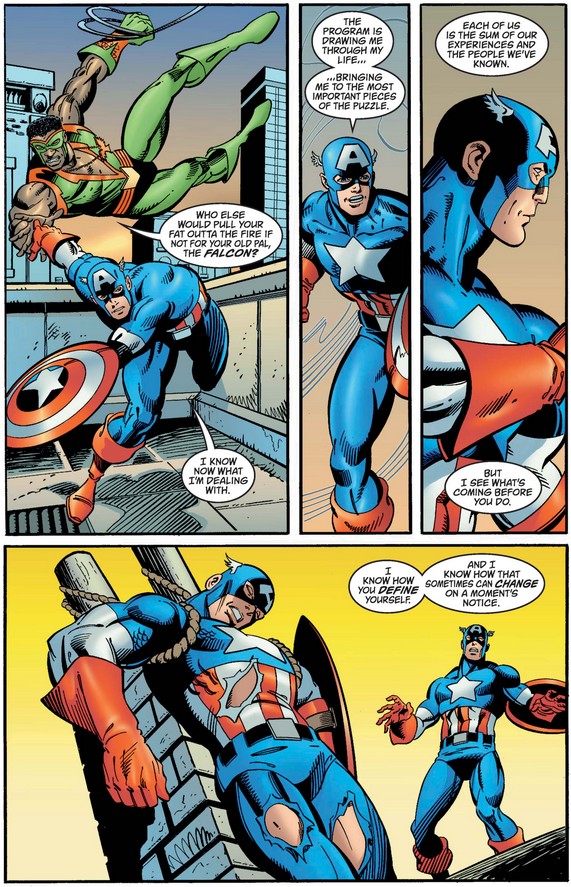
And there’s Nomad himself, with his ill-considered cape…
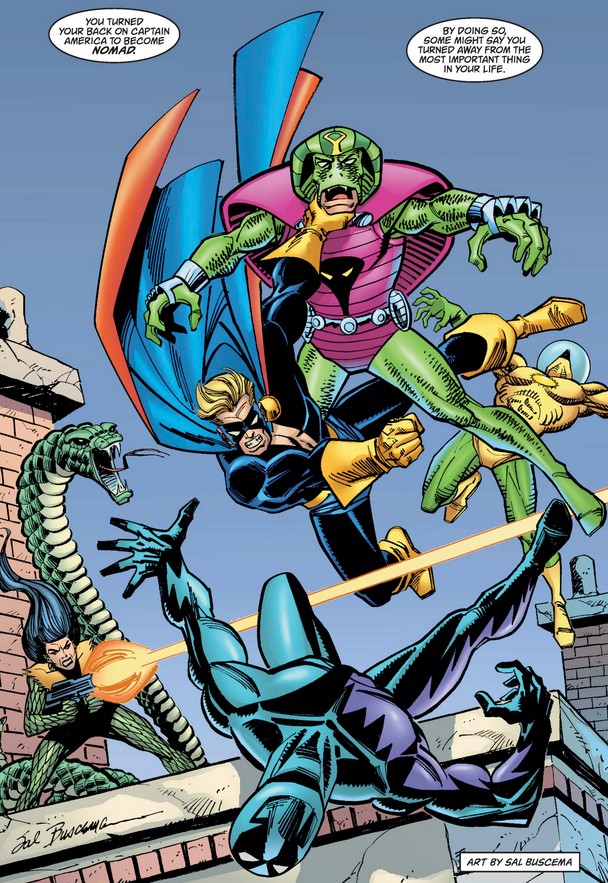
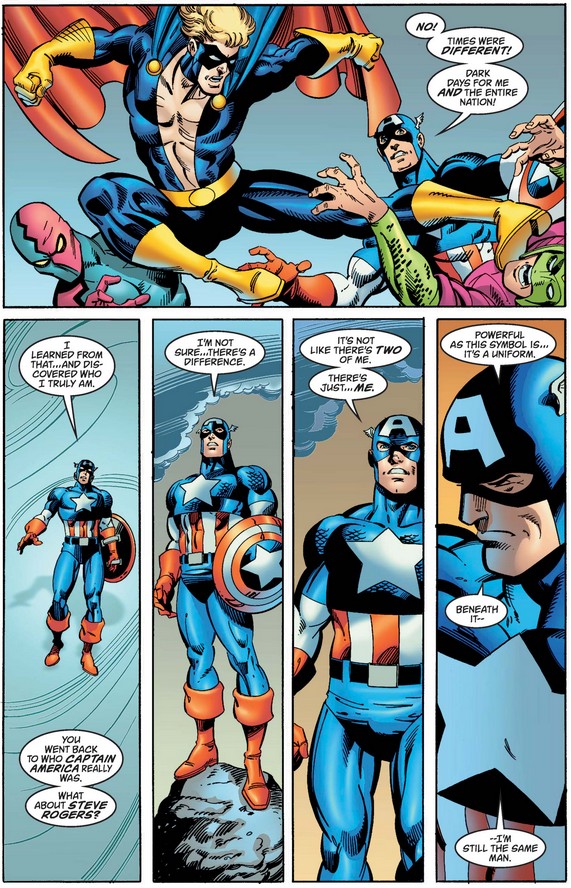
…after which Cap acknowledges that all his recent fretting about “who is Steve Rogers” is moot (although it doesn’t answer the question of whether he needs to spend time in his civilian identity and away from being the Sentinel of Liberty).
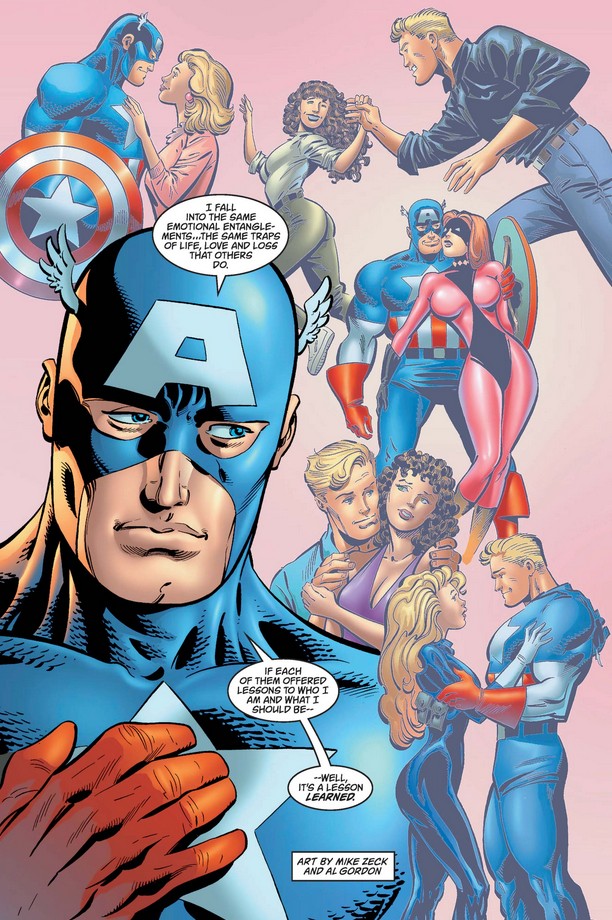
His thoughts turn to amour as he remembers the women in his life…
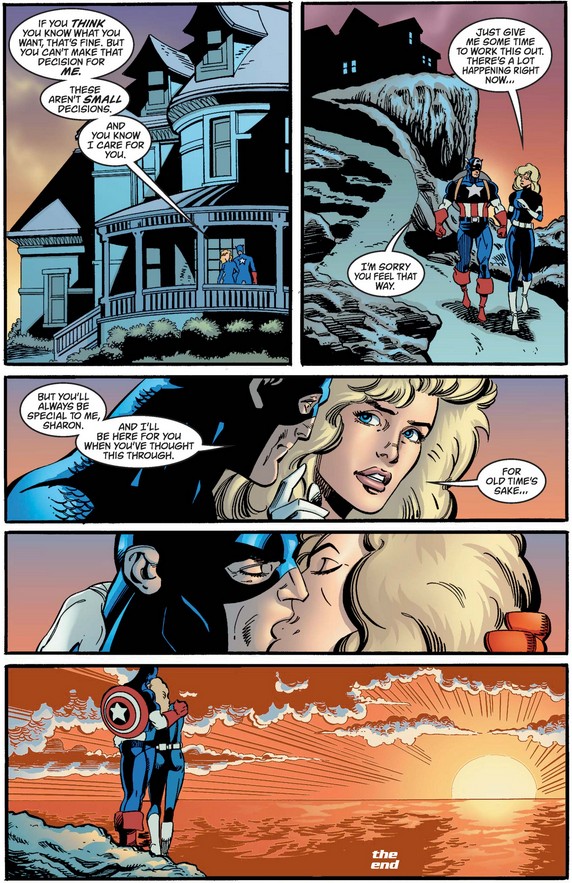
…before we see the one behind the voice and we learn the secret behind This Old House: Cap wants to prove to Sharon that he knows who he is now and, more important, what (and who) he wants.
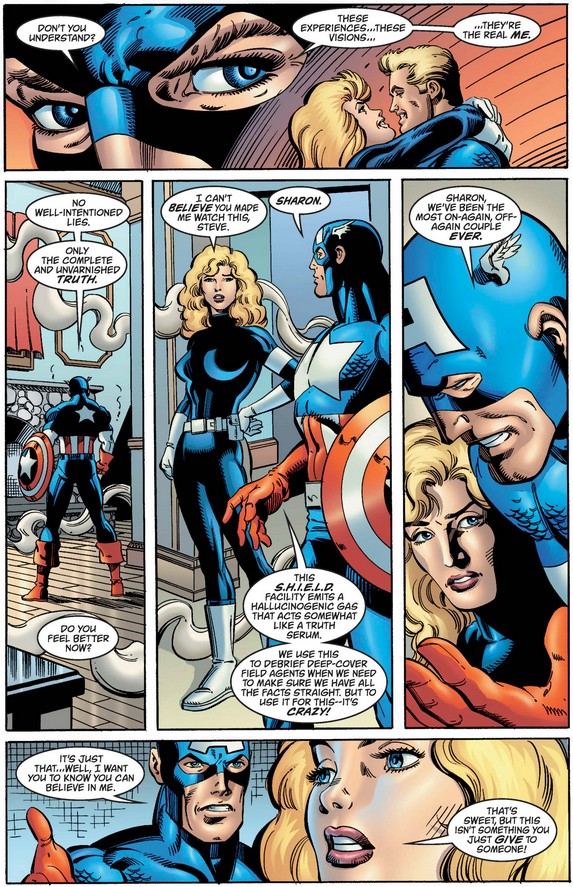
As jealous as she was over Connie, Sharon just isn’t ready, which Cap accepts, after which they end the night with a kiss while they watch the sun rise.
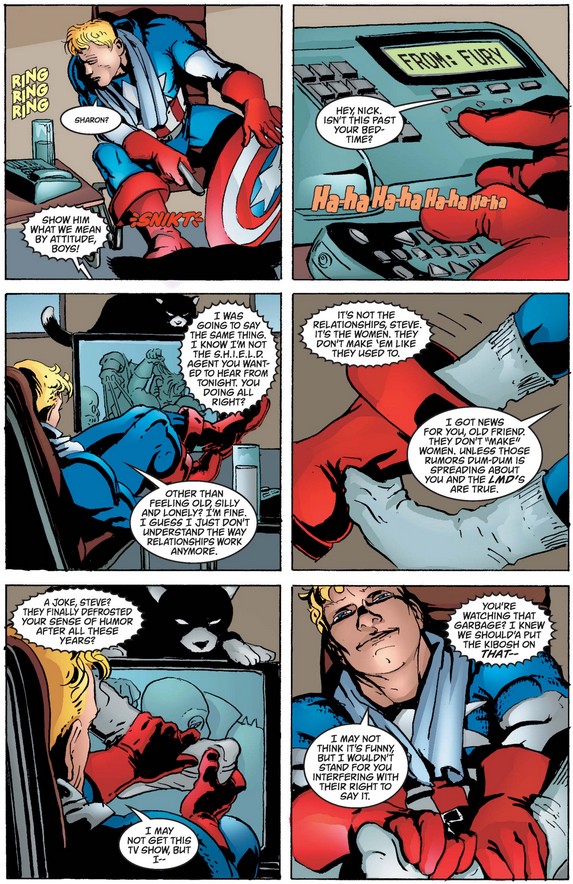
The fourth tale is the most potentially consequential one. Back at Avengers mansion, Steve and Sharon talk on the phone, continuing the same theme as above, while he tosses his shield around the room and watches a comedic TV adaptation of his adventures (also featuring Wolverine, Punisher, and Ghost Rider). Afterwards, he gripes about his romantic frustration with Nick Fury, cracking a joke before confirming his belief in the First Amendment.
A welcome distraction arrives in the form of a call to his old hotline (not referenced since Captain America #426, if I’m not mistaken), making him aware of a bomb threat in New Jersey. When he gets there, he is overwhelmed by hundreds of men, some of them elderly, in Red Skull masks and coats, revealing the true “threat” behind the call.
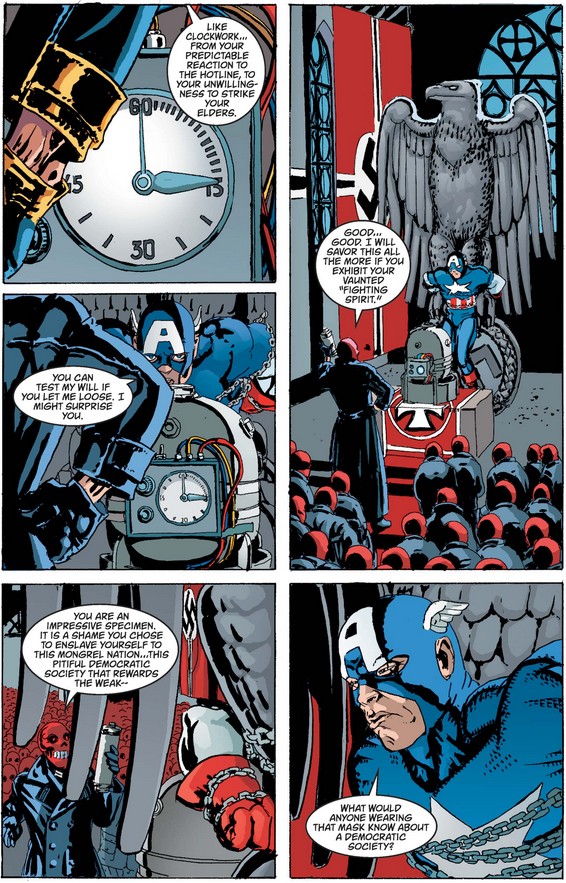
This guy is not the real Red Skull, but he definitely has the dialogue down pat, and after he explains the history of his particular Nazi group and how they assembled the nuclear weapon, he reveals his very simple plot (and utter disdain for the Garden State).
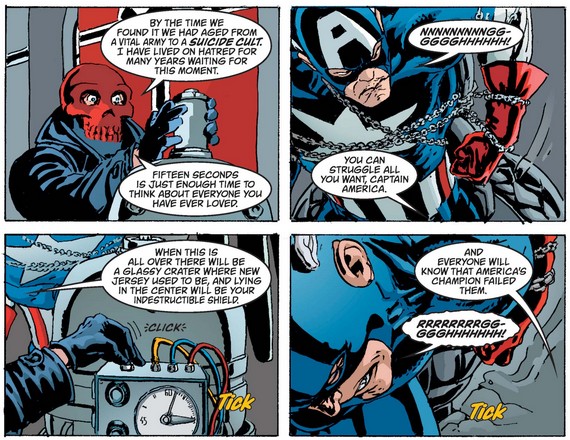
Cap has little trouble breaking free while he explains the phrase “your rights end where my nose begins,” commends the hope of a nation, and tosses the bomb out of the building before it explodes…
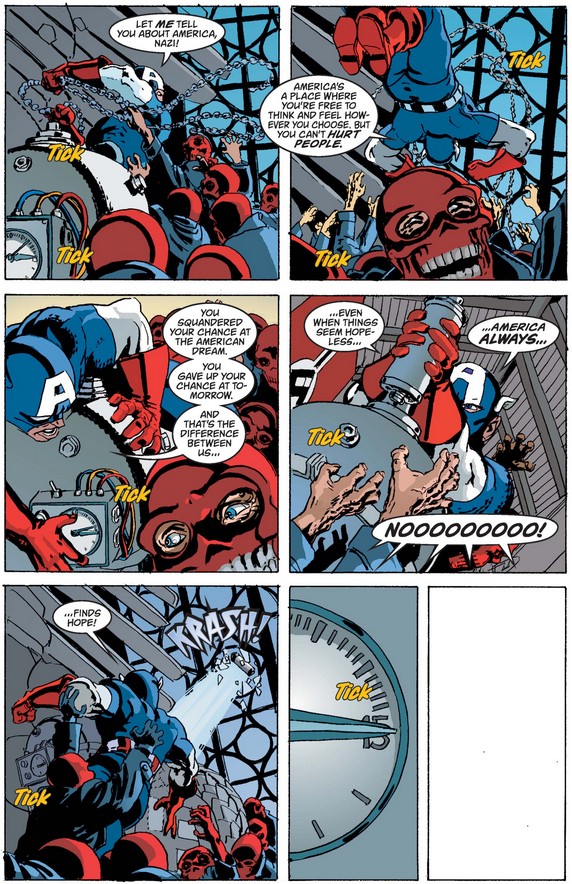
…but explode it does, although it does not seem to destroy the state of New Jersey. Someone and something are missing, however.
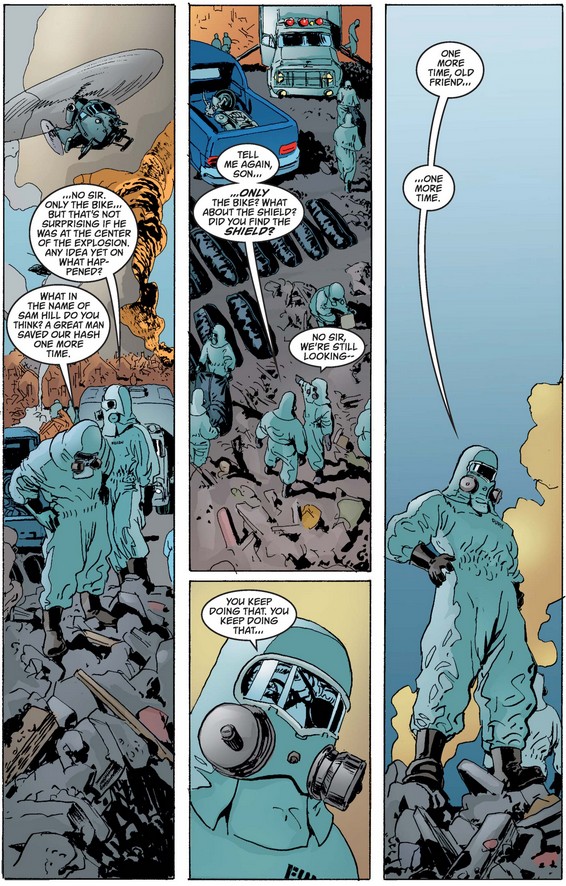
Despite not finding a body or shield, a shocking conclusion is drawn, which is announced in the fifth story…
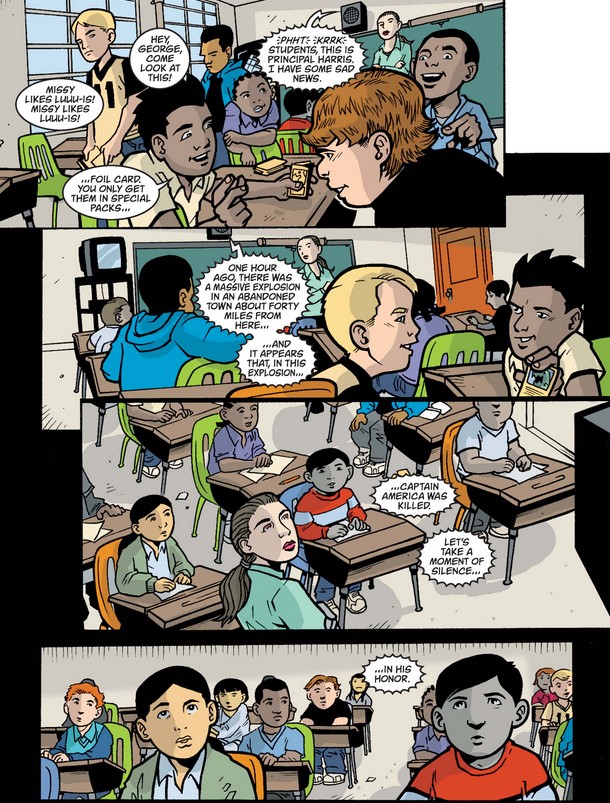
…which has a dramatic effect on one young fan who was attacked by several of his classmates who apparently assumed people who “looked like him” were responsible for Cap’s death.
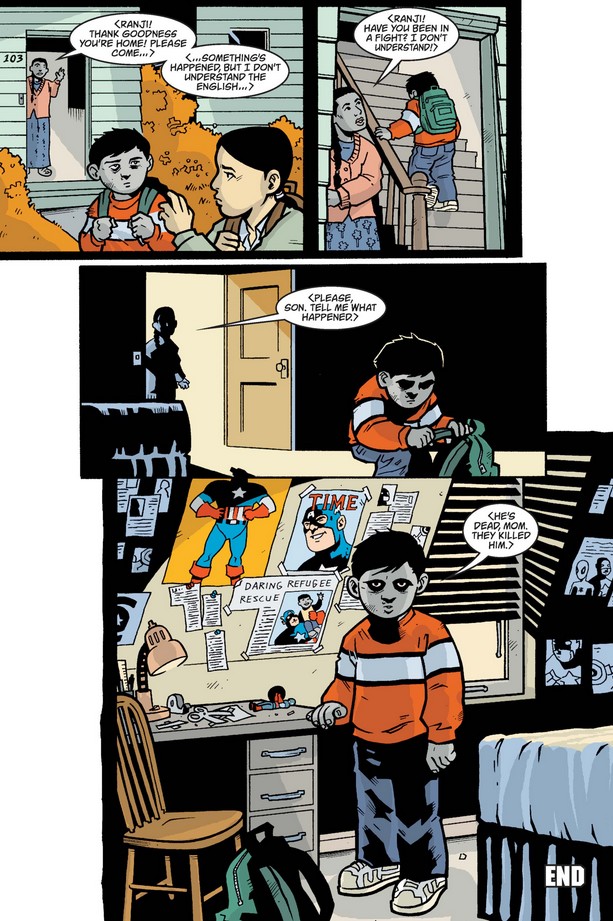
(This might make for an interesting origin story down the line if someone would follow up on it.)
The final story—illustrated by the undisputed matter of facial expressions, Kevin Maguire—consists mostly of reactions to the death of Captain America, both laudatory ones from friends and colleagues and some nasty ones from villains and foes. (Normally I would comment or summarize, but there are just so many, and this post is long enough as it is!)
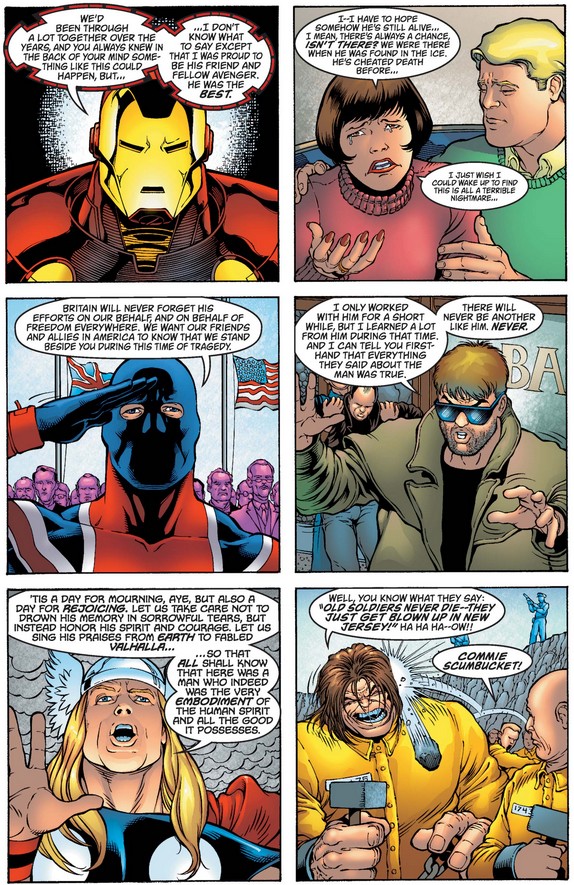
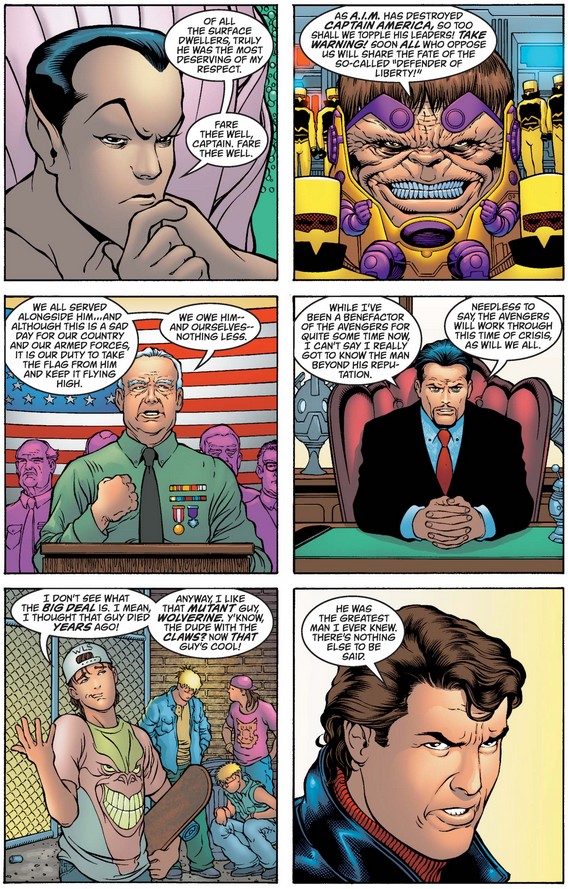
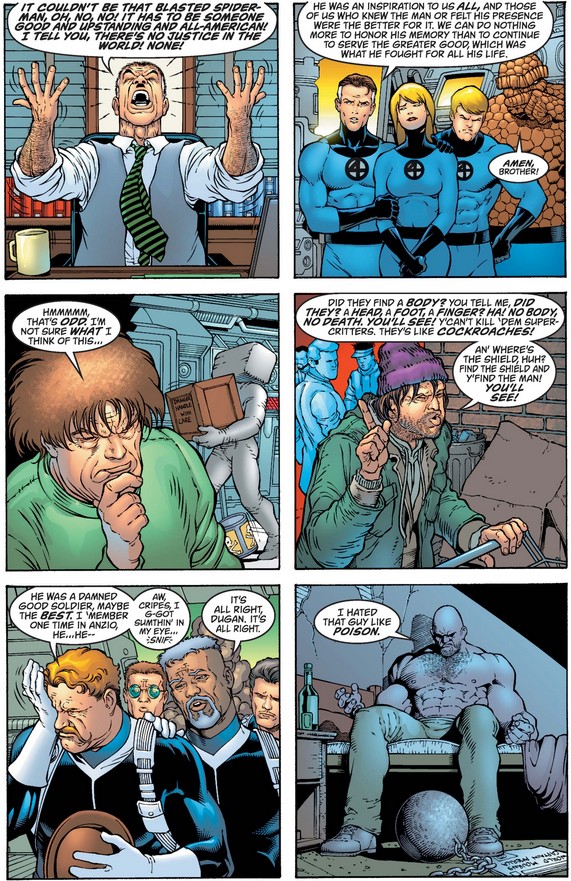
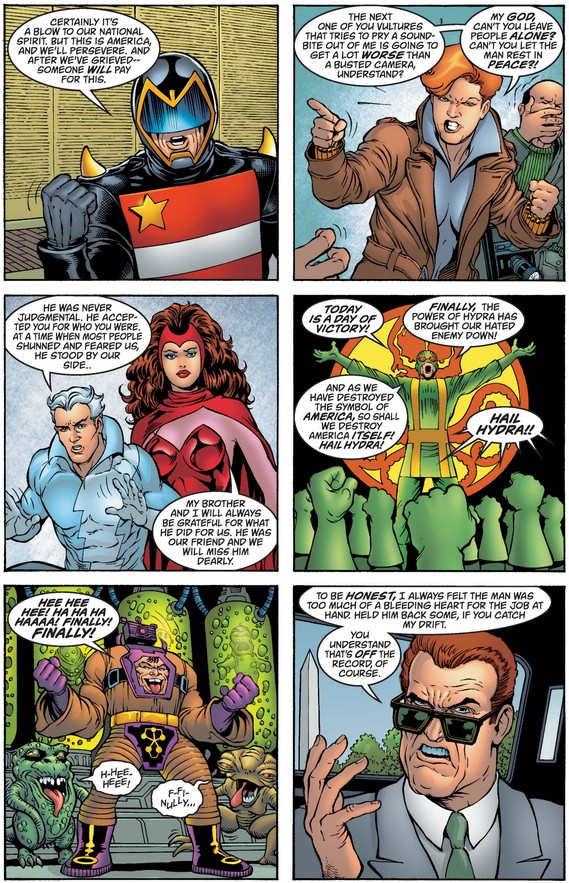
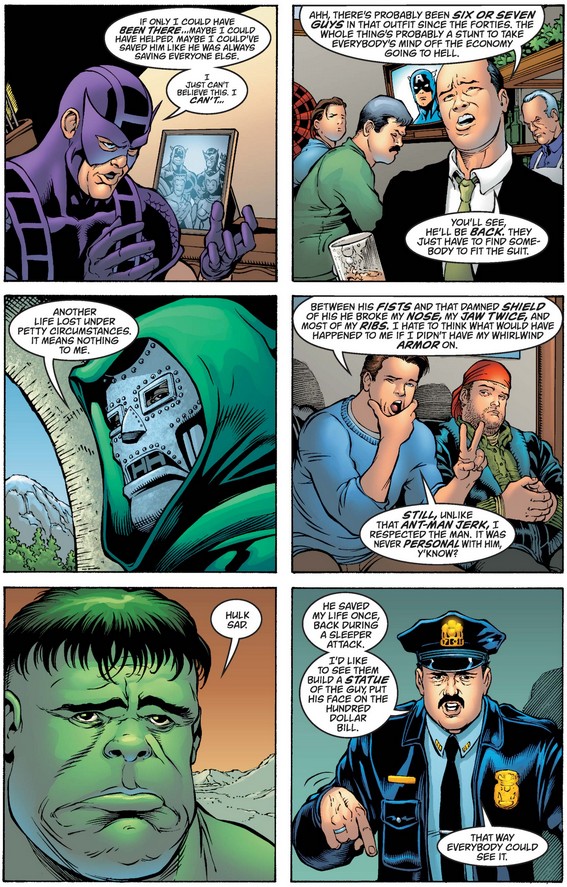
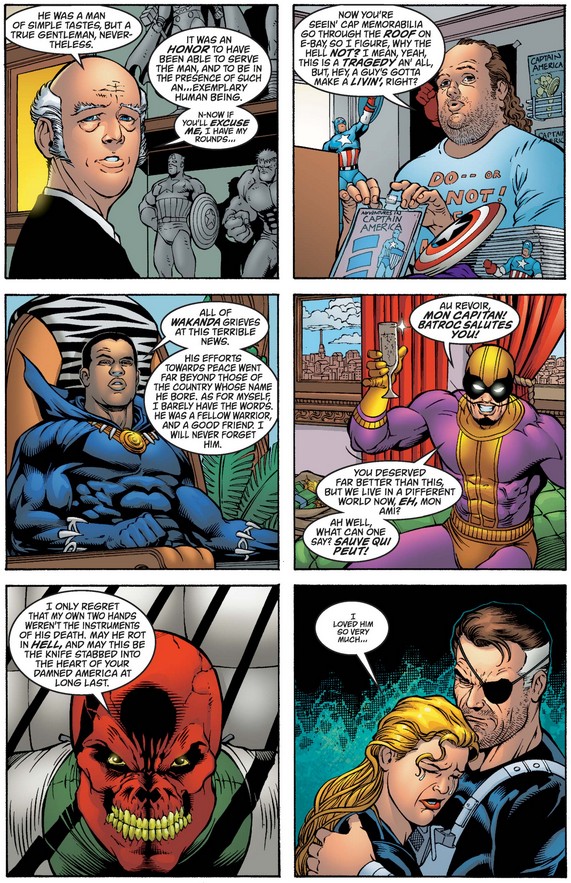
(Nice choice to end with the Red Skull and Sharon.)
All that remains is the funeral, with the main eulogy delivered by Sam Wilson, adding to the previous praise for Cap’s character and service as well as commemorating their close friendship and partnership…
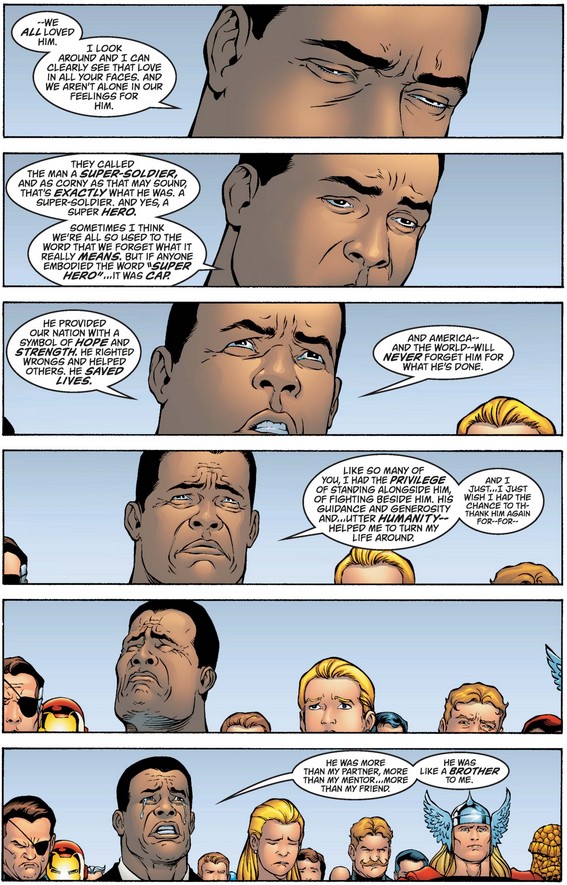
…before speaking final words on behalf of everyone assembled.
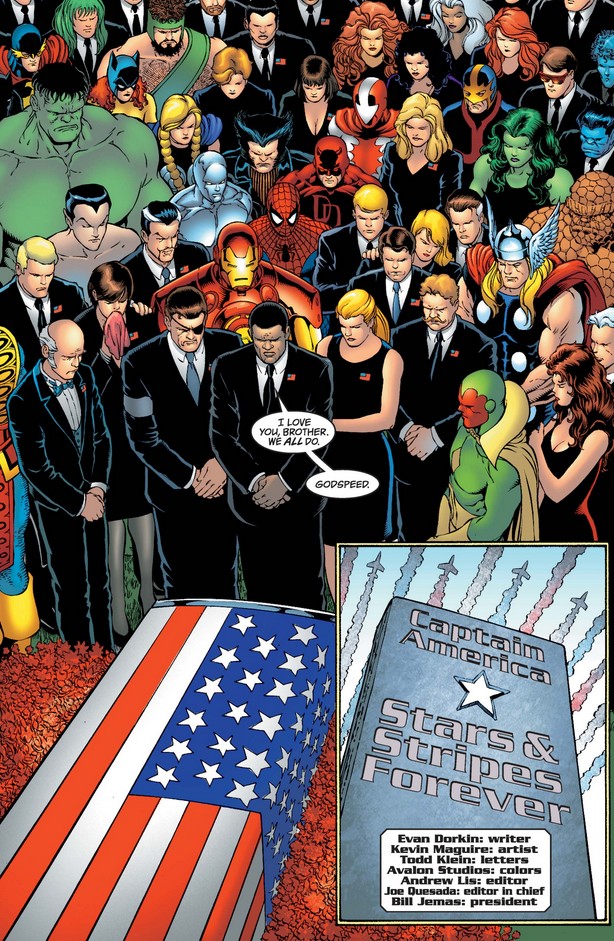
What will be the ramifications of this shocking death, memorialized here by the words and tears of heroes and schoolchildren alike? How will this momentous occasion be reflected the current Avengers run, and who will be the next Captain America? This monumental event must have rippled throughout the Marvel Universe, right?
Steve Rogers returns as Captain America next month in the Dead Men Running miniseries—which was actually previewed at the end of this very comic—followed by volume 4 of Captain America, and he continued to appear in Avengers as if nothing out of the ordinary ever happened in New Jersey that day. (No one cares what happens in New Jersey anyway, so I guess it makes sense.)
ISSUE DETAILS
Captain America (vol. 3) #50, February 2002:
“Silent Night-Silent Morning”: Dan Jurgens (writer and pencils), Bob Layton (inks), Avalon Studios (colors), Todd Klein (letters).
“Keep in Mind”: Kathryn Kuder (writer), Stuart Immonen (artist), Todd Klein (letters).
“To The Core”: Dan Jurgens (writer), Dan Jurgens, John Romita Sr., Bruce Timm, Ron Frenz, Sal Buscema, Rick Veitch, Tom Palmer (pencils), Bob Layton (inks), Edgar Tadeo (colors), Todd Klein (letters).
“Relics”: Brian David-Marshall (writer), Igor Kordey (pencils and inks), Avalon Studios (colors), Todd Klein (letters).
“A Moment of Silence”: Jen Van Meter (writer), Brian Hurtt (pencils), Jim Mahfood (inks), Avalon Studios (colors), Todd Klein (letters).
“Stars and Stripes Forever”: Even Dorkin (writer), Kevin Maguire (pencils and inks), Avalon Studios (colors), Todd Klein (letters).
More details at Marvel Database.
Collected in: Captain America by Dan Jurgens Omnibus.
PREVIOUS ISSUE: Captain America #49 (January 2002)
 THE VIRTUES OF CAPTAIN AMERICA
I love Jurgen’s wordless story. It’s one of my favorite Cap tales. That final panel where Cap gives the gift to Creel’s girl is what, to me, Steve Rogers is all about. Care and compassion for others.
The death of Cap story has some interesting historical elements. The Military, CIA and FBI did import many thousands of card-carrying Nazis at the end of the war- but not, as the story says, for information on Hitler’s plans for a nuclear device (by the end of 1944 we knew the Nazis had abandoned the project). They were brought here to work on the rocket program and to help us confront the USSR.
I love Cap’s succinct summation of (what) the US (should be): “America’s a place where you’re free to think and feel however you choose but you can’t hurt people.” A great Cap quote.
This abandoned story seems to herald the beginning of Marvel abandoning attempts at strict continuity. Other stories coming up in the next volume will be ignored as well.
Of course, in Volume 5, Marvel will reboot Cap completely. But even after that, and into the present, I’ve noticed inconsistencies- like Cap’s abilities changing so sometimes he’s beyond peak human.
I always liked Cap being simply human. I love to see my heroes punch above their weight & I love to see them fight villains who are truly formidable because they are more powerful than the hero- like the Absorbing Man in Jurgen’s Christmas story. Then the hero has to win through smarts, courage, being the better person and working together with others like Cap does with Mr. Grunnell.
LikeLike
Agreed! Especially about Cap with Grunnell and Creel.
LikeLike