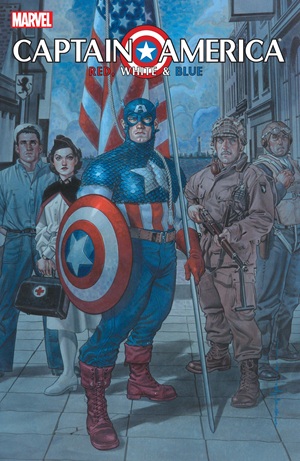
 This collection, published on the first anniversary of September 11, featured a number of new stories celebrating Captain America (and, by extension, America itself, I would assume), plus reprinting similar stories from Captain America (vol. 3) #50 (including the tale of his “death”). To be honest, they are a mixed bag, some being more parody than tribute, but five of them are worth discussing here.
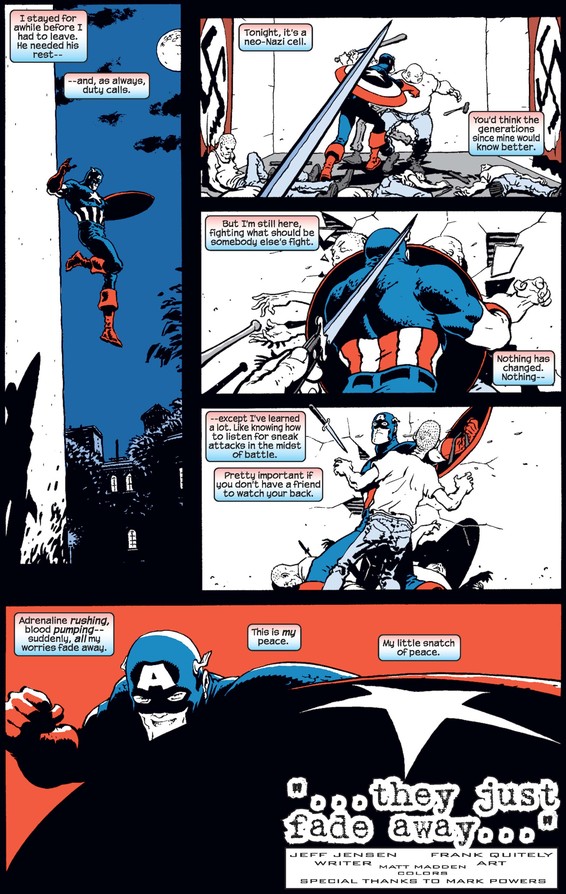
The first story we’ll cover is “They Just Fade Away” by Jeff Jensen and Frank Quitely (who draws Cap here for the first time, I believe). Below, we see Cap reminisce in the present about how everyone he knew during the war is passing away, and even worse that he never really had a chance to make friends with them. (Somewhere, Nick Fury sheds a tear.)
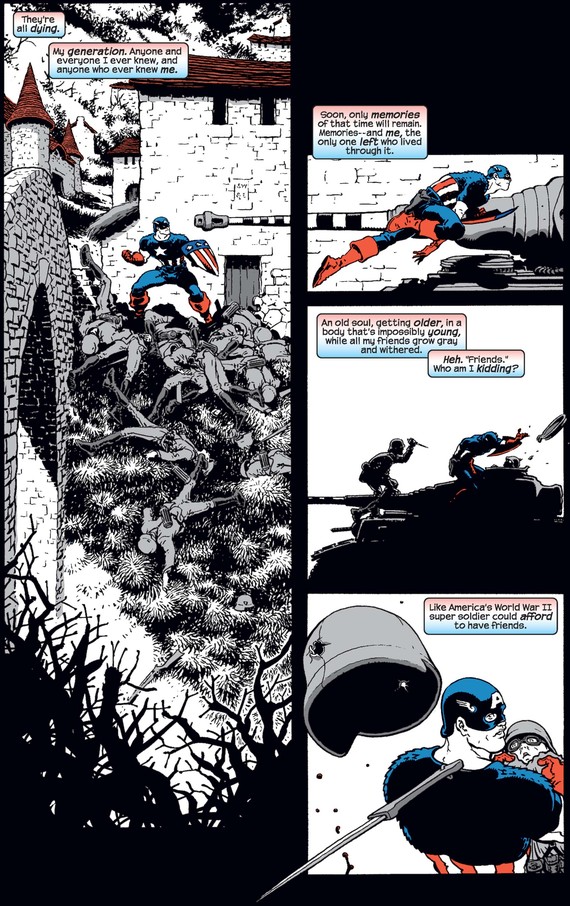
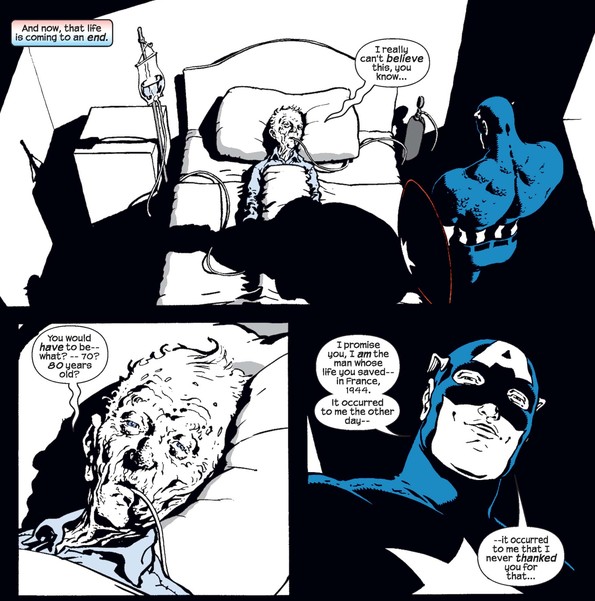
He remembers one guy who’s still around, and to whom he owes a bit of gratitude, not just for saving his life…
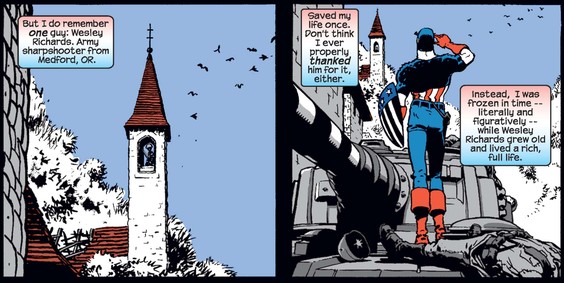
…but also for being a swell guy to a “cowardly malcontent.”
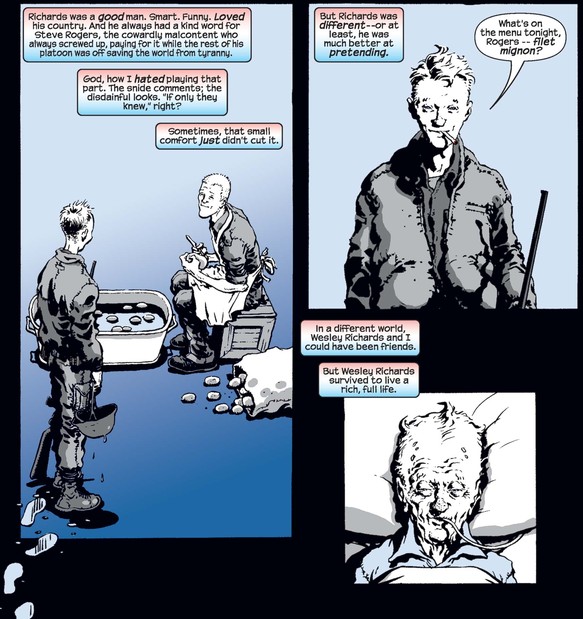
(If he’d gone through Project Rebirth already, Steve’s using some Christopher Reeve-level magic to look that meek!)
As Richards lies dying, Cap pays the debt he owes him…
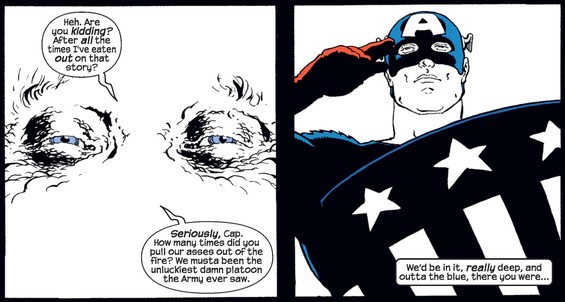
…which Richards dismisses just like Cap would.
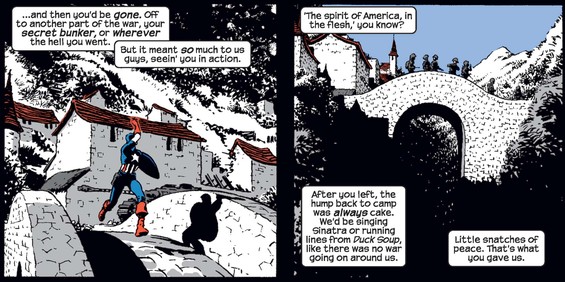
Richards goes on to explain how much the troops appreciated seeing Cap back then…
…and even remembers that “cowardly malcontent” and thinks how he’d have been transformed if he’d ever seen Cap himself.
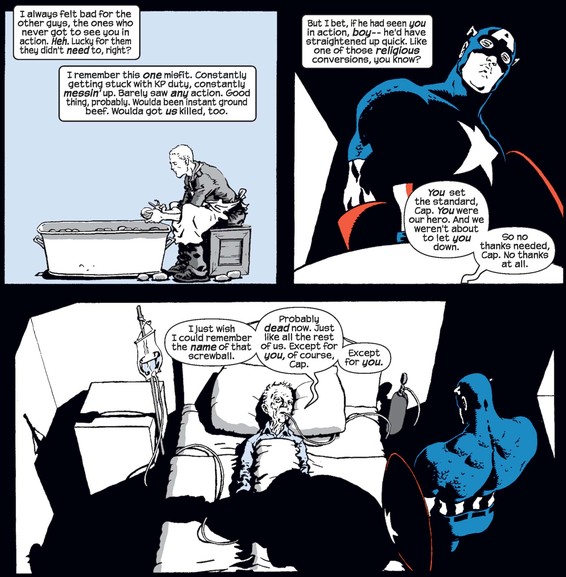
After leaving, Cap gets back to work, bemoaning the persistence of bigoted evil but appreciating the action with a nice callback to Richards’ earlier words.
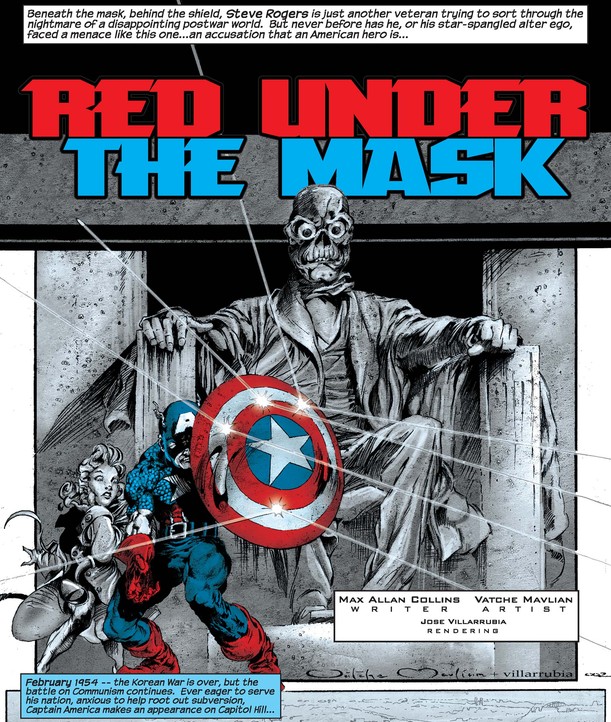
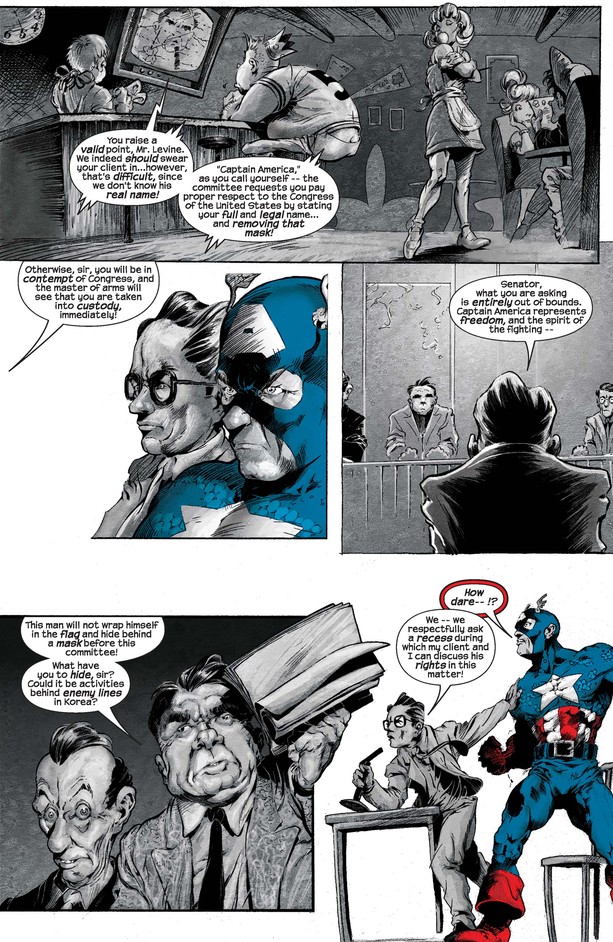
The second story, “Red Under the Mask” by Max Allan Collins and Vatche Mavlian, imagines a Captain America who survived World War II to face a Joseph McCarthy figure named Senator Joseph McRooter (get it?), who accuses him of harboring communist sympathies. (In other words, this Cap is not William Burnside, introduced in Captain America #153 to explain how Cap appeared in the 1950s if he died before the end of World War II according to Avengers #4.)
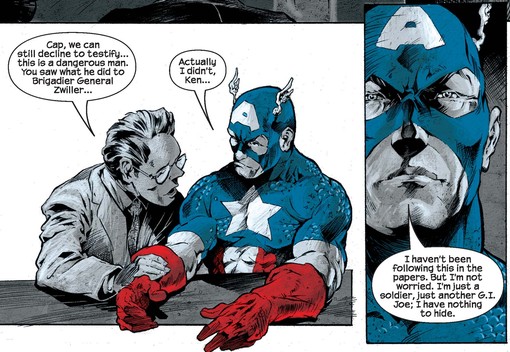
When his lawyer, Ken Levine, tries to warn him again appearing, Cap asserts his innocence and transparency (and reinforces that he is the original Steve Rogers, because Burnside never served—unless he considered himself a soldier even though he was only Cap during the Cold War).
The grilling begins with Cap’s official military status—or lack thereof, as he openly admits.
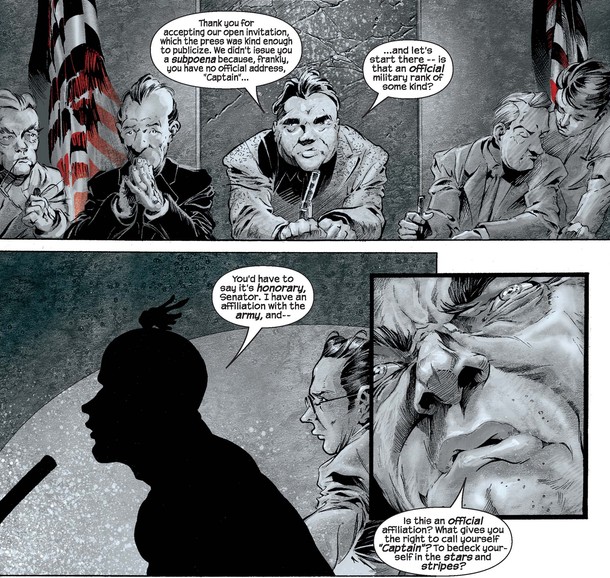
Umm, President Franklin Delano Roosevelt did… but we can assume McRooter, like McCarthy, was not a fan of him either.
After Levine reminds the senator that Cap hasn’t even been sworn in yet, McRooter uses that fact to demand that Cap unmask (a demand that, in a similar setting in America vs. the Justice Society, led to the break-up of that group). Levine argues for Cap’s symbolism to Americans, but the senator just accuses him of having something to hide, which naturally triggers the Sentinel of Liberty (which is presumably what McRooter wanted all along).
Later, Steve unloads to a friendly FBI agent (with a familiar name) about his discomfort with resorting to legal technicalities that make him look guilty, even though he realizes why he has to do it (as she reminds him).
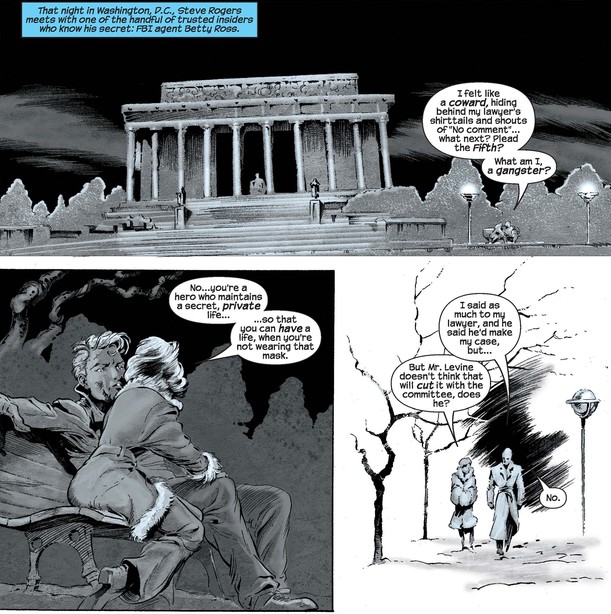
In the end, Ross gives him evidence that suggests McRooter is not who he claims to be—and the next day they’re in session, Cap removes the senator’s mask to reveal the Red Skull, having failed yet again to undermine American democracy.
Our third story, “American Dream” by Mark Waid, Mike Huddleston, and Bill Sienkiewicz, explores dreams that Cap had while frozen underwater following that fateful day in early 1945.
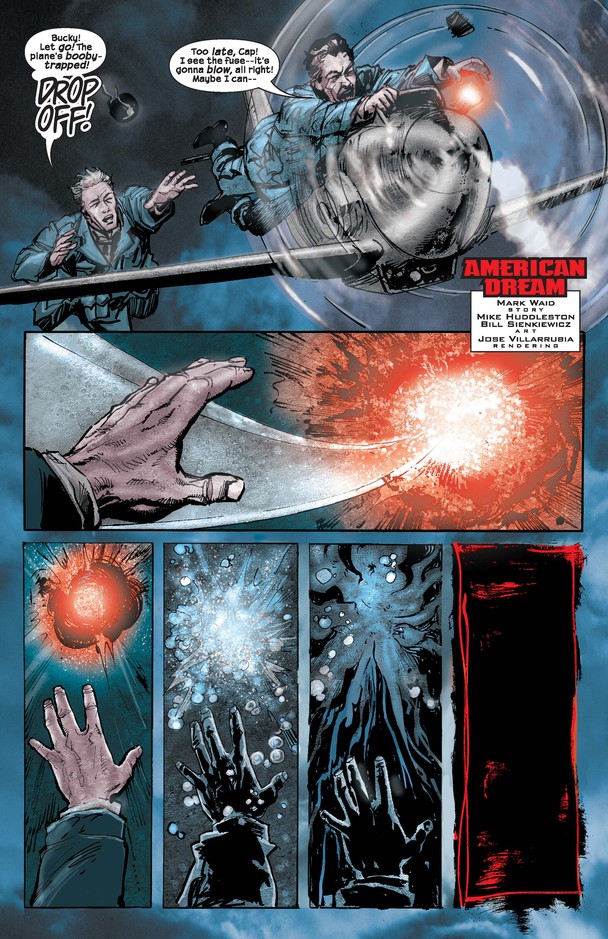
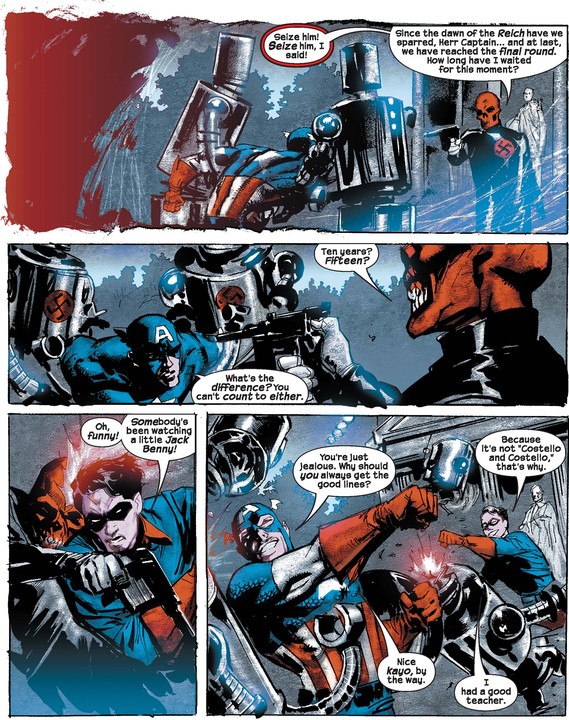
Each page shows a different scene of how his and Bucky’s lives would have gone if they had not disappeared that day. (The last horizontal panel on each page, not shown here, shows Cap gradually enveloped by ice.) The first dream shows Cap and Bucky fighting the Red Skull well into the 1950s, still working together happily in the prime of their lives.
The next dream shows a much older Cap, still working alongside Bucky in what Cap would imagine the future looked like based on the sci-fi novels and movies of the 1940s, including domed cities on the moon. Although Bucky denies it, Cap feels his age.
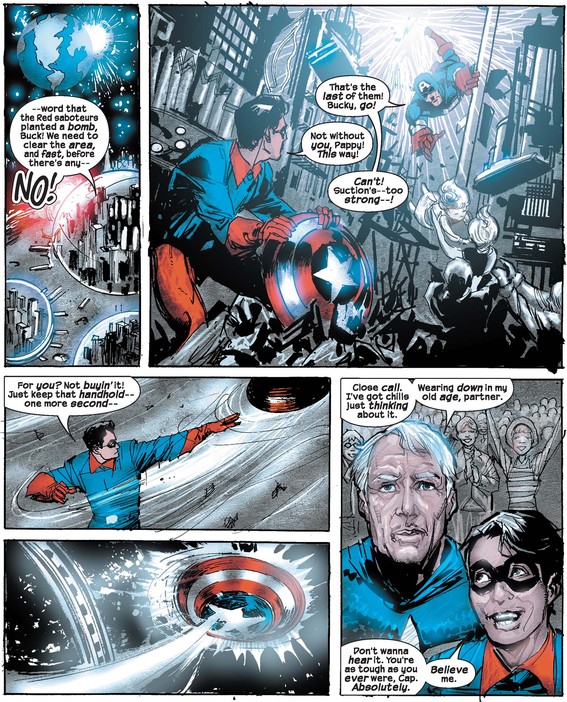
(What do you think: Jason Robards or Gregory Peck?)
In the next dream, Steve has retired to seek political office, although he still finds his fighting skills useful.
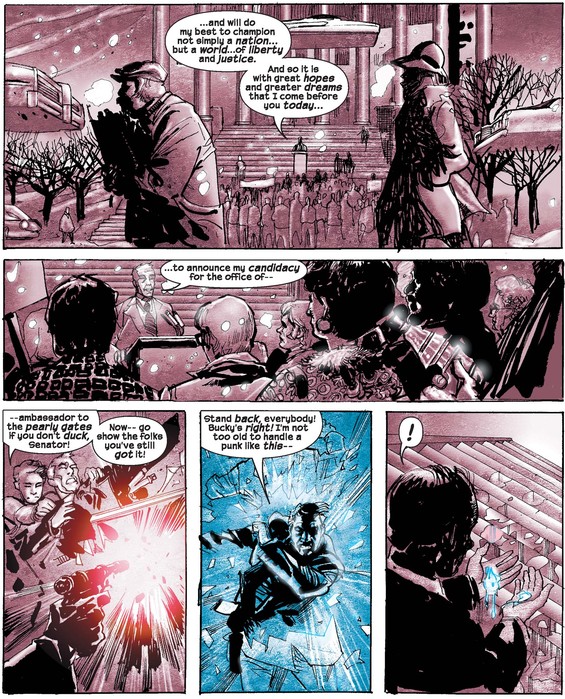
(The ice is likely a sign that the real world is beginning to encroach into his dreams.)
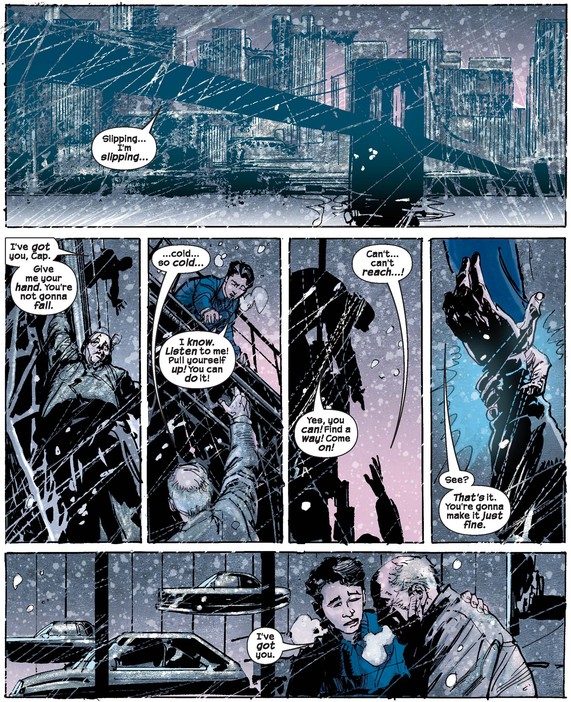
The next one shows Bucky saving an even older (and possibly senile) Steve from falling off the Brooklyn Bridge (leaving it to us to imagine how he got in this situation in the first place).
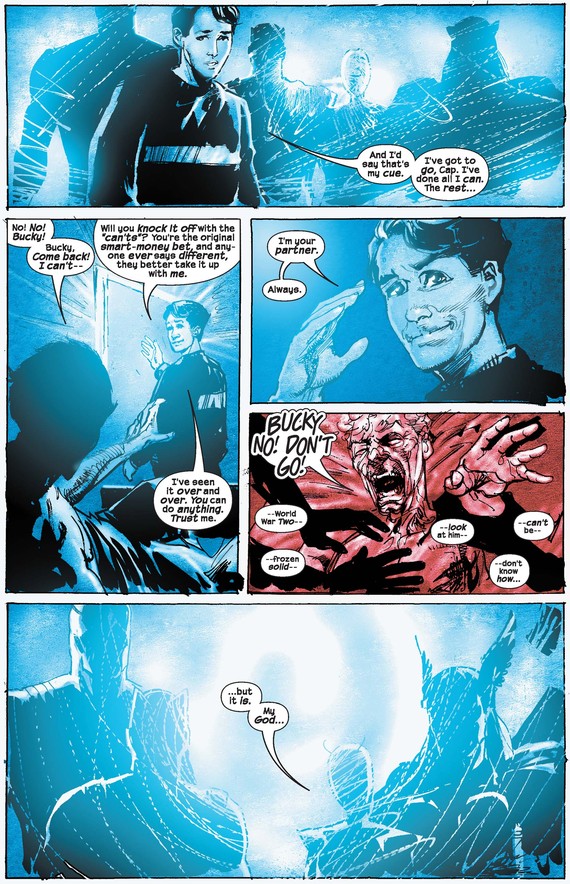
As the (final) panel at the bottom of the next page shows a craft with lights approaching the ice containing Cap, his dream shows Bucky imploring a dying Steve to fight as four mysterious figures appear behind him…
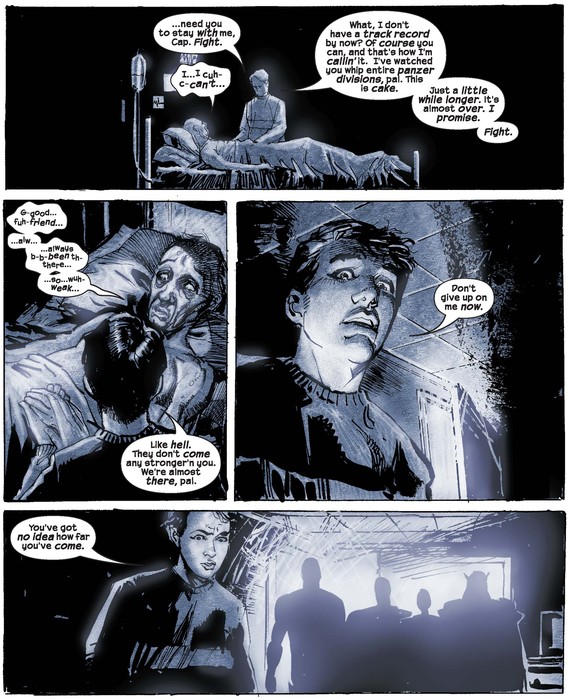
…and the dream merges with reality as Cap starts to come to. Dream-Steve screams for Bucky not to leave while a familiar scene plays out in the real world.
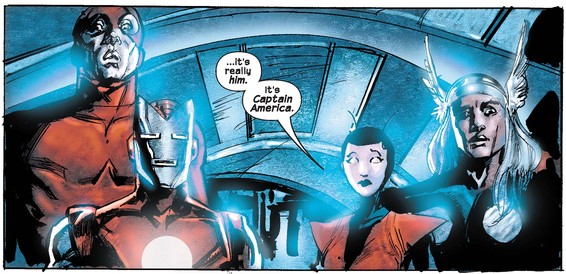
As the Avengers try to calm a disoriented Captain America, Hank Pym surmises what happened and can only guess at who was watching out for Cap the entire time…
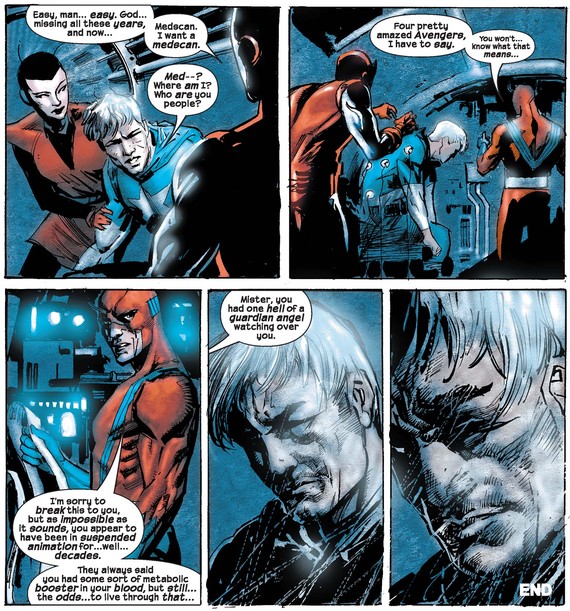
…but Cap knows all too well. (However, this will only make learning the news about Bucky all that much harder to take.)
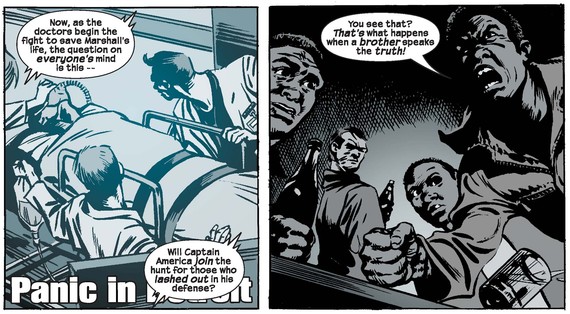
Our fourth story, “The Pledge” by Paul D. Storrie and David Lloyd, addresses the role Captain America, the man and the symbol, plays in debates about civil rights and racism. Below, the Detroit news reports on the shooting of Reverend Jonas Davies, “possibly” by white supremacists, for questioning whether a symbol that was created in a more racist era—not the man himself—is an appropriate presence at a ceremony celebrating Black veterans.
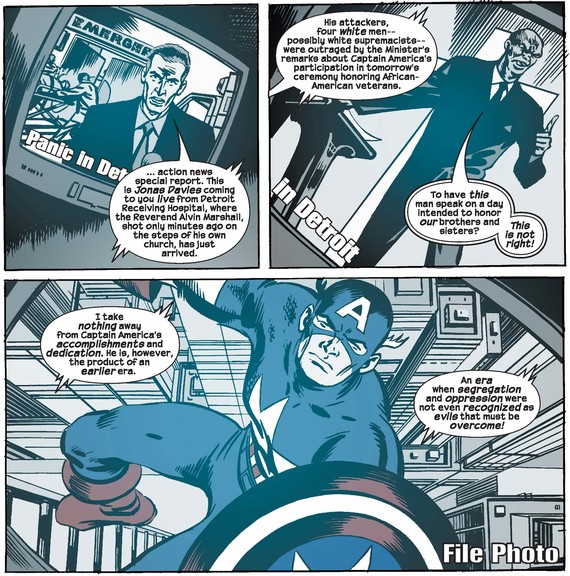
While the news reports concludes by wondering if Cap will help search for the shooters—even if that were his job, are they suggesting he’d be on the shooter’s side?—a debate starts in a local bar.
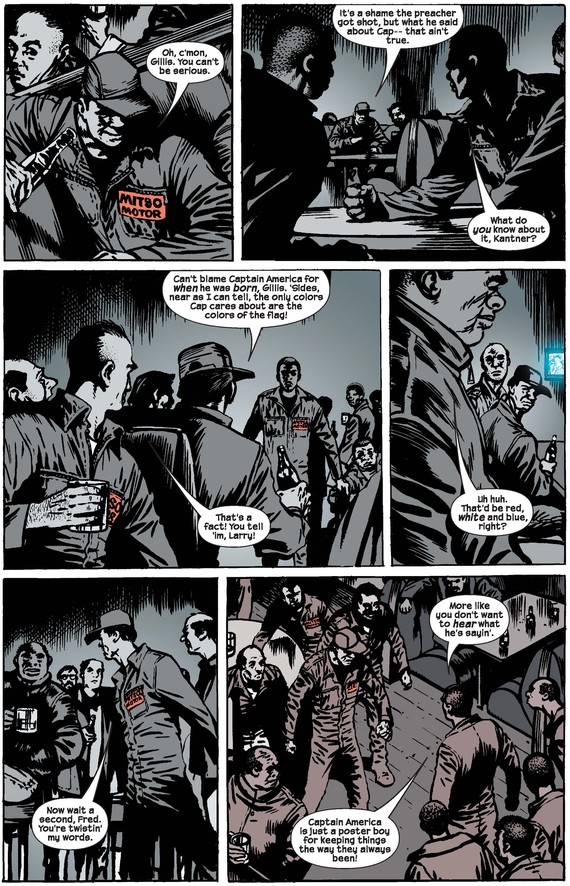
Two guys end up arguing past each other, the first defending Cap himself, while not denying the wrongs of his era, and the second arguing against the era and the mindset he feels he symbolizes, without addressing Cap himself.
An older Black man speaks up for Cap himself, citing his years-long partnership with the Falcon, which shifts the argument from Cap to Sam.
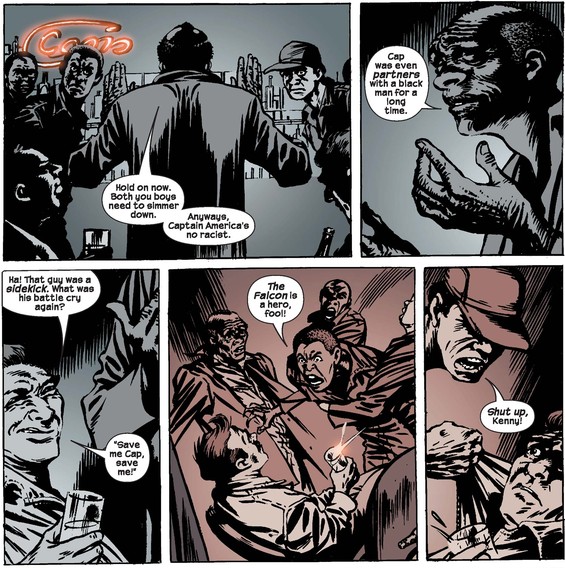
(Note that it’s Kantner who defends Sam above, blurring the racial lines in the debate a bit.)
This debate stops when the news returns with an update about Cap…
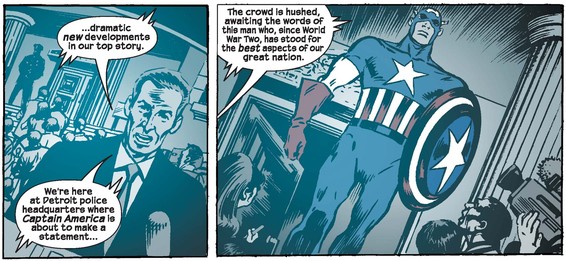
…in which, contrary to the reporter’s earlier implication, he actually feels he has to defend and explain his cooperation with the Detroit police in apprehending the shooters.
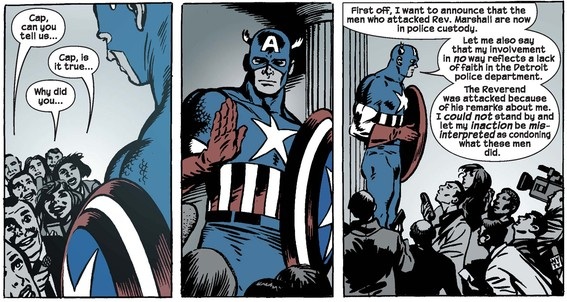
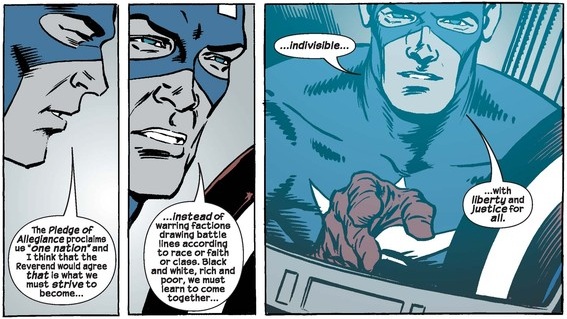
Cap doesn’t address the Reverend’s comments directly but asserts his problem with any position that encourages division instead of unity.
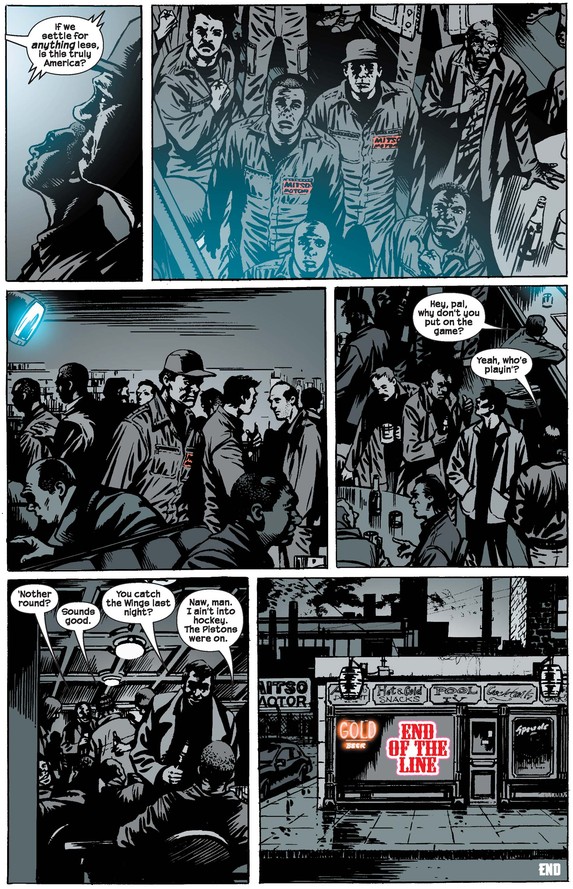
After his final words, the men in the bar seem satisfied, and the normal conversation resumes (a little too easily, perhaps, but very hopeful).
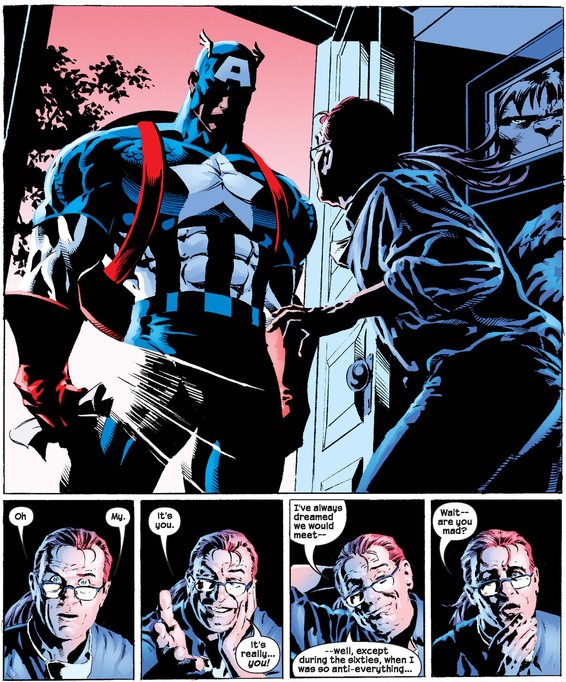
The final story, “Desecration” by Jeff Jensen and Mike Deodato, Jr., starts with Cap reacting to a Islamophobic mailer suggesting he sided with the 9/11 terrorists. When the FBI discover the party responsible for mailing them (in violation of several United States Post Office codes), Cap is all too happy to lead the arrest.
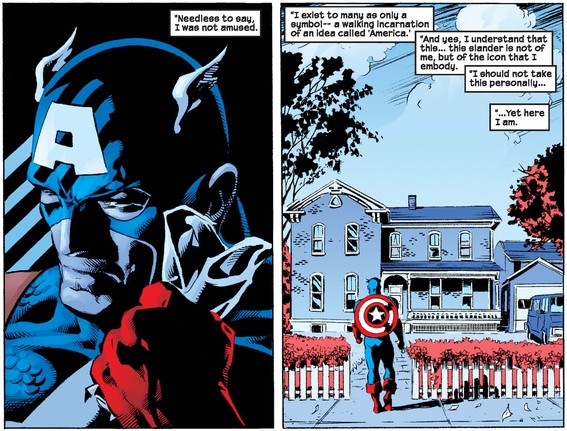
Imagine opening your door to Captain America, the size of the Hulk and looking like Batman after 72 hours of no sleep—and then see how this guy reacts.
He leads Cap down to his basement, walls adorned with pictures of Martin Luther King, Jr., Malcolm X, and John F. Kennedy, and full of people either working on computers or combining chemicals. As he goes on to explain, the printers concoct hate messages designed to appeal to different audiences by setting Captain America alongside whatever group they’re resentful towards…
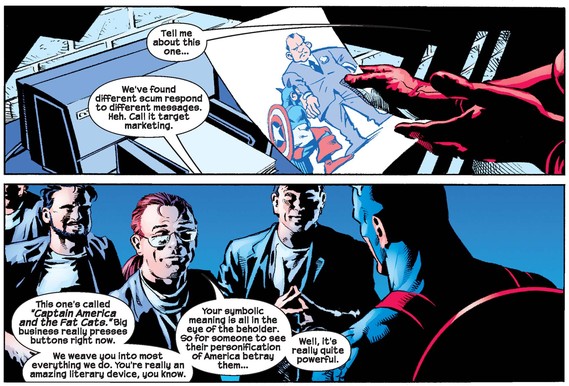
…and they coat them with anthrax before mailing them. (That’s the part the Post Office likely took exception to.)
When the man brags about having just mailed a batch to a Ku Klux Klan rally, Cap tries to get there before the poisoned mail does, sympathizing with the printers’ attitude toward hate but cursing their methods, in which they resort to the same murderous tactics they claim to be reacting to.
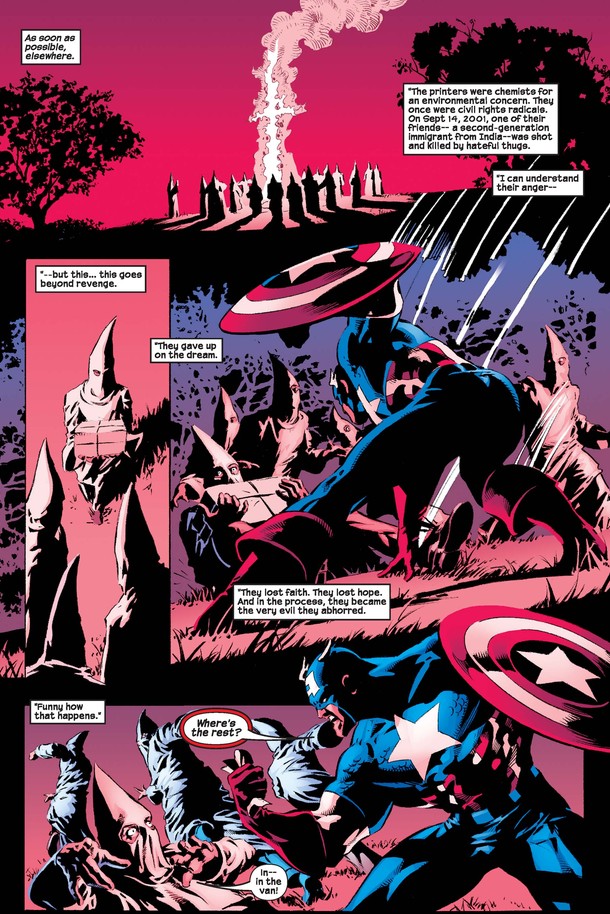
At the same time, Cap finds himself in the very uncomfortable position of having to save the lives of devoted racists—and in front of reporters, no less. He considers the unlikely chance that this might be reported without hyperbole or salaciousness, but finds it hard himself to explain why he did it in a way that sounds good. (Fighting to protecting the free speech rights of those who would deny those same rights to others makes sense in principle, but if it contributes to worse outcomes later, it can be difficult to defend the priority of that principle, especially to the people who get hurt.)
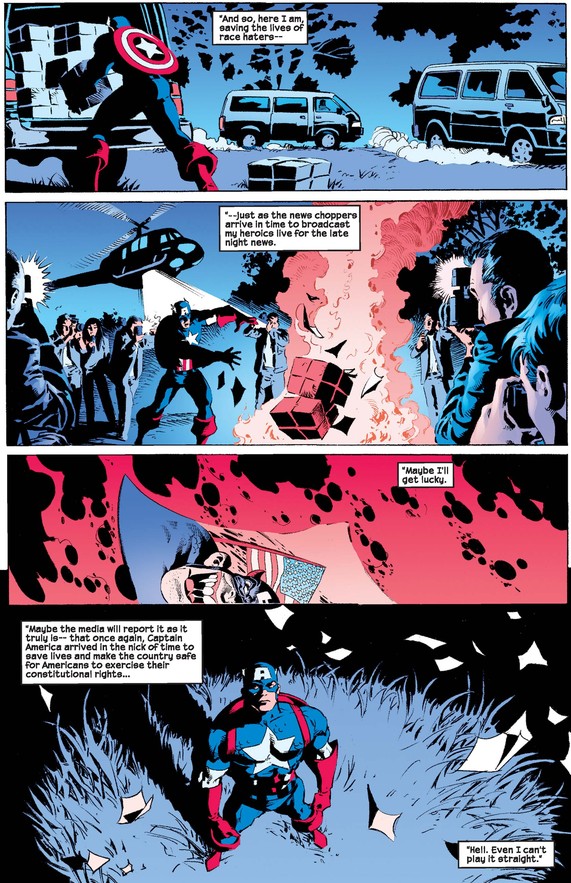
Speaking of Batman, Steve sits like Bruce Wayne in his den at Wayne Manor, reading the newspaper with one of J. Jonah Jameson’s famously nuanced headlines, confirming his suspicions.
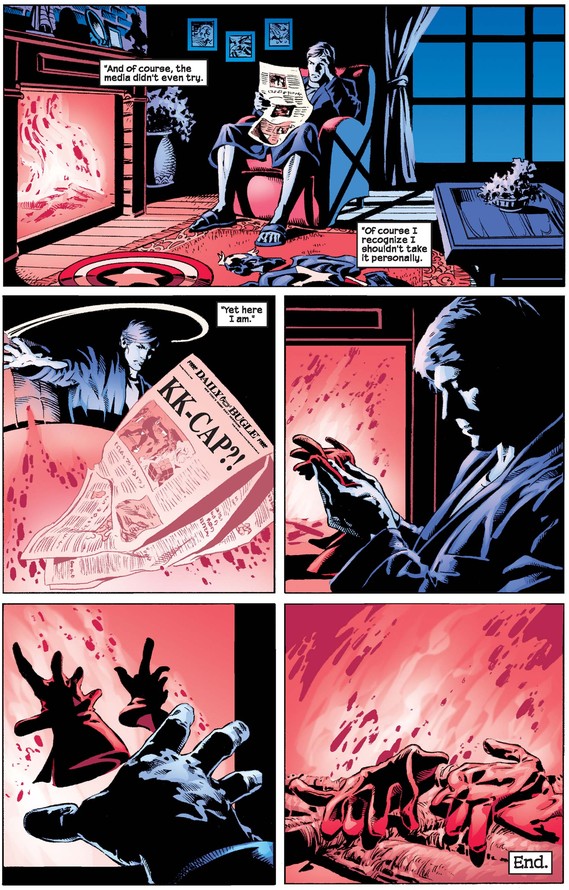
Throwing his gloves in the fire is very suggestive. Does this suggest retirement? Do the gloves represent “getting his hands dirty” by saving the Klansmen? Does it mean he’s “taking off the kid gloves” to get more proactive against hate groups? (Or maybe he just remembered that he touched anthrax with those gloves!)
ISSUE DETAILS
Captain America: Red, White & Blue, 2002:
“They Just Fade Away”: Jeff Jensen (writer), Frank Quitely (pencils and inks), Matt Madden (colors), Dave Sharpe (letters).
“Red Under the Mask”: Max Allan Collins (writer), Vatche Mavlian (pencils, inks, and colors), Dave Sharpe (letters).
“American Dream”: Mark Waid (writer), Mike Huddleston and Bill Sienkiewicz (art), (inks), José Villarrubia (colors), Dave Sharpe (letters).
“The Pledge”: Paul D. Storrie (writer), David Lloyd (pencils and inks), Chris Sotomayor (colors), Dave Sharpe (letters).
“Desecration”: Jeff Jensen (writer), Mike Deodato, Jr. (pencils, inks, and colors), Dave Sharpe (letters).
(More details at Marvel Database.)
Collected in: Captain America: Red, White & Blue.


Leave a Reply