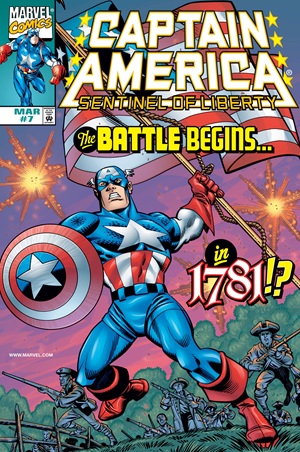
 This issue contains two stories. First in the comic, but second in this post, is the continuation of the Revolutionary-era Captain Steve Rogers story that began in the last issue (and unfortunately gets the cover of this one), which ends with a modern-day scene that raises even more questions than the ones mentioned before. But the first one we’ll discuss here is a much more meaningful story of President Franklin Delano Roosevelt’s impact on Steve Rogers, beginning at a very early age, a tale that also introduces new information about Steve’s mother Sarah.
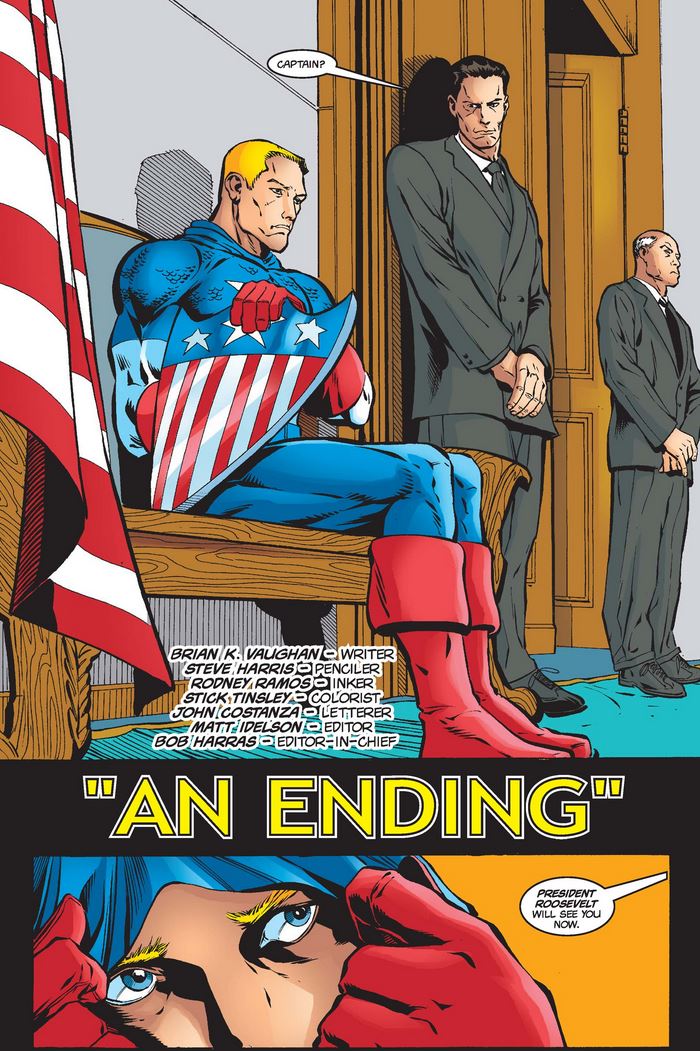
The latter story begins with a very early Cap waiting to see the president…
…before launching into a series of pages focusing on various years in Steve’s youth. First is 1933: specifically, March 4, 1933, the day of President Roosevelt’s inauguration, in which he spoke that famous line.
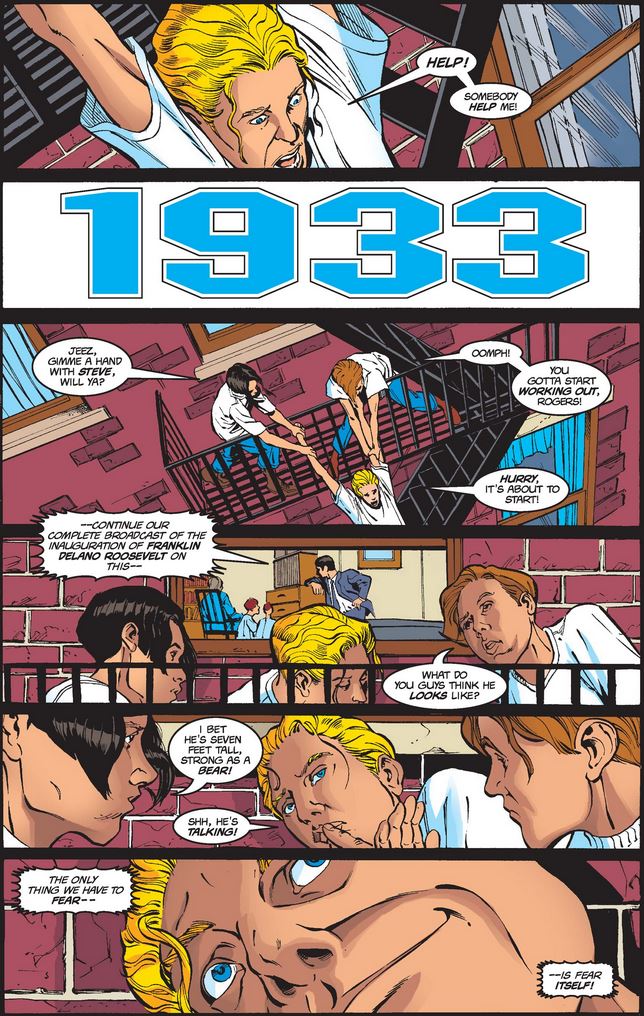
Besides Steve’s look of admiration, note his friends’ speculation about FDR’s appearance, which we’ll return to soon.
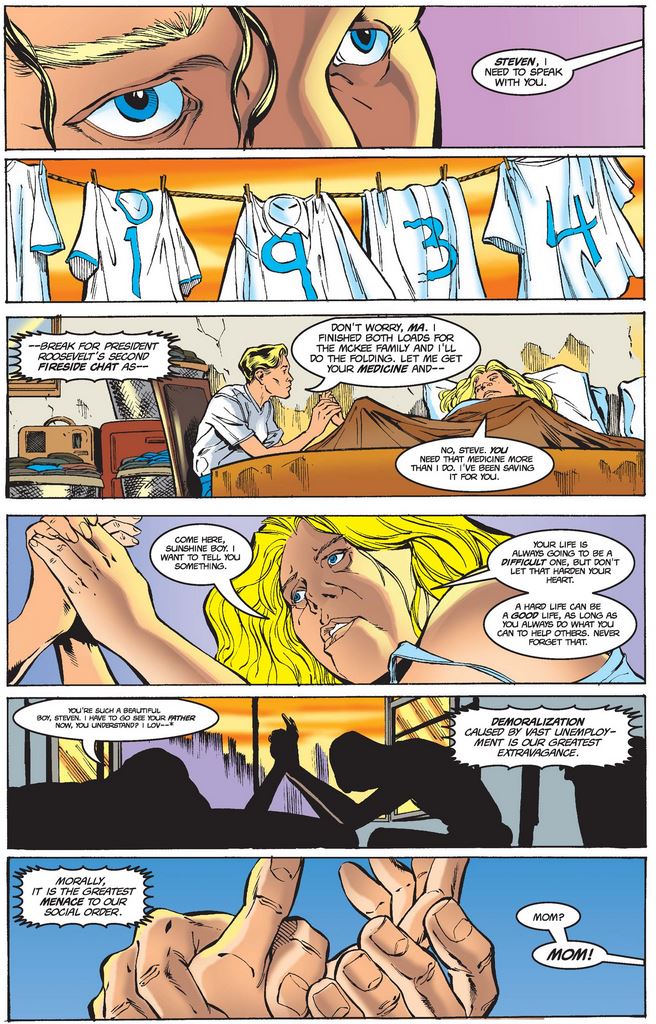
The next year, Steve is listening to one of FDR’s famous fireside chats, specifically the September 30, 1934 one, the day when his mother Sarah passes from a long illness (later revealed to be pneumonia). From this page we also learn that his father Joseph had already died by this point and Steve is sickly as well (needing the same medicine Sarah took). With her final breath, she tells her son that the good (and virtuous) life consists in helping others, at the same time that FDR is cautioning against becoming demoralized by the persistent economic depression (from which the country was only starting to emerge).
Five years later, artist Steve cheerfully works on a subway station mural under the auspices of FDR’s Works Progress Administration, a jobs program that, among other initiatives, hired thousands of artists to create cultural works.
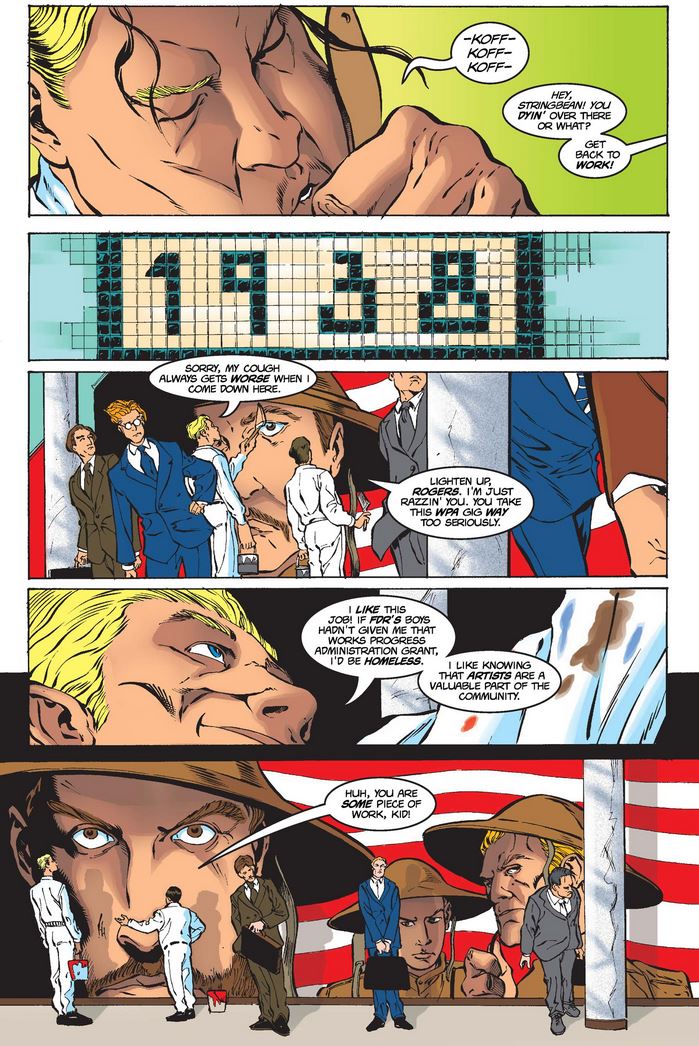
In 1940, Steve first feels the call to military service, at which point the story becomes more familiar (but no less stirring for its familiarity).
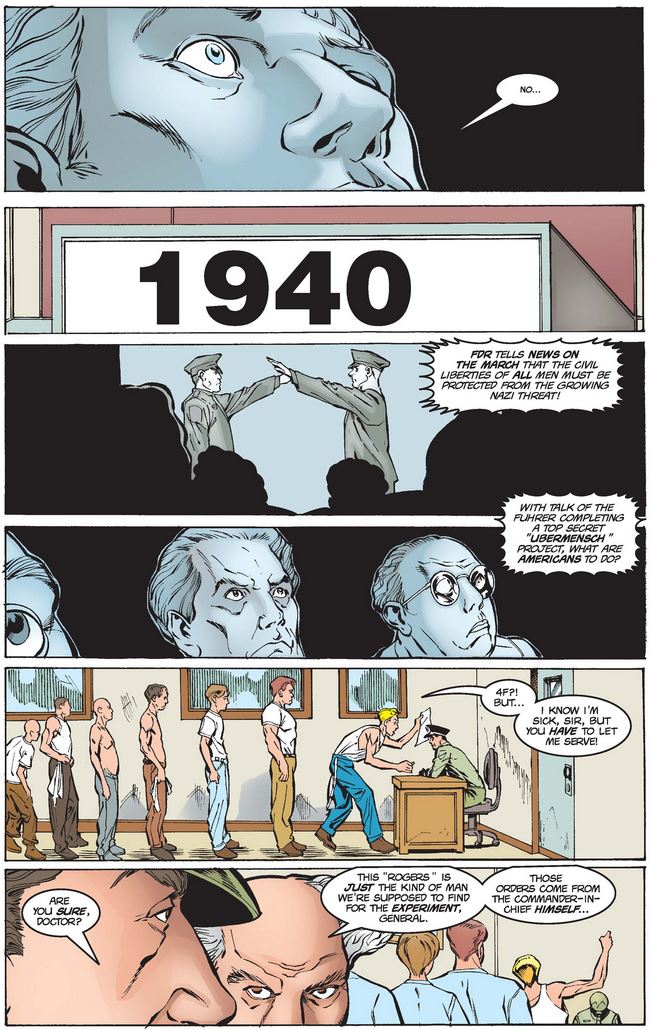
That brings us to 1941 and Cap’s “current” visit to FDR, when he met his idol for the first time and received his round shield (as shown in Captain America #255). Before he leaves, he has a question…
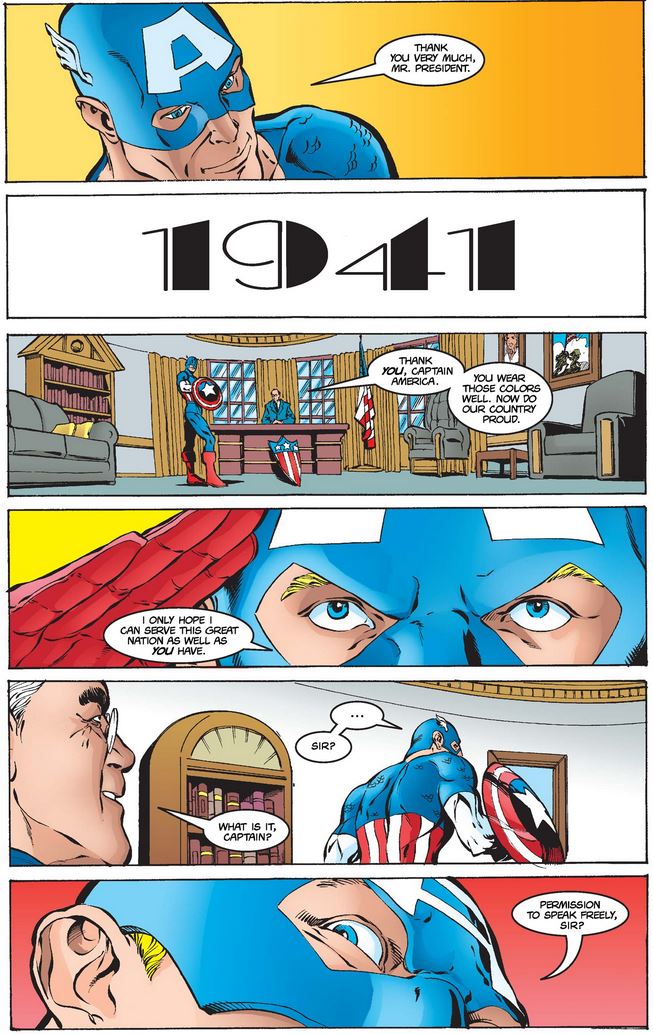
…and not surprisingly it comes from Cap’s humility and call to service. After he reveals how physically compromised he was before receiving the super-soldier serum and Vita-Rays, the president reveals something about his own health that was not widely known at the time.
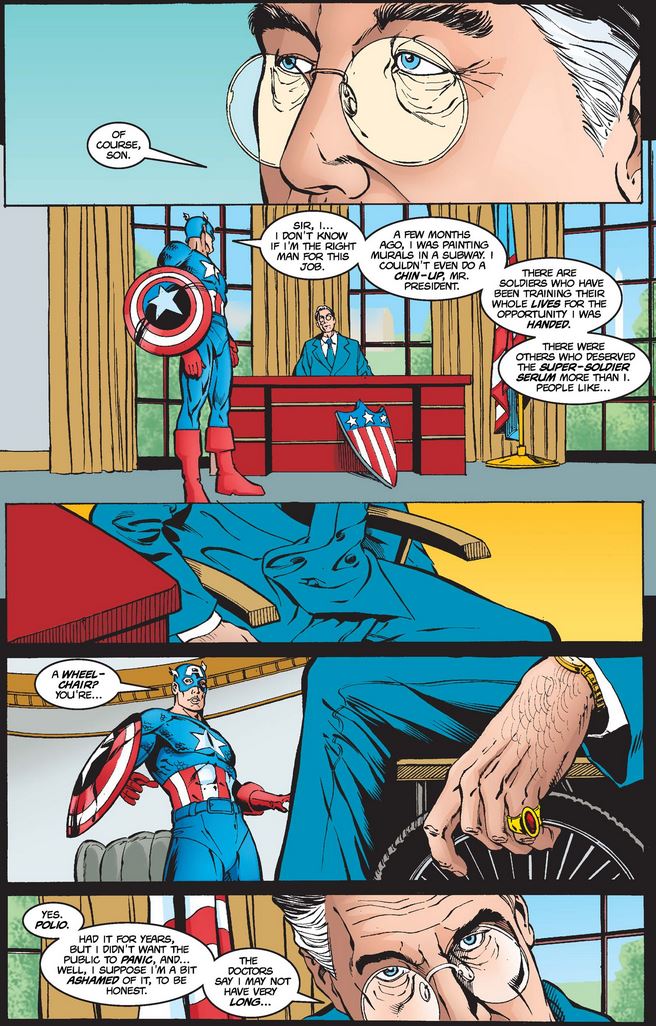
After Cap gets over his shock, FDR tells him that moral strength matters much more than physical strength and that it was Steve Rogers’ demonstrations of high character that made him the perfect candidate for Project Rebirth—which was intended for FDR as well, if the formula had not been lost with Professor Erskine’s assassination moments after Steve’s transformation.
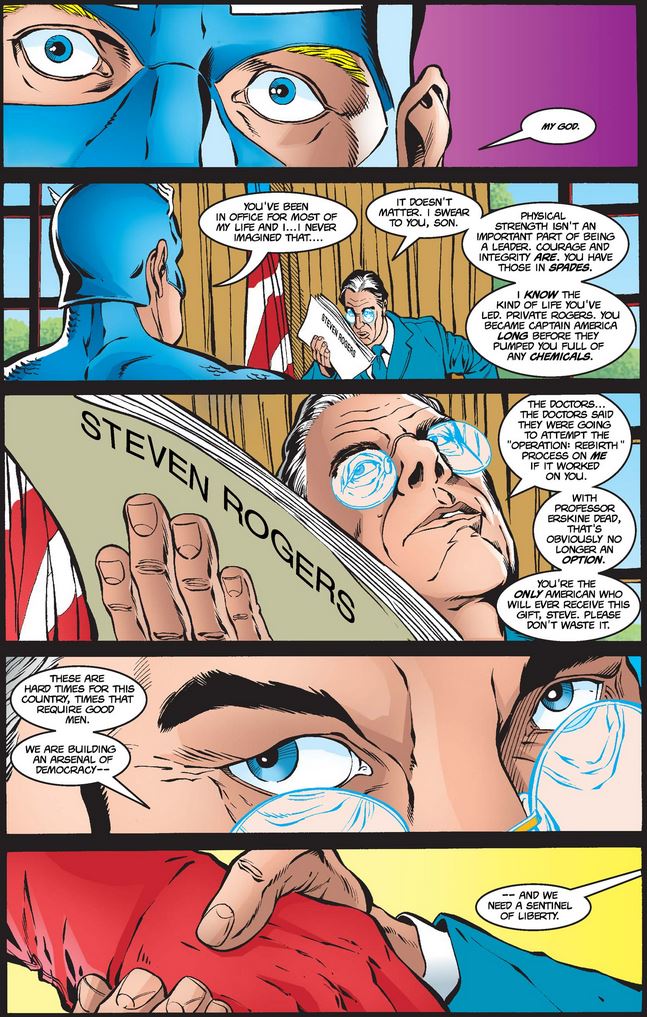
So that’s where that name comes from!
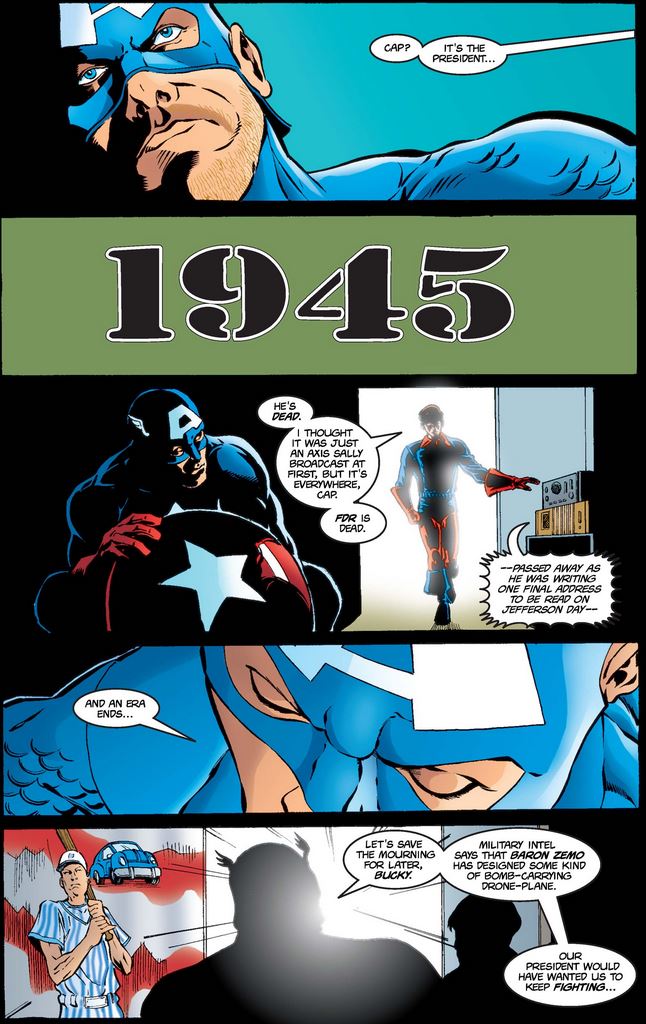
Flash forward four years to April 12, 1945, the day President Franklin Delano Roosevelt had a stroke and moved on from this world. Cap is presumably devastated, but chooses to honor the president by continuing the fight against tyranny—attacking Baron Zemo in what we must assume is Captain America and Bucky’s final mission for many years.
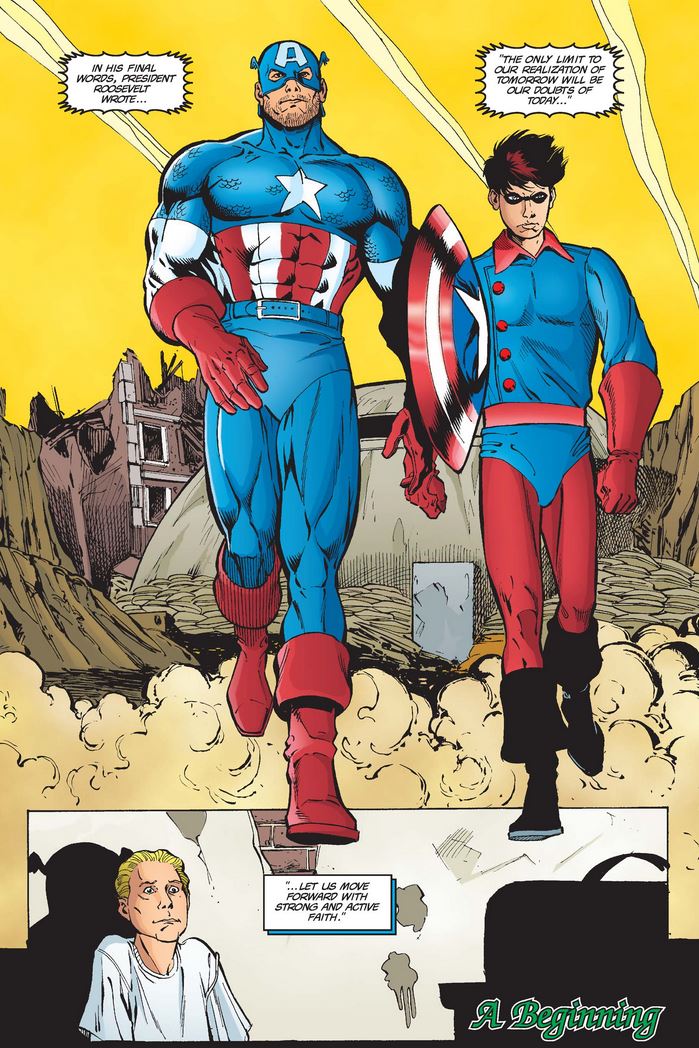
The final page of the story shows Cap and Bucky marching off to FDR’s final words while another panel shows young Steve listening to the wireless, which casts an inspiring shadow behind him.
OK, now the Revolutionary-era stuff, continuing from the last issue: Captain Steve Rogers from 1781 left a diary of his battles for liberty, which General Phillips apparently read to “our” Steve Rogers in early 1941, sometime between Project Rebirth and becoming Captain America.
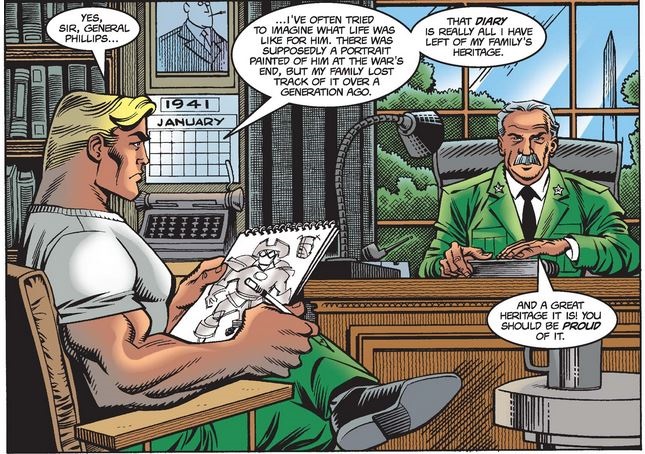
As explained in the last post, since it has become established that Sarah and Joseph were both immigrants from Ireland, it would take quite a bit of convoluted genealogy to figure out how Steve could have had an ancestor in America in 1781. But anyway…
Steve’s drawings—which bear an uncanny resemblance to this page from Captain America’s Bicentennial Battles—give the good general an idea.
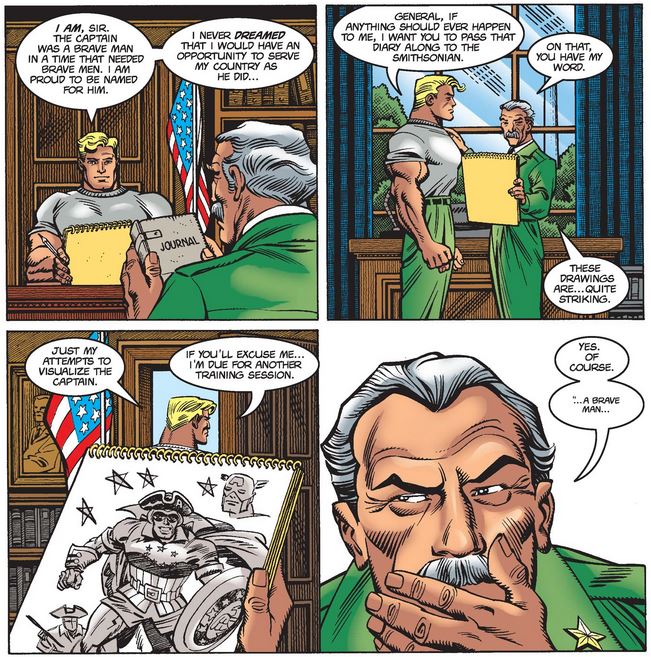
Later, he shows Steve the Nazis’ latest propaganda tool…
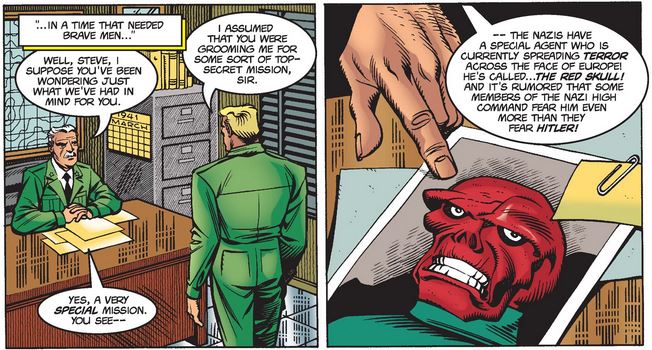
…and he proposes that Steve be the same for the cause of liberty and democracy, presenting him a uniform based on Steve’s rendering of his ancestor’s outfit.
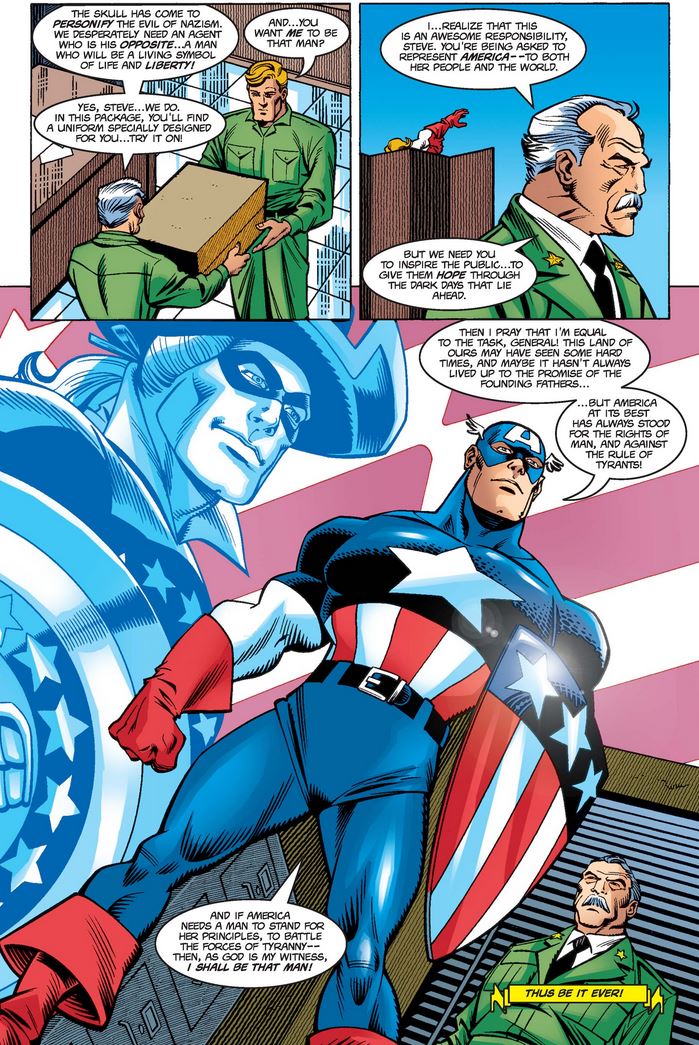
If this all makes you a bit dizzy, you’ve been paying attention! In the same Bicentennial Battles in which Jack Kirby suggested what a Revolutionary-era Cap might look like (after establishing the existence of that era’s Steve Rogers in Captain America #194), he also implied that Betsy Ross based the American flag off of Captain America’s outfit after he visited that era!
ISSUE DETAILS
Captain America: Sentinel of Liberty (vol. 1) #7, March 1999:
“An Ending”: Brian Vaughan (writer), Steve Harris (pencils), Rodney Ramos (inks), Kevin Tinsley (colors), John Costanza (letters).
“When Free Men Shall Stand!”: Roger Stern (writer), Ron Frenz (pencils), Roger Langridge (inks), Tom Smith (colors), John Costanza (letters).
(More details at Marvel Database.)
Collected in: Captain America: Sentinel of Liberty.
PREVIOUS ISSUES: Captain America: Sentinel of Liberty #5-6 (January-February 1999)
ALSO THIS MONTH: Captain America #15, Avengers #14, and Avengers Forever #4 (March 1999)
NEXT ISSUES: Captain America: Sentinel of Liberty #8-9 (April 1999)
 THE VIRTUES OF CAPTAIN AMERICA
Leave a comment