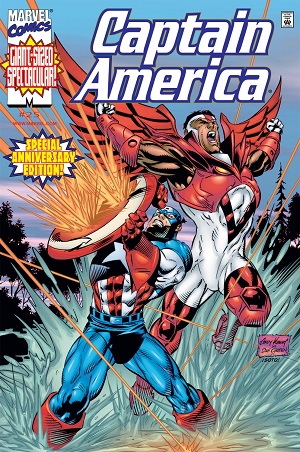
 With this issue we begin Dan Jurgens’ run on Captain America, which will eventually close out volume #3 with issue #50 (all collected here). His run begins with a three-part storyline drawn by Andy Kubert, granting some visual continuity with the previous run written by Mark Waid, and it features not only Sam Wilson’s Falcon, as seen on the cover, but also the return of one of Cap’s more repellent foes, as we will see on the last page. Also, we have several panels from the Heroes Reborn: Young Allies one-shot, which revisits some characters from the notorious Image Comics experiment from several years previous, one of them closely connected to our hero.
Captain America #25 begins with seven pages of Nick Fury being chased through the wilderness by armed goons before returning to New York City, where restaurant patrons are being held hostage by armed goons. The police outside are debating next steps, with a Detective O’Neil providing his personal assessment of the Avengers Prime…
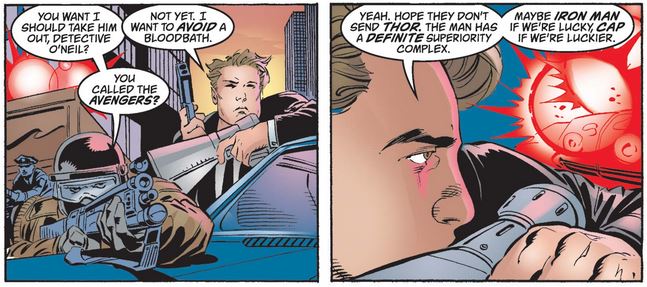
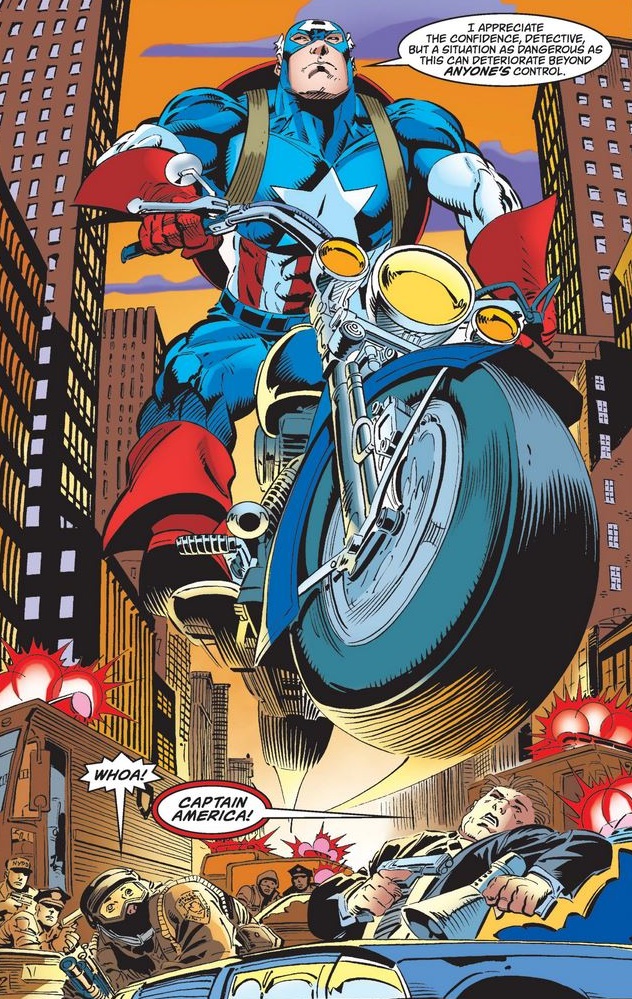
…at which Captain America is flattered but mindful to accurately assess the risk of the current situation. (How he heard O’Neil over the sound of his motorcycle is beyond me, never mind that he was not yet overhead when the detective said it.)
Cap doesn’t pause to compare notes, which the officer unfairly characterizes as a refusal to “listen to orders” rather than a single-minded focus on saving lives in an emergency.
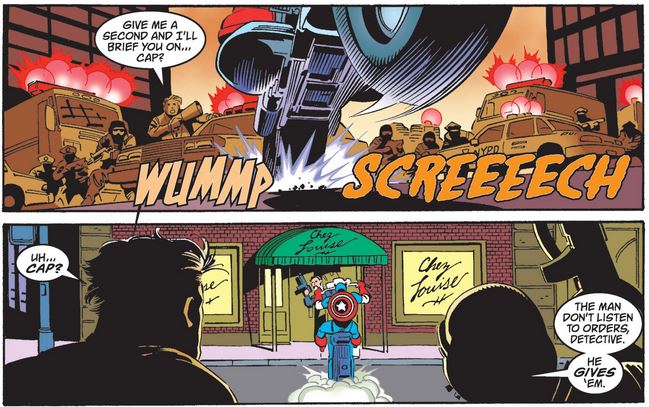
After making a dramatic entrance, Cap dismisses the gunman’s warning and offers a counter…
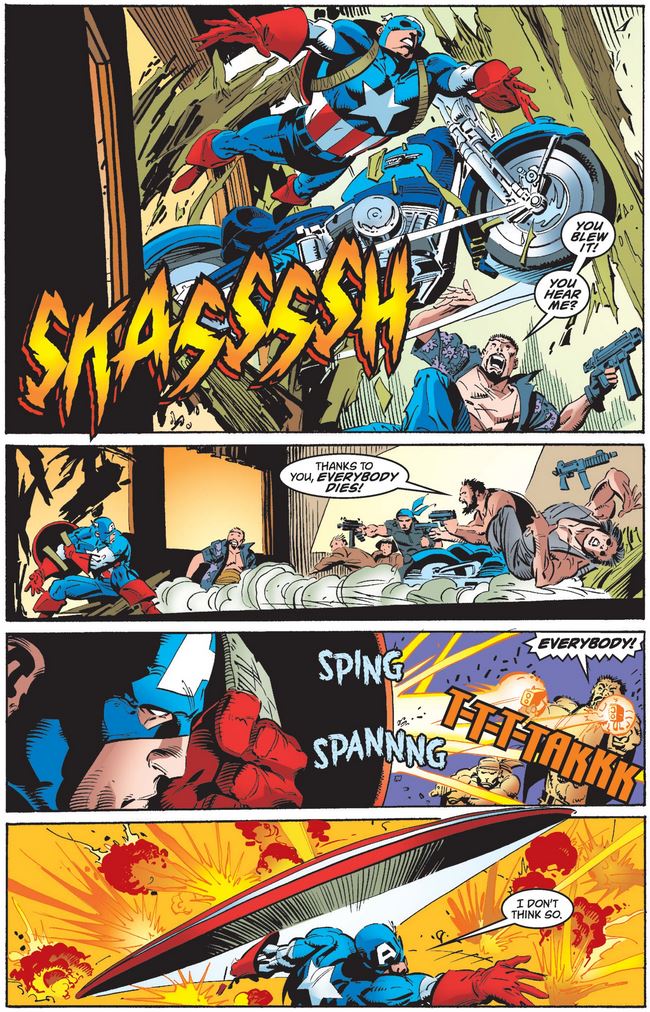
…which, after making its way around the room, returns to deal the final blow.
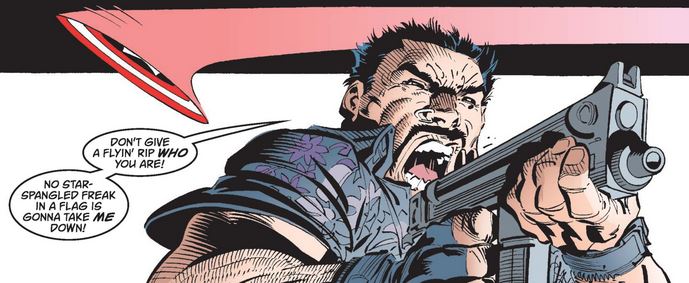
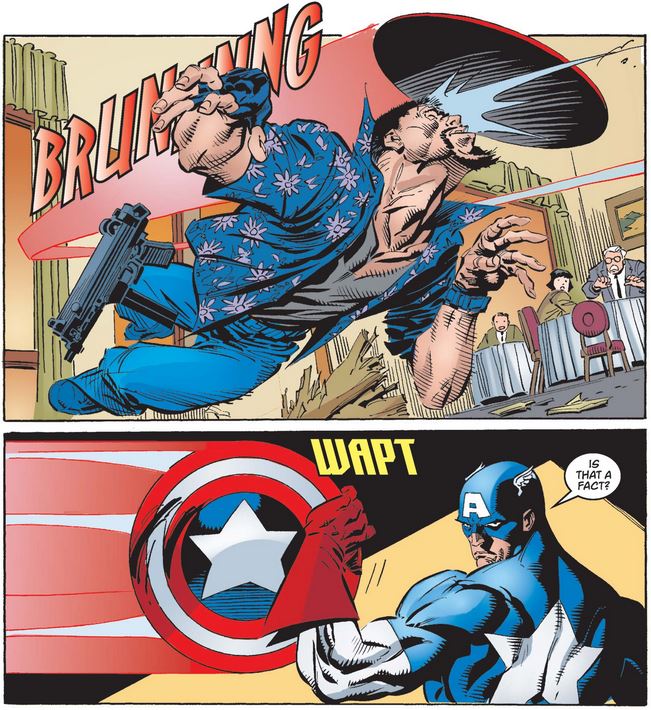
(Not gonna say it, not gonna say it, not gonna…)
After Cap dispatches the bad guys, the relieved customers express their astonishment and gratitude (as well as a secondhand marriage proposal).
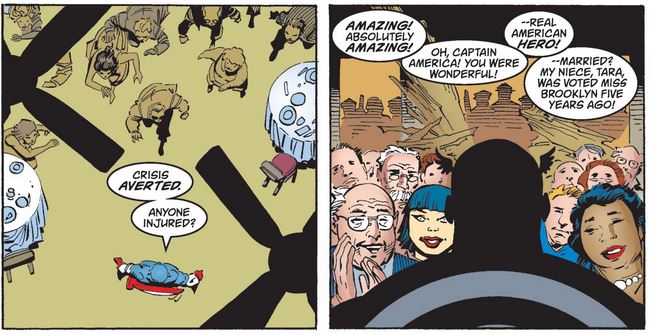
One patron in particular happens to have a personal connection with Cap, and Cap remembers him well.
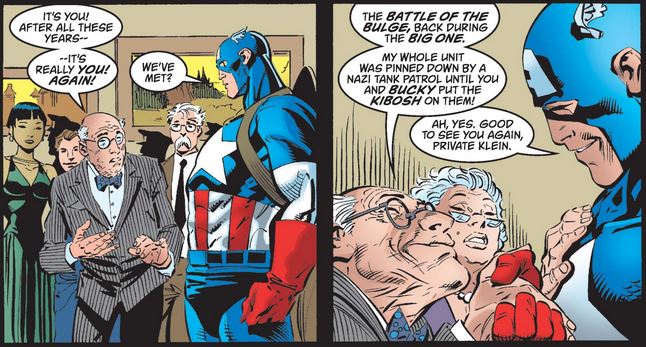
This is an example of one of my favorite things about Cap: he always remembers the names of veterans he met in World War II (and later conflicts), regardless of their rank or how briefly they interacted. Such is his respect and admiration for those who served alongside him without the benefit of super-soldier serum, Vita Rays, or a mighty shield.
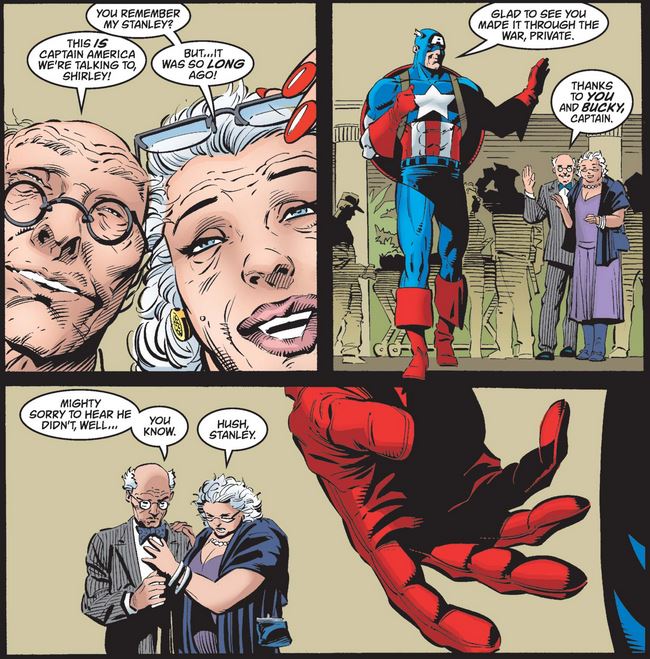
Cap is struck momentarily by the memory of the long-lost partner (whose return is still several years away), but assures Private Klein he’s OK before reconnecting with Detective O’Neil outside and smoothing over his “failure” to touch base before storming the restaurant before accepting O’Neil’s offer to have his bike fixed.
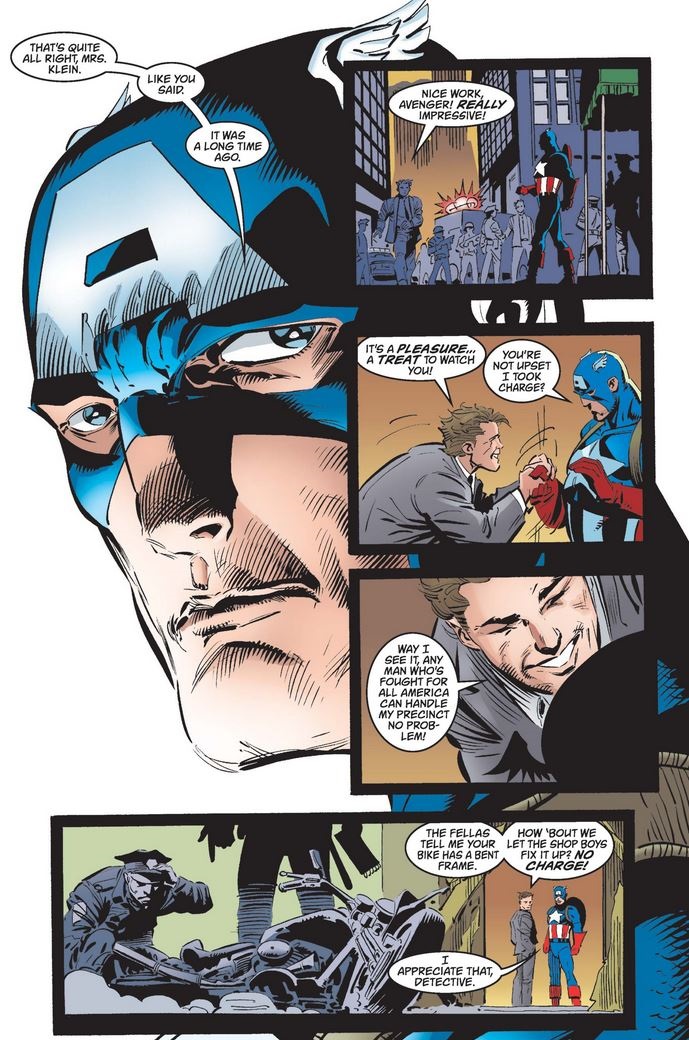
It may seem like a trivial matter, but this surprised me, because Cap ordinarily rejects such offers, especially without insisting on paying for the work. (Maybe the fact that the offer came from the NYPD and not a private citizen makes him feel better about it.)
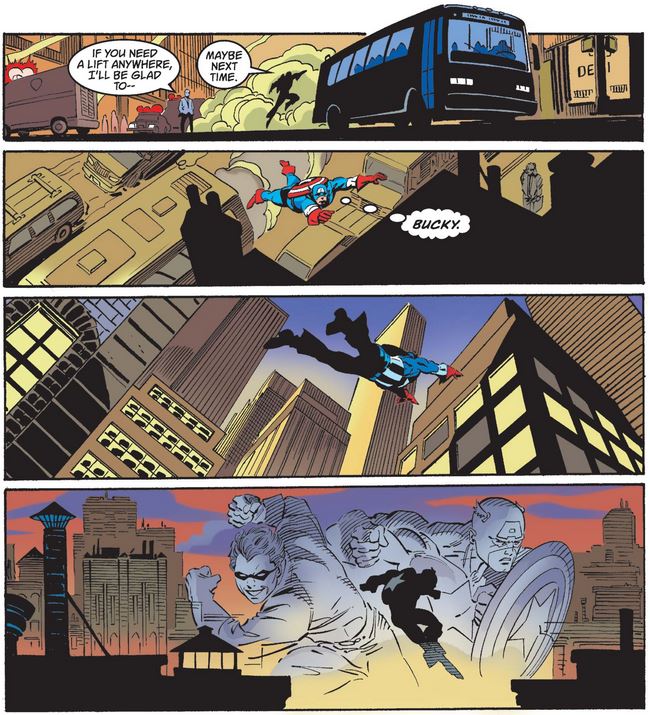
He does, however, turn down the offer of a ride, preferring to go on a rooftop run alone so he can reflect on Bucky, whose death still haunts him years after being revived without his partner by his side.
Soon Cap picks up on the fact that some particularly inept SHIELD agents are tracking him, so he saves them the trouble of chasing him. When the only one unafraid to speak tells our hero he’s under arrest, Cap is unbothered—and when he hears his old friend Dum Dum Dugan on the horn, he takes the issue up with him.
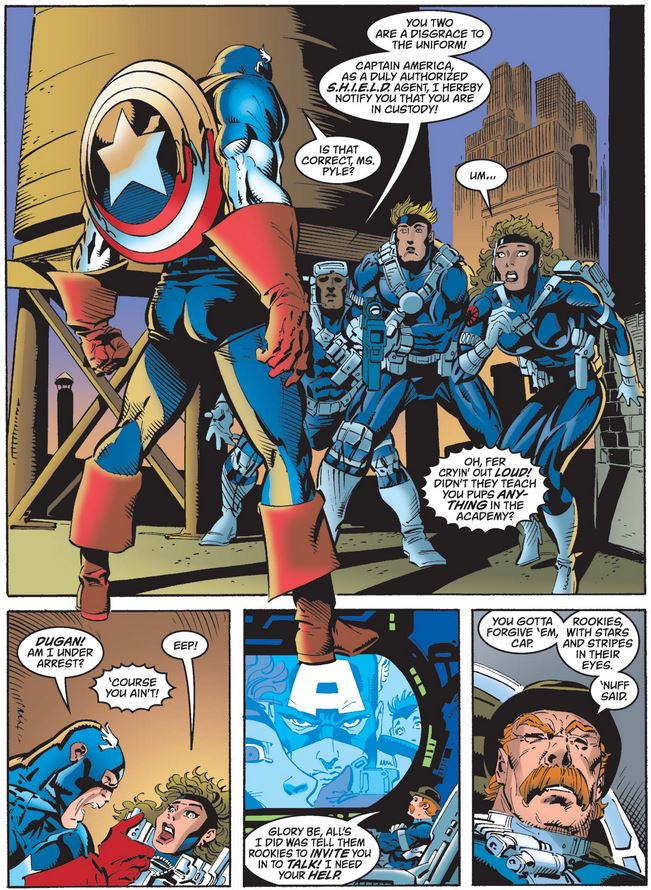
After he and the Little Rascals return to SHIELD HQ, Cap finds the Falcon there too—and in a different outfit than his recent appearances in Avengers. (And why does he seem to be a foot taller than Cap?)
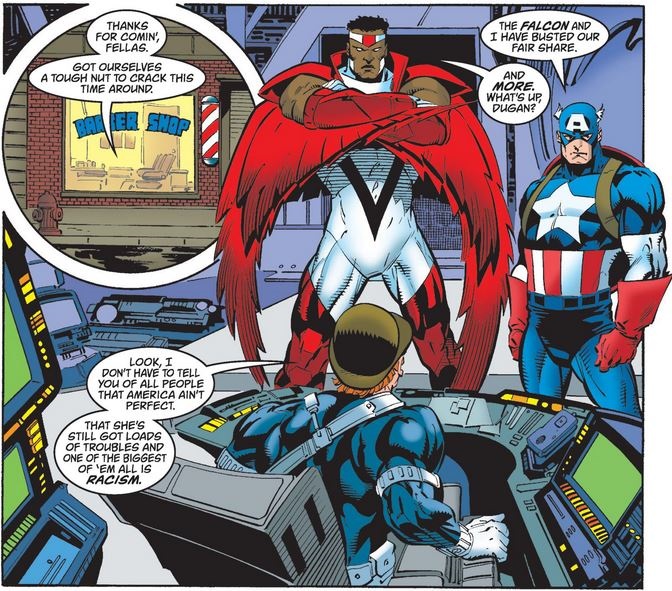
Dugan expands on that by telling Cap and Sam that General McAllister Groves, Chairman of the Joint Chiefs of Staff (the governing body of the entire U.S. military) and the most prominent Black member of the U.S. military ever, was abducted by a white supremacist group and forced to reveal the location of a former Soviet Union storehouse of chemical weapons. When Sam asks if he was recruited specifically because his race would be bait for the white supremacists, Dugan doesn’t deny it, but neither does Sam let it stop him from signing it to help. (Dugan also reveals that Nick Fury is also on the case, which is news to Cap and Sam because they both believed him to be dead, although neither is very surprised to learn he’s not.)
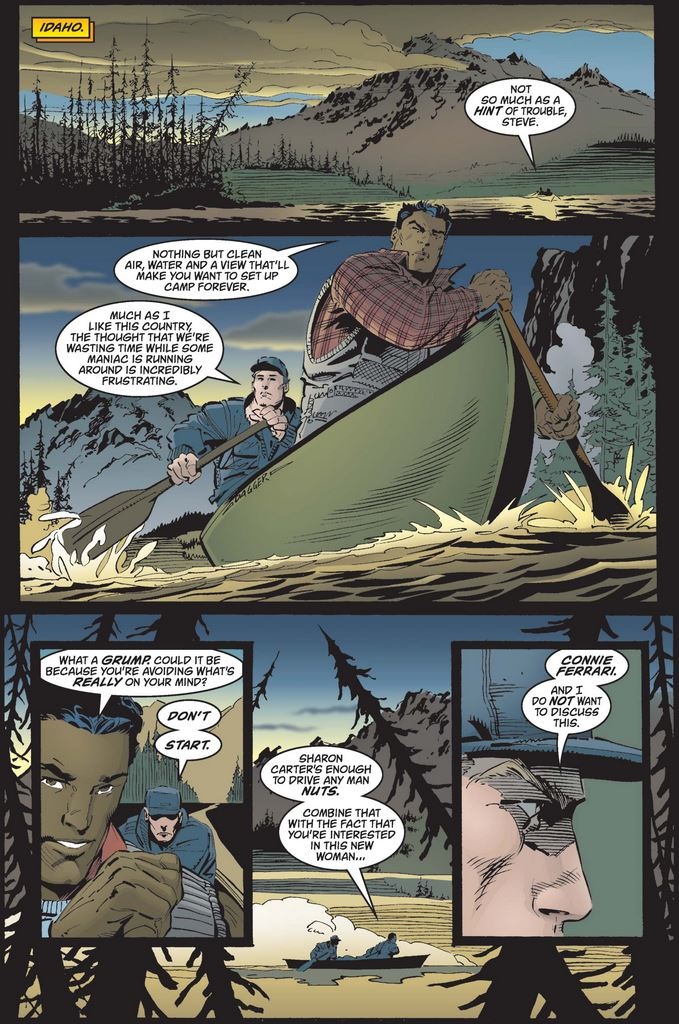
Next time we see our heroes, they’re canoeing in Idaho, with Steve frustrated at their inactivity and Sam prodding him for details on his love life (because Cap had asked Dugan for news on Sharon earlier, to no avail).
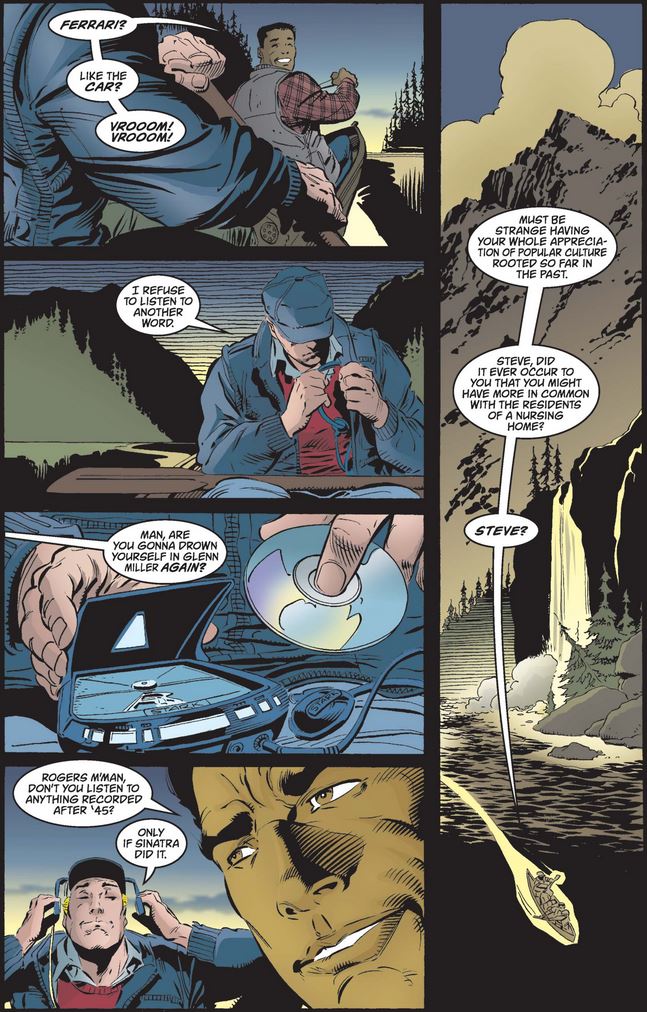
Steve indulges in a welcome bit of late-20th century technology to enjoy mid-20th century music—and to avoid Sam as he switches from teasing Steve about his problems with women to teasing him about his taste in entertainment.
By the way, Steve will finally relent on his choice in music in 2011’s Captain America: Man Out of Time #5, by Mark Waid and Jorge Molina, while on a solo camping trip in Arizona:
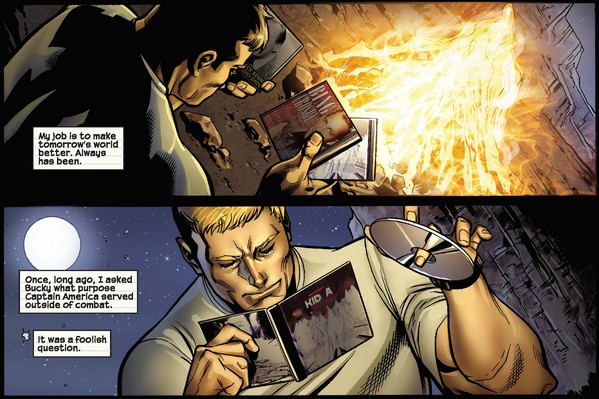
Although Man Out of Time took place shortly after his defrosting and meeting the Avengers, and therefore well before the current adventure with Sam, the sliding timescale also placed it after 2000, which is when Captain America #25 was published. (What a headache!)
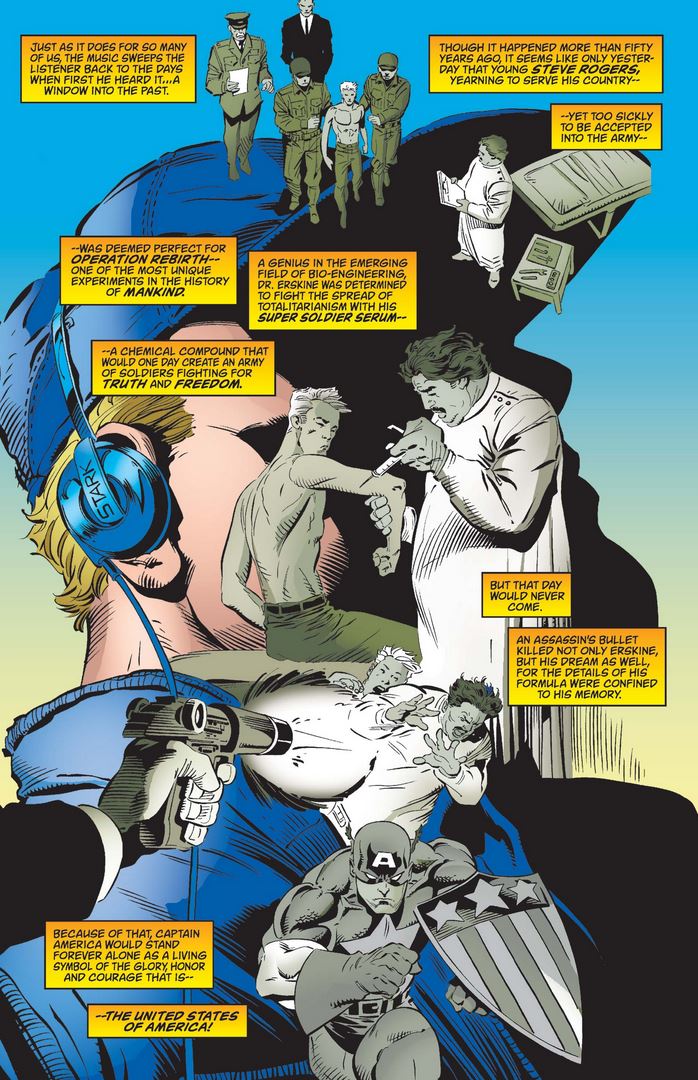
Back to our story: as Steve zones out to “In the Mood,” “Moonlight Serenade,” or Glenn Miller’s great work with the Andrews Sisters, he thinks back to his youth and how he became the Sentinel of Liberty. (No new details here, unless you count the Beats by Tony that Steve’s wearing now.)
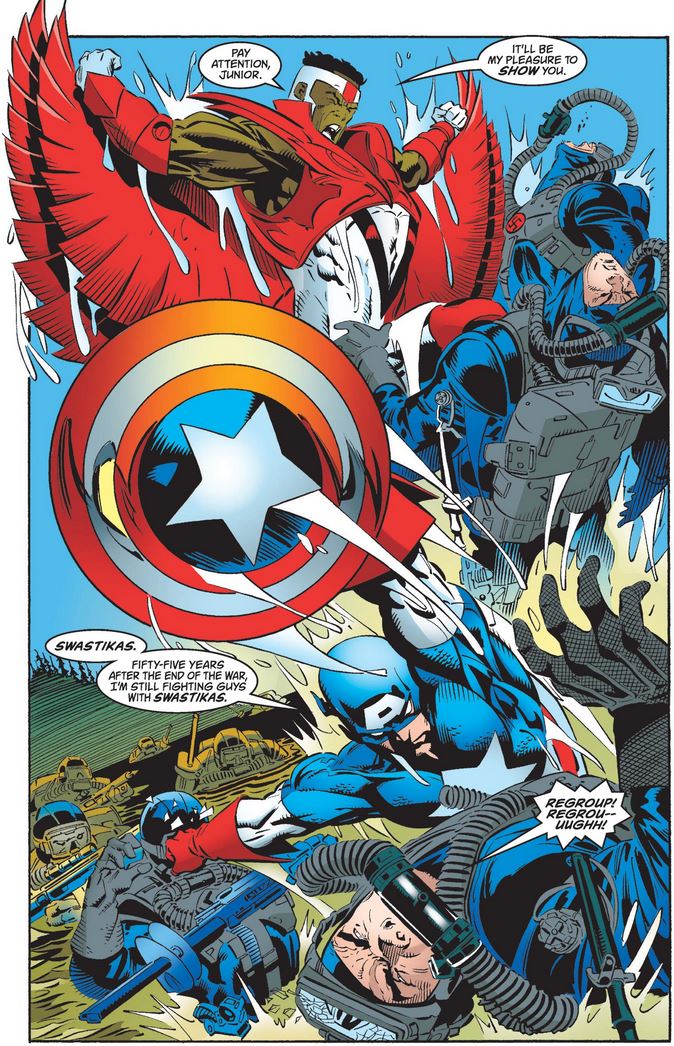
Interrupting Steve’s trip down memory lane (or lake), several men in scuba gear attack the boat from below, with one asking what threat two fishermen could possibly be. Sam answers while Steve notes one thing from his past he did not want to see again…
…especially not in the home of the brave and the land of the free.
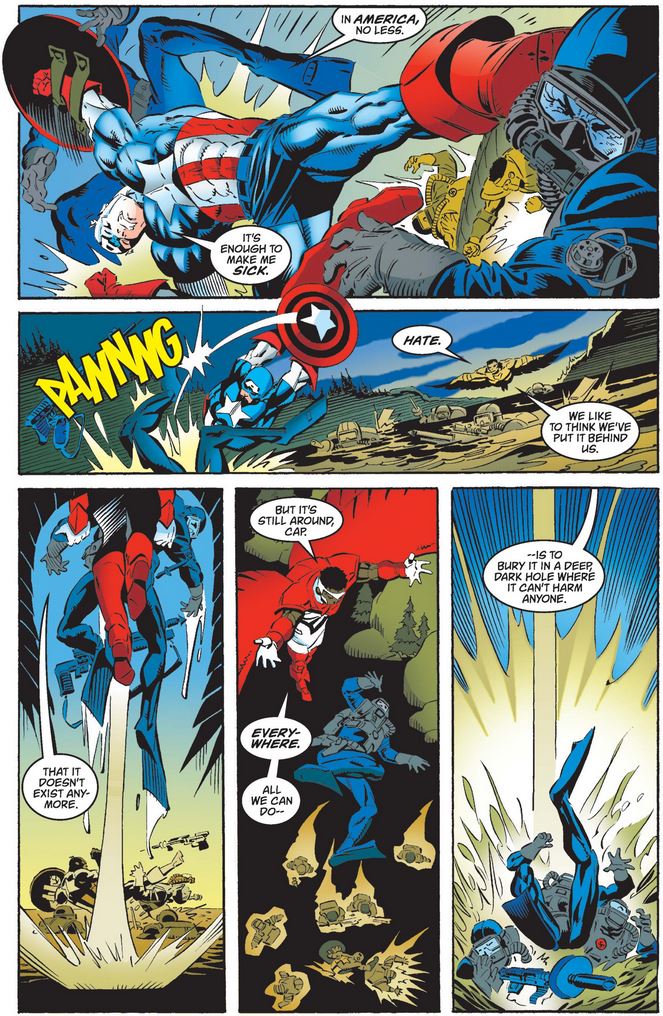
Amen, Sam—amen.
When two choppers appear, each man agrees to take one: Cap goes first, and shows how precise his aim with his shield is.
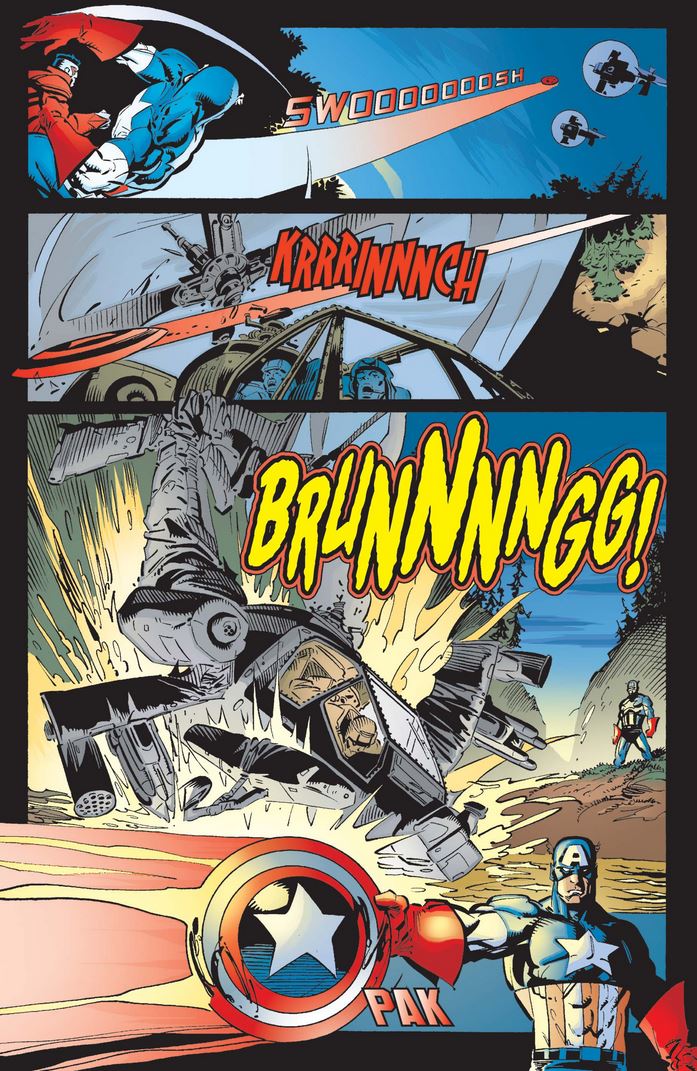
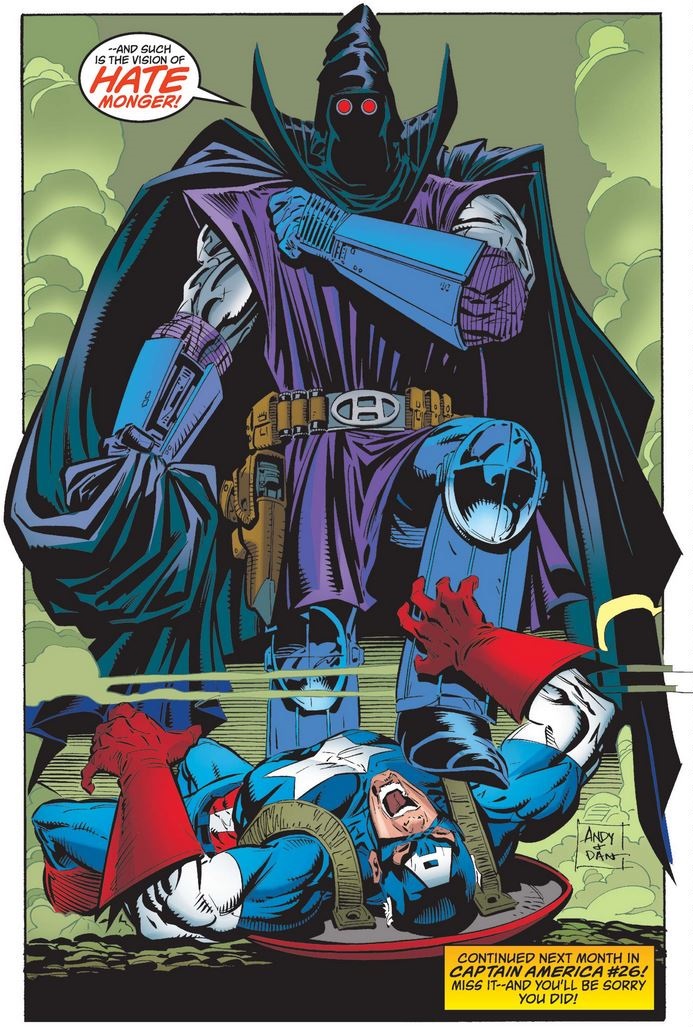
Sam let his chase him a bit before throwing some large rocks through its windshield, incapacitating the pilots. Before they can decide what to do next, a missile lands nearby and spreads knockout gas in the area, followed by the white supremacists’ leader, making vile comments about Sam before invoking Hitler himself.
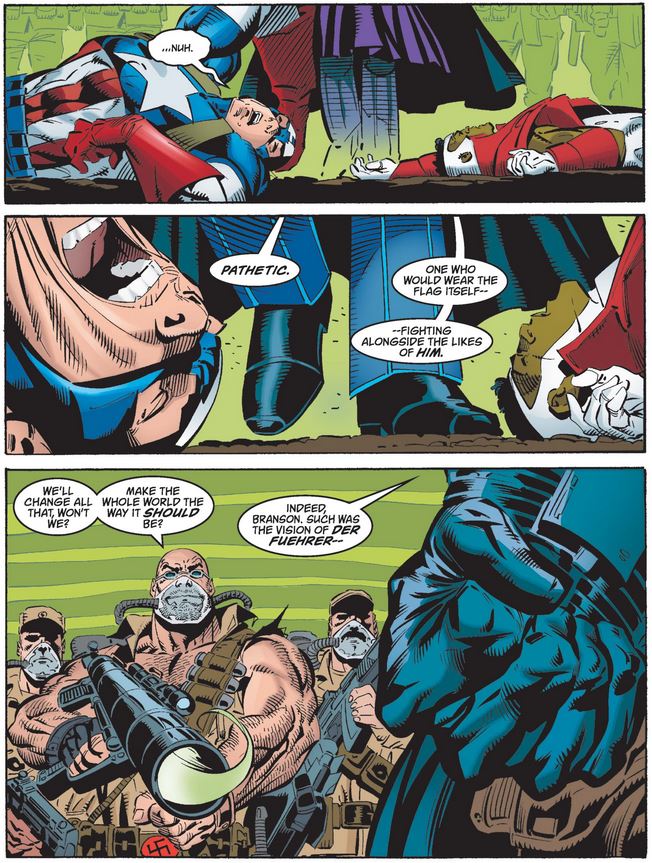
Or should I say, simply: himself.
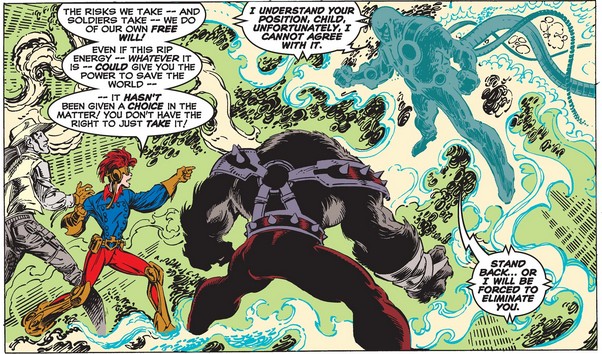
We’ll wrap up this story in the next post, but in the meantime: In the Heroes Reborn: Young Allies #1 one-shot, young Rikki Barnes, the Bucky to the Captain America of Franklin Richards’ pocket universe, faces a potentially cataclysmic choice about improper means to proper ends. She appeals to the memory of her mentor, as Cap’s former sidekicks often do…
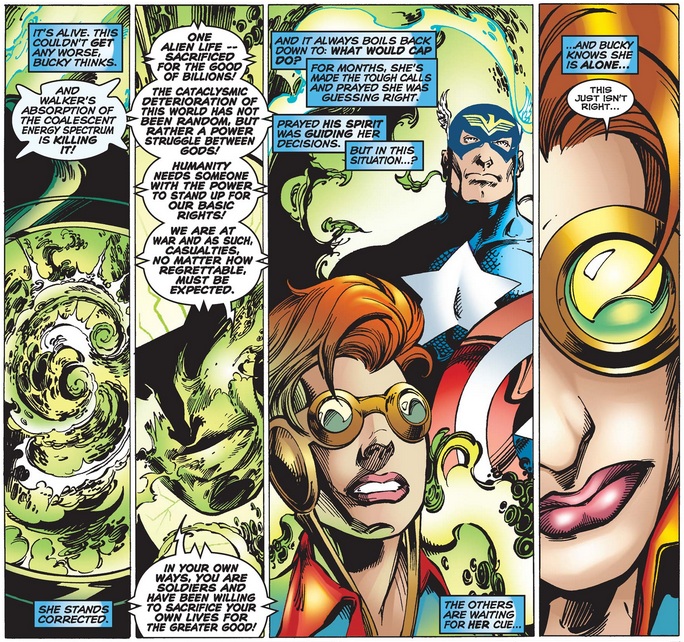
…and she finds the right solution all on her own, rejecting her foe’s sentimental appeal to the noble, voluntary sacrifice of soldiers.
ISSUE DETAILS
Captain America (vol. 3) #25, January 2000: Dan Jurgens (writer), Andy Kubert (pencils), Dan Green (inks), Gregory Wright (colors), Todd Klein (letters). (More details at Marvel Database.)
Collected in: Captain America by Dan Jurgens Omnibus.
Heroes Reborn: Young Allies #1, January 2000: Fabian Nicieza (writer), Mark Bagley (pencils), Al Vey (inks), Jason Wright (colors), Richard Starking and Saida Temofonte (letters). (More details at Marvel Database.)
Collected in: Heroes Reborn: The Return Omnibus.
PREVIOUS ISSUE: Captain America #24 (December 1999)
ALSO THIS MONTH: Avengers #24 and Generation X #59, Galactus the Devourer #5, and Domination Factor: Avengers #3.6 (January 2000)
NEXT ISSUE: Captain America #26-27 (February-March 2000)
 THE VIRTUES OF CAPTAIN AMERICA
Actually a frisbee can be thrown vertical (but it will eventually turn over). It’s a type of throw called the hammer throw & if you keep the disc perfectly vertical when you throw it the disc will fly vertical for a bit.
LikeLike
Right, for a bit. 😉
LikeLike